

The Journal of Practical Medicine ›› 2026, Vol. 42 ›› Issue (12): 2161-2169.doi: 10.3969/j.issn.1006-5725.2026.12.010
• Oncology: Diagnosis, Treatment and Prevention • Previous Articles
Danni YI,Zhiliang GUO,Chunfang CAI,Wangtao ZHAN,Qingli SHEN,Qingling WANG,Xuejin SHI,Suqi YE,Zequn LIU( )
)
Received:2025-10-24
Online:2026-06-25
Published:2026-06-30
Contact:
Zequn LIU
E-mail:perfect_qun@163.com;perfect-qun@163.com
CLC Number:
Danni YI,Zhiliang GUO,Chunfang CAI,Wangtao ZHAN,Qingli SHEN,Qingling WANG,Xuejin SHI,Suqi YE,Zequn LIU. Comparison of the curative effects and analysis of influencing factors between CO2 laser and loop electrosurgical excision procedure in the treatment of high-grade cervical intraepithelial lesions[J]. The Journal of Practical Medicine, 2026, 42(12): 2161-2169.
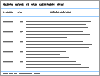
Tab.1
Comparison of general clinical data between the two groups before treatment"
| 指标 | CO2激光组(n = 154) | LEEP组(n = 113) | χ2/t值 | P值 |
|---|---|---|---|---|
| 年龄 | 36.5 ± 8.2 | 37.1 ± 9.0 | 0.56 | 0.576 |
| 细胞学检查 | 3.25 | 0.072 | ||
| NILM | 9(5.84) | 38(33.63) | ||
| ASCUS | 58(37.66) | 27(23.90) | ||
| LSIL | 66(42.86) | 25(22.12) | ||
| ASC-H及以上 | 21(13.64) | 23(20.35) | ||
| HR-HPV感染类型 | 1.89 | 0.389 | ||
| 单一HPV16/18 | 37(24.03) | 28(24.78) | ||
| 单一非16/18高危型 | 62(40.26) | 43(38.06) | ||
| 多重感染 | 55(35.71) | 42(37.16) |
Tab.2
Comparison of surgery-related indicators between the two groups"
| 指标 | CO2激光组(n = 154) | LEEP组(n = 113) | t/χ2值 | P值 |
|---|---|---|---|---|
| 手术时间/min | 10.0 ± 2.1 | 35.0 ± 5.4 | 15.32 | < 0.001 |
| 术中出血量/mL | 5.0 ± 1.2 | 20.0 ± 3.5 | 18.45 | < 0.001 |
| 术后出血时间/d | 3.2 ± 1.1 | 7.5 ± 2.3 | 12.67 | < 0.001 |
| 恢复时间/d | 30.0 ± 5.2 | 75.0 ± 15.4 | 12.34 | < 0.001 |
| 术后并发症/[例(%)] | 3(2.04) | 9(7.95) | 4.28 | 0.038 |
| 治疗费用/元 | 2 500 ± 500 | 5 500 ± 500 | 9.87 | < 0.001 |
Tab.3
Comparison of follow-up results between the two groups of patients after treatment"
| 106(68.83) | 90(79.65)* | 102(66.23) | 89(78.76)* | |
| 108(70.13) | 91(80.53)* | 126(81.81) | 100(88.50)* | |
| 141(91.56) | 104(92.03) | 149(96.75) | 108(95.57) | |
Tab.4
Comparison of HPV clearance rates stratified by HPV infection type"
| HPV感染类型 | 0 ~ 6个月 | 6 ~ 12个月 | ||||||
|---|---|---|---|---|---|---|---|---|
| CO2激光组 | LEEP组 | χ2值 | P值 | CO2激光组 | LEEP组 | χ2值 | P值 | |
| 单一感染 | ||||||||
| HPV16/18型 | 27/37(72.97) | 25/28(89.29) | 1.729 | 0.189 | 27/37(72.97) | 25/28(89.29) | 1.729 | 0.189 |
| 非16/18型其他型 | 50/62(80.65) | 37/43(86.05) | 0.211 | 0.646 | 48/62(77.42) | 37/43(86.05) | 0.730 | 0.393 |
| 多重感染 | ||||||||
| 16/18+其他高危型 | 17/26(65.38) | 12/21(57.14) | 0.076 | 0.782 | 16/26(61.54) | 12/21(57.14) | 0.000 | 0.995 |
| 其他高危型 | 15/29(51.72) | 17/21(80.95) | 3.337 | 0.068 | 14/29(48.28) | 17/21(80.95) | 4.220 | 0.040 |
Tab.5
Comparison of efficacy in patients aged 0 ? 6 months across different age groups"
| 年龄段 | 组别 | 病灶缓解 | HPV转阴 | TCT转阴 |
|---|---|---|---|---|
| ≤ 25岁 | CO2激光组(n = 24) | 19(79.17) | 19(79.17) | 22(91.67) |
| LEEP组(n = 2) | 2(100.00) | 2(100.00) | 2(100.00) | |
| 25 ~ 45岁 | CO2激光组(n =122) | 83(68.03) | 86(70.49) | 112(91.80) |
| LEEP组(n = 50) | 14(28.00)* | 39(78.00)* | 45(90.00) | |
| ≥ 45岁 | CO2激光组(n = 8) | 3(37.50) | 3(37.50) | 6(75.00) |
| LEEP组(n = 61) | 49(80.33)* | 50(81.97)* | 57(93.44) |
Tab.6
Comparison of efficacy in patients of different age groups over 6 ? 12 months"
| 年龄段 | 组别 | 病灶缓解 | HPV转阴 | TCT转阴 |
|---|---|---|---|---|
| ≤ 25岁 | CO2激光组(n = 24) | 18(75.00) | 21(87.50) | 23(95.83) |
| LEEP组(n = 2) | 2(100.00) | 2(100.00) | 2(100.00) | |
| 25 ~ 45岁 | CO2激光组(n = 122) | 80(65.57) | 99(81.15) | 119(97.54) |
| LEEP组(n = 50) | 14(28.00)* | 43(86.00) | 48(96.00) | |
| ≥ 45岁 | CO2激光组(n = 8) | 3(37.50) | 4(50.00) | 6(75.00) |
| LEEP组(n = 61) | 48(78.69)* | 55(90.16)* | 58(95.08) |
Tab.7
Variable assignment"
| 变量 | 赋值说明 |
|---|---|
| 治疗方式 | 0 = CO2激光;1 = LEEP |
| 年龄 | 1 = ≤ 25岁(参照),2 = 25 ~ 45岁,3 = ≥ 45岁 |
| HPV感染类型 | 1 =单一感染(参照),2 =多重感染 |
| 术前细胞学 | 0 = NILM,1 = ASCUS及以上 |
Tab.8
Univariate and multivariate analysis of clinical characteristics between the two groups"
| 特征 | 单因素分析 | 多因素分析 | ||
|---|---|---|---|---|
| OR(95%CI) | P值 | OR(95%CI) | P值 | |
| 治疗方式 | ||||
| LEEP | 参考 | 参考 | ||
| CO2 | 1.772(1.001 ~ 3.136) | 0.050 | 1.496(0.811 ~ 2.758) | 0.197 |
| 年龄 | ||||
| ≤ 25岁 | - | |||
| 25 ~ 45岁 | 1.440(0.507 ~ 4.089) | 0.493 | ||
| ≥ 45岁 | 1.087(0.348 ~ 3.390) | 0.886 | ||
| HPV感染 | ||||
| 单一感染 | - | - | ||
| 复合感染 | 2.095(1.207 ~ 3.636) | 0.009 | 2.077(1.190 ~ 3.628) | 0.010 |
| 术前细胞学 | ||||
| NILM | - | - | ||
| ASCUS及以上 | 2.344(0.998 ~ 5.507) | 0.051 | 1.928(0.776 ~ 4.786) | 0.157 |
Tab.9
Univariate and multivariate analysis of clinical characteristics between the two groups"
| 特征 | 单因素分析 | 多因素分析 | ||
|---|---|---|---|---|
| OR(95%CI) | P值 | OR(95%CI) | P值 | |
| 治疗方式 | ||||
| LEEP | - | |||
| CO2 | 1.641(0.823 ~ 3.272) | 0.160 | ||
| 年龄 | ||||
| ≤ 25岁 | - | |||
| 25 ~ 45岁 | 1.379(0.385 ~ 4.939) | 0.621 | ||
| ≥ 45岁 | 1.130(0.282 ~ 4.520) | 0.863 | ||
| HPV感染 | ||||
| 单一感染 | - | - | ||
| 复合感染 | 3.222(1.637 ~ 6.340) | 0.001 | 3.221(1.628 ~ 6.373) | 0.001 |
| 术前细胞学 | ||||
| NILM | - | - | ||
| ASCUS及以上 | 3.259(0.964 ~ 11.025) | 0.057 | 3.258(0.949 ~ 11.185) | 0.060 |
Tab.10
Univariate analysis of clinical characteristics between the two groups"
| 特征 | OR(95%CI) | P值 |
|---|---|---|
| 治疗方式 | ||
| LEEP | - | |
| CO2 | 1.491(0.726 ~ 3.060) | 0.277 |
| 年龄 | ||
| ≤ 25岁 | - | |
| 25 ~ 45岁 | 1.916(0.424 ~ 8.648) | 0.398 |
| ≥ 45岁 | 1.575(0.315 ~ 7.885) | 0.580 |
| HPV感染 | ||
| 单一感染 | - | |
| 复合感染 | 3.193(1.565 ~ 6.513) | 0.001 |
| 术前细胞学 | ||
| NILM | - | |
| ASCUS及以上 | 2.775(0.816 ~ 9.437) | 0.102 |
| [1] |
LI M, ZHANG X, ZHANG Q, et al. Underdiagnosis of cervical intraepithelial neoplasia by colposcopy and its association with thin high-grade squamous intraepithelial lesions[J]. Oncol Lett, 2023, 26(1): 287. doi:10.3892/ol.2023.13873 .
doi: 10.3892/ol.2023.13873 |
| [2] |
HAWWAS A R M, MOHAMED H A K, SAYEDAHMED O M E, et al. Topical timolol maleate 0.5% after fractional carbon dioxide laser versus fractional carbon dioxide laser alone in treatment of acne scars: Split face comparative study[J]. Sci Rep, 2023, 13(1): 9402. doi:10.1038/s41598-023-36398-5 .
doi: 10.1038/s41598-023-36398-5 |
| [3] |
KROG L, LYCKE K D, CHRISTIANSEN A G, et al. Insufficient training in colposcopy and loop electrosurgical excision procedure among residents[J]. Dan Med J, 2023,70(5):A11220695. PMID:.
pmid: 37125827 |
| [4] |
CANDIANI M, OTTOLINA J, TANDOI I, et al. Fertility sparing procedure using carbon dioxide fiber laser vaporization of ovarian endometrioma[J]. J Vis Exp, 2022(185). doi:10.3791/63607 .
doi: 10.3791/63607 |
| [5] |
FRANCOEUR A A, FUREY K B, RAMIREZ J, et al. Recurrent High-Grade Squamous Intraepithelial Lesion After Loop Excision Procedure Versus Loop Procedure With Top Hat[J]. J Low Genit Tract Dis, 2023, 27(3): 193-197. doi: 10.1097/LGT. 0000000000000755 .
doi: 10.1097/LGT. 0000000000000755 |
| [6] |
周晔, 袁丹丹, 沈兰凤, 等. 子宫颈微生态与宫颈鳞状上皮内病变关系的研究[J]. 中华检验医学杂志, 2020, 43(4): 468-474. doi: 10.3760/cma.j.cn114452-20191220-00739 .
doi: 10.3760/cma.j.cn114452-20191220-00739 |
| [7] |
NOURRISSON A, LEPETIT H, MARTY M, et al. Regression of cervical high-grade squamous intraepithelial lesions (HSIL/CIN2) managed expectantly[J]. J Gynecol Obstet Hum Reprod, 2022, 51(8): 102442. doi:10.1016/j.jogoh.2022.102442 .
doi: 10.1016/j.jogoh.2022.102442 |
| [8] |
UNGUREANU C, SOCOLOV D G, ANTON G, et al. Role of ProEx C immunocytochemistry in cervical high-grade squamous intraepithelial lesions detection[J]. Rom J Morphol Embryol, 2021, 62(4): 1029-1034. doi: 10.47162/RJME.62.4.15 .
doi: 10.47162/RJME.62.4.15 |
| [9] |
中国优生科学协会阴道镜和宫颈病理学分会, 中华医学会妇科肿瘤学分会, 中国妇幼健康研究会宫颈癌防控研究专委会, 等. 子宫颈鳞状上皮内病变光动力治疗专家共识[J]. 中国妇产科临床杂志, 2026, 27(2): 186-192. doi:10.13390/j.issn.1672-1861.2026.02.023 .
doi: 10.13390/j.issn.1672-1861.2026.02.023 |
| [10] |
WANG X, CHEN Y, HUANG J, et al. Comparative Efficacy of Photodynamic Therapy and Cold Knife Conization for Cervical High-Grade Squamous Intraepithelial Lesions[J]. Curr Oncol, 2025, 32(11):590. doi: 10.3390/curroncol32110590 .
doi: 10.3390/curroncol32110590 |
| [11] |
WU A, LI Q, LING J, et al. Effectiveness of photodynamic therapy in women of reproductive age with cervical high-grade squamous intraepithelial lesions (HSIL/CIN2)[J]. Photodiagnosis Photodyn Ther, 2021,36: 102517. doi: 10.1016/j.pdpdt.2021. 102517 .
doi: 10.1016/j.pdpdt.2021. 102517 |
| [12] |
DAVIDESKO S, MEIROVITZ M, SHACO-LEVY R, et al. Positive pathological margins after loop electrosurgical excision procedure-Management and outcome[J]. Eur J Surg Oncol, 2023, 49(5): 1031-1036. doi:10.1016/j.ejso.2023.01.025 .
doi: 10.1016/j.ejso.2023.01.025 |
| [13] |
BRADBURY M, RABASA J, MURCIA M T, et al. Can We Reduce Overtreatment of Cervical High-Grade Squamous Intraepithelial Lesions [J]. J Low Genit Tract Dis, 2022, 26(1): 20-26. doi: 10.1097/LGT.0000000000000635 .
doi: 10.1097/LGT.0000000000000635 |
| [14] |
BOGANI G, DI DONATO V, SOPRACORDEVOLE F, et al. Recurrence rate after loop electrosurgical excision procedure (LEEP) and laser Conization: A 5-year follow-up study[J]. Gynecol Oncol, 2020, 159(3): 636-641. doi:10.1016/j.ygyno.2020. 08.025 .
doi: 10.1016/j.ygyno.2020. 08.025 |
| [15] |
李清, 张宏伟, 陈丽梅, 等. CO2激光与LEEP术治疗适龄期女性宫颈高级别鳞状上皮内病变的临床疗效及妊娠结局[J]. 复旦学报(医学版), 2024, 51(5): 677-683. doi:10.3969/j.issn.1672-8467.2024.05.005 .
doi: 10.3969/j.issn.1672-8467.2024.05.005 |
| [16] |
NOURRISSON A, LEPETIT H, MARTY M, et al. Regression of cervical high-grade squamous intraepithelial lesions (HSIL/CIN2) managed expectantly[J]. J Gynecol Obstet Hum Reprod, 2022, 51(8): 102442. doi:10.1016/j.jogoh.2022.102442 .
doi: 10.1016/j.jogoh.2022.102442 |
| [17] |
LIANG J, ZHOU Y, XU Z, et al. Safety and efficacy of carbon dioxide laser therapy for vocal cord leukoplakia: A systematic review and meta-analysis[J]. Medicine, 2025, 104(7): e41539. doi:10.1097/MD.0000000000041539 .
doi: 10.1097/MD.0000000000041539 |
| [18] |
LIU Y, WU R, LI C, et al. Successful pregnancy and delivery after HiPorfin photodynamic therapy for cervical high-grade squamous intraepithelial lesion[J]. Photodiagnosis Photodyn Ther, 2024, 46: 104062. doi:10.1016/j.pdpdt.2024.104062 .
doi: 10.1016/j.pdpdt.2024.104062 |
| [19] |
WANG Y, CHUAN J, ZHU B, et al. Evaluation of PAX1/ST6GALNAC5 methylation as a triage test for cervical intraepithelial neoplasia and cervical cancer[J]. Epigenomics, 2023, 15(3): 131-145. doi:10.2217/epi-2022-0396 .
doi: 10.2217/epi-2022-0396 |
| [20] | ZHANG S, CAO Y, HU Y, et al. Correlation between persistent HPV infection and vaginal microecological imbalance after treatment of cervical high-grade squamous intraepithelial lesion[J]. Altern Ther Health Med, 2024, 30(1): 414-418. |
| [21] |
RUFAIL M, LEW M, PANG J, et al. Low-grade squamous intraepithelial lesion on Papanicolaou test: Follow-up rates and stratification of risk for high-grade squamous intraepithelial lesion[J]. J Am Soc Cytopathol, 2020, 9(4): 258-265. doi:10.1016/j.jasc.2020.02.003 .
doi: 10.1016/j.jasc.2020.02.003 |
| [22] |
中国优生科学协会阴道镜和宫颈病理学分会, 中华医学会妇科肿瘤学分会, 隋龙, 等. 子宫颈上皮内瘤变2级(CIN2)管理中国专家共识(2026版)[J]. 现代妇产科进展, 2026, 35(1): 1-8. doi:10.13283/j.cnki.xdfckjz.2026.01.001 .
doi: 10.13283/j.cnki.xdfckjz.2026.01.001 |
| [23] |
肖婷婷, 吴美琴, 范丽, 等. 宫颈高度鳞状上皮内病变术后高危型人乳头瘤病毒持续感染型别及危险因素[J]. 中华医院感染学杂志, 2024, 34(6): 892-896. doi:10.11816/cn.ni.2024-236200 .
doi: 10.11816/cn.ni.2024-236200 |
| [24] |
程小萍, 潘琳, 宋文萍. 不同级别宫颈鳞状上皮内病变患者宫颈分泌物各指标检测情况及其临床意义[J]. 中国微生态学杂志, 2024, 36(1): 85-89. doi: 10.13381/j.cnki.cjm.202401014 .
doi: 10.13381/j.cnki.cjm.202401014 |
| [25] |
李锐, 于波, 张杰, 等. 高危型HPV感染妇女阴道菌群及子宫颈菌群与子宫颈鳞状上皮内病变的相关性研究[J]. 中国妇产科临床杂志, 2024, 25(5): 388-391. doi:10.13390/j.issn.1672-1861.2024.05.002 .
doi: 10.13390/j.issn.1672-1861.2024.05.002 |
| [1] | Qiuhong LIN,Chunguang DONG,Jiahui HAN,Hongpeng DONG,Shujia ZHANG. The prognostic value of p16 protein expression in predicting outcomes of comprehensive treatment for locally advanced laryngeal and hypopharyngeal carcinoma [J]. The Journal of Practical Medicine, 2026, 42(9): 1545-1551. |
| [2] | Hongyan WANG,Wenying WANG,Guojing HE,Guoping CHEN,Lixia LUAN,Fangfang. XUE. Fractional CO2 laser combined with triamcinolone acetonide and econazole nitrate cream in the treatment of vulvar lichen sclerosus [J]. The Journal of Practical Medicine, 2024, 40(21): 3047-3053. |
| [3] | Min WANG,Dan MU,Dejun KONG,Li YANG,Lu YE,Dan HE. HPV16 E6 regulates miR-23a expression and promotes invasion and migration of cervical cancer cells [J]. The Journal of Practical Medicine, 2024, 40(2): 146-152. |
| [4] | LI Xiaomao, XIONG Qian. . Progress of interferon in the treatment of high⁃risk human papillomavirus infection [J]. The Journal of Practical Medicine, 2022, 38(19): 2384-2389. |
| [5] |
FENG Tongfu.
Changes and reflections on cervical cancer screening strategies [J]. The Journal of Practical Medicine, 2022, 38(15): 1865-1871. |
| [6] |
CHEN Xiang, DONG Yan, ZHANG Li..
Research progress on persistent high⁃risk human papillomavirus infection after conization of cervical high⁃ grade squamous intraepithelial lesions [J]. The Journal of Practical Medicine, 2021, 37(16): 2039-2043. |
| Viewed | ||||||
|
Full text |
|
|||||
|
Abstract |
|
|||||
