

The Journal of Practical Medicine ›› 2026, Vol. 42 ›› Issue (14): 2505-2512.doi: 10.3969/j.issn.1006-5725.2026.14.003
• Cardiovascular and Cerebrovascular Diseases Column • Previous Articles
Wenqian DONG( ),Beijian CHEN,Guoqing LI,Huaipeng ZHANG,Yuqing JIA,Guili GAO,Hong YANG,Jing LIU,Hua WANG,Xiangbing WANG,Xianghao YU,Qiuyu HOU,Xiaoyu XU
Received:2026-04-18
Online:2026-07-25
Published:2026-08-05
Contact:
Wenqian DONG
E-mail:dongwenqian227@163.com
CLC Number:
Wenqian DONG,Beijian CHEN,Guoqing LI,Huaipeng ZHANG,Yuqing JIA,Guili GAO,Hong YANG,Jing LIU,Hua WANG,Xiangbing WANG,Xianghao YU,Qiuyu HOU,Xiaoyu XU. Predictive value of remnant cholesterol for intracoronary thin-cap fibroatheroma and its correlation with plaque vulnerability features in patients with acute coronary syndrome[J]. The Journal of Practical Medicine, 2026, 42(14): 2505-2512.

Tab.1
Comparison of baseline data between the ACS group and the non-ACS group"
| 指标 | 非ACS组(n = 69) | ACS组(n = 117) | t/χ2/Z值 | P值 |
|---|---|---|---|---|
| 性别(男/女)/例 | 40/29 | 74/43 | 0.509 | 0.475 |
| 年龄/岁 | 62.6 ± 8.5 | 64.5 ± 9.4 | -1.388 | 0.167 |
| 吸烟史/[例(%)] | 15(21.7) | 42(35.9) | 4.094 | 0.043 |
| 家族史/[例(%)] | 13(18.8) | 27(23.1) | 0.461 | 0.497 |
| 高血压史/[例(%)] | 29(42.0) | 73(62.4) | 7.268 | 0.007 |
| 糖尿病史/[例(%)] | 17(24.6) | 46(39.3) | 4.175 | 0.041 |
| TC/(mmol/L) | 4.08 ± 0.96 | 4.62 ± 1.15 | -3.302 | 0.001 |
| HDL-C/(mmol/L) | 1.18 ± 0.31 | 1.07 ± 0.26 | 2.574 | 0.011 |
| LDL-C/(mmol/L) | 2.17 ± 0.80 | 2.52 ± 0.93 | -2.571 | 0.011 |
| RC[M(P25,P75))/(mmol/L) | 0.56(0.21,0.92) | 0.83(0.52,1.36) | -3.627 | < 0.001 |
| TG[M(P25,P75))/(mmol/L) | 1.93(1.57,2.38) | 1.97(1.69,2.54) | -0.950 | 0.342 |
Tab.2
Comparison of baseline data between the TCFA group and the non-TCFA group in ACS patients"
| 指标 | 非TCFA组(n = 68) | TCFA组(n = 49) | t/χ2/Z值 | P值 |
|---|---|---|---|---|
| 性别(男/女)/例 | 42/26 | 32/17 | 0.154 | 0.695 |
| 年龄/岁 | 64.3 ± 8.8 | 64.8 ± 10.2 | -0.344 | 0.778 |
| 吸烟史/[例(%)] | 19(27.9) | 23(46.9) | 4.467 | 0.035 |
| 家族史/[例(%)] | 14(20.6) | 13(26.5) | 0.567 | 0.452 |
| 高血压史/[例(%)] | 42(61.8) | 31(63.3) | 0.027 | 0.869 |
| 糖尿病史/[例(%)] | 20(29.4) | 26(53.1) | 6.676 | 0.010 |
| TC/(mmol/L) | 4.32 ± 1.10 | 5.05 ± 1.08 | -3.595 | < 0.001 |
| HDL-C/(mmol/L) | 1.10 ± 0.25 | 1.03 ± 0.27 | 1.490 | 0.139 |
| LDL-C/(mmol/L) | 2.34 ± 0.85 | 2.76 ± 0.98 | -2.458 | 0.015 |
| RC[M(P25,P75))/(mmol/L) | 0.67(0.43,0.92) | 1.21(0.76,1.56) | -3.710 | < 0.001 |
| TG[M(P25,P75))/(mmol/L) | 1.95(1.66,2.54) | 1.98(1.74,2.52) | -0.238 | 0.810 |
Tab.3
Multivariate Logistic regression analysis results of intracoronary TCFA in ACS patients"
| 变量 | B | SE | Waldχ2 | OR | 95%CI | P值 |
|---|---|---|---|---|---|---|
| 性别 | -0.227 | 0.499 | 0.206 | 0.797 | 0.299 ~ 2.122 | 0.650 |
| 年龄 | 0.003 | 0.023 | 0.021 | 1.003 | 0.959 ~ 1.050 | 0.884 |
| 糖尿病史 | 1.156 | 0.460 | 6.316 | 3.176 | 1.290 ~ 7.822 | 0.012 |
| 家族史 | 0.734 | 0.520 | 1.997 | 2.086 | 0.752 ~ 5.784 | 0.158 |
| 高血压史 | -0.009 | 0.463 | 0.000 | 0.991 | 0.400 ~2.457 | 0.985 |
| 吸烟史 | 1.045 | 0.488 | 4.583 | 2.842 | 1.092 ~ 7.397 | 0.032 |
| TG | 0.374 | 0.371 | 1.019 | 1.454 | 0.703 ~ 3.005 | 0.313 |
| HDL-C | -0.957 | 0.897 | 1.136 | 0.384 | 0.066 ~2.231 | 0.286 |
| LDL-C | 0.571 | 0.255 | 5.021 | 1.770 | 1.074 ~ 2.918 | 0.025 |
| RC | 1.071 | 0.372 | 8.281 | 2.917 | 1.407 ~ 6.048 | 0.004 |
Tab.4
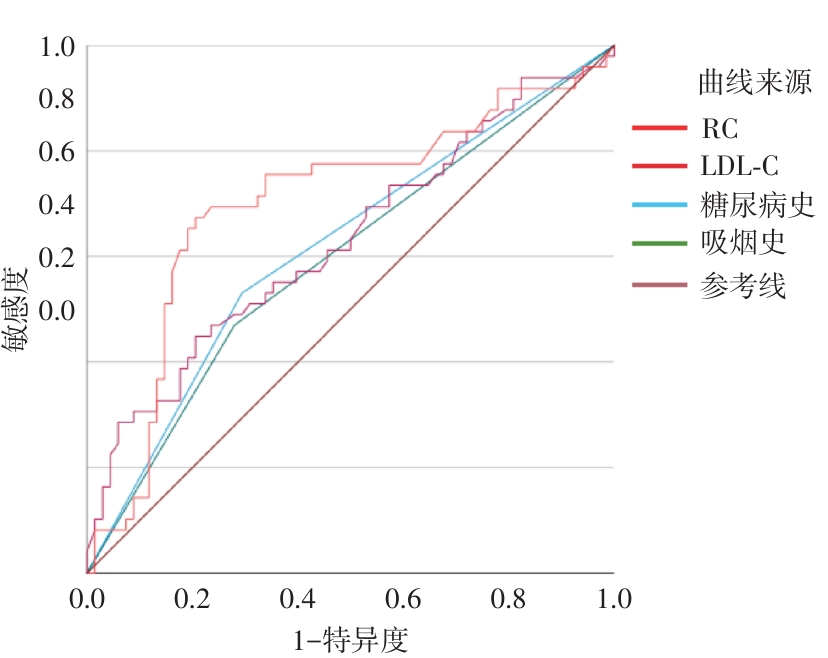
ROC curve analysis of diabetes history, smoking history, LDL-C, and RC for predicting intracoronary TCFA in patients with ACS"
| 指标 | 最佳截断值 | AUC(95%CI) | P值 | 敏感度/% | 特异度/% | 约登指数 |
|---|---|---|---|---|---|---|
| 糖尿病史 | 1 | 0.618(0.514 ~ 0.722) | 0.030 | 53.1 | 70.6 | 0.237 |
| 吸烟史 | 1 | 0.530(0.490 ~ 0.700) | 0.080 | 46.9 | 72.1 | 0.190 |
| LDL-C | 2.985 | 0.630(0.526 ~ 0.734) | 0.017 | 44.9 | 79.4 | 0.243 |
| RC | 0.975 | 0.702(0.600 ~ 0.803) | < 0.001 | 65.3 | 79.4 | 0.467 |
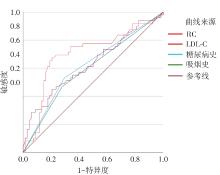
Fig.1
ROC curves of diabetes history, smoking history, LDL-C, and RC for predicting intracoronary TCFA in patients with ACS"
Tab.5
Comparison of OCT features between TCFA group and non-TCFA group in ACS patients"
| 指标 | 非TCFA组(n = 68) | TCFA组(n = 49) | t/χ2/Z值 | P值 |
|---|---|---|---|---|
| 最薄纤维帽厚度/μm | 91.41 ± 14.11 | 55.85 ± 5.51 | 18.870* | <0.001 |
| 最大脂质弧度/° | 94.72 ± 32.29 | 217.02 ± 20.96 | -24.826* | <0.001 |
| MLA/mm2 | 4.09 ± 0.37 | 2.85 ± 0.39 | 17.420 | <0.001 |
| 巨噬细胞浸润/[例(%)] | 10(14.7) | 16(32.7) | 5.307 | 0.021 |
| 微血管/[例(%)] | 9(13.2) | 8(16.3) | 0.219 | 0.640 |
| 胆固醇结晶/[例(%)] | 18(26.5) | 19(38.8) | 1.994 | 0.158 |
Tab.6
Spearman rank correlation analysis of RC and related OCT-derived plaque vulnerability features"
| 斑块特征 | rs 值 | P值 |
|---|---|---|
| 最薄纤维帽厚度 | -0.369 | <0.001 |
| 最大脂质弧度 | 0.438 | <0.001 |
| MLA | -0.342 | <0.001 |
| 巨噬细胞浸润 | 0.248 | 0.007 |
| [1] |
BHATT D L, LOPES R D, HARRINGTON R A. Diagnosis and treatment of acute coronary syndromes: A review[J]. JAMA, 2022, 327(7): 662. doi:10.1001/jama.2022.0358 .
doi: 10.1001/jama.2022.0358 |
| [2] |
CREA F, LIBBY P. Acute coronary syndromes: The way forward from mechanisms to precision treatment[J]. Circulation, 2017, 136(12): 1155-1166. doi:10.1161/circulationaha.117.029870 .
doi: 10.1161/circulationaha.117.029870 |
| [3] |
BYRNE R A, ROSSELLO X, COUGHLAN J J, et al. 2023 ESC Guidelines for the management of acute coronary syndromes[J]. Eur Heart J, 2023, 44(38): 3720-3826. doi:10.1093/eurheartj/ehad191 .
doi: 10.1093/eurheartj/ehad191 |
| [4] |
STONE G W, MAEHARA A, LANSKY A J, et al. A prospective natural-history study of coronary atherosclerosis[J]. N Engl J Med, 2011, 364(3): 226-235. doi:10.1056/nejmoa1002358 .
doi: 10.1056/nejmoa1002358 |
| [5] |
LIBBY P. Mechanisms of acute coronary syndromes and their implications for therapy[J]. N Engl J Med, 2013, 368(21): 2004-2013. doi:10.1056/NEJMra1216063 .
doi: 10.1056/NEJMra1216063 |
| [6] |
BENTZON J F, OTSUKA F, VIRMANI R, et al. Mechanisms of plaque formation and rupture[J]. Circ Res, 2014, 114(12): 1852-1866. doi:10.1161/circresaha.114.302721 .
doi: 10.1161/circresaha.114.302721 |
| [7] |
NORDESTGAARD B G, VARBO A. Triglycerides and cardiovascular disease[J]. Lancet, 2014, 384(9943): 626-635. doi:10.1016/S0140-6736(14)61177-6 .
doi: 10.1016/S0140-6736(14)61177-6 |
| [8] |
ROSENSON R S, DAVIDSON M H, HIRSH B J, et al. Genetics and causality of triglyceride-rich lipoproteins in atherosclerotic cardiovascular disease[J]. J Am Coll Cardiol, 2014, 64(23): 2525-2540. doi:10.1016/j.jacc.2014.09.042 .
doi: 10.1016/j.jacc.2014.09.042 |
| [9] |
SANDESARA P B, VIRANI S S, FAZIO S, et al. The forgotten lipids: Triglycerides, remnant cholesterol, and atherosclerotic cardiovascular disease risk[J]. Endocr Rev, 2019, 40(2): 537-557. doi:10.1210/er.2018-00184 .
doi: 10.1210/er.2018-00184 |
| [10] |
WANG K, WANG R, YANG J, et al. Remnant cholesterol and atherosclerotic cardiovascular disease: Metabolism, mechanism, evidence, and treatment[J]. Front Cardiovasc Med, 2022, 9: 913869. doi:10.3389/fcvm.2022.913869 .
doi: 10.3389/fcvm.2022.913869 |
| [11] |
HONG H, JIA H, ZENG M, et al. Risk stratification in acute coronary syndrome by comprehensive morphofunctional assessment with optical coherence tomography[J]. JACC Asia, 2022, 2(4): 460-472. doi:10.1016/j.jacasi.2022.03.004 .
doi: 10.1016/j.jacasi.2022.03.004 |
| [12] |
XING L, HIGUMA T, WANG Z, et al. Clinical significance of lipid-rich plaque detected by optical coherence tomography[J]. J Am Coll Cardiol, 2017, 69(20): 2502-2513. doi:10.1016/j.jacc.2017.03.556 .
doi: 10.1016/j.jacc.2017.03.556 |
| [13] |
FALK E, NAKANO M, BENTZON J F, et al. Update on acute coronary syndromes: The pathologists' view[J]. Eur Heart J, 2013, 34(10): 719-728. doi:10.1093/eurheartj/ehs411 .
doi: 10.1093/eurheartj/ehs411 |
| [14] |
AGUIRRE A D, ARBAB-ZADEH A, SOEDA T, et al. Optical coherence tomography of plaque vulnerability and rupture JACC focus seminar part 1/3[J]. J Am Coll Cardiol, 2021, 78(12): 1257-1265. doi:10.1016/j.jacc.2021.06.050 .
doi: 10.1016/j.jacc.2021.06.050 |
| [15] |
中国医师协会急诊医师分会, 国家卫健委能力建设与继续教育中心急诊学专家委员会, 中国医疗保健国际交流促进会急诊急救分会. 急性冠脉综合征急诊快速诊治指南(2019)[J]. 中华急诊医学杂志, 2019, 28(4): 421-428. doi:10.3760/cma.j.issn.1671-0282.2019.04.003 .
doi: 10.3760/cma.j.issn.1671-0282.2019.04.003 |
| [16] |
TEARNEY G J, REGAR E, AKASAKA T, et al. Consensus standards for acquisition, measurement, and reporting of intravascular optical coherence tomography studies[J]. J Am Coll Cardiol, 2012, 59(12): 1058-1072. doi:10.1016/j.jacc.2011. 09.079 .
doi: 10.1016/j.jacc.2011. 09.079 |
| [17] |
JOHNSON T W, RÄBER L, DI MARIO C, et al. Clinical use of intracoronary imaging. Part 2: Acute coronary syndromes, ambiguous coronary angiography findings, and guiding interventional decision-making: An expert consensus document of the European Association of Percutaneous Cardiovascular Interventions[J]. Eur Heart J, 2019, 40(31): 2566-2584. doi:10.1093/eurheartj/ehz332 .
doi: 10.1093/eurheartj/ehz332 |
| [18] |
闫海浩, 张飞飞, 党懿. 残余胆固醇与急性冠脉综合征患者易损斑块特征的相关性研究[J]. 中国全科医学, 2023, 26(26): 3303-3307, 3313. doi:10.12114/j.issn.1007-9572.2023.0093 .
doi: 10.12114/j.issn.1007-9572.2023.0093 |
| [19] |
DURAN E K, PRADHAN A D. Triglyceride-rich lipoprotein remnants and cardiovascular disease[J]. Clin Chem, 2021, 67(1): 183-196. doi:10.1093/clinchem/hvaa296 .
doi: 10.1093/clinchem/hvaa296 |
| [20] |
钱程昱, 王琳升, 熊兴江, 等. 血清低密度脂蛋白胆固醇、超敏C反应蛋白联合颈动脉超声参数诊断疑似冠心病患者的价值[J]. 实用医学杂志, 2025, 41(9): 1401-1406. doi:10.3969/j.issn.1006-5725.2025.09.019 .
doi: 10.3969/j.issn.1006-5725.2025.09.019 |
| [21] |
LIAO J, QIU M, SU X, et al. The residual risk of inflammation and remnant cholesterol in acute coronary syndrome patients on statin treatment undergoing percutaneous coronary intervention[J]. Lipds Health Dis, 2024, 23(1): 172. doi:10.1186/s12944-024-02156-3 .
doi: 10.1186/s12944-024-02156-3 |
| [22] |
HASHIMOTO T, MINAMI Y, ASAKURA K, et al. Lower levels of low-density lipoprotein cholesterol are associated with a lower prevalence of thin-cap fibroatheroma in statin-treated patients with coronary artery disease[J]. J Clin Lipidol, 2022, 16(1): 104-111. doi:10.1016/j.jacl.2021.11.012 .
doi: 10.1016/j.jacl.2021.11.012 |
| [23] |
NICHOLLS S J, KATAOKA Y, NISSEN S E, et al. Effect of evolocumab on coronary plaque phenotype and burden in statin-treated patients following myocardial infarction[J]. JACC Cardiovasc Imag, 2022, 15(7): 1308-1321. doi:10.1016/j.jcmg.2022. 03.002 .
doi: 10.1016/j.jcmg.2022. 03.002 |
| [24] |
ABTAHIAN F, YONETSU T, KATO K, et al. Comparison by optical coherence tomography of the frequency of lipid coronary plaques in current smokers, former smokers, and nonsmokers[J]. Am J Cardiol, 2014, 114(5): 674-680. doi:10.1016/j.amjcard.2014.05.056 .
doi: 10.1016/j.amjcard.2014.05.056 |
| [25] |
KEDHI E, BERTA B, ROLEDER T, et al. Thin-cap fibroatheroma predicts clinical events in diabetic patients with normal fractional flow reserve: The COMBINE OCT-FFR trial[J]. Eur Heart J, 2021, 42(45): 4671-4679. doi:10.1093/eurheartj/ehab433 .
doi: 10.1093/eurheartj/ehab433 |
| [26] |
SOROKIN A V, PATEL N, LI H, et al. Estimated sdLDL-C for predicting high-risk coronary plaque features in psoriasis: A prospective observational study[J]. Lipds Health Dis, 2023, 22(1): 55. doi:10.1186/s12944-023-01819-x .
doi: 10.1186/s12944-023-01819-x |
| [27] |
QUISPE R, MARTIN S S, MICHOS E D, et al. Remnant cholesterol predicts cardiovascular disease beyond LDL and ApoB: A primary prevention study[J]. Eur Heart J, 2021, 42(42): 4324-4332. doi:10.1093/eurheartj/ehab432 .
doi: 10.1093/eurheartj/ehab432 |
| [28] |
SHAO Q Y, YANG Z Q, WANG Y F, et al. Elevated remnant cholesterol is associated with adverse cardiovascular outcomes in patients with acute coronary syndrome[J]. J Atheroscler Thromb, 2022, 29(12): 1808-1822. doi: 10.5551/jat.63397 .
doi: 10.5551/jat.63397 |
| [29] |
巨名飞, 刘超, 马志刚, 等. 残余胆固醇水平对急性冠脉综合征患者发病的预测价值[J]. 吉林大学学报(医学版), 2023, 49(3): 765-769. doi:10.13481/j.1671-587X.20230327 .
doi: 10.13481/j.1671-587X.20230327 |
| [30] |
VARBO A, NORDESTGAARD B G. Remnant cholesterol and risk of ischemic stroke in 112, 512 individuals from the general population[J]. Ann Neurol, 2019, 85(4): 550-559. doi:10. 1002/ana.25432 .
doi: 10. 1002/ana.25432 |
| [31] |
ALLOZA I, SALEGI A, MENA J, et al. BIRC6 is associated with vulnerability of carotid atherosclerotic plaque[J]. Int J Mol Sci, 2020, 21(24): 9387. doi:10.3390/ijms21249387 .
doi: 10.3390/ijms21249387 |
| [32] |
TADA H, NOHARA A, INAZU A, et al. Remnant lipoproteins and atherosclerotic cardiovascular disease[J]. Clin Chim Acta, 2019, 490: 1-5. doi:10.1016/j.cca.2018.12.014 .
doi: 10.1016/j.cca.2018.12.014 |
| [33] |
HANSSON G K, LIBBY P, TABAS I. Inflammation and plaque vulnerability[J]. J Intern Med, 2015, 278(5): 483-493. doi:10.1111/joim.12406 .
doi: 10.1111/joim.12406 |
| [34] |
NEWBY A C. Metalloproteinase production from macrophages⁃a perfect storm leading to atherosclerotic plaque rupture and myocardial infarction[J]. Exp Physiol, 2016, 101(11): 1327-1337. doi:10.1113/EP085567 .
doi: 10.1113/EP085567 |
| [35] |
MATTHEWS C, GORENNE I, SCOTT S, et al. Vascular smooth muscle cells undergo telomere-based senescence in human atherosclerosis: Effects of telomerase and oxidative stress[J]. Circ Res, 2006, 99(2): 156-164. doi:10.1161/01.res.0000233315. 38086.bc .
doi: 10.1161/01.res.0000233315. 38086.bc |
| [36] |
CHILDS B G, BAKER D J, WIJSHAKE T, et al. Senescent intimal foam cells are deleterious at all stages of atherosclerosis[J]. Science, 2016, 354(6311): 472-477. doi:10.1126/science.aaf6659 .
doi: 10.1126/science.aaf6659 |
| [37] |
巨名飞, 刘超, 刘佳梅, 等. 急性冠状动脉综合征患者残余胆固醇水平与冠状动脉狭窄严重程度的相关性[J]. 实用医学杂志, 2023, 39(1): 71-75. doi:10.3969/j.issn.1006-5725.2023. 01.012 .
doi: 10.3969/j.issn.1006-5725.2023. 01.012 |
| [38] |
UEMURA S, ISHIGAMI K I, SOEDA T, et al. Thin-cap fibroatheroma and microchannel findings in optical coherence tomography correlate with subsequent progression of coronary atheromatous plaques[J]. Eur Heart J, 2012, 33(1): 78-85. doi:10.1093/eurheartj/ehr284 .
doi: 10.1093/eurheartj/ehr284 |
| [39] |
DAI J, TIAN J, HOU J, et al. Association between cholesterol crystals and culprit lesion vulnerability in patients with acute coronary syndrome: An optical coherence tomography study[J]. Atherosclerosis, 2016, 247: 111-117. doi:10.1016/j.atherosclerosis.2016.02.010 .
doi: 10.1016/j.atherosclerosis.2016.02.010 |
| [1] | Dujing SHAO,Xiaogang LIU,Yujie LIU,Sijia GUO,Ying ZHANG. Efficacy and lipid variability of inclisiran compared to PCSK9 monoclonal antibodie in ACS: A real-world retrospective analysis [J]. The Journal of Practical Medicine, 2026, 42(11): 1933-1941. |
| [2] | Xue HE,Huan MA,Cong LI,Yan WANG,Yu KUANG,Lei LIU,Honghua YU,Xiaohong. YANG. Retinal neurovascular characteristics and their correlation with depression severity in patients with coronary artery disease and depression [J]. The Journal of Practical Medicine, 2025, 41(4): 515-521. |
| [3] | Shuo LI,Yunpeng ZHANG,Yan HUANG,Jing WANG,yang BAI,Shuzhong. DUAN. The relationship between remnant cholesterol and clinicopathological characteristics in patients with IgA nephropathy [J]. The Journal of Practical Medicine, 2025, 41(21): 3322-3329. |
| [4] | Lili SU,Nuo LI,Wei FANG,Menghua CHEN,Sina QIN,Yegui YANG. Association between residual cholesterol and metabolic associated fatty liver disease risk at different triglyceride levels [J]. The Journal of Practical Medicine, 2025, 41(17): 2676-2682. |
| [5] | Xinyu CHEN,Xiaolei LUO,Yimeng HUANG,Li MA. Predictive value of non⁃invasive assessment for adverse events in acute coronary syndrome patients with chronic kidney disease [J]. The Journal of Practical Medicine, 2025, 41(13): 1971-1978. |
| [6] | Zhiqiang LIU,Zhikun ZHAO,Wei MI,Gang WANG,Liang. LI. Predictive modeling of transient arrhythmia after PCI in patients with acute coronary syndromes [J]. The Journal of Practical Medicine, 2025, 41(13): 2025-2032. |
| [7] | Zaili LU,Chaozhong LI,Jie XIA,Yuzhu WU,Ranzun ZHAO. The application value and research progress of blood flow reserve fraction based on optical coherence tomography in coronary heart disease [J]. The Journal of Practical Medicine, 2024, 40(20): 2960-2964. |
| [8] | Shuhong RUI,Chenfang WANG,Yunhe LI,Junlan PAN,Jianlou WANG. Effects of indobuprofen combined with nicodil on inflammatory factors, myocardial injury markers and platelet function in patients with ACS after PCI [J]. The Journal of Practical Medicine, 2024, 40(12): 1706-1711. |
| [9] | RUI Shuhong, WANG Chenfang, LI Yunhe, PAN Junlan, WANG Jianlou. . Effects of indobufen combined with clopidogrel on vascular endothelial function,inflammatory factors and oxidative stress in patients with acute coronary syndrome [J]. The Journal of Practical Medicine, 2023, 39(12): 1551-1555. |
| [10] |
JU Mingfei, LIU Chao, LIU Jiamei, SHAO Wen′ge, LIU Tingting, ZHAO Juan..
Correlation between remnant cholesterol levels and the severity of coronary artery stenosis in patients with ACS [J]. The Journal of Practical Medicine, 2023, 39(1): 71-75. |
| [11] |
LI Cong, KONG Lingcong, HU Lianting, YUAN Haiyun, REN Yun, ZHAO Hanpeng, WANG Yan, CHEN Xuanhui, LIU Huazhang, KUANG Yu, LIANG Huiying, YU Honghua, YANG Xiaohong. .
A clinical study on intelligent prediction of perioperative outcomes in congenital heart disease based on optical coherence tomography angiography technology [J]. The Journal of Practical Medicine, 2022, 38(9): 1136-1140. |
| [12] |
SHEN Peiqing, LI Yongrong, FAN Lingling. .
Significance of ganglion cell complex in the diagnosis of diabetic retinopathy
[J]. The Journal of Practical Medicine, 2021, 37(8): 1072-1079.
|
| [13] |
LI Yingxiao, SONG Xuelian, LÜ Caixia, XIE Yuetao, ZHANG Feifei, DANG Yi..
Clinical efficacy of drug⁃coated balloon versus drug⁃eluting stent for treatment of in⁃stent restenosis with heterogeneous neointimal pattern [J]. The Journal of Practical Medicine, 2021, 37(5): 637-642. |
| Viewed | ||||||
|
Full text |
|
|||||
|
Abstract |
|
|||||
