

The Journal of Practical Medicine ›› 2026, Vol. 42 ›› Issue (11): 1933-1941.doi: 10.3969/j.issn.1006-5725.2026.11.006
• Cardiovascular and Cerebrovascular Diseases Column • Previous Articles
Dujing SHAO,Xiaogang LIU,Yujie LIU,Sijia GUO,Ying ZHANG( )
)
Received:2025-12-19
Online:2026-06-10
Published:2026-06-15
Contact:
Ying ZHANG
E-mail:zy89769402@126.com
CLC Number:
Dujing SHAO,Xiaogang LIU,Yujie LIU,Sijia GUO,Ying ZHANG. Efficacy and lipid variability of inclisiran compared to PCSK9 monoclonal antibodie in ACS: A real-world retrospective analysis[J]. The Journal of Practical Medicine, 2026, 42(11): 1933-1941.
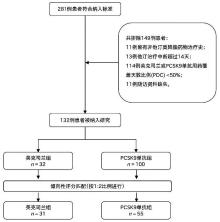
Fig.1
Study flow diagram"
Tab.1
Baseline characteristics before and after PSM: Inclisiran vs. PCSK9 mAb Groups"
| 项目 | 匹配前 | 匹配后 | ||||||
|---|---|---|---|---|---|---|---|---|
| 英克司兰组(n = 32) | PCSK9单抗组(n = 100) | t/χ2值 | P值 | 英克司兰组(n = 31) | PCSK9 单抗组(n = 55) | t/χ2值 | P值 | |
| 年龄(x ± s)/岁 | 57.88 ± 13.51 | 58.74 ± 9.78 | 0.16 | 0.694 | 57.90 ± 13.73 | 58.44 ± 10.34 | 0.04 | 0.839 |
| 男性 | 24(75.00) | 70(70.00) | 0.10 | 0.749 | 23(74.19) | 40(72.73) | 0.02 | 0.883 |
| BMI(x ± s)/(kg/m2) | 26.30 ± 2.75 | 26.39 ± 3.35 | 0.02 | 0.888 | 26.33 ± 2.79 | 26.59 ± 3.46 | 0.13 | 0.720 |
| 高血压 | 23(71.88) | 57(57.00) | 1.67 | 0.197 | 22(70.97) | 37(67.27) | 0.13 | 0.723 |
| 糖尿病 | 6(18.75) | 23(23.00) | 0.07 | 0.795 | 6(19.35) | 11(20.00) | 0.01 | 0.942 |
| 卒中 | 5(15.63) | 13(13.00) | 0.01 | 0.936 | 4(12.90) | 9(16.36) | 0.19 | 0.667 |
| 吸烟 | 17(53.13) | 43(43.00) | 0.64 | 0.425 | 16(51.61) | 28(50.91) | 0.00 | 0.950 |
| 基线LDL-C水平(x ± s)/(mmol/L) | 2.81 ± 0.94 | 3.04 ± 0.90 | 1.57 | 0.213 | 2.85 ± 0.93 | 2.91 ± 0.88 | 0.08 | 0.784 |
| 血运重建类型 | 0.92 | 0.632 | 0.33 | 0.846 | ||||
| Non | 3(9.38) | 15(15.00) | 3(9.68) | 7(12.73) | ||||
| PCI | 28(87.50) | 80(80.00) | 27(87.10) | 47(85.45) | ||||
| CABG | 1(3.13) | 5(5.00) | 1(3.22) | 1(1.82) | ||||
| ACS类型 | 0.42 | 0.810 | ||||||
| UA | 21(65.63) | 71(71.00) | 21(67.74) | 37(67.27) | 0.05 | 0.974 | ||
| NSTEMI | 7(21.88) | 17(17.00) | 6(19.35) | 10(18.18) | ||||
| STEMI | 4(12.50) | 12(12.00) | 4(12.90) | 8(14.55) | ||||
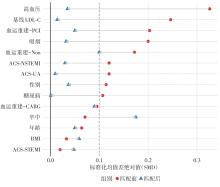
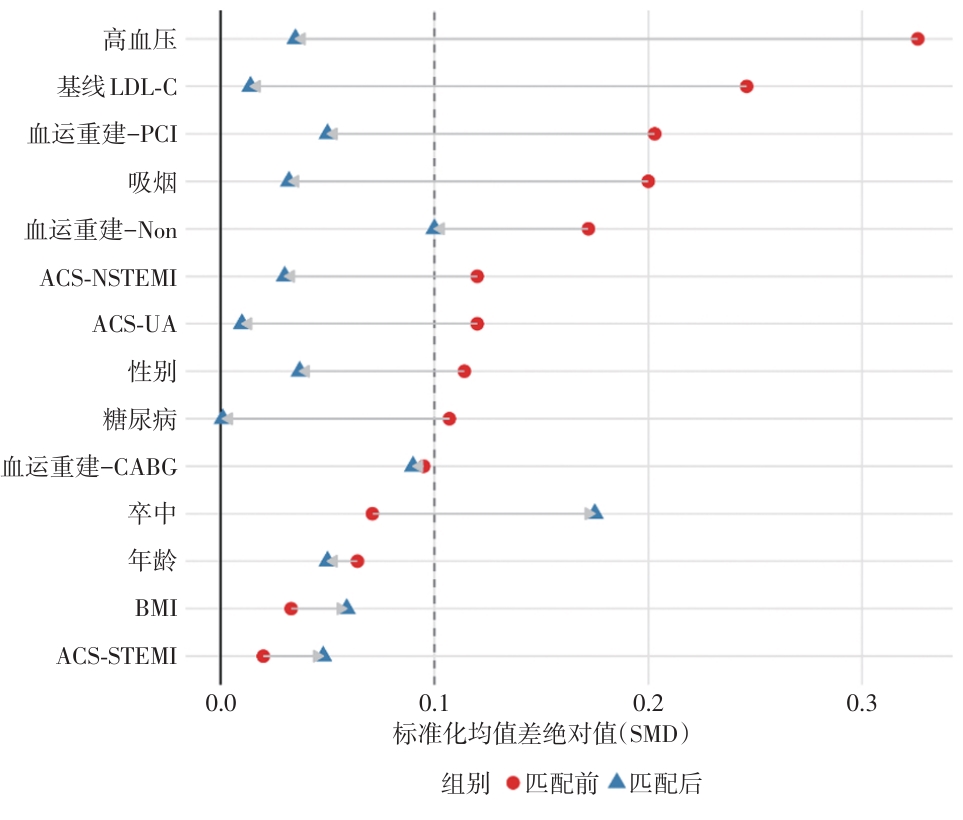
Fig.2
Distribution of SMD before and after PSM"
Tab.2
Distribution of patients according to ASCVD risk stratification"
| ASCVD风险分层 | PCSK9单抗组(n = 55) | 英克司兰组 (n = 31) | P值 |
|---|---|---|---|
| 超高危 | 49(89.0) | 29(94.0) | 0.7* |
| 极高危 | 6(11.0) | 2(6.5) | - |
Tab.3
LDL-C levels and reduction after treatment in both groups"
| 随访点 | LDL-C/(mmol/L) | LDL-C降幅/% | ||||||
|---|---|---|---|---|---|---|---|---|
| 英克司兰组 | PCSK9单抗组 | Z值 | P值 | 英克司兰组 | PCSK9单抗组 | Z值 | P值 | |
| 访视1 | 0.82(0.53,1.06) | 1.14(0.78,1.77) | 2.46 | 0.010 | 68.57(53.47,78.90) | 58.74(39.09,68.39) | -2.01 | 0.045 |
| 访视2 | 0.83(0.61,1.34) | 1.49(1.06,1.93) | 3.77 | < 0.001 | 64.00(48.87,81.01) | 47.83(26.23,59.81) | -3.37 | < 0.001 |
| 访视3 | 0.90(0.70,1.27) | 1.27(1.11,1.86) | 3.10 | 0.002 | 61.26(54.79,73.23) | 49.62(37.21,64.66) | -2.85 | 0.004 |
Tab.4
Between-group differences in LDL-C over time assessed by GEE modeling"
| 变量 | β | SE | Waldχ2 | 95%CI | P值 |
|---|---|---|---|---|---|
| 截距 | 0.414 | 0.198 | 4.38 | 0.026 ~ 0.801 | 0.036 |
| 组间(英克司兰 vs. PCSK9单抗) | -0.300 | 0.120 | 6.23 | -0.535 ~ -0.064 | 0.013 |
| 随访点 | 3.14 | 0.208 | |||
| 访视1 | -0.015 | 0.182 | -0.373 ~ 0.342 | ||
| 访视2 | -0.029 | 0.135 | -0.293 ~ 0.235 | ||
| 访视3 | - | - | - | ||
| 组间×随访点 | 4.20 | 0.122 | |||
| 组间×访视1 | -0.074 | 0.207 | -0.480 ~ 0.332 | ||
| 组间×访视2 | 0.226 | 0.171 | -0.109 ~ 0.561 | ||
| 组间×访视3 | - | - | - | ||
| 基线LDL-C | 0.220 | 0.059 | 14.06 | 0.105 ~ 0.335 | < 0.001 |
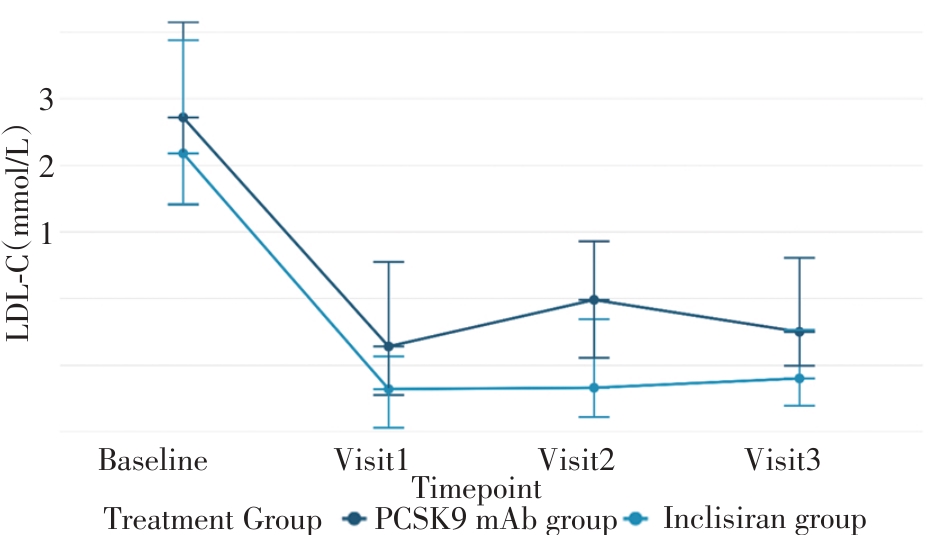
Fig.3
LDL-C levels and trends over time in both groups"
Tab.5
Comparison of LDL-C target achievement rates between the two groups after treatment"
| 随访点 | 1.8 mmol/L | 1.4 mmol/L +较基线降低≥ 50% | ||||
|---|---|---|---|---|---|---|
| 英克司兰组 | PCSK9单抗组 | P值 | 英克司兰组 | PCSK9单抗组 | P值 | |
| 访视1 | 87.10 | 76.36 | 0.272* | 77.42 | 47.27 | 0.007* |
| 访视2 | 87.10 | 63.64 | 0.025* | 67.74 | 30.91 | 0.001* |
| 访视3 | 93.55 | 73.08 | 0.024* | 74.19 | 40.38 | 0.003* |
Tab.6
Comparison of LDL-C variability between the two groups after treatment M(P25,P75)/(mmol/L)"
| 变异性指标 | 英克司兰组 | PCSK9单抗组 | Z值 | P值 |
|---|---|---|---|---|
| SD | 0.21(0.14,0.72) | 0.39(0.28,0.59) | 1.53 | 0.034 |
| ASV | 0.28(0.17,0.71) | 0.47(0.32,0.80) | 2.18 | 0.029 |
Tab.7
Comparison of safety profiles between the two groups"
| 组别 | 变量 | 治疗前 | 治疗后 | Z值 | P值 |
|---|---|---|---|---|---|
| 英克司兰组 | ALT/(U/L) | 35.00(21.40,51.20) | 28.00(19.45,41.95) | -1.97 | 0.050 |
| AST/(U/L) | 30.00(18.15,36.25) | 22.60(18.70,30.25) | -1.68 | 0.096 | |
| Scr/(μmol/L) | 76.00(66.00,87.00) | 75.40(71.50,81.28) | 0.08 | 0.945 | |
| 葡萄糖/(mmol/L) | 5.55(5.11,6.42) | 6.00(5.47,6.66) | 1.86 | 0.064 | |
| PCSK9单抗组 | ALT/(U/L) | 22.50(16.80,36.30) | 23.80(15.65,31.50) | -1.27 | 0.207 |
| AST/(U/L) | 19.40(16.70,24.90) | 20.30(17.30,26.30) | -0.20 | 0.844 | |
| Scr/(μmol/L) | 71.00(62.00,82.97) | 72.41(65.00,81.00) | 0.16 | 0.884 | |
| 葡萄糖/(mmol/L) | 5.97(5.36,6.59) | 6.15(5.62,6.95) | 1.30 | 0.195 |
| [1] |
RAO S V, O′DONOGHUE M L, RUEL M, et al. 2025 ACC/AHA/ACEP/NAEMSP/SCAI guideline for the management of patients with acute coronary syndromes: A report of the American College of Cardiology/American Heart Association Joint Committee on Clinical Practice Guidelines[J]. JACC, 2025, 85(22): 2135-2237. doi: 10.1016/j.jacc.2024.11.009 .
doi: 10.1016/j.jacc.2024.11.009 |
| [2] |
SONG J, MURUGIAH K, HU S, et al. Incidence, predictors, and prognostic impact of recurrent acute myocardial infarction in China[J]. Heart, 2021, 107(4): 313-318. doi: 10.1136/heartjnl-2020-317165 .
doi: 10.1136/heartjnl-2020-317165 |
| [3] |
王增武, 刘静, 李建军, 等. 中国血脂管理指南(2023年)[J]. 中国循环杂志, 2023, 38(3): 237-271. doi: 10.3969/j.issn.1000-3614. 2023.03.001 .
doi: 10.3969/j.issn.1000-3614. 2023.03.001 |
| [4] |
BYRNE R A, ROSSELLO X, COUGHLAN J, et al. 2023 ESC Guidelines for the management of acute coronary syndromes[J]. Eur Heart J Acute Cardiovasc Care, 2024, 13(1): 55-161. doi: 10.1093/ehjacc/zuad107 .
doi: 10.1093/ehjacc/zuad107 |
| [5] |
TOMLINSON B, CHAN P, LIU Z M. Statin responses in Chinese patients[J]. J Atheroscler Thromb, 2018, 25(2): 199-202. doi: 10.5551/jat.40204 .
doi: 10.5551/jat.40204 |
| [6] |
赵旺, 叶平, 胡大一, 等. 根据《中国成人血脂异常防治指南(2016年修订版)》再分析DYSIS-China横断面调查[J]. 中国心血管杂志, 2020, 25(1): 55-61. doi: 10.3969/j.issn.1007-5410. 2020.01.013 .
doi: 10.3969/j.issn.1007-5410. 2020.01.013 |
| [7] |
董耀辉, 王晓慧, 胡钢. 阿利西尤单抗联用海博麦布对急性ST段抬高型心肌梗死的疗效[J]. 实用医学杂志, 2024, 40(9): 1298-1302. doi: 10.3969/j.issn.1006-5725.2024.09.020 .
doi: 10.3969/j.issn.1006-5725.2024.09.020 |
| [8] |
张卫丰, 马海龙, 张金玲. PCSK9抑制剂对ST段抬高型急性心肌梗死PCI后炎症水平和心室重构的影响[J]. 实用医学杂志, 2024, 40(15): 2142-2147. doi: 10.3969/j.issn.1006-5725. 2024.15.017 .
doi: 10.3969/j.issn.1006-5725. 2024.15.017 |
| [9] |
李建军. 前蛋白转换酶枯草溶菌素9单抗在亚洲人群治疗中的心血管获益[J]. 中华老年心脑血管病杂志, 2021, 23(1): 94-96. doi: 10.3969/j.issn.1009-0126.2021.01.024 .
doi: 10.3969/j.issn.1009-0126.2021.01.024 |
| [10] |
HUO Y, LESOGOR A, LEE C W, et al. Efficacy and safety of inclisiran in Asian patients: Results from ORION-18[J]. JACC Asia, 2024, 4(2): 123-134. doi: 10.1016/j.jacasi.2023.09.006 .
doi: 10.1016/j.jacasi.2023.09.006 |
| [11] |
ARNOLD N, KOENIG W. Lipid Lowering Drugs in Acute Coronary Syndromes (ACS)[J]. Curr Atheroscler Rep, 2023, 25(12): 939-946. doi: 10.1007/s11883-023-01163-6 .
doi: 10.1007/s11883-023-01163-6 |
| [12] |
LIU X, WU S, SONG Q, et al. Visit-to-visit variability of lipid measurements and the risk of myocardial infarction and all-cause mortality: A prospective cohort study[J]. Atherosclerosis, 2020, 312: 110-116. doi: 10.1016/j.atherosclerosis.2020.09.003 .
doi: 10.1016/j.atherosclerosis.2020.09.003 |
| [13] |
NAKANO S, OTAKE H, KAWAMORI H, et al. Association between visit-to-visit variability in low-density lipoprotein cholesterol and plaque rupture that leads to acute coronary syndrome[J]. Circ Rep, 2021, 3(9): 540-549. doi: 10.1253/circrep.CR-21-0080 .
doi: 10.1253/circrep.CR-21-0080 |
| [14] |
BANGALORE S, BREAZNA A, DEMICCO D A, et al. Visit-to-visit low-density lipoprotein cholesterol variability and risk of cardiovascular outcomes: Insights from the TNT trial[J]. J Am Coll Cardiol, 2015, 65(15): 1539-1548. doi: 10.1016/j.jacc.2015. 02.017 .
doi: 10.1016/j.jacc.2015. 02.017 |
| [15] |
RAZAVI A C, SHAPIRO M D. The discovery of PCSK9 as a pivotal point in the prevention of cardiovascular disease[J]. Am J Prev Cardiol, 2025: 101314. doi: 10.1016/j.ajpc.2025.101314 .
doi: 10.1016/j.ajpc.2025.101314 |
| [16] |
ROSENSON R S, HEGELE R A, FAZIO S, et al. The evolving future of PCSK9 inhibitors[J]. J Am Coll Cardiol, 2018, 72(3): 314-329. doi: 10.1016/j.jacc.2018.04.054 .
doi: 10.1016/j.jacc.2018.04.054 |
| [17] |
SCHERER N, DINGS C, BöHM M, et al. Alternative treatment regimens with the PCSK9 inhibitors alirocumab and evolocumab: A pharmacokinetic and pharmacodynamic modeling approach[J]. J Clin Pharmacol, 2017, 57(7): 846-854. doi: 10.1002/jcph.866 .
doi: 10.1002/jcph.866 |
| [18] |
WASSERMAN S M, SABATINE M S, KOREN M J, et al. Comparison of LDL-C reduction using different evolocumab doses and intervals: Biological insights and treatment implications[J]. J Cardiovasc Pharmacol Ther, 2018, 23(5): 423-432. doi: 10. 1177/1074248418774043 .
doi: 10. 1177/1074248418774043 |
| [19] |
赵紫楠, 史琛, 胡欣, 等. 小干扰RNA降脂药物药学专家共识[J]. 中国医院药学杂志, 2024, 44(1): 9-17. doi: 10.13286/j.1001-5213.2024.01.02 .
doi: 10.13286/j.1001-5213.2024.01.02 |
| [20] |
RAY K K, TROQUAY R P, VISSEREN F L, et al. Long-term efficacy and safety of inclisiran in patients with high cardiovascular risk and elevated LDL cholesterol (ORION-3): Results from the 4-year open-label extension of the ORION-1 trial[J]. Lancet Diabetes Endocrinol, 2023, 11(2): 109-119. doi: 10.1016/S2213-8587(22)00353-9 .
doi: 10.1016/S2213-8587(22)00353-9 |
| [21] |
WRIGHT R S, RAAL F J, KOENIG W, et al. Inclisiran administration potently and durably lowers LDL-C over an extended-term follow-up: The ORION-8 trial[J]. Cardiovasc Res, 2024, 120(12): 1400-1410. doi: 10.1093/cvr/cvae109 .
doi: 10.1093/cvr/cvae109 |
| [22] |
DEC A, NIEMIEC A, WOJCIECHOWSKA E, et al. Inclisiran—a revolutionary addition to a cholesterol-lowering therapy[J]. Int J Mol Sci, 2023, 24(7): 6858. doi: 10.3390/ijms24076858 .
doi: 10.3390/ijms24076858 |
| [23] |
霍勇, 李勇, 韩雅君, 等. 英克司兰治疗亚洲动脉粥样硬化性心血管疾病患者或高危人群的疗效与安全性:ORION-18研究中国大陆亚组分析[J]. 中国循环杂志, 2025, 40(2): 124-130. doi: 10.3969/j.issn.1000-3614.2025.02.002 .
doi: 10.3969/j.issn.1000-3614.2025.02.002 |
| [24] |
LAN N S, CHEN R T, DWIVEDI G, et al. Learnings from implementation strategies to improve lipid management[J]. Curr Cardiol Rep, 2025, 27(1): 9. doi: 10.1007/s11886-024-02174-8 .
doi: 10.1007/s11886-024-02174-8 |
| [25] |
ZHENG X, JIN Y, FAN M, et al. Multilevel Factors Predict Medication Adherence and Efficacy within 12 Months in Patients Receiving PCSK9 Monoclonal Antibodies: The Findings from a Real-World Analysis in China[J]. J Atheroscler Thromb, 2025: 65624. doi: 10.5551/jat.65624 .
doi: 10.5551/jat.65624 |
| [26] |
WILKINSON M J, BAJAJ A, BROUSSEAU M E, et al. Harnessing RNA interference for cholesterol lowering: The bench‐to‐bedside story of Inclisiran[J]. J Am Heart Assoc, 2024, 13(6): e032031. doi: 10.1161/JAHA.123.032031 .
doi: 10.1161/JAHA.123.032031 |
| [27] |
KILLIAN M O, CLIFFORD S, LUSTRIA M L A, et al. Directly observed therapy to promote medication adherence in adolescent heart transplant recipients[J]. Pediatr Transplant, 2022, 26(5): e14288. doi: 10.1111/petr.14288 .
doi: 10.1111/petr.14288 |
| [28] |
NIU C, PARLAPALLI A, NEENAN J, et al. Six-month adherence among early inclisiran initiators vs. anti-pcsk9 mabs users: A retrospective analysis of US claims databases[J]. Circulation, 2023, 148(): A12945-A12945. doi: 10.1161/circ.148.suppl_1.12945 .
doi: 10.1161/circ.148.suppl_1.12945 |
| [29] |
CHAN J S K, SATTI D I, LEE Y H A, et al. High visit-to-visit cholesterol variability predicts heart failure and adverse cardiovascular events: A population-based cohort study[J]. Eur J Prev Cardiol, 2022, 29(14): e323-e325. doi: 10.1093/eurjpc/zwac097 .
doi: 10.1093/eurjpc/zwac097 |
| [30] |
SHENG C-S, MIAO Y, DING L, et al. Prognostic significance of visit-to-visit variability, and maximum and minimum LDL cholesterol in diabetes mellitus[J]. Lipids Health Dis, 2022, 21(1): 19. doi: 10.1186/s12944-022-01628-8 .
doi: 10.1186/s12944-022-01628-8 |
| [31] |
LI S, HOU L, ZHU S, et al. Lipid variability and risk of cardiovascular diseases and all-cause mortality: A systematic review and meta-analysis of cohort studies[J]. Nutrients, 2022, 14(12): 2450. doi: 10.3390/nu14122450 .
doi: 10.3390/nu14122450 |
| [1] | Chengyu QIAN,Linsheng WANG,Xingjiang XIONG,Weidong QIAN. Predictive value of serum LDL⁃C and hs⁃CRP combined with carotid ultrasound parameters in patients with suspected coronary heart disease [J]. The Journal of Practical Medicine, 2025, 41(9): 1401-1406. |
| [2] | Xinyu CHEN,Xiaolei LUO,Yimeng HUANG,Li MA. Predictive value of non⁃invasive assessment for adverse events in acute coronary syndrome patients with chronic kidney disease [J]. The Journal of Practical Medicine, 2025, 41(13): 1971-1978. |
| [3] | Zhiqiang LIU,Zhikun ZHAO,Wei MI,Gang WANG,Liang. LI. Predictive modeling of transient arrhythmia after PCI in patients with acute coronary syndromes [J]. The Journal of Practical Medicine, 2025, 41(13): 2025-2032. |
| [4] | A′fang SU,Guangjian LI,Yunshui ZHANG,Xiujuan ZHAO,Shouling WU,Xiaozhong. JIANG. A study on the association between exposure of uric acid accumulation and risks of acute pancreatitis [J]. The Journal of Practical Medicine, 2024, 40(14): 2009-2014. |
| [5] | Shuhong RUI,Chenfang WANG,Yunhe LI,Junlan PAN,Jianlou WANG. Effects of indobuprofen combined with nicodil on inflammatory factors, myocardial injury markers and platelet function in patients with ACS after PCI [J]. The Journal of Practical Medicine, 2024, 40(12): 1706-1711. |
| [6] | Li′na MA,Zhenhua CAO,Bing. YANG. Correlation between sdLDL⁃C, CXCL12 and CVD in diabetic patients [J]. The Journal of Practical Medicine, 2023, 39(22): 2953-2957. |
| [7] | RUI Shuhong, WANG Chenfang, LI Yunhe, PAN Junlan, WANG Jianlou. . Effects of indobufen combined with clopidogrel on vascular endothelial function,inflammatory factors and oxidative stress in patients with acute coronary syndrome [J]. The Journal of Practical Medicine, 2023, 39(12): 1551-1555. |
| [8] |
JU Mingfei, LIU Chao, LIU Jiamei, SHAO Wen′ge, LIU Tingting, ZHAO Juan..
Correlation between remnant cholesterol levels and the severity of coronary artery stenosis in patients with ACS [J]. The Journal of Practical Medicine, 2023, 39(1): 71-75. |
| Viewed | ||||||
|
Full text |
|
|||||
|
Abstract |
|
|||||
