

The Journal of Practical Medicine ›› 2026, Vol. 42 ›› Issue (10): 1752-1761.doi: 10.3969/j.issn.1006-5725.2026.10.009
• Chronic Disease Control • Previous Articles
Lunlun LI1,Linlin YANG2,Lijuan WANG3( )
)
Received:2026-01-06
Online:2026-05-25
Published:2026-05-27
Contact:
Lijuan WANG
E-mail:jy820916@126.com
CLC Number:
Lunlun LI,Linlin YANG,Lijuan WANG. Analysis of the relationship between the levels of serum AFABP, PARP1, GRP78 and IGFBP-7 in patients with chronic heart failure and their clinical classification and prognosis[J]. The Journal of Practical Medicine, 2026, 42(10): 1752-1761.
Tab.1
Clinical features"
| 临床特征 | CHF组(n = 259) | 对照组(n = 259) | χ2/t值 | P值 |
|---|---|---|---|---|
| 年龄( | 63.14±5.44 | 62.71±5.82 | 0.869 | 0.385 |
| 性别 | 0.502 | 0.478 | ||
| 男 | 150(57.92) | 142(54.83) | ||
| 女 | 109(42.08) | 117(45.17) | ||
| BMI( | 23.60 ± 1.43 | 23.42 ± 1.58 | 1.359 | 0.175 |
| 心功能分级 | - | - | ||
| Ⅱ级 | 106(40.93) | - | ||
| Ⅲ级 | 91(35.14) | - | ||
| Ⅳ级 | 62(23.94) | - | ||
| 临床分型 | - | - | ||
| 保留组 | 114(44.02) | - | ||
| 临界组 | 91(35.14) | - | ||
| 减低组 | 54(20.85) | - |
Tab.2
Comparison of serum AFABP, PARP1, GRP78 and IGFBP-7 levels between the CHF group and the control group xˉ?±?s"
| 指标 | CHF组(n = 259) | 对照组(n = 259) | t值 | P值 |
|---|---|---|---|---|
| AFABP/(ng/mL) | 245.01 ± 66.37 | 25.05 ± 7.55 | 52.994 | < 0.001 |
| PARP1/(μg/L) | 8.61 ± 2.64 | 3.97 ± 1.13 | 26.004 | < 0.001 |
| GRP78/(ng/mL) | 429.11 ± 105.12 | 285.83 ± 84.62 | 17.087 | < 0.001 |
| IGFBP-7/(μg/L) | 68.93 ± 21.85 | 44.67 ± 11.22 | 15.895 | < 0.001 |
Tab.3
Comparison of serum AFABP, PARP1, GRP78 and IGFBP-7 levels in CHF patients with different cardiac function grades"
| 指标 | 心功能分级 | F值 | P值 | ||
|---|---|---|---|---|---|
| Ⅱ级(n = 106) | Ⅲ级(n = 91) | Ⅳ级(n = 62) | |||
| AFABP/(ng/mL) | 192.64 ± 59.26 | 230.73 ± 68.36* | 313.29 ± 83.96*# | 60.034 | < 0.001 |
| PARP1/(μg/L) | 6.93 ± 2.13 | 8.99 ± 2.82* | 9.89 ± 2.36*# | 33.258 | < 0.001 |
| GRP78/(ng/mL) | 375.21 ± 89.75 | 428.85 ± 96.38* | 484.28 ± 98.57*# | 26.785 | < 0.001 |
| IGFBP-7/(μg/L) | 52.28 ± 15.54 | 67.17 ± 21.84* | 87.65 ± 23.28*# | 62.063 | < 0.001 |
Tab.4
Comparison of serum AFABP, PARP1, GRP78 and IGFBP-7 levels in CHF patients with different clinical typing xˉ?±?s"
| 指标 | 临床分型 | F值 | P值 | ||
|---|---|---|---|---|---|
| 减低组(n = 54) | 临界组(n = 91) | 保留组(n = 114) | |||
| AFABP/(ng/mL) | 311.48 ± 86.53*# | 221.58 ± 66.03* | 205.27 ± 63.12 | 44.626 | < 0.001 |
| PARP1/(μg/L) | 9.66 ± 2.88*# | 9.31 ± 3.04* | 6.88 ± 2.17 | 29.989 | < 0.001 |
| GRP78/(ng/mL) | 553.28 ± 125.03*# | 413.19 ± 107.35* | 322.97 ± 89.77 | 90.323 | < 0.001 |
| IGFBP-7/(μg/L) | 80.38 ± 20.52*# | 71.84 ± 22.46* | 53.95 ± 16.90 | 39.436 | < 0.001 |
Tab.5
The correlation between the levels of serum AFABP, PARP1, GRP78 and IGFBP-7 and NYHA cardiac function classification and clinical typing"
| 指标 | NYHA心功能分级 | 临床分型 | ||
|---|---|---|---|---|
| r值 | P值 | r值 | P值 | |
| AFABP | 0.652 | < 0.001 | 0.496 | 0.012 |
| PARP1 | 0.570 | 0.009 | 0.768 | < 0.001 |
| GRP78 | 0.631 | < 0.001 | 0.601 | 0.006 |
| IGFBP-7 | 0.588 | 0.003 | 0.608 | < 0.001 |
Tab.6
Univariate analysis of the prognosis of CHF patients 例(%)"
| 因素 | 预后不良组(n = 64) | 预后良好组(n = 184) | χ2 /t值 | P值 |
|---|---|---|---|---|
| 年龄( | 64.87 ± 5.97 | 62.95 ± 5.28 | 3.877 | < 0.001 |
| 性别 | 2.033 | 0.154 | ||
| 男 | 41(64.06) | 99(53.80) | ||
| 女 | 23(35.94) | 85(46.20) | ||
| BMI( | 23.77 ± 1.53 | 23.50 ± 1.48 | 1.246 | 0.214 |
| 心功能分级 | 10.838 | 0.004 | ||
| Ⅱ级 | 16(25.00) | 89(48.37) | ||
| Ⅲ级 | 27(42.19) | 57(30.98) | ||
| Ⅳ级 | 21(32.81) | 38(20.65) | ||
| 临床分型 | 7.665 | 0.022 | ||
| 保留组 | 19(29.69) | 90(48.91) | ||
| 临界组 | 26(40.63) | 60(32.61) | ||
| 减低组 | 19(29.69) | 34(18.48) | ||
| AFABP( | 256.21 ± 81.10 | 210.86 ± 57.95 | 4.832 | < 0.001 |
| PARP1( | 9.16 ± 2.85 | 7.25 ± 2.29 | 5.382 | < 0.001 |
| GRP78( | 470.22 ± 134.38 | 363.76 ± 115.30 | 10.590 | < 0.001 |
| IGFBP-7( | 74.26 ± 21.79 | 63.58 ± 19.18 | 3.702 | < 0.001 |
Tab.7
Variable assignment table for prognosis of CHF patients"
| 自变量 | 变量性质 | 赋值方法 |
|---|---|---|
| CHF | Y | 0=无,1=有 |
| 心功能分级 | X1 | 0=Ⅱ级,1=Ⅲ级,2=Ⅳ级 |
| 临床分型 | X2 | 0=保留组,1=临界组,2=减低组 |
| AFABP/(ng/mL) | X3 | 原值输入 |
| PARP1/(μg/L) | X4 | 原值输入 |
| GRP78/(ng/mL) | X5 | 原值输入 |
| IGFBP-7/(μg/L) | X6 | 原值输入 |
Tab.8
Multivariate analysis of the prognosis of CHF patients"
| 多因素 | β | SE | Wald χ2 | P值 | OR | 95%CI |
|---|---|---|---|---|---|---|
| 心功能分级 | 1.127 | 0.412 | 7.483 | 0.006 | 3.086 | 1.376 ~ 6.921 |
| HFrEF表型 | 1.294 | 0.327 | 15.659 | < 0.001 | 3.647 | 1.921 ~ 6.923 |
| AFABP水平 | 0.984 | 0.389 | 6.399 | 0.011 | 2.675 | 1.248 ~ 5.734 |
| PARP1水平 | 0.998 | 0.376 | 7.045 | 0.008 | 2.713 | 1.298 ~ 5.669 |
| GRP78水平 | 0.913 | 0.411 | 4.935 | 0.026 | 2.492 | 1.113 ~ 5.576 |
| IGFBP-7水平 | 0.805 | 0.336 | 5.740 | 0.017 | 2.237 | 1.158 ~ 4.321 |
Tab.9
The predictive efficacy of combined detection of serum AFABP, PARP1, GRP78 and IGFBP-7 levels for poor prognosis in patients with CHF"
| 指标 | 敏感度/% | 特异度/% | AUC | 95%CI | 截断值 | P值 |
|---|---|---|---|---|---|---|
| AFABP/(ng/mL) | 62.50 | 69.02 | 0.658* | 0.595 ~ 0.717 | 234.21 | < 0.001 |
| PARP1/(μg/L) | 75.00 | 61.41 | 0.707* | 0.646 ~ 0.763 | 7.81 | < 0.001 |
| GRP78/(ng/mL) | 64.06 | 81.52 | 0.759* | 0.701 ~ 0.811 | 449.83 | < 0.001 |
| IGFBP-7/(μg/L) | 65.62 | 68.48 | 0.685* | 0.624 ~ 0.743 | 70.62 | < 0.001 |
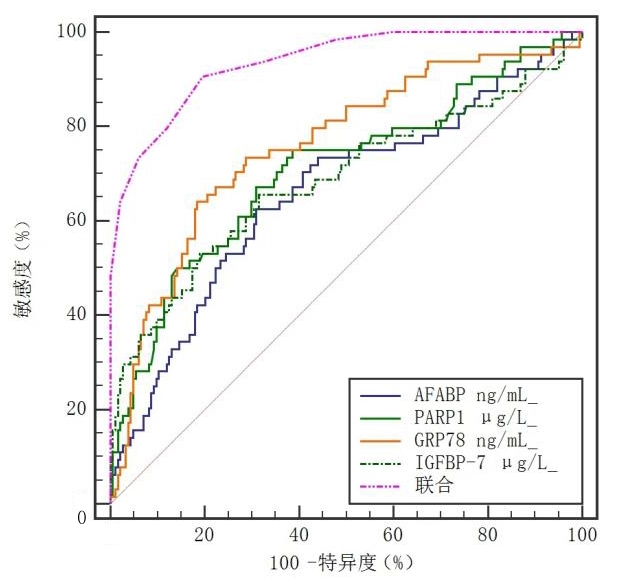
| 联合 | 90.62 | 80.43 | 0.936 | 0.898 ~ 0.963 | 12.00 | < 0.001 |
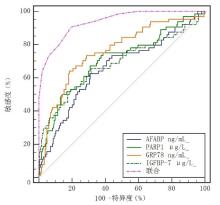
Fig.1
ROC curve of the predictive efficacy of combined detection of serum AFABP, PARP1, GRP78 and IGFBP-7 levels for poor prognosis in patients with CHF"
| [1] |
CIUCA-PANĂ M A, BOULMPOU A, ILERI C, et al. Chronic Heart Failure and Coronary Artery Disease: Pharmacological Treatment and Cardiac Rehabilitation[J]. Med,2025, 61(2): 211. doi: 10.3390/medicina61020211 .
doi: 10.3390/medicina61020211 |
| [2] |
POWRÓZEK T, SKWAREK-DZIEKANOWSKA A, SOBIESZEK G, et al. Correlation between Neutrophil-to-Lymphocyte Ratio, Platelets-to-Lymphocyte Ratio, C-Reactive Protein-to-Albumin Ratio and Clinical Picture of Elderly Chronic Heart Failure Patients[J]. J Clin Med, 2024, 13(2): 433. doi: 10.3390/jcm13020433 .
doi: 10.3390/jcm13020433 |
| [3] |
HEIDENREICH P A, BOZKURT B, AGUILAR D, et al. 2022 AHA/ACC/HFSA Guideline for the Management of Heart Failure: A Report of the American College of Cardiology/American Heart Association Joint Committee on Clinical Practice Guidelines[J]. Circ,2022, 145(18): 895-1032. doi: 10.1161/CIR.0000000000001063 .
doi: 10.1161/CIR.0000000000001063 |
| [4] |
LI N, HAN J X. Research progress of mhr, rdw, d-dimer/fib and vascular endothelial function in chronic heart failure[J]. Clin Med Insights Cardiol, 2022, 12(6): 843-850. doi: 10.12677/acm.2022.126843 .
doi: 10.12677/acm.2022.126843 |
| [5] |
LI B, ZAMZAM A, SYED M H, et al. Fatty acid binding protein 4 has prognostic value in peripheral artery disease[J]. J Vasc Surg, 2023, 78(3): 719-726. doi: 10.1016/j.jvs.2023.03.096 .
doi: 10.1016/j.jvs.2023.03.096 |
| [6] |
SHU J, YAN S, JU C, et al. PARP1 Promotes Heart Regeneration and Cardiomyocyte Proliferation[J]. Int J Biol Sci, 2024, 20(5): 1602-1616. doi: 10.7150/ijbs.85526 .
doi: 10.7150/ijbs.85526 |
| [7] |
SHI C, ZHANG Q, LI Y, et al. Polyethylene glycol loxenatide protects diabetic kidneys by inhibiting GRP78/PERK/eIF2alpha pathway, and improves cardiac injury by suppressing TLR4/NF-kappaB inflammatory pathway[J]. BMC Cardiovasc Disord,2024, 24(1): 704. doi: 10.1186/s12872-024-04427-4 .
doi: 10.1186/s12872-024-04427-4 |
| [8] |
ADAMSON C, WELSH P, DOCHERTY K F, et al. IGFBP-7 and Outcomes in Heart Failure With Reduced Ejection Fraction: Findings From DAPA-HF[J]. JACC Heart Fail, 2023, 11(3): 291-304. doi: 10.1016/j.jchf.2022.09.004 .
doi: 10.1016/j.jchf.2022.09.004 |
| [9] |
NAHLER M P G. New york heart association classification (NYHA)[M]. Vienna: Springer Verlag, 2009: 143-149. doi: 10.1007/978-3-211-89836-9_911 .
doi: 10.1007/978-3-211-89836-9_911 |
| [10] |
MCDONAGH T A, METRA M, ADAMO M, et al. 2021 ESC guidelines for the diagnosis and treatment of acute and chronic heart failure[J]. Eur Heart J, 2021, 42(36): 3599-3726.doi:10.1093/eurjhf/hfn030 .
doi: 10.1093/eurjhf/hfn030 |
| [11] |
中华医学会, 中华医学会杂志社, 中华医学会全科医学分会, 等. 慢性心力衰竭基层诊疗指南(2019 年)[J]. 中华全科医师杂志, 2019, 18(10): 936-947. doi: 10.3760/cma.j.issn.1671-7368.2019.10.008 .
doi: 10.3760/cma.j.issn.1671-7368.2019.10.008 |
| [12] |
ADAMO M, CHIONCEL O, PAGNESI M, et al. Epidemiology, pathophysiology, diagnosis and management of chronic right-sided heart failure and tricuspid regurgitation. A clinical consensus statement of the Heart Failure Association (HFA) and the European Association of Percutaneous Cardiovascular Interventions (EAPCI) of the ESC[J]. Eur J Heart Fail,2024,26(1):18-33. doi: 10.1002/ejhf.3106 .
doi: 10.1002/ejhf.3106 |
| [13] |
MASCOLO A, DI MAURO G, CAPPETTA D, et al. Current and future therapeutic perspective in chronic heart failure[J]. Pharmacol Res,2022,175:106035. doi: 10.1016/j.phrs.2021.106035 .
doi: 10.1016/j.phrs.2021.106035 |
| [14] |
WANG C, GE J B, ZHANG Y, et al. Multidisciplinary management of chronic heart failure complicated with chronic obstructive pulmonary disease: an expert consensus[J]. Chest, 2025, 168(6): 2215-2228. doi: 10.1164/rccm.202407-1320ST .
doi: 10.1164/rccm.202407-1320ST |
| [15] |
SACCO S, PONIKOWSKI P, VOORS A A, et al. Quadruple therapy for chronic heart failure: Updated evidence and clinical practice recommendations[J]. Eur Heart J, 2024, 45(32): 2890-2901. doi: 10.1002/ehf2.14857 .
doi: 10.1002/ehf2.14857 |
| [16] |
季润青, 张丽华, 黄星荷, 等. 不同左心室射血分数心力衰竭住院患者的临床特征,诊疗情况及结局差异[J]. 中国循环杂志, 2021, 36(8): 769-774. doi: 10.3969/j.issn.1000-3614.2021.08.007 .
doi: 10.3969/j.issn.1000-3614.2021.08.007 |
| [17] |
DUBIN R F, DEO R, REN Y, et al. Investigators. Incident heart failure in chronic kidney disease: Proteomics informs biology and risk stratification[J]. Eur Heart J, 2024, 45(30): 2752-2767. doi: 10.1093/eurheartj/ehae288 .
doi: 10.1093/eurheartj/ehae288 |
| [18] |
杨凯同, 和丽丽, 左庆娟, 等. 慢性心力衰竭患者血清脯氨酸脱氢酶水平与左心收缩功能的关联性分析[J]. 吉林大学学报(医学版), 2024, 50(6): 1719-1727. doi: 10.13481/j.1671-587X.20240626 .
doi: 10.13481/j.1671-587X.20240626 |
| [19] |
LIU X, CHEN L, YANG H, et al. Novel biomarkers for prognosis assessment in chronic heart failure: a systematic review and meta-analysis[J]. J Card Fail, 2023, 29(8): 1123-1135. doi: 10.1186/s12872-025-04704-w .
doi: 10.1186/s12872-025-04704-w |
| [20] |
LEE C H, KAN A K C, LUI D T W, et al. Prospective association of serum adipocyte fatty acid-binding protein with heart failure hospitalization in diabetes[J]. ESC Heart Fail, 2021, 8(5): 3964-3974. doi: 10.1007/s00395-022-00925-8 .
doi: 10.1007/s00395-022-00925-8 |
| [21] |
WANG Z, QIU Z, HUA S, et al. Nuclear Tkt promotes ischemic heart failure via the cleaved Parp1/Aif axis[J]. Basic Res Cardiol, 2022, 117(1): 18. doi: 10.1016/j.heliyon.2023.e13436 .
doi: 10.1016/j.heliyon.2023.e13436 |
| [22] |
ZHAO X, ZHANG D Q, SONG R, et al. The clinical significance of circulating glucose-regulated protein 78, Caspase-3, and C/EBP homologous protein levels in patients with heart failure[J]. Heliyon, 2023, 9(2): 13436. doi: 10.1016/j.heliyon.2023.e13436 .
doi: 10.1016/j.heliyon.2023.e13436 |
| [23] |
FERREIRA J P, PACKER M, SATTAR N, et al. Insulin-like growth factor binding protein-7 concentrations in chronic heart failure: Results from the EMPEROR programme[J]. Eur J Heart Fail, 2024, 26(4): 806-816. doi: 10.1002/ejhf.3227 .
doi: 10.1002/ejhf.3227 |
| [24] |
TAN E S J, CHAN S P, CHOI Y C, et al. Regional handling and prognostic performance of circulating insulin-like growth factor binding protein-7 in heart failure[J]. JACC Heart Fail, 2023, 11(6): 662-674. doi: 10.1016/j.jchf.2023.01.016 .
doi: 10.1016/j.jchf.2023.01.016 |
| [25] |
PANICHELLA G, TOMASONI D, AIMO A, et al. Insulin-like growth factor binding protein-7 in heart failure: The challenge of moving from risk prediction to a biomarker-guided management[J]. Eur J Heart Fail, 2024, 26(8): 1827-1829. doi: 10.1002/ejhf.3287 .
doi: 10.1002/ejhf.3287 |
| [26] |
YAMASHITA S, BU X, ISHIWATA-ENDO H, et al. A PARP inhibitor, rucaparib, improves cardiac dysfunction in ADP-ribose-acceptor hydrolase 3 (Arh3) deficiency[J]. BioRxiv, 2023, 7(1): 2023. doi: 10.1101/2023.02.07.527369 .
doi: 10.1101/2023.02.07.527369 |
| [27] |
徐亚萍, 单燕, 陆秋英, 等. 血清Ang-2, PARP1,hs-CRP/PAB比值在老年心力衰竭并发心律失常患者中的变化及与预后的关系[J]. 哈尔滨医科大学学报, 2025, 3(59): 294-299. doi: 10.20010/j.issn.1000-1905.2025.03.0294 .
doi: 10.20010/j.issn.1000-1905.2025.03.0294 |
| Viewed | ||||||
|
Full text |
|
|||||
|
Abstract |
|
|||||
