

The Journal of Practical Medicine ›› 2025, Vol. 41 ›› Issue (23): 3717-3722.doi: 10.3969/j.issn.1006-5725.2025.23.013
• Clinical Research • Previous Articles
Wei WEI1,Shanhong OUYANG1,Xiaojing. HU2( )
)
Received:2025-08-04
Online:2025-12-10
Published:2025-12-18
Contact:
Xiaojing. HU
E-mail:humama2015@126.com
CLC Number:
Wei WEI,Shanhong OUYANG,Xiaojing. HU. Early prognostic prediction study for critically ill neonates based on dynamic changes in perfusion index[J]. The Journal of Practical Medicine, 2025, 41(23): 3717-3722.
Tab.1
General information of newborns"
| 组别 | 例数 | 胎龄/周 | 出生体质量/kg | 性别/例 | 分娩方式/例 | ||
|---|---|---|---|---|---|---|---|
| 男 | 女 | 阴道分娩 | 剖宫产 | ||||
| 健康组 | 100 | 39.36 ± 1.11 | 3.26 ± 0.28 | 52 | 48 | 55 | 45 |
| 低危重组 | 44 | 39.32 ± 1.02 | 3.20 ± 0.25 | 24 | 20 | 21 | 23 |
| 中危重组 | 61 | 39.24 ± 1.07 | 3.22 ± 0.29 | 29 | 32 | 25 | 36 |
| 高危重组 | 37 | 39.28 ± 1.10 | 3.17 ± 0.24 | 20 | 17 | 16 | 21 |
| F/χ2 值 | 0.167 | 1.190 | 0.651 | 4.680 | |||
| P值 | 0.919 | 0.314 | 0.885 | 0.197 | |||
Tab.2
Comparison of PI values of newborns in each group 6 to 72 hours after birth"
| 组别 | 例数 | 6 h | 18 h | 24 h | 48 h | 72 h | F值 | P值 |
|---|---|---|---|---|---|---|---|---|
| 健康组 | 100 | 2.61 ± 0.32 | 2.77 ± 0.39 | 2.86 ± 0.47 | 3.09 ± 0.74 | 3.31 ± 0.82 | 22.334 | < 0.001 |
| 低危重组 | 44 | 1.21 ± 0.23 | 1.45 ± 0.27 | 1.59 ± 0.26 | 1.87 ± 0.32 | 2.13 ± 0.54 | 48.307 | < 0.001 |
| 中危重组 | 61 | 0.94 ± 0.18 | 1.17 ± 0.21 | 1.30 ± 0.21 | 1.61 ± 0.28 | 1.89 ± 0.35 | 132.113 | < 0.001 |
| 高危重组 | 37 | 0.61 ± 0.14 | 0.89 ± 0.15 | 1.00 ± 0.19 | 1.25 ± 0.20 | 1.63 ± 0.30 | 132.096 | < 0.001 |
| F值 | 902.514 | 564.238 | 407.873 | 169.751 | 108.139 | |||
| P值 | < 0.001 | < 0.001 | < 0.001 | < 0.001 | < 0.001 |
Tab.3
Correlation analysis of neonatal severity and PI value"
| 指标 | 危重程度 | |
|---|---|---|
| r值 | P值 | |
| 6 h PI值 | -0.428 | < 0.001 |
| 18 h PI值 | -0.406 | < 0.001 |
| 24 h PI值 | -0.403 | < 0.001 |
| 48 h PI值 | -0.393 | < 0.001 |
| 72 h PI值 | -0.389 | < 0.001 |
Tab.4
Comparison of PI values of different prognosis newborns at 6 ~ 72 hours"
| 组别 | 例数 | 6 h | 18 h | 24 h | 48 h | 72 h | F值 | P值 |
|---|---|---|---|---|---|---|---|---|
| 预后良好组 | 104 | 0.98 ± 0.17 | 1.24 ± 0.22 | 1.37 ± 0.20 | 1.69 ± 0.34 | 1.99 ± 0.31 | 245.239 | < 0.001 |
| 预后不良组 | 38 | 0.82 ± 0.15 | 1.03 ± 0.18 | 1.15 ± 0.25 | 1.35 ± 0.21 | 1.64 ± 0.27 | 79.413 | < 0.001 |
| t值 | 5.117 | 5.271 | 5.415 | 5.767 | 6.156 | |||
| P值 | < 0.001 | < 0.001 | < 0.001 | < 0.001 | < 0.001 |
Tab.5
Correlation analysis of prognosis of critically Ill newborns and PI value"
| 指标 | β | SE | Waldχ2 | P值 | OR值(95%置信区间) |
|---|---|---|---|---|---|
| 6 h PI值 | -0.163 | 0.074 | 4.852 | 0.028 | 0.850(0.735 ~ 0.982) |
| 18 h PI值 | -0.168 | 0.069 | 5.928 | 0.015 | 0.845(0.738 ~ 0.968) |
| 24 h PI值 | -0.160 | 0.077 | 4.318 | 0.038 | 0.852(0.733 ~ 0.991) |
| 48 h PI值 | -0.174 | 0.081 | 4.615 | 0.032 | 0.840(0.717 ~ 0.985) |
| 72 h PI值 | -0.177 | 0.072 | 6.043 | 0.014 | 0.838(0.728 ~ 0.965) |
Tab.6
ROC curve analysis of the value of PI index in predicting poor prognosis in critically Ill neonates"
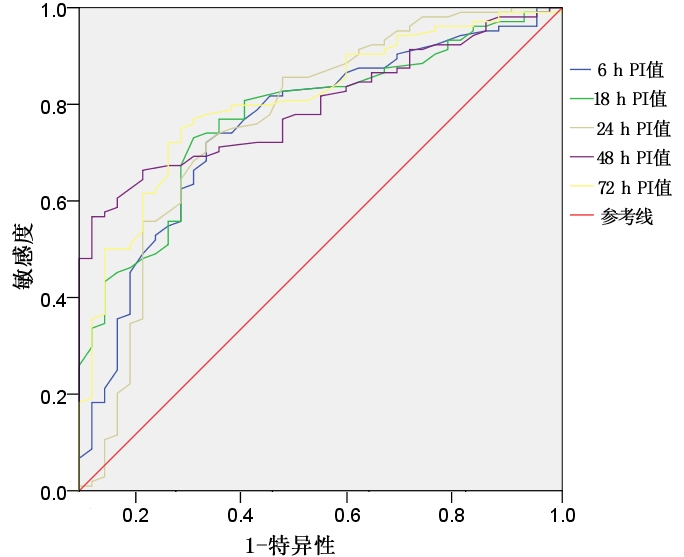
| 因素 | AUC | SE | P值 | 截断值 | 敏感度 | 特异度 | 95%CI | 约登指数 |
|---|---|---|---|---|---|---|---|---|
| 6 h PI值 | 0.760 | 0.045 | < 0.001 | 0.88 | 0.721 | 0.736 | 0.681 ~ 0.827 | 0.458 |
| 18 h PI值 | 0.779 | 0.041 | < 0.001 | 1.12 | 0.731 | 0.763 | 0.701 ~ 0.844 | 0.494 |
| 24 h PI值 | 0.768 | 0.049 | < 0.001 | 1.25 | 0.721 | 0.737 | 0.689 ~ 0.834 | 0.458 |
| 48 h PI值 | 0.797 | 0.036 | < 0.001 | 1.65 | 0.567 | 0.974 | 0.721 ~ 0.860 | 0.541 |
| 72 h PI值 | 0.808 | 0.039 | < 0.001 | 1.82 | 0.750 | 0.790 | 0.733 ~ 0.869 | 0.540 |
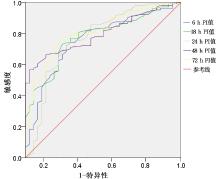
Fig.1
ROC curve analysis of the value of PI index in predicting poor prognosis of critically ill newborns"
| [1] | MANDALA V K, MENDU S B, BOLLABOINA S K Y, et al. Role of Perfusion Index and Pulse Variability Index in the Assessment of Neonatal Hemodynamics: A Systematic Review[J]. Cureus, 2023, 15(10): e48058. |
| [2] |
GUO Q, LIAN H, WANG G, et al. Prospective Evaluation of the Peripheral Perfusion Index in Assessing the Organ Dysfunction and Prognosis of Adult Patients With Sepsis in the ICU[J]. J Intensive Care Med, 2024, 39(11): 1109-1119. doi:10.1177/08850666241252758
doi: 10.1177/08850666241252758 |
| [3] | ZHAO Q M, CHEN H Y, LI S X, et al. Trajectories of oxygen saturation within 6-72 hours after birth in neonates at moderate altitude: A prospective longitudinal cohort study[J]. World J Pediatr, 2023, 19(9): 894-901. |
| [4] |
ARGUN M, SUNKAK S, ELMALI F, et al. Perfusion index in newborns with CHD without clinical signs of hypoperfusion and heart failure: Comparison with healthy newborns[J]. Cardiol Young, 2023, 33(7): 1092-1096. doi:10.1017/s1047951123002469
doi: 10.1017/s1047951123002469 |
| [5] |
SAINI S S, SHRIVASTAV A K, SUNDARAM V, et al. Role of perfusion index and plethysmography variability index for predicting outcomes in neonatal sepsis[J]. Acta Paediatr, 2023, 112(9): 1884-1891. doi:10.1111/apa.16856
doi: 10.1111/apa.16856 |
| [6] |
ANNE RP, SUNDARAM V, KUMAR P. Change in Score for Neonatal Acute Physiology-Ⅱ Measurements for Prediction of Mortality in Severely Septic Preterm Neonates[J]. Indian J Pediatr, 2023, 90(4): 348-354. doi:10.1007/s12098-022-04190-4
doi: 10.1007/s12098-022-04190-4 |
| [7] | FUJIYOSHI J, INOUE H, SAWANO T, et al. Critical diseases in neonates after discharge home from birth hospital: A retrospective study from a tertiary hospital in Japan[J]. Early Hum Dev, 2023, 18(6): 105869. |
| [8] |
COUTROT M, DUDOIGNON E, JOACHIM J, et al. Perfusion index: Physical principles, physiological meanings and clinical implications in anaesthesia and critical care[J]. Anaesth Crit Care Pain Med, 2021, 40(6): 100964. doi:10.1016/j.accpm.2021.100964
doi: 10.1016/j.accpm.2021.100964 |
| [9] |
LIN W T, ZHANG Y J, YAN M K, et al. The role of the tissue perfusion index in predicting disease severity and prognosis in patients with severe and critical COVID-19[J]. J Intensive Care Med, 2024, 39(12): 1212-1220. doi:10.1177/08850666241253162
doi: 10.1177/08850666241253162 |
| [10] |
SUN X, HE H, XU M, et al. Peripheral perfusion index of pulse oximetry in adult patients: A narrative review[J]. Eur J Med Res, 2024, 29(1): 457. doi:10.1186/s40001-024-02048-3
doi: 10.1186/s40001-024-02048-3 |
| [11] |
JIANG S L, ZHAN Y J, YAN P, et al. Pulse Oximetry and Perfusion Index Screening for Congenital Heart Defects: A Systematic Review and Meta-analysis[J]. Am J Perinatol, 2023, 40(15): 1611-1617. doi:10.1055/s-0042-1748163
doi: 10.1055/s-0042-1748163 |
| [12] | ALAKAYA M, ARSLANKÖYLÜ A E. Evaluation of perfusion index in pediatric trauma patients[J]. Ulus Travma Acil Cerrahi Derg, 2022, 28(5): 593-598. |
| [13] | PERRONE S, GIORDANO M, DE BERNARDO G, et al. Peripheral Saturation and Perfusion Index on the First Day of Life Play a Role in Early Discharge of Healthy Term Newborns[J]. Int J Clin Pract, 2022, 29(4): 2887312. |
| [14] |
HUA W, NIU C, XUAN Y, et al. Peripheral perfusion index in well newborns at 6 to 72 h of life at different altitudes: A multi-center study in China[J]. Eur J Pediatr, 2023, 182(2): 907-915. doi:10.1007/s00431-022-04725-z
doi: 10.1007/s00431-022-04725-z |
| [15] |
HU X, NIU C, ZHENG R, et al. Changes in peripheral perfusion index within 72 h of life in a cohort of very low birth weight infants[J]. Chin Med J (Engl), 2022, 135(10): 1252-1254. doi:10.1097/cm9.0000000000002030
doi: 10.1097/cm9.0000000000002030 |
| [16] |
NASSER R A, JOSEPH S, POULOSE A A, et al. Validation of Peripheral Perfusion Index as a Noninvasive Screening Tool in Predicting Adverse Neonatal Outcome[J]. Ann Afr Med, 2025, 24(3): 598-603. doi:10.4103/aam.aam_101_24
doi: 10.4103/aam.aam_101_24 |
| [17] |
WANG W, YU X. Comment on: Value of peripheral perfusion index to predict acute limb ischaemia in newborns after peripheral artery cannulation[J]. J Clin Nurs, 2024, 33(7): 2801-2802. doi:10.1111/jocn.17108
doi: 10.1111/jocn.17108 |
| [18] |
NARAYANAN B J, RAO S V, KANDASAMY S. Peripheral Perfusion Index for Prediction of Fluid Responsiveness in Spontaneously Breathing Critically Ill Patients: A Prospective Observational Study[J]. Indian J Crit Care Med, 2025, 29(2): 151-154. doi:10.5005/jp-journals-10071-24898
doi: 10.5005/jp-journals-10071-24898 |
| [19] | 刘雪琴, 张卫星, 沈洁, 等. 早期新生儿灌注指数与疾病严重程度的相关性研究[J]. 中国小儿急救医学, 2022, 29(4): 288-291. |
| [20] | 陈小琴, 张卫星, 刘雪琴. 脉搏血氧灌注指数及脉搏灌注变异指数在指导危重新生儿撤离呼吸机中的应用[J]. 广东医学, 2022, 43(11): 1337-1340. |
| Viewed | ||||||
|
Full text |
|
|||||
|
Abstract |
|
|||||
