

The Journal of Practical Medicine ›› 2025, Vol. 41 ›› Issue (22): 3579-3584.doi: 10.3969/j.issn.1006-5725.2025.22.016
• Clinical Research • Previous Articles
Mei HUA1,Xiaolu ZHAI1,Chong TANG2,Ying CHEN1,Dian YIN1( )
)
Received:2025-09-18
Online:2025-11-25
Published:2025-11-26
Contact:
Dian YIN
E-mail:13862916086@163.com
CLC Number:
Mei HUA,Xiaolu ZHAI,Chong TANG,Ying CHEN,Dian YIN. Expression of serum microRNA⁃497 in patients with colorectal cancer and its diagnostic and prognostic values[J]. The Journal of Practical Medicine, 2025, 41(22): 3579-3584.

Tab.1
Comparison of serum miR-497 and CEA levels between the two groups"
| 组别 | 例数 | miR-497(相对表达量) | CEA/(ng/mL) | CA199/(U/mL) |
|---|---|---|---|---|
| 对照组 | 100 | 26.32 ± 8.53 | 1.86 ± 0.34 | 13.57 ± 3.56 |
| CRC组 | 122 | 9.54 ± 2.73 | 37.48 ± 10.61 | 61.35 ± 18.27 |
| t值 | 20.542 | 33.544 | 25.744 | |
| P值 | < 0.001 | < 0.001 | < 0.001 |
Tab.2
Comparison of serum miR-497 levels in CRC patients with different pathological features"
| 临床病理特征 | 例数 (n = 122) | miR-497 (相对表达量) | t值 | P值 |
|---|---|---|---|---|
| 年龄 | 1.315 | 0.191 | ||
| < 60岁 | 77 | 10.26 ± 3.24 | ||
| ≥ 60岁 | 45 | 9.51 ± 2.66 | ||
| 性别 | 0.852 | 0.396 | ||
| 男 | 69 | 10.08 ± 2.34 | ||
| 女 | 53 | 9.69 ± 2.71 | ||
| 肿瘤最大径 | 1.536 | 0.127 | ||
| < 5 cm | 54 | 10.38 ± 3.53 | ||
| ≥ 5 cm | 68 | 9.39 ± 2.87 | ||
| 肿瘤位置 | 1.709 | 0.090 | ||
| 左半结肠 | 68 | 10.05 ± 3.41 | ||
| 右半结肠 | 33 | 9.87 ± 2.73 | ||
| 直肠 | 21 | 9.92 ± 2.82 | ||
| TNM分期 | 4.844 | < 0.001 | ||
| Ⅱ期 | 88 | 11.06 ± 1.58 | ||
| Ⅲ期 | 34 | 8.83 ± 3.51 | ||
| 分化程度 | - | - | ||
| 低分化 | 122 | 8.81 ± 2.56 | ||
| 脉管浸润 | 1.764 | 0.080 | ||
| 是 | 65 | 9.48 ± 2.44 | ||
| 否 | 57 | 10.29 ± 2.63 | ||
| 神经浸润 | 1.467 | 0.145 | ||
| 是 | 61 | 9.51 ± 3.08 | ||
| 否 | 61 | 10.26 ± 2.54 | ||
| 淋巴结转移 | 9.584 | < 0.001 | ||
| 有 | 34 | 7.24 ± 2.59 | ||
| 无 | 88 | 12.53 ± 3.08 |
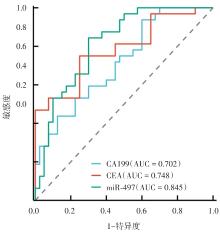
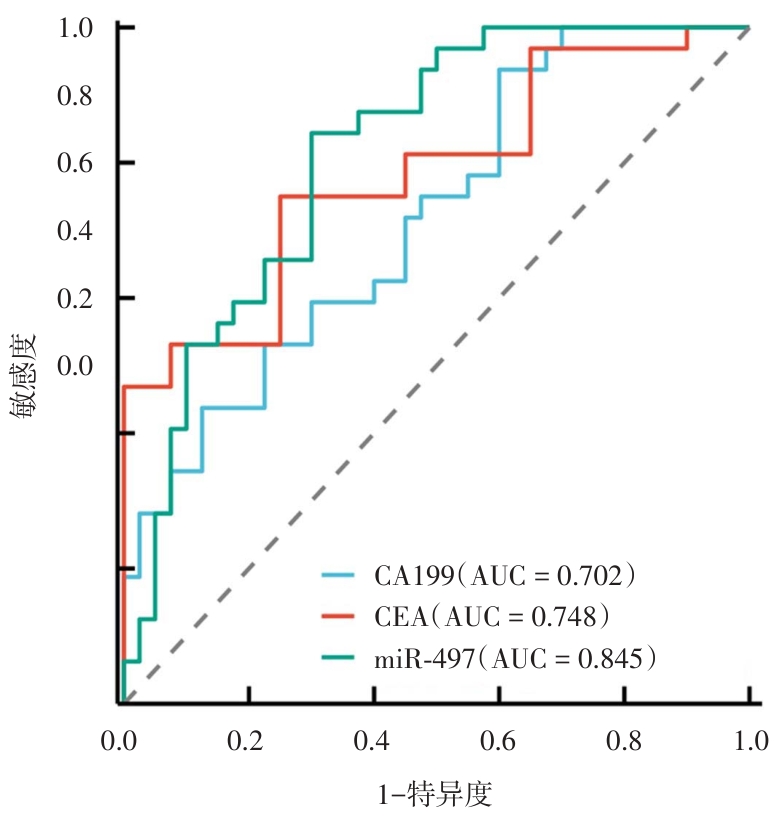
Fig.1
ROC curves of serum miR-497, CEA, and CA199 levels for diagnosing colorectal cancer"
Tab.3
Diagnostic efficacy of serum miR-497, CEA and CA199 levels for colorectal cancer"
| 指标 | AUC | 敏感度/% | 特异度/% | 截断值 | 95%CI |
|---|---|---|---|---|---|
| miR-497 | 0.845 | 84.37 | 74.53 | 18.06 | 0.729 ~ 0.919 |
| CEA | 0.748 | 67.73 | 70.89 | 21.70 | 0.633 ~ 0.864 |
| CA199 | 0.702 | 80.01 | 68.06 | 48.60 | 0.596 ~ 0.832 |
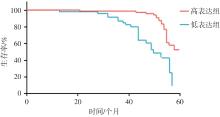
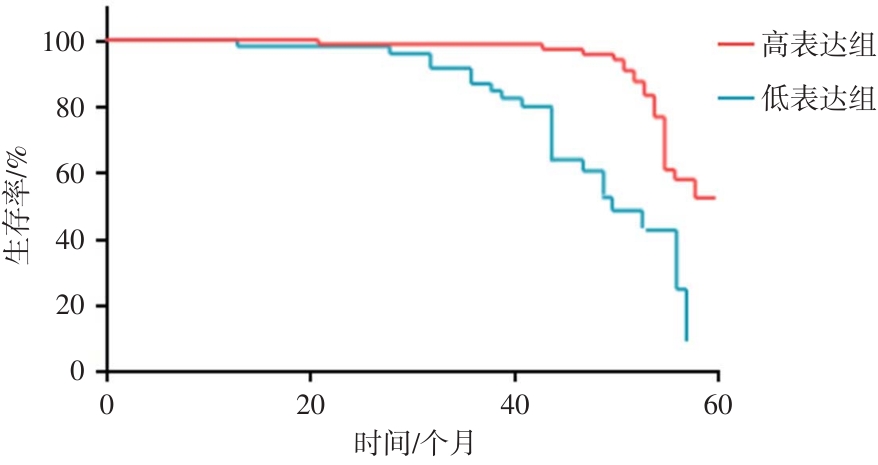
Fig.2
DFS comparison between the two groups 3 years after operation"
Tab.4
Cox risk regression analysis results for prognosis in CRC patients"
| 变量 | 单因素分析 | 多因素分析 | ||
|---|---|---|---|---|
| HR(95%CI) | P值 | HR(95%CI) | P值 | |
| miR-497低表达 | 2.280(1.412 ~ 3.681) | 0.001 | 1.923(1.184 ~ 3.125) | 0.008 |
| TNM分期 | 2.796(1.627 ~ 4.807) | < 0.001 | 2.511(1.421 ~ 4.437) | 0.002 |
| 淋巴结转移 | 2.143(1.295 ~ 3.547) | 0.003 | 1.753(1.151 ~ 2.664) | 0.011 |
| 神经浸润 | 1.732(1.020 ~ 2.942) | 0.042 | 1.289(0.751 ~ 2.213) | 0.353 |
| 年龄≥ 60岁 | 1.102(0.671 ~ 1.810) | 0.705 | - | - |
| 性别女 | 0.945(0.587 ~ 1.520) | 0.812 | - | - |
| 肿瘤最大径≥ 5 cm | 1.244(0.765 ~ 2.022) | 0.381 | - | - |
| 低分化 | 1.611(0.968 ~ 2.680) | 0.067 | - | - |
| [1] |
SHIN A E, GIANCOTTI F G, RUSTGI A K. Metastatic colorectal cancer: Mechanisms and emerging therapeutics[J]. Trends Pharmacol Sci, 2023, 44(4): 222-236. doi:10.1016/j.tips.2023.01.003
doi: 10.1016/j.tips.2023.01.003 |
| [2] | ROSHANDEL G, FERLAY J, GHANBARI-MOTLAGH A, et al. Cancer in Iran 2008 to 2025: Recent incidence trends and short-term predictions of the future burden[J]. Int J Cancer, 2021, 149(3): 594-605. |
| [3] |
IACUZZO C, GERMAN P, TROIAN M, et al. Serum carcinoembryonic antigen pre-operative level in colorectal cancer: Revisiting risk stratification[J]. ANZ J Surg, 2021, 91(6): E367-E374. doi:10.1111/ans.16861
doi: 10.1111/ans.16861 |
| [4] |
KAWAMURA H, HONDA M, TAKANO Y, et al. Prognostic Role of Carcinoembryonic Antigen and Carbohydrate Antigen 19-9 in Stage IV Colorectal Cancer[J]. Anticancer Res, 2022, 42(8): 3921-3928. doi:10.21873/anticanres.15886
doi: 10.21873/anticanres.15886 |
| [5] |
HUANG X, ZHU X, YU Y, et al. Dissecting miRNA signature in colorectal cancer progression and metastasis[J].Cancer Lett, 2021, 501: 66-82. doi:10.1016/j.canlet.2020.12.025
doi: 10.1016/j.canlet.2020.12.025 |
| [6] |
TIAN Y, CHEN Z H, WU P, et al. MIR497HG-Derived miR-195 and miR-497 Mediate Tamoxifen Resistance via PI3K/AKT Signaling in Breast Cancer[J]. Adv Sci (Weinh), 2023, 10(12): e2204819. doi:10.1002/advs.202204819
doi: 10.1002/advs.202204819 |
| [7] |
HSU X R, WU J E, WU Y Y, et al. Exosomal long noncoding RNA MLETA1 promotes tumor progression and metastasis by regulating the miR-186-5p/EGFR and miR-497-5p/IGF1R axes in non-small cell lung cancer[J]. J Exp Clin Cancer Res, 2023, 42(1): 283-288. doi:10.1186/s13046-023-02859-y
doi: 10.1186/s13046-023-02859-y |
| [8] |
CHEN X, ZHOU L, HAN Y, et al. miR-497-5p Expression and Biological Activity in Gastric Cancer[J]. J Cancer, 2024, 15(12): 3995-4006. doi:10.7150/jca.90087
doi: 10.7150/jca.90087 |
| [9] |
HUANG L, DING W, WU H, et al. miR-497/195 Cluster Affects the Development of Colorectal Cancer by Targeting FRA1[J]. Mol Biotechnol, 2024, 66(5): 1019-1030. doi:10.1007/s12033-023-01000-w
doi: 10.1007/s12033-023-01000-w |
| [10] | 秦新裕, 许剑民, 任黎,等. 2018版 《中国结直肠癌肝转移诊断和综合治疗指南》解读[J]. 临床外科杂志, 2019, 27(1): 9-13. |
| [11] | 杨潇, 王涛, 王伟, 等. 结直肠癌患者的血清脂质组学特点及其诊断价值[J].实用医学杂志, 2025, 41(11): 1742-1750. |
| [12] | 吴娜, 张泽天, 王锐. B7族同源体3、过氧化物酶1、硫氧还蛋白在溃疡性结肠炎及其相关性结直肠癌患者血清和组织中的表达及意义[J].实用医学杂志, 2025, 41(9):1407-1412. |
| [13] |
AISHAHRANI S H, Al-HADEITHI Z S M, ALMALKI S G,et al. LncRNA-miRNA interaction is involved in colorectal cancer pathogenesis by modulating diverse signaling pathways[J]. Pathol Res Pract, 2023,251:154898-154894. doi:10.1016/j.prp.2023.154898
doi: 10.1016/j.prp.2023.154898 |
| [14] |
MALKI M, GOLCHIN A, JAVADI S, et al.Role of exosomal miRNA in chemotherapy resistance of Colorectal cancer: A systematic review[J].Chem Biol Drug Des, 2023, 101(5): 1096-1112. doi:10.1111/cbdd.13947
doi: 10.1111/cbdd.13947 |
| [15] |
LIU Y, CHEN J. Expression Levels and Clinical Significance of Serum miR-497, CEA, CA24-2, and HBsAg in Patients with Colorectal Cancer[J]. Biomed Res Int, 2022, 2022(4): 3541403-3541408. doi:10.1155/2022/3541403
doi: 10.1155/2022/3541403 |
| [16] | 蔡蓉, 王上, 程福晴, 等. 基于CDK16/MYC探讨葛根芩连汤含药血清抑制糖酵解促进结直肠癌细胞5-FU敏感性的作用机制[J/OL]. 中国实验方剂学杂志, 1-12[2025-09-16]. . |
| [17] | 潘儒艳, 王月, 朱麒, 等. 血清总胆固醇、高密度脂蛋白和脂蛋白(a)对结直肠癌预后的临床意义[J]. 中国新药杂志,2025, 34(5): 494-497. |
| [18] | 徐妙文, 吴正, 曹小卫, 等. 基于AuNHs和酶剪切策略的SERS传感器高灵敏检测结直肠癌患者血清中的miR-21[J/OL].分析试验室, 1-14[2025-09-16]. . |
| [19] | 顾晶晶, 陈萍, 高婕, 等.贝伐珠单抗联合化疗对晚期结直肠癌血清肿瘤标志物及血清TGF-β1、Smad-3、Smad-7的影响[J]. 中国医院药学杂志, 2024, 44(24): 2904-2908. |
| [20] | 王万平, 任明君, 闭婉英, 等. Hsa_circ_0078607在结直肠癌组织及血清中的异常高表达及其临床意义[J]. 中国肿瘤生物治疗杂志, 2023, 30(10): 893-901. |
| [21] | 蒲艳. miR-497在乳腺癌进展中的作用机制研究及其对MAPK/ERK信号通路的调节影响[D]. 泸州:西南医科大学, 2019. |
| [22] |
GATTUSO G, LONGO F, SPOTO G,et al. Diagnostic and Prognostic Significance of a Four-miRNA Signature in Colorectal Cancer[J]. Int J Mol Sci, 2025, 26(3): 1219. doi:10.3390/ijms26031219
doi: 10.3390/ijms26031219 |
| [23] | LIU Y, CHEN J. Expression Levels and Clinical Significance of Serum miR-497, CEA, CA24-2, and HBsAg in Patients with Colorectal Cancer[J]. Biomed Res Int, 2022, 23(56): 354-358. |
| [24] |
SALEHI A M, TOROGI F, JALILIAN F A,et al. The Potential Role of Curcumin as a Regulator of microRNA in Colorectal Cancer: A Systematic Review[J]. Microrna, 2025, 14(1): 42-48. doi:10.2174/0122115366304114240904051429
doi: 10.2174/0122115366304114240904051429 |
| [25] | SONG M, LIU J. Circ_0067717 promotes colorectal cancer cell growth, invasion and glutamine metabolism by serving as a miR-497-5p sponge to upregulate SLC7A5[J]. Histol Histopathol, 2023, 38(1): 53-64. |
| [26] |
EIFIKY A M, EID M M, EL-MANAWATY M,et al. Production of novel theranostic nano-vector based on superparamagnetic iron oxide nanoparticles/miR-497 targeting colorectal cancer[J]. Sci Rep, 2025, 15(1): 4247. doi:10.1038/s41598-025-88165-3
doi: 10.1038/s41598-025-88165-3 |
| [27] |
KATTAN S W, HOBANI Y H, ABUBAKR BABTEEN N,et al. Association of B-cell lymphoma 2/microRNA-497 gene expression ratio score with metastasis in patients with colorectal cancer: A propensity-matched cohort analysis[J]. J Clin Lab Anal, 2022, 36(2): e24227. doi:10.1002/jcla.24227
doi: 10.1002/jcla.24227 |
| [28] |
HUANG L, DING W, WUI H,et al. miR-497/195 Cluster Affects the Development of Colorectal Cancer by Targeting FRA1[J]. Mol Biotechnol, 2024, 66(5): 1019-1030. doi:10.1007/s12033-023-01000-w
doi: 10.1007/s12033-023-01000-w |
| [29] |
WU H, DU J, HU P,et al. Kaempferol Induces DNA Damage in Colorectal Cancer Cells by Regulating the MiR-195/miR-497-PFKFB4-Mediated Nonoxidative Pentose Phosphate Pathway[J]. J Agric Food Chem, 2025, 73(14): 8312-8322. doi:10.1021/acs.jafc.4c13123
doi: 10.1021/acs.jafc.4c13123 |
| [30] | INTERNATION B R. Retracted: Expression Levels and Clinical Significance of Serum miR-497, CEA, CA24-2, and HBsAg in Patients with Colorectal Cancer[J]. Biomed Res Int, 2024, 24(75): 987-989. |
| Viewed | ||||||
|
Full text |
|
|||||
|
Abstract |
|
|||||
