实用医学杂志 ›› 2025, Vol. 41 ›› Issue (24): 3883-3890.doi: 10.3969/j.issn.1006-5725.2025.24.012

• 临床研究 • 上一篇    

大分割放疗联合免疫治疗对肺转移瘤患者预后的影响

张路1,何芬1,梁晓一1,刘小霞1,蓝茂英1,许文伟1,莫威1,孙建聪1,邹俊涛2()   

  1. 1.广州医科大学附属第一医院放疗科 (广东 广州 510145 )
    2.中山大学中山医学院人体解剖学教研室 ;(广东 广州 510080 )
  • 收稿日期:2025-10-17 出版日期:2025-12-25 发布日期:2025-12-25
  • 通讯作者: 邹俊涛 E-mail:zoujunt@mail.sysu.edu.cn
  • 基金资助:
    广东省自然科学基金项目(2022A1515010690);广东省科学技术协会项目(粤科协学〔2025〕2号);广东省科学技术协会项目(粤科协学〔2023〕22号);广东省振兴科技基金会项目(粤兴基金会〔2024〕42号);广东省振兴科技基金会项目(粤兴基金会〔2024〕24号);广州市科技局市校(院)联合资助项目(202201020436);广州市临床特色技术项目(2019TS28);广州市科技局基础研究计划市校(院)企联合资助项目(2024A03J1223)

Impact of hypofractionated radiotherapy combined with immunotherapy on the prognosis of patients with lung metastases

Lu ZHANG1,Fen HE1,Xiaoyi LIANG1,Xiaoxia LIU1,Maoying LAN1,Wenwei XU1,Wei MO1,Jiancong SUN1,Juntao. ZOU2()   

  1. *.Department of Radiation Oncology,the First Affiliated Hospital of Guangzhou Medical University,Guangzhou 510145,Guangdong,China
  • Received:2025-10-17 Online:2025-12-25 Published:2025-12-25
  • Contact: Juntao. ZOU E-mail:zoujunt@mail.sysu.edu.cn

摘要:

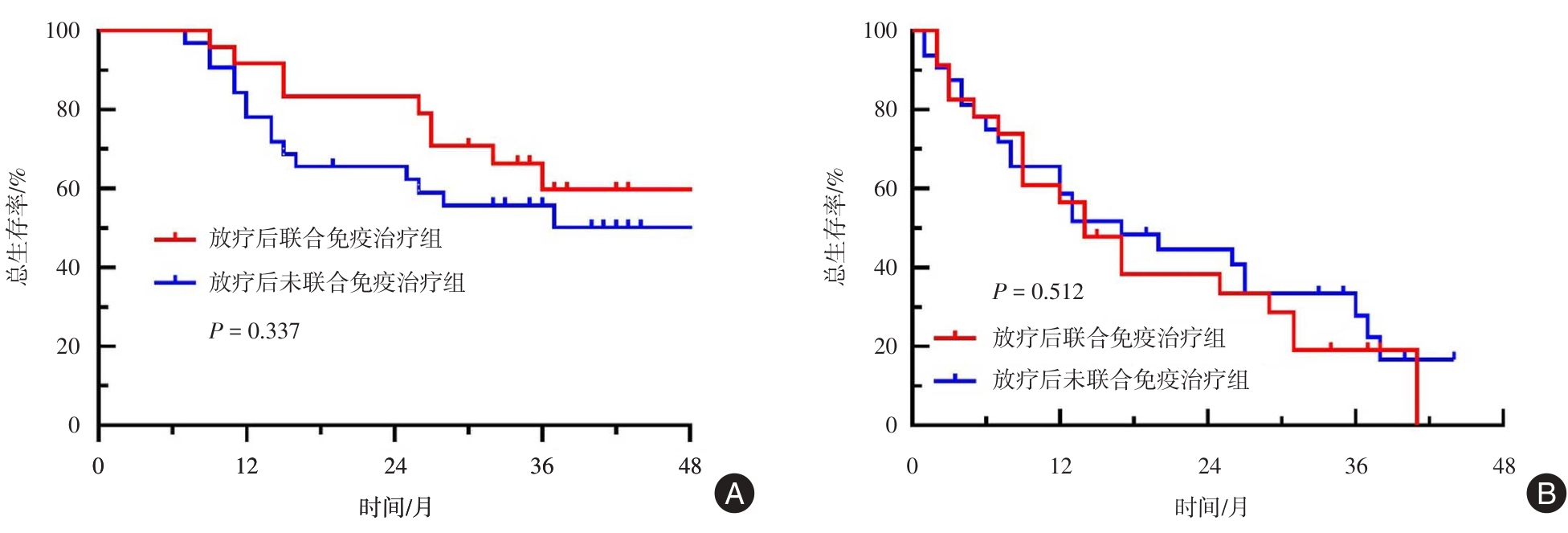
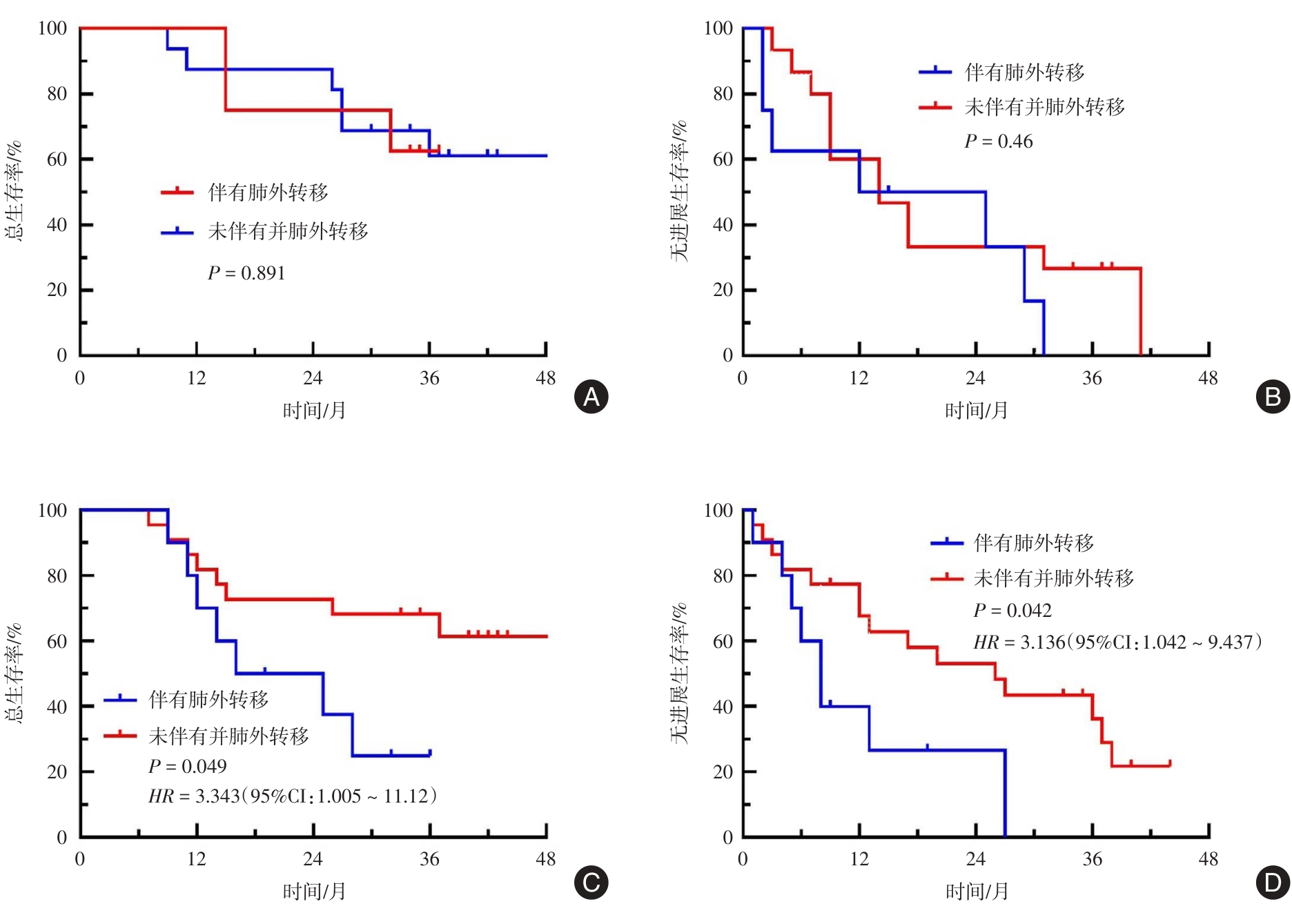
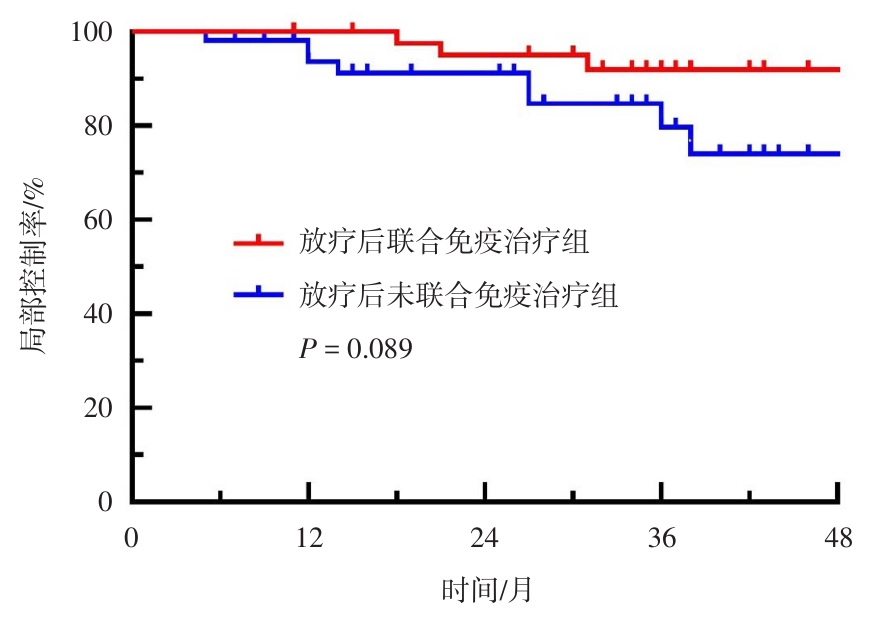
目的 评估大分割放疗或立体定向放射治疗(stereotactic body radiotherapy,SBRT)后联合免疫治疗对肺转移瘤患者生存的影响,并分析该联合治疗方案的疗效和安全性。 方法 回顾性纳入2021年1月至2023年1月在广州医科大学附属第一医院接受大分割放疗或SBRT治疗的56例不同病理类型肺转移瘤患者(共104个病灶)的临床资料。根据治疗策略,将患者分为大分割放疗或SBRT后联合免疫治疗组(n = 24)和大分割放疗或SBRT后未联合免疫治疗组(n = 32)。主要研究目的为总生存时间(overall survival,OS),次要研究目的包括无进展生存时间(progression-free survival,PFS),局部控制率(local control rate,LCR)和安全性。通过Kaplan-Meier和Cox回归模型进行生存分析,并探索伴有肺外转移在不同治疗策略下的预后价值。 结果 纳入患者原发肿瘤以肺癌(35/56,62.5%),消化系统(8/56,14.3%)和头颈肿瘤(6/56,10.7%)为主。至数据分析截止日(2025年7月31日),放疗后联合免疫治疗组的2年和3年OS高于未联合免疫治疗组,呈现生存获益趋势,但差异无统计学意义(2年OS:83.3% vs. 65.6%;3年OS:59.8% vs. 55.8%,P = 0.337)。探索性分析发现,在未联合免疫治疗组中,伴有肺外转移患者较仅肺转移瘤患者的生存期明显缩短,中位OS为16个月vs.未达到(HR = 3.343,95% CI:1.005~11.120,P = 0.049),中位PFS为8个月vs. 26个月(HR = 3.136,95% CI:1.042~9.437,P = 0.042)。而在联合免疫治疗组中,是否伴有肺外转移对OS(HR = 1.099,95% CI:0.268~4.496,P = 0.891)与PFS(HR = 1.525,95% CI:0.558~4.167,P = 0.46)均无显著影响。联合治疗组2年和3年LCR在数值上高于未联合免疫治疗组(2年:95% vs. 91.2%;3年:91.9% vs. 79.7%,P = 0.089)。治疗安全性良好,≥ 2级急性放射性肺炎(acute radiation pneumonitis, ARP)发生率为15.4%,无4级及以上ARP事件。 结论 大分割放疗或SBRT后联合免疫治疗显示出改善肺转移瘤患者生存的趋势,虽未达到统计学显著性,但是对伴有肺外转移的患者,采用该治疗模式能够获得与仅肺转移患者相当的生存预后。这一发现具有一定的临床启发意义,为晚期肺转移瘤的治疗策略优化提供了新思路。

关键词: 免疫治疗, 肺转移瘤, 肺外转移, 大分割放疗

Abstract:

Objective To evaluate the impact of combining immunotherapy with hypofractionated radiotherapy or stereotactic body radiotherapy (SBRT) on survival outcomes in patients with lung metastases, and to analyze the efficacy and safety of this combined treatment approach. Methods Clinical data from 56 patients (104 lesions) with various pathological types of lung metastases who received hypofractionated radiotherapy or SBRT at The First Affiliated Hospital of Guangzhou Medical University between January 2021 and January 2023 were retrospectively analyzed. According to treatment strategy, patients were categorized into two groups: The combination group (hypofractionated radiotherapy or SBRT followed by immunotherapy, n = 24) and the non-combination group (hypofractionated radiotherapy or SBRT without immunotherapy, n = 32). The primary endpoint was overall survival (OS), while secondary endpoints included progression-free survival (PFS), local control rate (LCR), and safety. Survival outcomes were evaluated using the Kaplan-Meier method and Cox proportional hazards regression models. Additionally, the prognostic impact of concurrent extrapulmonary metastases under different treatment strategies was assessed. Results The primary tumors in the included patients were predominantly lung cancer (35/56, 62.5%), followed by digestive system cancers (8/56, 14.3%) and head and neck cancers (6/56, 10.7%). As of the data cutoff date for analysis (July 31, 2025), the combination group demonstrated higher 2-year and 3-year overall survival (OS) rates compared to the non-combination group, indicating a trend toward improved survival; however, the difference did not reach statistical significance (2-year OS: 83.3% vs. 65.6%; 3-year OS: 59.8% vs. 55.8%; P = 0.337). In exploratory analyses, patients in the non-combination group with concurrent extrapulmonary metastases had significantly worse survival outcomes than those with pulmonary-only metastases, with a median OS of 16 months versus not reached (HR = 3.343, 95% CI: 1.005 ~ 11.120, P = 0.049) and a median progression-free survival (PFS) of 8 months versus 26 months (HR = 3.136, 95% CI: 1.042 ~ 9.437, P = 0.042). In contrast, in the combination group, the presence of extrapulmonary metastases did not significantly affect OS (HR = 1.099, 95% CI: 0.268 ~ 4.496, P = 0.891) or PFS (HR = 1.525, 95% CI: 0.558 ~ 4.167, P = 0.460). The 2-year and 3-year LCRs were numerically higher in the combination group compared to the non-combination group (2-year: 95% vs. 91.2%; 3-year: 91.9% vs. 79.7%, P = 0.089). Treatment was well tolerated, with a ≥ grade 2 acute radiation pneumonitis (ARP) incidence of 15.4%, and no grade 4 or higher ARP events were observed. Conclusions The combination of immunotherapy with hypofractionated radiotherapy or SBRT demonstrates a promising trend toward improved survival in patients with lung metastases. Notably, for patients who also have extrapulmonary metastases, this combined approach may yield survival outcomes comparable to those observed in patients with lung-limited disease alone. These findings offer valuable insights into optimizing treatment strategies for advanced-stage lung metastases.

Key words: immunotherapy, lung metastases, extrapulmonary metastases, hypofractionated radiotherapy

中图分类号: