

The Journal of Practical Medicine ›› 2026, Vol. 42 ›› Issue (12): 2223-2229.doi: 10.3969/j.issn.1006-5725.2026.12.018
• Chronic Disease Control • Previous Articles
Yukun SHEN,Weifeng ZHAO,Bo LI,Zhi PENG,Jingming HE( )
)
Received:2026-03-17
Online:2026-06-25
Published:2026-06-30
Contact:
Jingming HE
E-mail:hejingming_ok@163.com
CLC Number:
Yukun SHEN,Weifeng ZHAO,Bo LI,Zhi PENG,Jingming HE. Analysis of the application value of Zero-PVA versus CP in anterior cervical discectomy and fusion for single-level cervical spondylosis based on imaging indicators[J]. The Journal of Practical Medicine, 2026, 42(12): 2223-2229.
Tab.1
Comparison of operation time, bleeding volume, and length of hospital stay between two groups"
| 组别 | 手术时间/min | 术中出血量/mL | 住院时间/d |
|---|---|---|---|
| Zero-PVA组(n = 101) | 46.37 ± 7.40 | 32.14 ± 8.61 | 5.94 ± 1.20 |
| CP组(n = 103) | 48.19 ± 8.17 | 38.08 ± 9.33 | 6.39 ± 1.35 |
| t值 | 1.667 | 4.723 | 2.515 |
| P值 | 0.097 | < 0.001 | 0.013 |
Tab.2
Comparison of perioperative imaging indicators between two groups"
| 组别 | 颈椎前凸角/° | 融合节段高度/mm | ||||
|---|---|---|---|---|---|---|
| 术前 | 术后1周 | 术后3个月 | 术前 | 术后1周 | 术后3个月 | |
| Zero-PVA组(n = 101) | 13.40 ± 2.21 | 18.06 ± 3.54* | 17.15 ± 3.18* | 33.03 ± 4.16 | 36.82 ± 5.31* | 36.91 ± 5.07* |
| CP组(n = 103) | 14.36 ± 2.56 | 17.98 ± 3.63* | 17.03 ± 3.59* | 32.80 ± 3.75 | 36.95 ± 5.25* | 36.40 ± 5.19* |
| F值 | F组间 = 0.502,F时间 = 169.648,F组间·时间 = 0.593 | F组间 = 0.229,F时间 = 234.157,F组间·时间 = 0.214 | ||||
| P值 | P组间 = 0.661,P时间 < 0.001,P组间·时间 = 0.361 | P组间 = 0.846,P时间 < 0.001,P组间·时间 = 0.663 | ||||
| 组别 | 融合节段Cobb角/° | C2-7Cobb角/° | ||||
| 术前 | 术后1周 | 术后3个月 | 术前 | 术后1周 | 术后3个月 | |
| Zero-PVA组(n = 101) | 4.25 ± 0.28 | 7.87 ± 1.74*# | 6.72 ± 1.60*# | 11.89 ± 2.85 | 15.78 ± 3.57* | 15.32 ± 3.60* |
| CP组(n = 103) | 4.19 ± 0.31 | 6.05 ± 1.67* | 5.80 ± 1.52* | 12.02 ± 2.96 | 16.10 ± 3.64* | 16.04 ± 3.22* |
| F值 | F组间 = 68.339,F时间 = 267.641,F组间·时间 = 5.637 | F组间 = 0.502,F时间 = 169.648,F组间·时间 = 0.593 | ||||
| P值 | P组间 < 0.001,P时间 < 0.001,P组间·时间 < 0.001 | P组间 = 0.661,P时间 < 0.001,P组间·时间 = 0.361 | ||||

Fig.1
Images of a typical case 1"
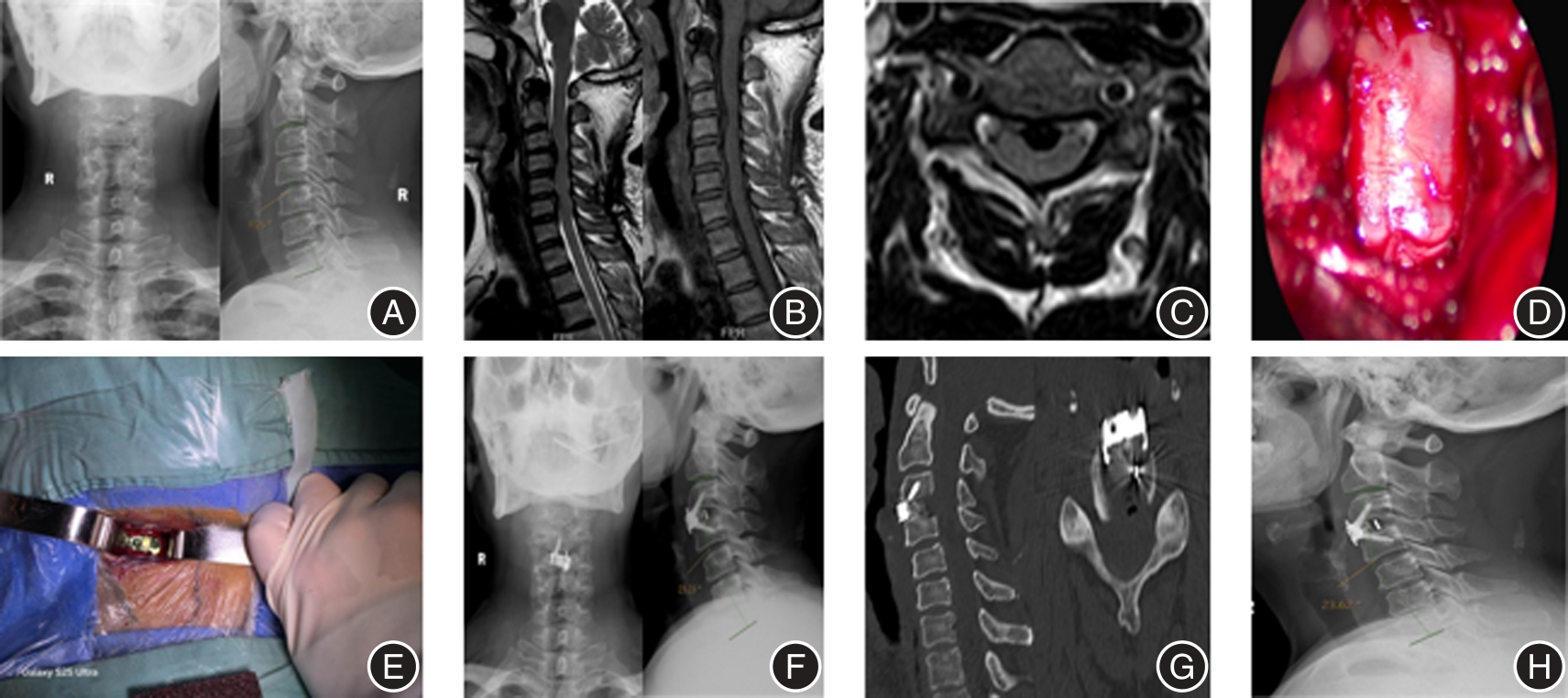
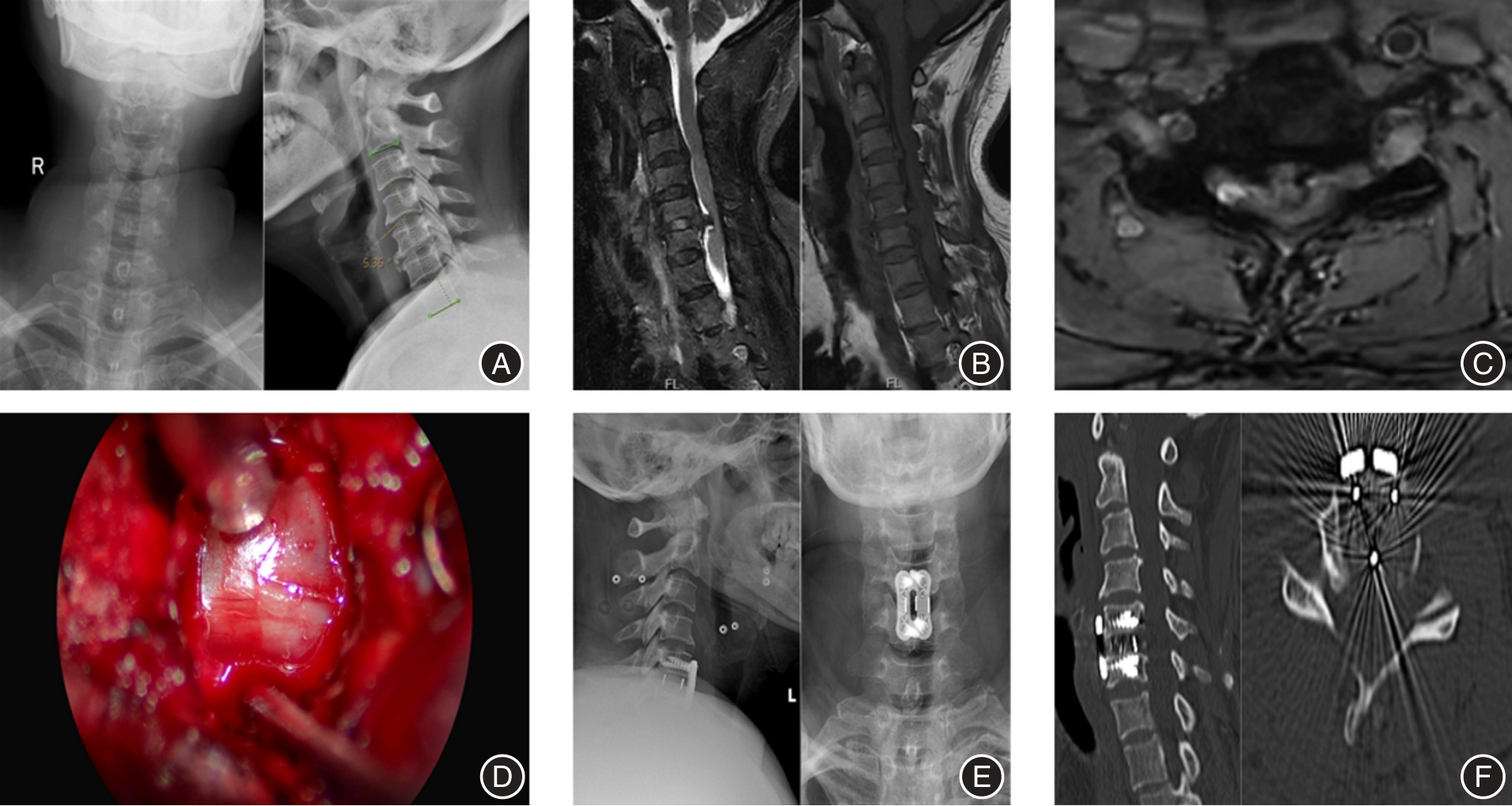
Fig.2
Images of a typical case 2"
Tab.3
Comparison of Bridwell grades of interbody fusion between two groups"
| 组别 | Ⅰ级 | Ⅱ级 | Ⅲ级 | Ⅳ级 |
|---|---|---|---|---|
| Zero-PVA组(n = 101) | 78(77.23) | 22(21.78) | 1(0.99) | 0(0.00) |
| CP组(n = 103) | 52(50.49) | 42(40.78) | 9(8.74) | 0(0.00) |
| Z值 | 17.097 | |||
| P值 | < 0.001 | |||
Tab.4
Comparison of JOA scores and NDI between two groups"
| 组别 | JOA评分 | NDI | ||
|---|---|---|---|---|
| 术前 | 术后3个月 | 术前 | 术后3个月 | |
| Zero-PVA组(n = 101) | 9.36 ± 2.60 | 13.37 ± 1.85* | 54.17 ± 14.63 | 22.69 ± 5.03* |
| CP组(n = 103) | 8.78 ± 2.49 | 13.01 ± 1.57* | 52.89 ± 15.01 | 23.24 ± 7.20* |
| t值 | 1.627 | 1.500 | 0.617 | 0.631 |
| P值 | 0.105 | 0.135 | 0.538 | 0.529 |
Tab.5
Comparison of complications between two groups"
| 组别 | 融合器沉降 | 邻近节段退变 | 吞咽困难 | 合计 |
|---|---|---|---|---|
| Zero-PVA组(n = 101) | 0(0.00) | 2(1.98) | 1(0.99) | 3(2.97) |
| CP组(n = 103) | 5(4.85) | 4(3.88) | 2(1.94) | 11(10.68) |
| χ2 值 | 4.742 | |||
| P值 | 0.029 |
| [1] |
GUO X, KOU S, YANG B, et al. Efficacy of Daiwenjiu ointment on the treatment of cervical spondylosis with nerve root type caused by cold dampness obstruction[J]. Int J Neurosci, 2025,135(6):665-672. doi: 10.1080/00207454.2024.2324026 .
doi: 10.1080/00207454.2024.2324026 |
| [2] |
LI P, LEI R, DING L, et al. Long-term Clinical Outcomes and Optimal Treatment Approaches of Degenerative Cervical Spondylosis: A 12-Year Multicenter Retrospective Cohort Study[J]. Spine (Phila Pa 1976), 2025,50(13):890-901.doi: 10.1097/BRS.0000000000005266 .
doi: 10.1097/BRS.0000000000005266 |
| [3] |
JIANG J, MA J, SU L, et al. Positioning and clinical application of the inflection point of the uncinate process in anterior cervical discectomy and fusion (ACDF): A retrospective study[J]. Eur Spine J, 2025,34(8):3314-3325. doi: 10.1007/s00586-025-09071-w .
doi: 10.1007/s00586-025-09071-w |
| [4] |
夏毕成,孙建广,黄世磊,等. 零切迹椎间融合器与独立和钛板椎间融合器联合对双节段跳跃型颈椎病的疗效比较[J]. 中华医学杂志,2022,102(19):1450-1457. doi:10.3760/cma.j.cn112137-20220128-00208 .
doi: 10.3760/cma.j.cn112137-20220128-00208 |
| [5] |
DERMAN P B, YUSUFBEKOV R, BRAAKSMA B. Device profile of the FlareHawk interbody fusion system, an endplate-conforming multi-planar expandable lumbar interbody fusion cage[J]. Expert Rev Med Devices, 2023,20(5):357-364. doi: 10.1080/17434440.2023.2198123 .
doi: 10.1080/17434440.2023.2198123 |
| [6] |
ZHU J, CUI Y, SHEN H, et al. Biomechanical performance of a novel zero-profile interbody cage: A cadaveric study[J]. PLoS One, 2025,20(4):e0317375. doi: 10.1371/journal.pone. 0317375 .
doi: 10.1371/journal.pone. 0317375 |
| [7] |
LI X F, JIN L Y, LIANG C G, et al. Adjacent-level biomechanics after single-level anterior cervical interbody fusion with anchored zero-profile spacer versus cage-plate construct: A finite element study[J]. BMC Surg, 2020,20(1):66. doi: 10.1186/s12893-020-00729-4 .
doi: 10.1186/s12893-020-00729-4 |
| [8] |
XIE Y, NIE Y, LUNDGREN J, et al. Cervical Spondylosis Diagnosis Based on Convolutional Neural Network with X-ray Images[J]. Sensors (Basel), 2024,24(11):3428.doi: 10.3390/s24113428 .
doi: 10.3390/s24113428 |
| [9] |
SON J I, LEE Y S, KO M J, et al. Effect of Mixture of Recombinant Human Bone Morphogenic Protein-2 and Demineralized Bone Matrix in Lateral Lumbar Interbody Fusion[J]. J Korean Neurosurg Soc, 2024,67(3):354-363. doi: 10.3340/jkns. 2023.0136 .
doi: 10.3340/jkns. 2023.0136 |
| [10] |
SHIN D A, LEE S H, OH S, et al. Probabilistic graphical modelling using Bayesian networks for predicting clinical outcome after posterior decompression in patients with degenerative cervical myelopathy[J]. Ann Med, 2023,55(1):2232999. doi: 10.1080/07853890.2023.2232999 .
doi: 10.1080/07853890.2023.2232999 |
| [11] |
JOHN B, RØE C, BROX J I, et al. Responsiveness and minimal important change of neck disability index and numeric pain rating scale for neck patients in the Norwegian neck and back register[J]. Eur Spine J, 2025,34(6):2219-2226.doi: 10.1007/s00586-025-08836-7 .
doi: 10.1007/s00586-025-08836-7 |
| [12] |
HAYASHI T, MURATA S, IWAHASHI H, et al. Efficacy of titanium-coated PEEK cages with two blades in anterior cervical decompression fixation: Bone fusion rates and surgical outcomes[J]. J Orthop Sci, 2025,30(6):1019-1025. doi: 10.1016/j.jos.2025.03.009 .
doi: 10.1016/j.jos.2025.03.009 |
| [13] |
NISHIDA N, JIANG F, ASANO T, et al. Effect of posterior decompression with and without fixation on a kyphotic cervical spine with ossification of the posterior longitudinal ligament[J]. Spinal Cord, 2023,61(2):133-138. doi: 10.1038/s41393-022-00857-z .
doi: 10.1038/s41393-022-00857-z |
| [14] |
BURKHARDT B W, KEROLUS M G, WITIW C D, et al. Anterior cervical discectomy and fusion with a dynamic translational plating versus a rigid carbon fiber reinforced PEEK plating system-a comparison study of radiographic parameters[J]. Br J Neurosurg, 2024,38(1):99-103. doi: 10.1080/02688697. 2021. 1976394 .
doi: 10.1080/02688697. 2021. 1976394 |
| [15] |
SCHOLZ M, SCHLEICHER P, PABST S, et al. A zero-profile anchored spacer in multilevel cervical anterior interbody fusion: Biomechanical comparison to established fixation techniques[J]. Spine (Phila Pa 1976), 2015,40(7):E375-E380. doi: 10.1097/BRS.0000000000000768 .
doi: 10.1097/BRS.0000000000000768 |
| [16] |
ZHANG J, WANG S, TANG X, et al. Clinical and radiological comparison of the zero-profile anchored cage and traditional cage-plate fixation in single-level anterior cervical discectomy and fusion[J]. Eur J Med Res, 2022,27(1):189.doi: 10.1186/s40001-022-00813-w .
doi: 10.1186/s40001-022-00813-w |
| [17] |
熊礼顺,谭菁华,尹健,等. 零切迹椎间融合器与椎间融合器联合钛板应用于颈椎前路椎间盘切除融合术的临床疗效和影像学分析[J]. 实用医学杂志,2024,40(22):3165-3171. doi:10.3969/j.issn.1006-5725.2024.22.008 .
doi: 10.3969/j.issn.1006-5725.2024.22.008 |
| [18] |
WANG A P, SLATER T D, RAFTERY K A, et al. Endplate preparation for anterior cervical discectomy and fusion: Does the amount of endplate removed affect cage subsidence risk[J]. Eur Spine J, 2025,34(8):3294-3303. doi: 10.1007/s00586-025-08997-5 .
doi: 10.1007/s00586-025-08997-5 |
| [19] |
刘启彬,吴亚伟,龙科含,等. 单节段颈椎减压融合个性化与成品零切迹融合器比较[J]. 中国矫形外科杂志,2025,33(2):124-130. doi:10.20184/j.cnki.Issn1005-8478.110075 .
doi: 10.20184/j.cnki.Issn1005-8478.110075 |
| [20] |
MILLER A K, ZAKKO P, PARK D K, et al. Cervical disc arthroplasty versus anterior cervical discectomy and fusion: An analysis of the Michigan Spine Surgery Improvement Collaborative Database[J]. Spine J, 2024,24(5):791-799. doi: 10.1016/j.spinee.2023.12.004 .
doi: 10.1016/j.spinee.2023.12.004 |
| [21] |
SINGH L, MULTANI K M, AGRAWAL N. Fusion Free Median Corpectomy-Long-Term Consequence of Foregoing Fusion and Fixation: A Serendipitous Observation[J]. Neurol India, 2024,72(6):1246-1253.doi: 10.4103/neurol-india.Neurol-India-D-24-00777 .
doi: 10.4103/neurol-india.Neurol-India-D-24-00777 |
| [22] |
AMBATI V S, MACKI M, CHAN A K, et al. Three-level ACDF versus 3-level laminectomy and fusion: Are there differences in outcomes? An analysis of the Quality Outcomes Database cervical spondylotic myelopathy cohort[J]. Neurosurg Focus, 2023,55(3):E2.doi: 10.3171/2023.6.FOCUS23295 .
doi: 10.3171/2023.6.FOCUS23295 |
| [23] |
PU H Y, WANG J Z, GUO J W, et al. Comparison of Hounsfield Unit Value and Vertebral Bone Quality Score in Predicting Cage Subsidence After Zero-P Fusion Surgery[J]. Orthopedics, 2025,48(6):e231-e237. doi: 10.3928/01477447-20250827-01 .
doi: 10.3928/01477447-20250827-01 |
| [24] |
WANG Z, CHEN Q, WANG J, et al. Reduced Forearm Bone Mineral Density Predicts Cage Subsidence After Anterior Cervical Discectomy and Fusion in Cervical Spondylosis[J]. World Neurosurg, 2025,201:124318.doi: 10.1016/j.wneu.2025.124318 .
doi: 10.1016/j.wneu.2025.124318 |
| [25] |
SINGH M, BALMACENO-CRISS M, ANDERSON G, et al. Anterior cervical discectomy and fusion versus cervical disc arthroplasty: An epidemiological review of 433,660 surgical patients from 2011 to 2021[J]. Spine J, 2024,24(8):1342-1351.doi: 10.1016/j.spinee.2024.02.016 .
doi: 10.1016/j.spinee.2024.02.016 |
| [26] |
MOLFENTER S M, AMIN M R, BALOU M, et al. A scoping review of the methods used to capture dysphagia after anterior cervical discectomy and fusion: The need for a paradigm shift[J]. Eur Spine J, 2023,32(3):969-976.doi: 10.1007/s00586-022-07515-1 .
doi: 10.1007/s00586-022-07515-1 |
| Viewed | ||||||
|
Full text |
|
|||||
|
Abstract |
|
|||||
