

The Journal of Practical Medicine ›› 2026, Vol. 42 ›› Issue (12): 2200-2207.doi: 10.3969/j.issn.1006-5725.2026.12.015
• Chronic Disease Control • Previous Articles
Zhisheng WU,Yang WU,Lina GUAN( )
)
Received:2026-02-25
Online:2026-06-25
Published:2026-06-30
Contact:
Lina GUAN
E-mail:sanjin_lsx@163.com
CLC Number:
Zhisheng WU,Yang WU,Lina GUAN. Analysis of influencing factors of atherosclerotic stenosis of the intracranial segment of the vertebral artery based on brain-carotid artery ultrasound parameters[J]. The Journal of Practical Medicine, 2026, 42(12): 2200-2207.
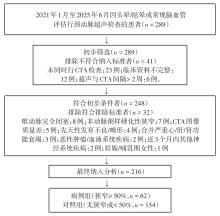
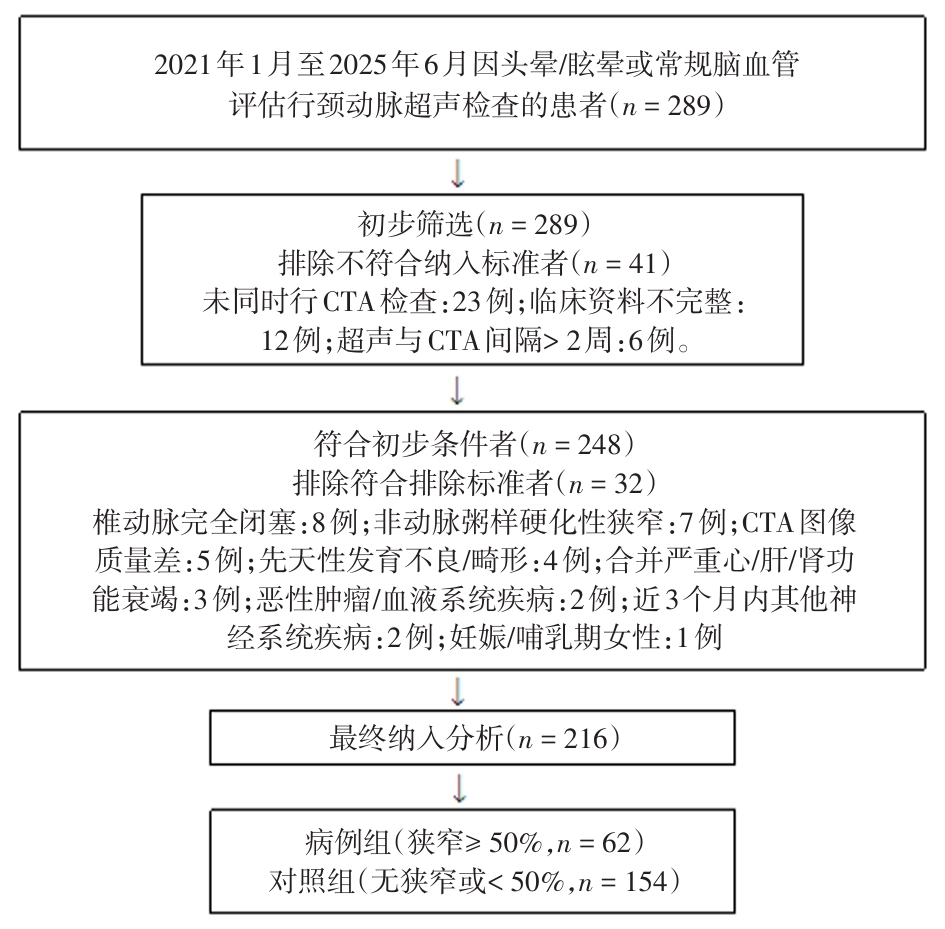
Fig 1
Flowchart of patient enrollment"

Tab.1
Comparison of two groups of hemodynamic parameters"
| 血流动力学参数 | 病例组(n = 62) | 对照组(n = 154) | t值 | P值 |
|---|---|---|---|---|
| 椎动脉管径/mm | 2.41 ± 0.58 | 3.50 ± 1.03 | 7.840 | < 0.001 |
| 椎动脉收缩期峰值流速/(cm/s) | 143.16 ± 37.52 | 56.84 ± 14.27 | 24.524 | < 0.001 |
| 椎动脉舒张末期流速/(cm/s) | 55.95 ± 9.05 | 23.04 ± 7.14 | 28.296 | < 0.001 |
| 阻力指数 | 0.61 ± 0.20 | 0.59 ± 0.16 | 0.774 | 0.441 |
Tab.2
Univariate analysis of atherosclerotic stenosis of the intracranial segment of the vertebral artery"
| 因素 | 病例组(n = 62) | 对照组(n = 154) | χ2/t值 | P值 |
|---|---|---|---|---|
| 年龄(x ± s)/岁 | 59.39 ± 4.27 | 58.78 ± 4.93 | 0.854 | 0.394 |
| 性别 | 0.189 | 0.664 | ||
| 男 | 41(66.13) | 97(62.99) | ||
| 女 | 21(33.87) | 57(37.01) | ||
| BMI(x ± s)/(kg/m2) | 23.54 ± 1.32 | 23.16 ± 1.75 | 1.541 | 0.125 |
| 吸烟史 | 31(50.00) | 53(34.42) | 4.517 | 0.034 |
| 饮酒史 | 33(53.23) | 80(51.95) | 0.029 | 0.865 |
| 总胆固醇(x ± s)/(mmol/L) | 5.11 ± 1.36 | 4.86 ± 1.25 | 1.296 | 0.196 |
| 甘油三酯(x ± s)/(mmol/L) | 1.52 ± 0.46 | 1.40 ± 0.45 | 1.762 | 0.080 |
| 高密度脂蛋白(x ± s)/(mmol/L) | 1.89 ± 0.53 | 2.00 ± 0.59 | 1.275 | 0.204 |
| 低密度脂蛋白(x ± s)/(mmol/L) | 2.96 ± 0.78 | 2.43 ± 0.73 | 4.732 | < 0.001 |
| 合并高血压 | 37(59.68) | 62(40.26) | 6.713 | 0.010 |
| 合并糖尿病 | 22(35.48) | 29(18.83) | 6.796 | 0.009 |
| 合并冠心病 | 27(43.55) | 60(38.96) | 0.387 | 0.534 |
| 斑块形态 | 10.983 | 0.001 | ||
| 偏心型 | 37(59.68) | 54(35.06) | ||
| 向心型 | 25(40.32) | 100(64.94) | ||
| 斑块负荷(x ± s)/% | 63.72 ± 21.23 | 9.84 ± 2.78 | 30.946 | < 0.001 |
Tab.3
The variable assignment table for atherosclerotic stenosis of the intracranial segment of the vertebral artery"
| 自变量 | 赋值方法 |
|---|---|
| 吸烟史 | 0=无,1=有 |
| 低密度脂蛋白/(mmol/L) | 原值输入 |
| 合并高血压 | 0=无,1=有 |
| 合并糖尿病 | 0=无,1=有 |
| 斑块形态 | 0=向心型,1=偏心型 |
| 斑块负荷 | 原值输入 |
Tab.4
Multivariate analysis of atherosclerotic stenosis of the intracranial segment of the vertebral artery"
| 影响因素 | β | SE | Waldχ2 | P值 | OR | 95%CI | VIF值 |
|---|---|---|---|---|---|---|---|
| 吸烟史 | 1.206 | 0.498 | 5.865 | 0.015 | 3.340 | 1.258 ~ 8.865 | 2.53 |
| 低密度脂蛋白水平升高 | 0.872 | 0.338 | 6.656 | 0.010 | 2.392 | 1.233 ~ 4.639 | 3.37 |
| 合并高血压 | 0.967 | 0.441 | 4.808 | 0.028 | 2.630 | 1.108 ~ 6.242 | 1.86 |
| 合并糖尿病 | 1.052 | 0.402 | 6.848 | 0.009 | 2.863 | 1.302 ~ 6.296 | 2.25 |
| 偏心型斑块 | 0.974 | 0.326 | 8.927 | 0.003 | 2.649 | 1.398 ~ 5.018 | 3.01 |
| 斑块负荷大 | 0.909 | 0.343 | 7.023 | 0.008 | 2.482 | 1.267 ~ 4.861 | 2.91 |
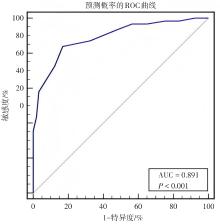
Fig 2
ROC curve"
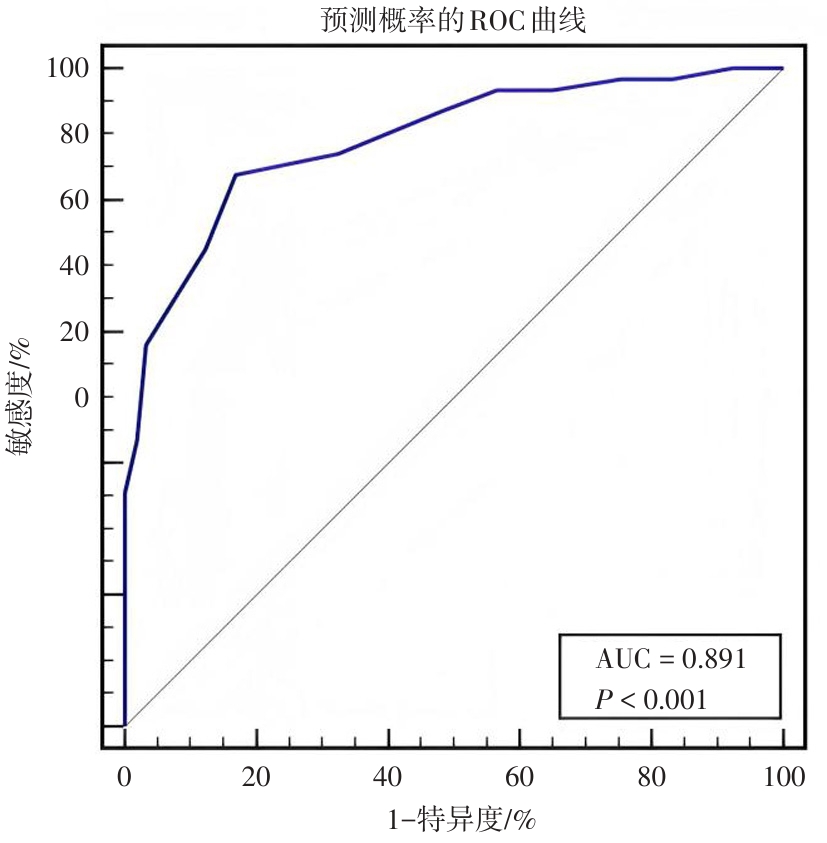
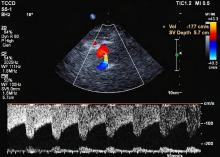
Fig 3
Ultrasonic manifestations of the intracranial segment of the left vertebral artery with stenosis"
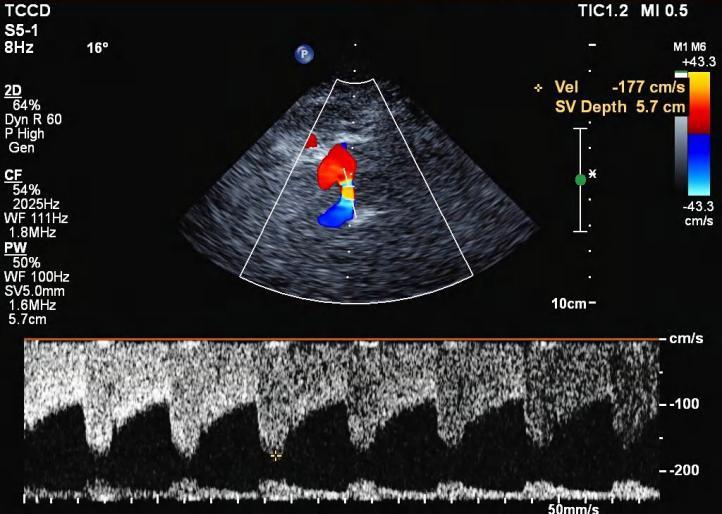
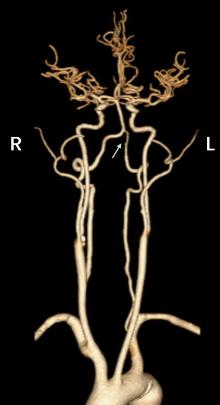
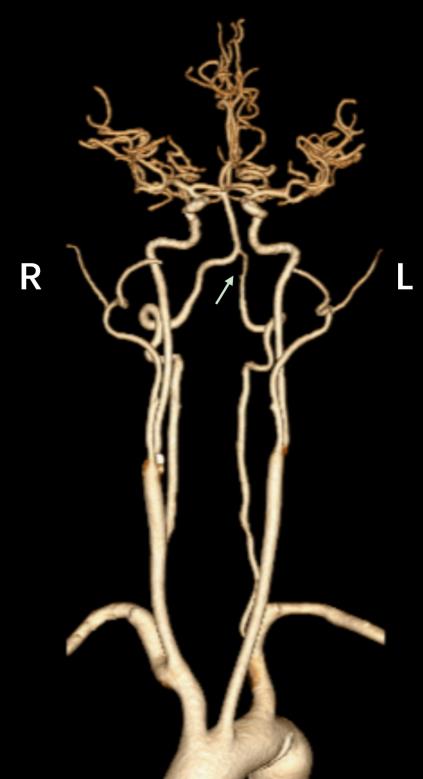
Fig.4
CTA reconstruction image"
| [1] |
王云灿, 曹广运, 吴海波, 等. 基于颈动脉超声造影评估颈内动脉壁面切应力与颈动脉斑块内新生血管的关系[J]. 实用医学杂志, 2024, 40(22): 3232-3237. doi:10.3969/j.issn.1006-5725.2024.22.019 .
doi: 10.3969/j.issn.1006-5725.2024.22.019 |
| [2] |
MALTSEVA A N, DORZHIEVA R V, KOPEVA K V, et al. Coronary computed tomography angiography atherosclerotic plaque volume as a predictor of myocardial blood flow impairment in non-obstructive coronary artery disease[J]. Rev Cardiovasc Med, 2025, 26(9): 39291. doi:10.31083/RCM39291 .
doi: 10.31083/RCM39291 |
| [3] |
SUN T, HUANG L, ZHAO Y, et al. Development and validation of a nomogram model for predicting infarction after superficial temporal artery⁃middle cerebral artery bypass in patients with intracranial atherosclerotic stenosis[J]. Neurosurg Rev, 2025, 48(1): 682. doi:10.1007/s10143-025-03855-w .
doi: 10.1007/s10143-025-03855-w |
| [4] | 张洁. 头颈部血管超声对颅内外动脉粥样硬化性大动脉狭窄诊断阈值的研究[D]. 长春: 吉林大学, 2022. |
| [5] |
TAKAFUMI S, HOJO R, TSUCHIYAMA T, et al. A case report of Bow Hunter′s syndrome with intravascular ultrasound showing changing significant severe stenosis of the left vertebral artery associated with turning left[J]. Eur Heart J Case Rep, 2024, 8(1): ytad639. doi:10.1093/ehjcr/ytad639 .
doi: 10.1093/ehjcr/ytad639 |
| [6] | 贾建平, 陈生弟. 神经病学[M]. 7版. 北京: 人民卫生出版社, 2013. |
| [7] |
BARBOUR M A, WHITEHEAD B, GUMBO C, et al. Traumatic brain injury persistently increases the incidence of both ischemic and hemorrhagic strokes: Potential mechanisms[J]. Prog Neurobiol, 2025, 248: 102749. doi:10.1016/j.pneurobio.2025.102749 .
doi: 10.1016/j.pneurobio.2025.102749 |
| [8] |
HE X, XIAO H, GUO H, et al. Atrial fibrillation-related ischemic stroke and cognitive impairment: Research progress on the characteristics and pathogenesis[J]. Brain Res Bull, 2025, 227: 111392. doi:10.1016/j.brainresbull.2025.111392 .
doi: 10.1016/j.brainresbull.2025.111392 |
| [9] |
涂秋月, 彭鑫玉, 贺子毅, 等. 中国日益加重的动脉粥样硬化性心血管病负担: 基于GBD2021数据库的生活方式和代谢因素分析[J]. 陆军军医大学学报, 2025, 47(22): 2824-2836. doi:10.16016/j.2097-0927.202508023 .
doi: 10.16016/j.2097-0927.202508023 |
| [10] |
ZHANG F F, THAPA M, ZOU H Y, et al. Optical coherence tomography evaluation of vessel wall microstructure before and after endovascular stent treatment for intracranial vertebrobasilar atherosclerotic stenosis[J]. Quant Imaging Med Surg, 2025, 15(6): 5520-5533. doi:10.21037/qims-2024-2487 .
doi: 10.21037/qims-2024-2487 |
| [11] |
杨翠英, 谢迎新, 刘晓伟, 等. 超声监测动脉粥样硬化性肾动脉狭窄患者血流动力学与肾实质弹性值预测肾功能预后的价值[J]. 河北医科大学学报, 2026, 47(1): 57-65. doi:10.3969/j.issn.1007-3205.2026.01.009 .
doi: 10.3969/j.issn.1007-3205.2026.01.009 |
| [12] |
VOICU S, GUREVICH S, KOSMOPOULOS M, et al. Leg reperfusion technique optimization and ischemia diagnosis using ultrasound in patients treated with extracorporeal life support for refractory cardiac arrest-An observational cohort study[J]. Resusc Plus, 2025, 26: 101073. doi:10.1016/j.resplu.2025.101073 .
doi: 10.1016/j.resplu.2025.101073 |
| [13] |
LI S, TIAN X, IP B, et al. Cerebral hemodynamics and stroke risks in symptomatic intracranial atherosclerotic stenosis with internal versus cortical borderzone infarcts: A computational fluid dynamics study[J]. J Cereb Blood Flow Metab, 2024, 44(4): 516-526. doi:10.1177/0271678X231211449 .
doi: 10.1177/0271678X231211449 |
| [14] |
ZHENG Y, FENG H, HAN Q, et al. The influence of different implantation depths on the hemodynamics in the treatment of stenosis in the starting segment of vertebral arteries[J]. Comput Methods Biomech Biomed Eng, 2025, 28(6): 841-854. doi: 10.1080/10255842.2025.2480269 .
doi: 10.1080/10255842.2025.2480269 |
| [15] |
SAHIN H, GOKCE M. The Effect of the Vertebral Artery Stenosis on the Basilar Artery Tortuosity[J]. Turk Neurosurg, 2023, 33(1): 156-161. doi: 10.5137/1019-5149 .
doi: 10.5137/1019-5149 |
| [16] |
赵元宾, 白晓燕, 张超, 等. 四维血流MRI对动脉粥样硬化性狭窄大脑中动脉局部血流动力学与斑块形态特征相关性的研究[J]. 中华放射学杂志, 2025, 59(3): 261-268. doi:10.3760/cma.j.cn112149-20240206-00068 .
doi: 10.3760/cma.j.cn112149-20240206-00068 |
| [17] |
陈克尚, 赵懿, 林应源, 等. 经颅磁刺激治疗急性大脑中动脉狭窄或闭塞临床效果观察[J]. 山东医药, 2025, 65(1): 43-47. doi:10.3969/j.issn.1002-266X.2025.01.010 .
doi: 10.3969/j.issn.1002-266X.2025.01.010 |
| [18] |
LIU Y Y, TIEN T Y, HUNG C L, et al. Transdermal nicotine patch increases the number and function of endothelial progenitor cells in young healthy nonsmokers without adverse hemodynamic effects[J]. Clin Pharmacol Ther, 2024, 116(1): 128-135. doi:10.1002/cpt.3249 .
doi: 10.1002/cpt.3249 |
| [19] |
MORAT N, CIVIERI G, SPEZIA M, et al. Angiotensin Ⅱ and Atherosclerosis: A New Cardiovascular Risk Factor Beyond Hypertension[J]. Int J Mol Sci, 2025, 26(15): 7525-7527. doi: 10.3390/ijms26157527 .
doi: 10.3390/ijms26157527 |
| [20] |
LIU Z, WANG H, YANG Z, et al. Causal associations between type 1 diabetes mellitus and cardiovascular diseases: A Mendelian randomization study[J]. Cardiovasc Diabetol, 2023, 22(1): 234-236. doi: 10.1186/s12933-023-01974-6 .
doi: 10.1186/s12933-023-01974-6 |
| [21] |
孙亚召, 孟杰杰, 吴英杰, 等. 低密度脂蛋白亚型和其他血脂残余风险指标与老年缺血性心脑血管病终点事件的关系[J]. 中华老年心脑血管病杂志, 2023, 25(5): 485-488. doi: 10.3969/ j.issn.1009-0126.2023.05.010 .
doi: 10.3969/ j.issn.1009-0126.2023.05.010 |
| [22] |
孙宜永, 闫鹏, 李珊, 等. 椎动脉发育不良与急性单发后循环梗死患者梗死部位和椎-基底动脉形态及斑块特征关系的研究[J]. 中国脑血管病杂志, 2023, 20(4): 230-238, 247. doi:10.3969/j.issn.1672-5921.2023.04.003 .
doi: 10.3969/j.issn.1672-5921.2023.04.003 |
| [23] |
韩琳, 王杰, 李子昂, 等. 颅内血管狭窄程度与责任斑块特征对卒中复发风险的关联性研究[J]. 实用放射学杂志, 2025, 41(10): 1593-1599. doi:10.3969/j.issn.1002-1671.2025.10.001 .
doi: 10.3969/j.issn.1002-1671.2025.10.001 |
| [24] |
朱雨蒙, 朱丽平, 葛学, 等. 基于MRI的颈动脉易损斑块与脑白质高信号的相关性研究[J]. 放射学实践, 2024, 39(4): 436-440. doi:10.13609/j.cnki.1000-0313.2024.04.002 .
doi: 10.13609/j.cnki.1000-0313.2024.04.002 |
| [25] |
IJAZ A, YARLAGADDA B, ORECCHIONI M. Foamy macrophages in atherosclerosis: Unraveling the balance between pro- and anti-inflammatory roles in disease progression[J]. Front Cardiovasc Med, 2025, 12: 1589629. doi:10.3389/fcvm.2025. 1589629 .
doi: 10.3389/fcvm.2025. 1589629 |
| [26] |
LI Q, FU J, PARK K, et al. Insulin receptors in vascular smooth muscle cells regulate plaque stability of atherosclerosis[J]. Cardiovasc Res, 2024, 120(16): 2017-2030. doi:10.1093/cvr/cvae193 .
doi: 10.1093/cvr/cvae193 |
| Viewed | ||||||
|
Full text |
|
|||||
|
Abstract |
|
|||||
