

The Journal of Practical Medicine ›› 2026, Vol. 42 ›› Issue (11): 1915-1922.doi: 10.3969/j.issn.1006-5725.2026.11.004
• Cardiovascular and Cerebrovascular Diseases Column • Previous Articles
Peng LÜ1,Di SHI2,Shuchong SHAN2,Jingcui QIN2( )
)
Received:2025-12-21
Online:2026-06-10
Published:2026-06-15
Contact:
Jingcui QIN
E-mail:qjc1911101@163.com
CLC Number:
Peng LÜ,Di SHI,Shuchong SHAN,Jingcui QIN. Relationship between serum levels of Panx-1 and Sestrin2 and the severity and prognosis of patients with acute cerebral hemorrhage[J]. The Journal of Practical Medicine, 2026, 42(11): 1915-1922.
Tab.1
Comparison of clinical data and serum indicators between the two groups"
| 项目 | 对照组(n = 200) | AICH组(n = 208) | χ2/t值 | P值 |
|---|---|---|---|---|
| 性别/例 | 0.588 | 0.443 | ||
| 男 | 103 | 115 | ||
| 女 | 97 | 93 | ||
| 年龄/岁 | 57.25 ± 10.13 | 58.34 ± 9.06 | 1.147 | 0.252 |
| BMI/(kg/m2) | 22.15 ± 1.67 | 22.43 ± 1.88 | 1.588 | 0.113 |
| 吸烟史/[例(%)] | 37(18.50) | 35(16.83) | 0.196 | 0.658 |
| 酗酒史/[例(%)] | 9(4.50) | 11(5.29) | 0.135 | 0.712 |
| 高血压史/[例(%)] | 17(8.50) | 179(86.06) | 245.703 | < 0.001 |
| 糖尿病史/[例(%)] | 15(7.50) | 18(8.65) | 0.183 | 0.669 |
| 冠心病史/[例(%)] | 11(5.50) | 10(4.81) | 0.101 | 0.752 |
| Panx-1/(mg/mL) | 2.03 ± 0.55 | 13.58 ± 3.72 | 44.278 | < 0.001 |
| Sestrin2/(ng/mL) | 1.72 ± 0.41 | 15.77 ± 4.08 | 49.406 | < 0.001 |
Tab.2
Comparison of serum levels of Panx-1 and Sestrin2 in AICH patients with different degrees of neurological deficit x ± s"
| 组别 | 例数 | Panx-1/(mg/mL) | Sestrin2/(ng/mL) |
|---|---|---|---|
| 轻度缺损亚组 | 63 | 9.67 ± 2.34 | 11.52 ± 3.19 |
| 中度缺损亚组 | 94 | 13.51 ± 3.25* | 15.81 ± 4.37* |
| 重度缺损亚组 | 51 | 18.55 ± 4.08*# | 20.95 ± 4.82*# |
| F值 | 114.711 | 71.996 | |
| P值 | < 0.001 | < 0.001 |
Tab.3
Comparison of clinical data and serum indicators in AICH patients with different prognoses"
| 项目 | 预后良好组(n = 141) | 预后不良组(n = 67) | χ2/t值 | P值 |
|---|---|---|---|---|
| 性别/例 | 0.779 | 0.378 | ||
| 男 | 75 | 40 | ||
| 女 | 66 | 27 | ||
| 年龄/岁 | 57.95 ± 9.87 | 59.19 ± 9.62 | 0.854 | 0.394 |
| BMI/(kg/m2) | 22.39 ± 1.71 | 22.52 ± 1.83 | 0.501 | 0.617 |
| 吸烟史/[例(%)] | 24(17.02) | 11(16.42) | 0.012 | 0.913 |
| 酗酒史/[例(%)] | 7(4.96) | 4(5.97) | 0.092 | 0.762 |
| 高血压史/[例(%)] | 121(85.82) | 58(86.57) | 0.021 | 0.884 |
| 糖尿病史/[例(%)] | 12(8.51) | 6(8.96) | 0.011 | 0.915 |
| 冠心病史/[例(%)] | 8(5.67) | 2(2.99) | 0.727 | 0.397 |
| 收缩压/mmHg | 152.74 ± 15.65 | 155.63 ± 14.91 | 1.263 | 0.208 |
| 舒张压/mmHg | 92.03 ± 6.16 | 93.27 ± 6.83 | 1.309 | 0.192 |
| 白细胞计数/(×109/L) | 8.36 ± 2.07 | 8.82 ± 2.16 | 1.477 | 0.141 |
| 血红蛋白/(g/L) | 142.66 ± 15.74 | 139.98 ± 11.83 | 1.367 | 0.174 |
| 血小板计数/(×109/L) | 251.87 ± 30.69 | 259.11 ± 35.32 | 1.513 | 0.132 |
| 出血部位/[例(%)] | 0.907 | 0.635 | ||
| 基底节区 | 76(53.90) | 32(47.76) | ||
| 脑叶内 | 34(24.11) | 20(29.85) | ||
| 其他 | 31(21.99) | 15(22.39) | ||
| 血肿体积/mL | 10.37 ± 2.44 | 25.42 ± 6.17 | 19.263 | < 0.001 |
| GCS评分/分 | 10.86 ± 3.02 | 5.14 ± 1.15 | 19.686 | < 0.001 |
| NIHSS评分/分 | 8.49 ± 2.16 | 17.06 ± 4.28 | 15.480 | < 0.001 |
| ICU住院时间/d | 3.15 ± 0.87 | 7.02 ± 1.99 | 15.241 | < 0.001 |
| 并发脑疝/[例(%)] | 2(1.42) | 5(7.46) | 5.101 | 0.024 |
| 并发肺部感染/[例(%)] | 11(7.80) | 9(22.39) | 8.836 | 0.003 |
| 并发深静脉血栓/[例(%)] | 1(0.71) | 4(5.97) | 5.357 | 0.021 |
| Panx-1/(mg/mL) | 11.85 ± 3.02 | 17.23 ± 4.15 | 9.485 | < 0.001 |
| Sestrin2/(ng/mL) | 14.23 ± 2.87 | 19.01 ± 3.99 | 8.785 | < 0.001 |
Tab.4
Correlation analysis between serum Panx-1, Sestrin2 levels and severity indicators in AICH patients"
| 指标 | Panx-1 | Sestrin2 | ||
|---|---|---|---|---|
| r值 | P值 | r值 | P值 | |
| 血肿体积 | 0.236 | 0.078 | 0.251 | 0.092 |
| GCS评分 | -0.457 | 0.012 | -0.492 | 0.008 |
| NIHSS评分 | 0.535 | < 0.001 | 0.509 | < 0.001 |
Tab.5
Multivariate logistic regression analysis of poor prognosis in AICH patients"
| 自变量 | 单因素分析 | 多因素分析 | ||||
|---|---|---|---|---|---|---|
| OR | 95%CI | P值 | OR | 95%CI | P值 | |
| 性别 | 1.696 | 0.881 ~ 3.263 | 0.114 | - | - | - |
| 年龄 | 1.893 | 0.841 ~ 4.261 | 0.123 | - | - | - |
| BMI | 1.361 | 0.597 ~ 3.099 | 0.463 | - | - | - |
| 吸烟史 | 1.430 | 0.428 ~ 3.258 | 0.394 | - | - | - |
| 酗酒史 | 1.597 | 0.701 ~ 3.637 | 0.265 | - | - | - |
| 高血压史 | 1.818 | 0.798 ~ 4.142 | 0.155 | - | - | - |
| 糖尿病史 | 1.231 | 0.655 ~ 2.314 | 0.518 | - | - | - |
| 冠心病史 | 1.125 | 0.585 ~ 2.165 | 0.724 | - | - | - |
| 收缩压 | 1.422 | 0.439 ~ 4.609 | 0.557 | - | - | - |
| 舒张压 | 2.121 | 0.654 ~ 6.876 | 0.210 | - | - | - |
| 白细胞计数 | 1.737 | 0.392 ~ 7.703 | 0.468 | - | - | - |
| 血红蛋白 | 1.293 | 0.307 ~ 5.450 | 0.726 | - | - | - |
| 血小板计数 | 1.224 | 0.430 ~ 3.486 | 0.705 | - | - | - |
| 出血部位 | 1.219 | 0.633 ~ 2.346 | 0.553 | - | - | - |
| 血肿体积 | 3.228 | 1.460 ~ 7.141 | 0.004 | 4.609 | 1.686 ~ 12.597 | 0.003 |
| GCS评分 | 0.327 | 0.170 ~ 0.629 | 0.001 | 0.198 | 0.070 ~ 0.565 | 0.002 |
| NIHSS评分 | 7.885 | 1.871 ~ 33.236 | 0.005 | 8.654 | 3.404 ~ 21.998 | < 0.001 |
| ICU住院时间 | 2.787 | 1.563 ~ 4.969 | 0.001 | 2.998 | 1.507 ~ 5.965 | 0.002 |
| 并发脑疝 | 6.001 | 1.546 ~ 23.297 | 0.010 | 6.373 | 1.642 ~ 24.737 | 0.007 |
| 并发肺部感染 | 6.821 | 1.187 ~ 39.186 | 0.031 | 7.389 | 1.795 ~ 30.421 | 0.006 |
| 并发深静脉血栓 | 8.215 | 1.999 ~ 33.756 | 0.003 | 8.602 | 1.959 ~ 37.781 | 0.004 |
| Panx-1 | 7.708 | 1.679 ~ 29.834 | 0.008 | 8.012 | 3.049 ~ 21.058 | < 0.001 |
| Sestrin2 | 5.795 | 1.375 ~ 24.426 | < 0.017 | 7.050 | 2.605 ~ 19.081 | < 0.001 |
Tab.6
Predictive value of serum levels of Panx-1 and Sestrin2 for poor prognosis in AICH patients"
| 因素 | AUC(95%CI) | 最佳截断值 | 敏感度/% | 特异度/% | Youden指数 |
|---|---|---|---|---|---|
| Panx-1 | 0.701(0.629 ~ 0.773) | 14.87 mg/mL | 71.64 | 74.05 | 0.457 |
| Sestrin2 | 0.677(0.598 ~ 0.755) | 17.31 ng/mL | 70.15 | 78.01 | 0.482 |
| Panx-1 + Sestrin2 | 0.865(0.815 ~ 0.914) | - | 80.60 | 77.30 | 0.579 |
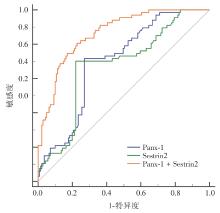
Fig.1
ROC curves of serum levels of Panx-1 and Sestrin2 for predicting poor prognosis in AICH patients"
| [1] |
CONNOLLY S J, SHARMA M, COHEN A T, et al. Andexanet for Factor Xa Inhibitor-Associated Acute Intracerebral Hemorrhage[J]. N Engl J Med, 2024, 390(19): 1745-1755. doi: 10.1056/NEJMoa2313040 .
doi: 10.1056/NEJMoa2313040 |
| [2] |
WU L Y, YE Z N, ZHOU C H, et al. Roles of pannexin-1 channels in inflammatory response through the TLRs/NF-kappa B signaling pathway following experimental subarachnoid hemorrhage in rats[J]. Front Mol Neurosci, 2017, 10: 175. doi:10.3389/fnmol.2017.00175 .
doi: 10.3389/fnmol.2017.00175 |
| [3] |
SUN X G, CHU X H, GODJE GODJE I S, et al. Aerobic glycolysis induced by mTOR/HIF-1α promotes early brain injury after subarachnoid hemorrhage via activating M1 microglia[J]. Transl Stroke Res, 2024, 15(1): 1-15. doi:10.1007/s12975-022-01105-5 .
doi: 10.1007/s12975-022-01105-5 |
| [4] |
中华医学会神经病学分会, 中华医学会神经病学分会脑血管病学组. 中国脑出血诊治指南(2019)[J]. 中华神经科杂志, 2019, 52(12): 994-1005. doi:10.3760/cma.j.issn.1006-7876. 2019.12.003 .
doi: 10.3760/cma.j.issn.1006-7876. 2019.12.003 |
| [5] |
ALEMSEGED F, ROCCO A, ARBA F, et al. Posterior national institutes of health stroke scale improves prognostic accuracy in posterior circulation stroke[J]. Stroke, 2022, 53(4): 1247-1255. doi:10.1161/STROKEAHA.120.034019 .
doi: 10.1161/STROKEAHA.120.034019 |
| [6] | 张磊, 刘建民. 改良Rankin量表[J]. 中华神经外科杂志, 2012, 28(5): 512. |
| [7] |
WU H, JIA Q, LIU G, et al. Decreased uric acid levels correlate with poor outcomes in acute ischemic stroke patients, but not in cerebral hemorrhage patients[J]. J Stroke Cerebrovasc Dis, 2014, 23(3): 469-475. doi:10.1016/j.jstrokecerebrovasdis. 2013.04.007 .
doi: 10.1016/j.jstrokecerebrovasdis. 2013.04.007 |
| [8] |
《中国脑卒中防治报告》编写组, 王陇德. 《中国脑卒中防治报告2021》概要[J]. 中国脑血管病杂志, 2023, 20(11): 783-792, 封3. doi:10.3969/j.issn.1672-5921.2023.11.009 .
doi: 10.3969/j.issn.1672-5921.2023.11.009 |
| [9] |
徐瀚, 陆岳, 袁璞. 脑出血急性期血清神经递质及应激激素变化与继发性脑损伤的关系[J]. 实用医学杂志, 2024, 40(23): 3343-3348. doi:10.3969/j.issn.1006-5725.2024.23.010 .
doi: 10.3969/j.issn.1006-5725.2024.23.010 |
| [10] |
VOLOBUEVA M N, SULEYMANOVA E M, SMIRNOVA M P, et al. A single episode of cortical spreading depolarization increases mRNA levels of proinflammatory cytokines, calcitonin gene-related peptide and pannexin-1 channels in the cerebral cortex[J]. Int J Mol Sci, 2023, 24(1): 85. doi:10.3390/ijms 24010085 .
doi: 10.3390/ijms 24010085 |
| [11] |
WEI R, WANG J, XU Y, et al. Probenecid protects against cerebral ischemia/reperfusion injury by inhibiting lysosomal and inflammatory damage in rats[J]. Neuroscience, 2015, 301: 168-177. doi:10.1016/j.neuroscience.2015.05.070 .
doi: 10.1016/j.neuroscience.2015.05.070 |
| [12] |
JIAN Z, DING S, DENG H, et al. Probenecid protects against oxygen–glucose deprivation injury in primary astrocytes by regulating inflammasome activity[J]. Brain Res, 2016, 1643: 123-129. doi:10.1016/j.brainres.2016.05.002 .
doi: 10.1016/j.brainres.2016.05.002 |
| [13] |
NI B K, CAI J Y, LIN Q, et al. Evaluation of serum pannexin-1 as a prognostic biomarker for traumatic brain injury[J]. Clin Chim Acta, 2019, 488: 159-164. doi:10.1016/j.cca.2018.11.015 .
doi: 10.1016/j.cca.2018.11.015 |
| [14] |
ZHANG L, XIE Q, HONG H, et al. Increased serum pannexin-1 concentrations reflect illness severity and predict a poor prognosis after acute supratentorial intracerebral hemorrhage: A prospective longitudinal cohort study[J]. Clin Chim Acta, 2023, 540: 117218. doi:10.1016/j.cca.2023.117218 ..
doi: 10.1016/j.cca.2023.117218 |
| [15] |
ZHANG Z, LEI Y, YAN C, et al. Probenecid relieves cerebral dysfunction of sepsis by inhibiting pannexin 1-dependent ATP release[J]. Inflammation, 2019, 42(3): 1082-1092. doi:10.1007/s10753-019-00969-4 .
doi: 10.1007/s10753-019-00969-4 |
| [16] |
伍晓梅,彭林辉,李孔平,左夏林. 水通道蛋白4在缺血性卒中后的作用及调控机制研究进展[J]. 中国脑血管病杂志,2024,21(10):693-699. doi:10.3969/j.issn.1672-5921.2024.10.008 .
doi: 10.3969/j.issn.1672-5921.2024.10.008 |
| [17] |
CARR M, GONZALEZ G, MARTINELLI A, et al. Upregulated expression of the antioxidant sestrin 2 identified by transcriptomic analysis of Japanese encephalitis virus-infected SH-SY5Y neuroblastoma cells[J]. Virus Genes, 2019, 55(5): 630-642. doi:10.1007/s11262-019-01683-x .
doi: 10.1007/s11262-019-01683-x |
| [18] |
LI Y, WU J, YU S, et al. Sestrin2 promotes angiogenesis to alleviate brain injury by activating Nrf2 through regulating the interaction between p62 and Keap1 following photothrombotic stroke in rats[J]. Brain Res, 2020, 1745: 146948. doi:10.1016/j.brainres.2020.146948 .
doi: 10.1016/j.brainres.2020.146948 |
| [19] |
GUTIÉRREZ-MIRANDA B, GALLARDO I, MELLIOU E, et al. Oleacein attenuates the pathogenesis of experimental autoimmune encephalomyelitis through both antioxidant and anti-inflammatory effects[J]. Antioxidants, 2020, 9(11): 1161. doi:10.3390/antiox9111161 . [LinkOut]
doi: 10.3390/antiox9111161 |
| [20] |
DING S, MA N, LIU H, et al. Sesn2 attenuates the damage of endothelial progenitor cells induced by angiotensin II through regulating the Keap1/Nrf2 signal pathway[J]. Aging, 2020, 12(24): 25505-25527. doi:10.18632/aging.104156 .
doi: 10.18632/aging.104156 |
| [21] |
KHAN O U R, FAROOQI H A, NABI R, et al. Advancements in prognostic markers and predictive models for intracerebral hemorrhage: From serum biomarkers to artificial intelligence models[J]. Neurosurg Rev, 2024, 47(1): 382. doi:10.1007/s10143-024-02635-2 .
doi: 10.1007/s10143-024-02635-2 |
| [22] |
DOU X, DONG W, GU Y, et al. Significance of serum sestrin2 as a biomarker of severity and functional outcome in acute intracerebral hemorrhage: A prospective observational longitudinal study[J]. BMC Neurol, 2023, 23(1): 424. doi:10.1186/s12883-023-03470-6 .
doi: 10.1186/s12883-023-03470-6 |
| [23] |
HE T, LI W, SONG Y, et al. Sestrin2 regulates microglia polarization through mTOR-mediated autophagic flux to attenuate inflammation during experimental brain ischemia[J]. J Neuroinflammation, 2020, 17(1): 329. doi:10.1186/s12974-020-01987-y .
doi: 10.1186/s12974-020-01987-y |
| [24] |
FREDERIKSEN S D, WICKI-STORDEUR L E, SWAYNE L A. Overlap in synaptic neurological condition susceptibility pathways and the neural pannexin 1 interactome revealed by bioinformatics analyses[J]. Channels, 2023, 17: 2253102. doi:10.1080/19336950.2023.2253102 .
doi: 10.1080/19336950.2023.2253102 |
| [25] |
SADRIA M, LAYTON A T. Interactions among mTORC, AMPK and SIRT: A computational modelfor cell energybalance and metabolism[J]. Cell Commun Signal, 2021, 19(1): 57. doi:10.1186/s12964-021-00706-1 .
doi: 10.1186/s12964-021-00706-1 |
| [26] |
YANG J, GUO Q, WANG L, et al. POU domain class 2 transcription factor 2 inhibits ferroptosis in cerebral ischemia reperfusion injury by activating Sestrin2[J]. Neurochem Res, 2023, 48(2): 658-670. doi:10.1007/s11064-022-03791-x .
doi: 10.1007/s11064-022-03791-x |
| [27] |
SU A X, MA Z J, LI Z Y, et al. Serum levels of neurotensin, pannexin-1, and sestrin-2 and the correlations with sleep quality or/and cognitive function in the patients with chronic insomnia disorder[J]. Front Psychiatry, 2024, 15: 1360305. doi:10.3389/fpsyt.2024.1360305 .
doi: 10.3389/fpsyt.2024.1360305 |
| [28] |
CHEN X Y, YUAN S Y, MI L Y, et al. Pannexin1: Insight into inflammatory conditions and its potential involvement in multiple organ dysfunction syndrome [J]. Front Immunol, 2023, 14: 1217366. doi.10.3389/fimmu.2023.1217366. doi:10.3389/fimmu.2023.1217366
doi: 10.3389/fimmu.2023.1217366 |
| Viewed | ||||||
|
Full text |
|
|||||
|
Abstract |
|
|||||
