

The Journal of Practical Medicine ›› 2026, Vol. 42 ›› Issue (6): 1024-1034.doi: 10.3969/j.issn.1006-5725.2026.06.015
• Chronic Disease Control • Previous Articles
Dandan GUO1( ),Shuangshuang MENG2,Shujing WANG1
Received:2025-10-16
Revised:2025-12-22
Accepted:2025-12-25
Online:2026-03-25
Published:2026-03-26
Contact:
Dandan GUO
E-mail:15039026101@163.com
CLC Number:
Dandan GUO,Shuangshuang MENG,Shujing WANG. Study on the predictive value of ILC2 cell proportion combined with sST2 protein level for postoperative recurrence of refractory chronic rhinosinusitis with nasal polyps[J]. The Journal of Practical Medicine, 2026, 42(6): 1024-1034.
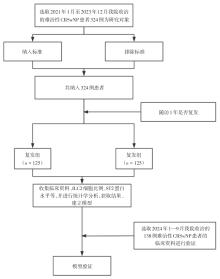
Fig.1
Subject selection flowchart"

Tab.1
Comparison of clinical data between the recurrence group and the non-recurrence group"
| 项目 | 复发组(n = 125) | 未复发组(n = 199) | χ2/F/t值 | P值 |
|---|---|---|---|---|
| 年龄(x ± s)/岁 | 43.79 ± 4.33 | 41.91 ± 5.92 | 3.071 | 0.002 |
| 性别 | 2.523 | 0.112 | ||
| 男 | 71(56.80) | 95(47.74) | ||
| 女 | 54(43.20) | 104(52.26) | ||
| 体质量指数(x ± s)/(kg/m2) | 22.75 ± 3.31 | 22.96 ± 3.70 | 0.518 | 0.605 |
| CRS病程(x ± s)/年 | 4.37 ± 1.25 | 4.28 ± 0.97 | 0.726 | 0.468 |
| 哮喘史 | 11(8.80) | 9(4.52) | 2.425 | 0.119 |
| 糖尿病史 | 15(12.00) | 17(8.54) | 1.031 | 0.310 |
| 高血压史 | 13(10.40) | 19(9.55) | 0.063 | 0.802 |
| 饮酒史 | 37(29.60) | 45(22.61) | 1.983 | 0.159 |
| 吸烟史 | 29(23.20) | 33(16.58) | 2.172 | 0.141 |
| 过敏性鼻炎史 | 28(22.40) | 25(12.56) | 5.430 | 0.020 |
| 胃食管反流 | 22(17.60) | 25(12.56) | 1.571 | 0.210 |
| CRSwNP家族史 | 18(14.40) | 17(8.54) | 2.734 | 0.098 |
| 鼻息肉类型 | 1.645 | 0.200 | ||
| 单发性 | 42(33.60) | 81(40.70) | ||
| 多发性 | 83(66.40) | 118(59.30) | ||
| 鼻窦炎分型 | 6.859 | 0.032 | ||
| Ⅰ型 | 23(18.40) | 59(29.65) | ||
| Ⅱ型 | 41(32.80) | 68(34.17) | ||
| Ⅲ型 | 61(48.80) | 72(36.18) | ||
| 鼻中隔偏曲 | 47(37.60) | 56(28.14) | 3.168 | 0.075 |
| 嗅觉功能评分(x ± s)/分 | 4.96 ± 1.03 | 4.71 ± 1.04 | 2.114 | 0.035 |
| Lund-Mackay评分(x ± s)/分 | 16.21 ± 4.05 | 15.23 ± 3.91 | 2.166 | 0.031 |
| Davos评分(x ± s)/分 | 1.67 ± 0.41 | 1.57 ± 0.39 | 2.203 | 0.028 |
| 使用鼻减充血剂 | 64(51.20) | 92(46.23) | 0.759 | 0.384 |
| 手术时长 | 4.266 | 0.039 | ||
| ≤ 2 h | 83(66.40) | 153(76.88) | ||
| > 2 h | 42(33.60) | 46(23.12) | ||
| 填充物 | 1.220 | 0.269 | ||
| 明胶海绵+凡士林纱布 | 42(33.60) | 79(39.70) | ||
| 纳吸棉 | 83(66.40) | 120(60.30) | ||
| 定期进行术腔清理 | 95(76.00) | 143(71.86) | 0.675 | 0.411 |
| WBC(x ± s)/(×109·L-1) | 10.02 ± 2.31 | 9.69 ± 2.05 | 1.342 | 0.180 |
| CRP(x ± s)/(mg/L) | 10.03 ± 2.41 | 9.57 ± 2.31 | 1.716 | 0.087 |
| CD4+(x ± s)/(cells/μL) | 785.42 ± 215.36 | 812.75 ± 198.54 | 1.167 | 0.244 |
| CD8+(x ± s)/(cells/μL) | 513.28 ± 158.69 | 501.33 ± 122.41 | 0.761 | 0.447 |
| CD4+/CD8+ | 1.53 ± 0.43 | 1.62 ± 0.39 | 1.943 | 0.053 |
| TBIL(x ± s)/(μmol/L) | 18.43 ± 4.45 | 17.59 ± 4.03 | 1.754 | 0.080 |
| NEUT(x ± s)/(×109·L-1) | 9.07 ± 2.08 | 8.51 ± 2.13 | 2.325 | 0.021 |
| ALB(x ± s)/(g/L) | 36.82 ± 4.15 | 37.48 ± 3.76 | 1.477 | 0.141 |
| IL-21(x ± s)/(pg/mL) | 73.16 ± 15.74 | 69.95 ± 15.17 | 1.827 | 0.069 |
| IgE(x ± s)/(IU/mL) | 181.29 ± 34.78 | 178.54 ± 41.00 | 0.622 | 0.534 |
| EOS(x ± s)/(×109·L-1) | 1.56 ± 0.32 | 1.55 ± 0.31 | 0.279 | 0.780 |
| ILC2细胞比例(x ± s)/% | 7.02 ± 2.21 | 5.93 ± 1.06 | 5.956 | < 0.001 |
| sST2(x ± s)/(ng/mL) | 3.35 ± 0.94 | 2.87 ± 0.73 | 5.146 | < 0.001 |
Tab.2
Factors influencing postoperative recurrence in refractory CRS with NP patients: Univariate analysis"
| 因素 | B | SE | Wald χ2 | P值 | OR | 95%CI |
|---|---|---|---|---|---|---|
| 年龄 | 0.043 | 0.021 | 4.037 | 0.045 | 1.044 | 1.001 ~ 1.088 |
| 过敏性鼻炎史 | 0.606 | 0.302 | 4.015 | 0.045 | 1.833 | 1.013 ~ 3.316 |
| 鼻窦炎分型 | ||||||
| Ⅰ型 | Ref. | 6.753 | 0.034 | |||
| Ⅱ型 | 0.436 | 0.315 | 1.911 | 0.167 | 1.547 | 0.833 ~ 2.870 |
| Ⅲ型 | 0.776 | 0.301 | 6.643 | 0.010 | 2.173 | 1.204 ~ 3.922 |
| 嗅觉功能评分 | 0.241 | 0.117 | 4.221 | 0.040 | 1.272 | 1.011 ~ 1.601 |
| Lund-Mackay评分 | 0.057 | 0.029 | 3.995 | 0.046 | 1.059 | 1.004 ~ 1.121 |
| Davos评分 | 0.552 | 0.274 | 4.070 | 0.044 | 1.737 | 1.016 ~ 2.970 |
| 手术时长 | 0.521 | 0.253 | 4.226 | 0.040 | 1.683 | 1.025 ~ 2.765 |
| NEUT | 0.159 | 0.054 | 8.655 | 0.003 | 1.172 | 1.054 ~ 1.303 |
| ILC2细胞比例 | 0.817 | 0.106 | 59.627 | < 0.001 | 2.264 | 1.840 ~ 2.785 |
| sST2 | 1.107 | 0.167 | 43.788 | < 0.001 | 3.025 | 2.179 ~ 4.199 |
Tab.3
Multivariate logistic regression analysis of factors influencing postoperative recurrence in refractory CRS with nasal polyps patients"
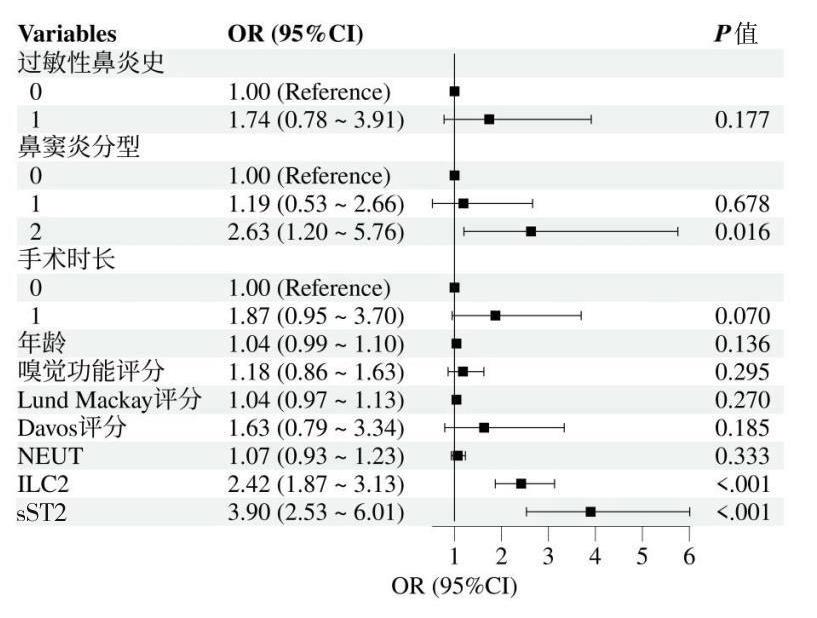
| 因素 | B | SE | Wald χ2 | P值 | OR | 95%CI |
|---|---|---|---|---|---|---|
| 年龄 | 0.043 | 0.029 | 2.220 | 0.136 | 1.044 | 0.987 ~ 1.104 |
| 过敏性鼻炎史 | 0.556 | 0.412 | 1.820 | 0.177 | 1.744 | 0.777 ~ 3.911 |
| 鼻窦炎分型 | ||||||
| Ⅰ型 | Ref. | |||||
| Ⅱ型 | 0.171 | 0.413 | 0.172 | 0.679 | 1.186 | 0.529 ~ 2.663 |
| Ⅲ型 | 0.966 | 0.400 | 5.842 | 0.016 | 2.629 | 1.200 ~ 5.755 |
| 嗅觉功能评分 | 0.169 | 0.161 | 1.098 | 0.295 | 1.184 | 0.863 ~ 1.625 |
| Lund-Mackay评分 | 0.043 | 0.039 | 1.216 | 0.270 | 1.044 | 0.967 ~ 1.126 |
| Davos评分 | 0.486 | 0.367 | 1.757 | 0.185 | 1.626 | 0.792 ~ 3.336 |
| 手术时长 | 0.628 | 0.347 | 3.285 | 0.070 | 1.874 | 0.950 ~ 3.697 |
| NEUT | 0.069 | 0.071 | 0.938 | 0.333 | 1.071 | 0.932 ~ 1.232 |
| ILC2细胞比例 | 0.883 | 0.132 | 45.046 | < 0.001 | 2.418 | 1.869 ~ 3.130 |
| sST2 | 1.361 | 0.220 | 38.107 | < 0.001 | 3.900 | 2.532 ~ 6.008 |
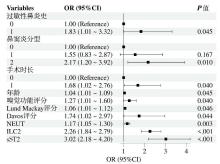
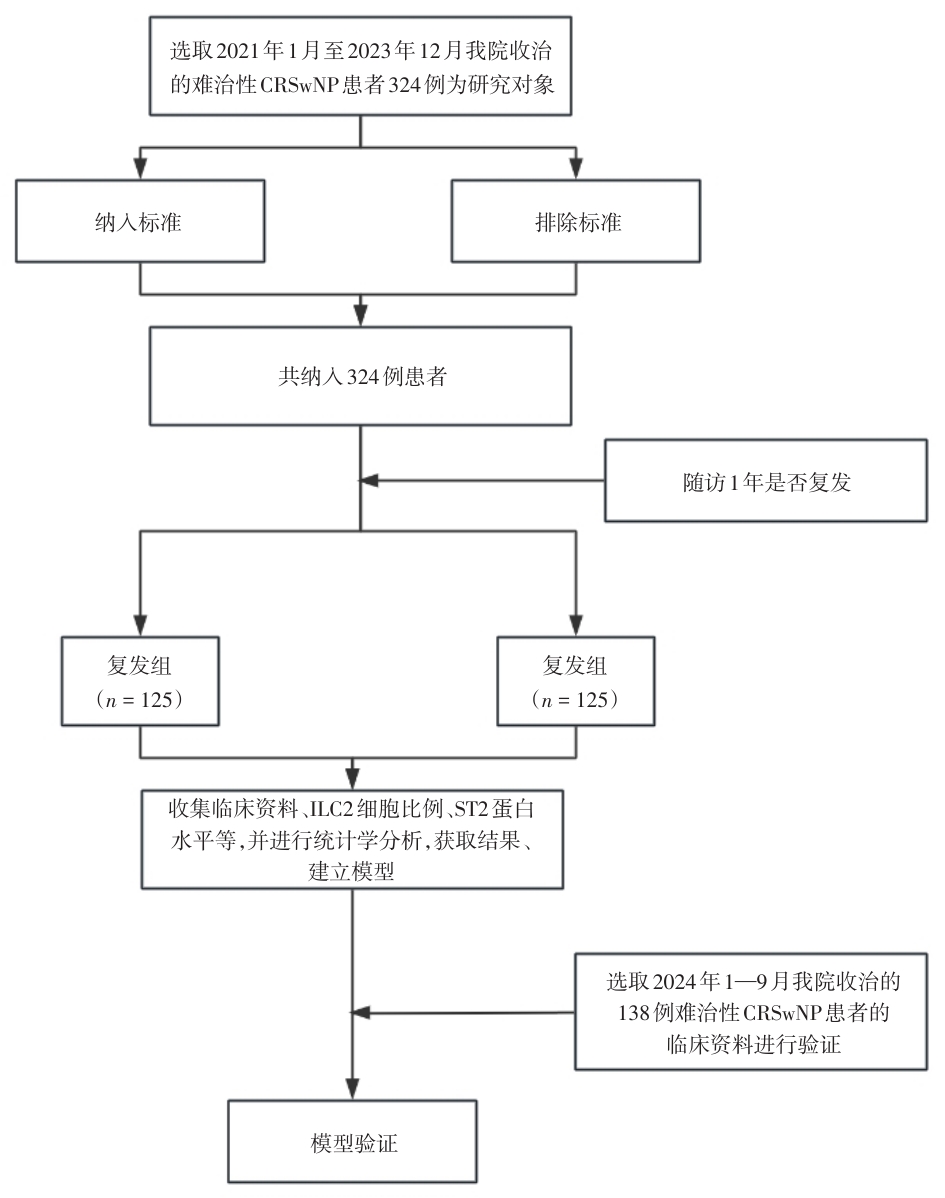
Fig.2
Single-factor significant variable forest plot"
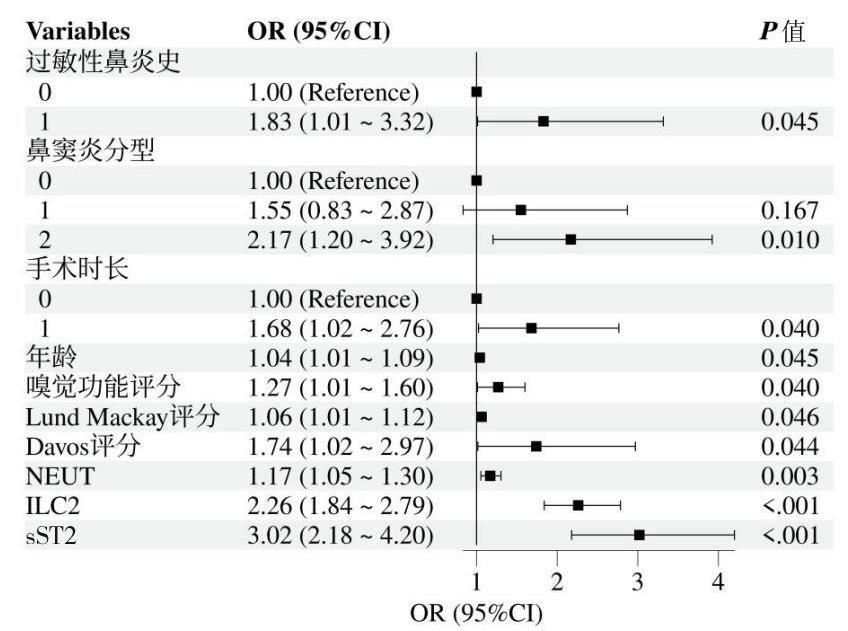
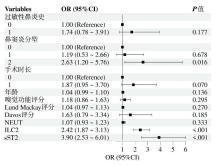
Fig.3
Forest plot of significant multifactorial variables"
Tab.4
Predictive value of individual and combined factors for postoperative recurrence in refractory CRS with NP patients"
| 指标 | AUC | 标准误 | 95%CI | P值 | 约登指数 | Cut-off值 | 敏感度/% | 特异度/% |
|---|---|---|---|---|---|---|---|---|
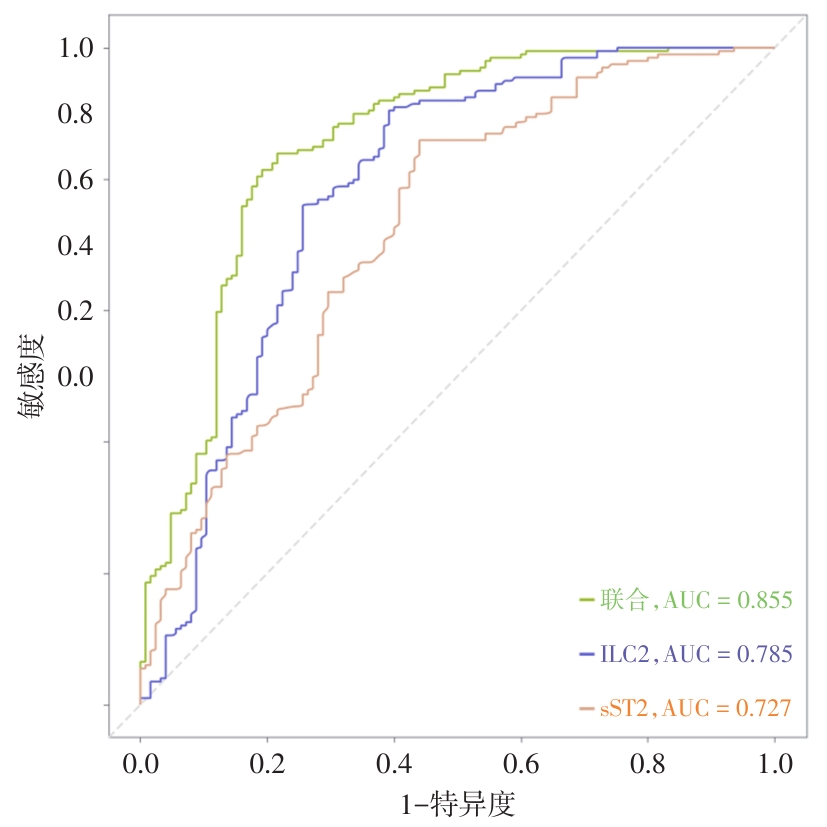
| ILC2细胞比例 | 0.785* | 0.028 | 0.736 ~ 0.828 | < 0.001 | 0.513 | > 7.00% | 60.80 | 90.45 |
| sST2 | 0.727* | 0.029 | 0.675 ~ 0.774 | < 0.001 | 0.419 | > 3.43 ng/mL | 56.00 | 85.93 |
| 联合 | 0.855 | 0.023 | 0.812 ~ 0.892 | < 0.001 | 0.623 2 | - | 78.40 | 83.92 |
| ZILC2~联合 | 3.367 | |||||||
| ZsST2~联合 | 4.464 |
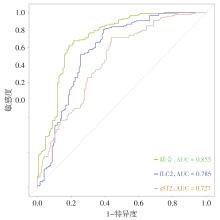
Fig.4
ROC curves for predicting postoperative recurrence in refractory CRS with NP patients using individual and combined factors"
Tab.5
Comparison of clinical data between training and validation sets"
| 项目 | 训练集(n = 324) | 验证集(n = 138) | χ2/F/t值 | P值 |
|---|---|---|---|---|
| 年龄/岁 | 42.64 ± 5.43 | 43.05 ± 5.01 | 0.759 | 0.448 |
| 性别/[例(%)] | 1.764 | 0.184 | ||
| 男 | 166(51.23) | 80(57.97) | ||
| 女 | 158(48.77) | 58(42.03) | ||
| 体质量指数/(kg/m2) | 22.88 ± 3.55 | 23.45 ± 3.02 | 1.649 | 0.100 |
| CRS病程/年 | 4.31 ± 1.09 | 4.35 ± 1.23 | 0.347 | 0.729 |
| 哮喘史/[例(%)] | 20(6.17) | 11(7.97) | 0.500 | 0.480 |
| 糖尿病史/[例(%)] | 32(9.88) | 15(10.87) | 0.104 | 0.747 |
| 高血压史/[例(%)] | 32(9.88) | 16(11.59) | 0.307 | 0.580 |
| 饮酒史/[例(%)] | 82(25.31) | 45(32.61) | 2.587 | 0.108 |
| 吸烟史/[例(%)] | 62(19.14) | 29(21.01) | 0.082 | 0.774 |
| 过敏性鼻炎史/[例(%)] | 53(16.36) | 31(22.46) | 2.425 | 0.119 |
| 胃食管反流/[例(%)] | 47(14.51) | 15(10.87) | 1.102 | 0.294 |
| CRSwNP家族史/[例(%)] | 35(10.80) | 11(7.97) | 0.865 | 0.352 |
| 鼻息肉类型/[例(%)] | 0.279 | 0.597 | ||
| 单发性 | 123(37.96) | 56(40.58) | ||
| 多发性 | 201(62.04) | 82(59.42) | ||
| 鼻窦炎分型/[例(%)] | 1.496 | 0.473 | ||
| Ⅰ型 | 82(25.31) | 41(29.71) | ||
| Ⅱ型 | 109(33.64) | 48(34.78) | ||
| Ⅲ型 | 133(41.05) | 49(35.51) | ||
| 鼻中隔偏曲 /[例(%)] | 103(31.79) | 42(30.43) | 0.083 | 0.774 |
| 嗅觉功能评分/分 | 4.81 ± 1.04 | 4.70 ± 1.15 | 1.008 | 0.314 |
| Lund-Mackay评分/分 | 15.61 ± 3.99 | 16.04 ± 4.12 | 1.050 | 0.294 |
| Davos评分/分 | 1.61 ± 0.40 | 1.67 ± 0.38 | 1.498 | 0.135 |
| 是否使用鼻减充血剂/[例(%)] | 0.257 | 0.612 | ||
| 是 | 156(48.15) | 70(50.72) | ||
| 否 | 168(51.85) | 68(49.28) | ||
| 手术时长 /[例(%)] | 0.006 | 0.938 | ||
| ≤ 2 h | 236(72.84) | 101(73.19) | ||
| > 2 h | 88(27.16) | 37(26.81) | ||
| 填充物/[例(%)] | 0.258 | 0.611 | ||
| 明胶海绵+凡士林纱布 | 121(37.35) | 55(39.86) | ||
| 纳吸棉 | 203(62.65) | 83(60.14) | ||
| 是否定期进行术腔清理/[例(%)] | 2.550 | 0.110 | ||
| 是 | 238(73.46) | 111(80.43) | ||
| 否 | 86(26.54) | 27(19.57) | ||
| WBC/(× 109·L-1) | 9.82 ± 2.12 | 9.74 ± 2.29 | 0.362 | 0.717 |
| CRP/(mg/L) | 9.75 ± 2.28 | 9.65 ± 2.07 | 0.443 | 0.676 |
| CD4+/(cells/μL) | 802.21 ± 205.30 | 804.74 ± 199.42 | 0.122 | 0.902 |
| CD8+/(cells/μL) | 506.50 ± 168.70 | 509.23 ± 141.05 | 0.167 | 0.868 |
| CD4+/CD8+ | 1.59 ± 0.41 | 1.61 ± 0.42 | 0.476 | 0.634 |
| TBIL/(μmol/L) | 17.91 ± 4.21 | 18.04 ± 3.39 | 0.321 | 0.748 |
| NEUT/(× 109·L-1) | 8.73 ± 2.13 | 8.56 ± 2.21 | 0.776 | 0.438 |
| ALB/(g/L) | 37.23 ± 3.92 | 38.01 ± 4.15 | 1.923 | 0.055 |
| IL-21/(pg/mL) | 71.19 ± 15.45 | 71.83 ± 12.80 | 0.428 | 0.669 |
| IgE/(IU/mL) | 179.60 ± 38.69 | 180.11 ± 40.08 | 0.128 | 0.898 |
| EOS(× 109·L-1) | 1.55 ± 0.31 | 1.57 ± 0.33 | 0.622 | 0.534 |
| ILC2细胞比例/% | 6.35 ± 1.69 | 6.54 ± 1.47 | 1.148 | 0.251 |
| sST2/(ng/mL) | 3.06 ± 0.85 | 3.10 ± 0.71 | 0.485 | 0.628 |
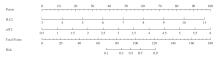
Fig.5
Column chart model"
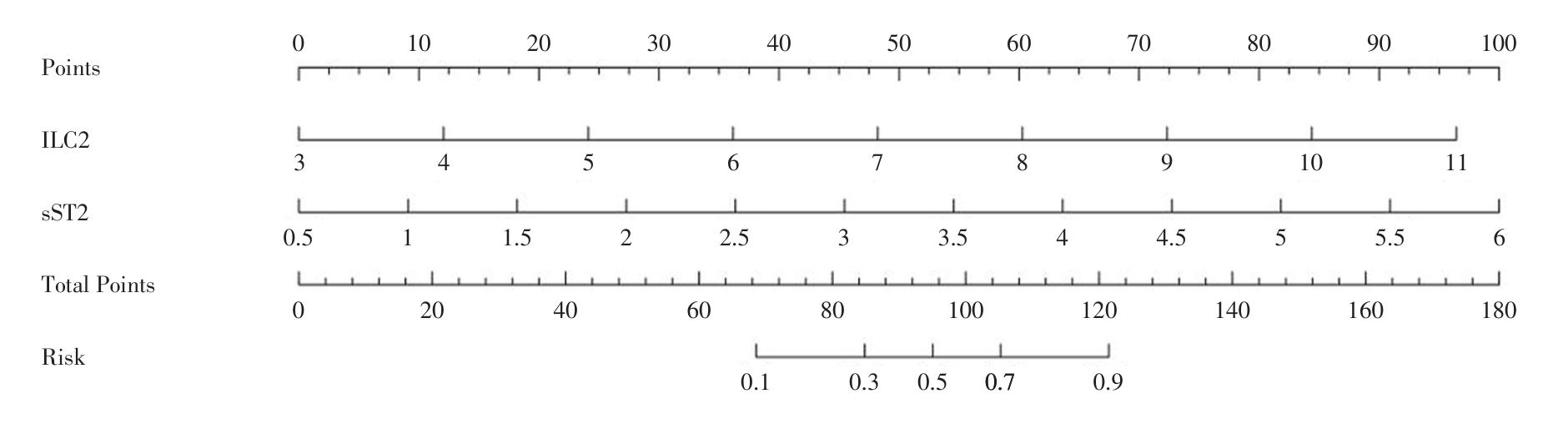
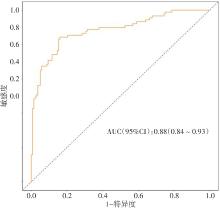
Fig.6
Training set ROC curve"
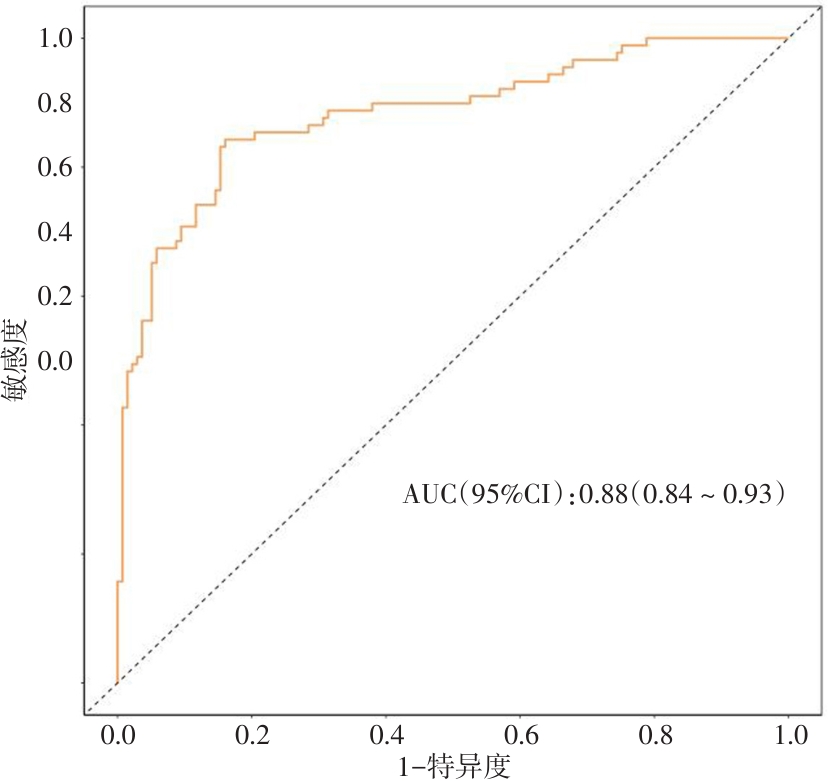
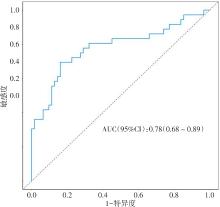
Fig.7
ROC curve for the validation set"
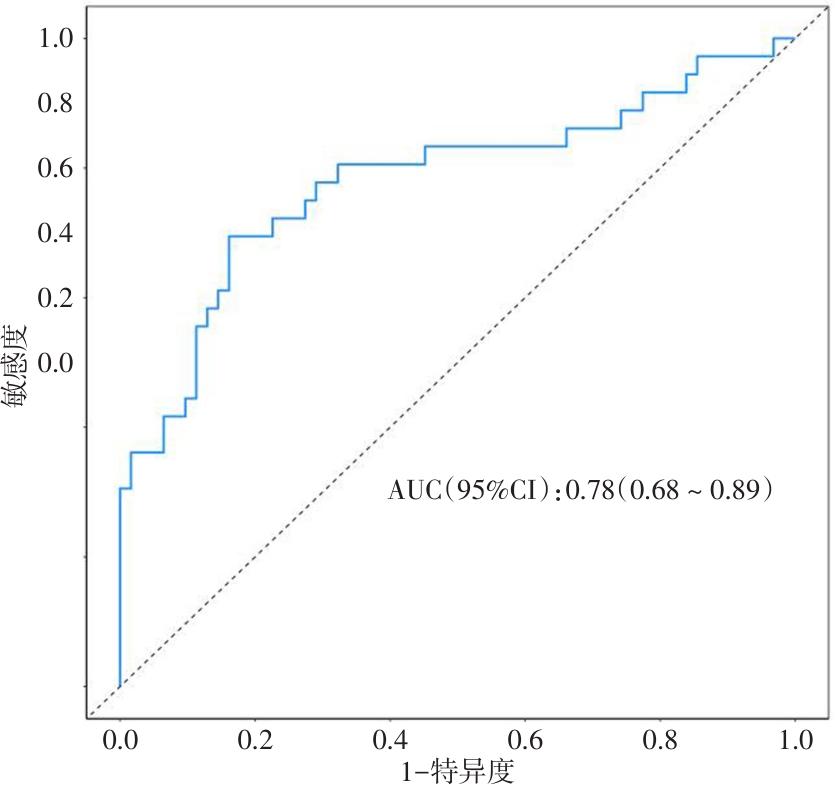
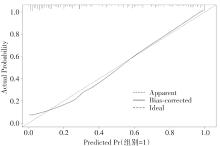
Fig.8
Training set calibration curve"
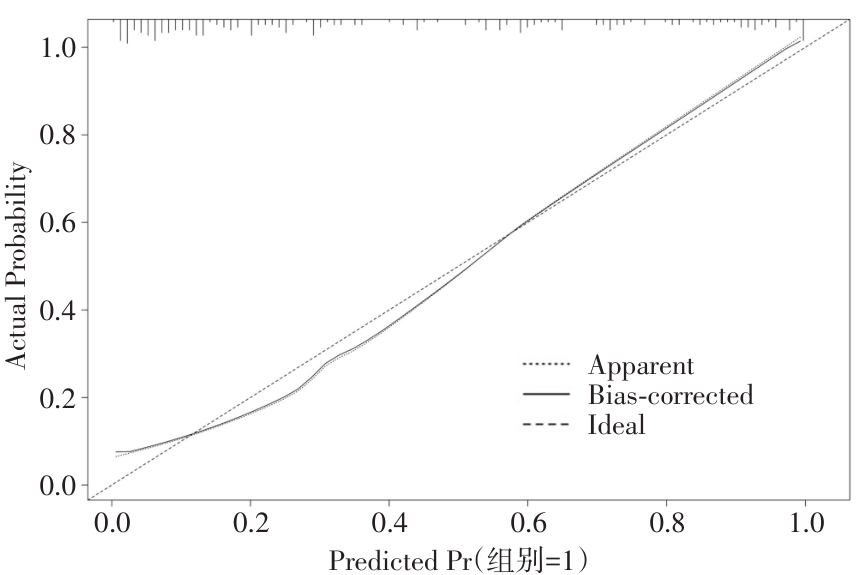
Fig.9
Validation set calibration curve"
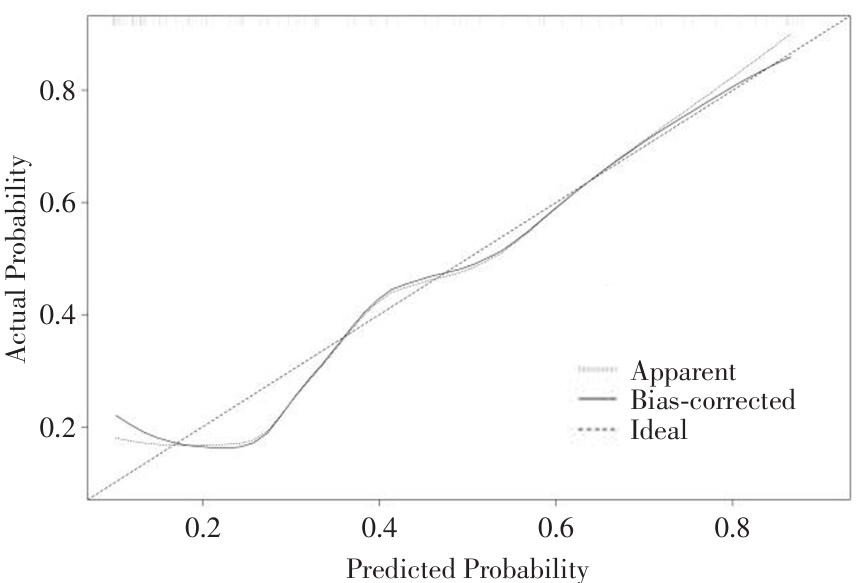
Fig.10
Decision curve for the training set"
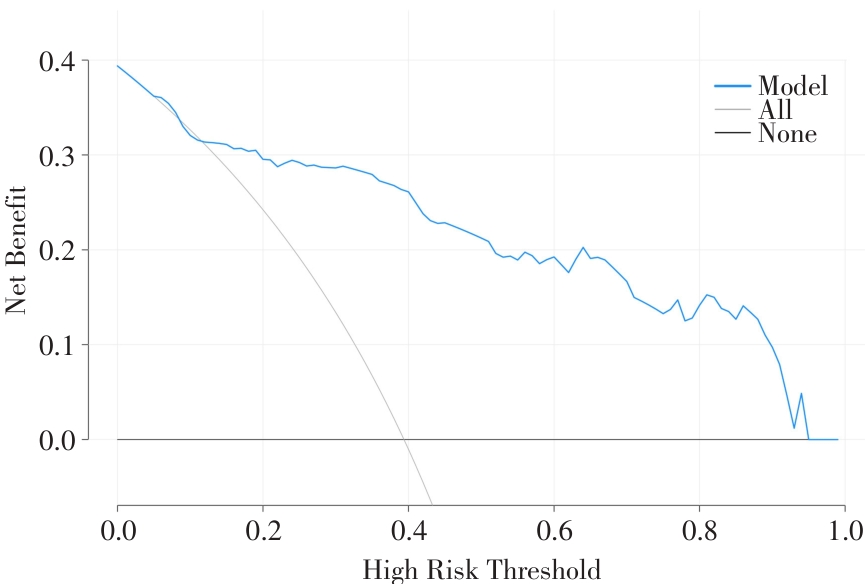
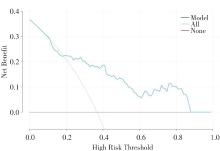
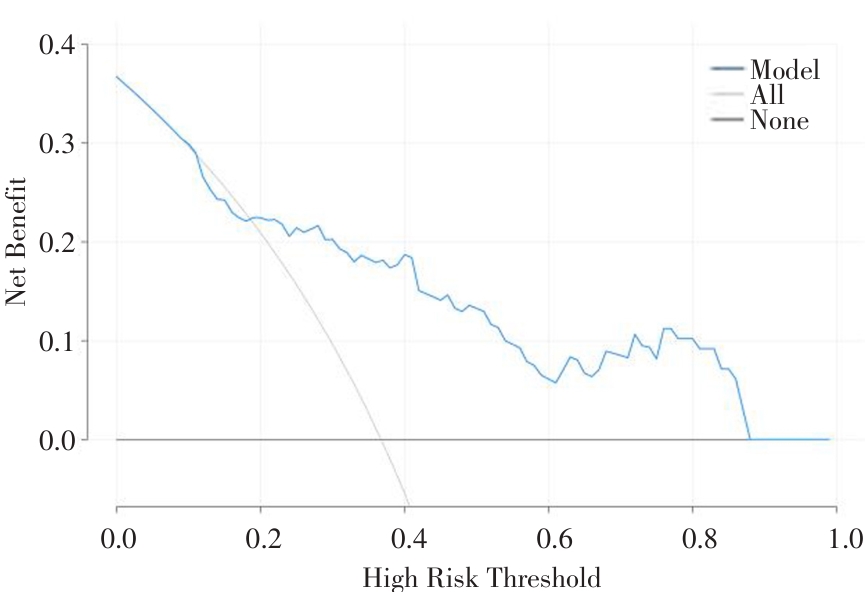
Fig. 11
Decision curve for the validation set"
| [1] |
冯娟娟,程泽星,肖路. NLRP3炎性小体水平联合ECP/MPO比值预测慢性鼻窦炎鼻内镜术后复发的临床价值[J].实用医学杂志, 2024, 40(22): 3196-3201. doi:10.3969/j.issn.1006-5725.2024.22.013 .
doi: 10.3969/j.issn.1006-5725.2024.22.013 |
| [2] |
MIN H K, LEE S, KIM S, et al. Global incidence and prevalence of chronic rhinosinusitis: A systematic review[J]. Clin Exp Allergy, 2025, 55(1): 52-66. doi: 10.1111/cea.14592 .
doi: 10.1111/cea.14592 |
| [3] |
KIM D H, SHIN H, STYBAYEVA G, et al. A comparison of doxycycline and conventional treatments of refractory chronic rhinosinusitis with nasal polyps: A systematic review and meta-analysis[J]. Eur Arch Otorhinolaryngol, 2024, 281(8): 3949-3957. doi: 10.1007/s00405-024-08563-7 .
doi: 10.1007/s00405-024-08563-7 |
| [4] |
GERSTACKER K, KETTERER M C, JAKOB T F, et al. Real life observational study of treatment success of monoclonal antibodies for refractory chronic rhinosinusitis with nasal polyps[J]. J Clin Med, 2023, 12(13): 4374. doi: 10.3390/jcm12134374 .
doi: 10.3390/jcm12134374 |
| [5] |
STEVENS W W, KATO A. Group 2 innate lymphoid cells in nasal polyposis[J]. Ann Allergy Asthma Immunol., 2021, 126(2): 110-117. doi: 10.1016/j.anai.2020.08.001 .
doi: 10.1016/j.anai.2020.08.001 |
| [6] |
LI M, DUAN L, CAI Y, et al. Prognostic value of soluble suppression of tumorigenesis-2 (sST2) for cardiovascular events in coronary artery disease patients with and without diabetes mellitus[J]. Cardiovasc Diabetol, 2021, 20(1): 49. doi: 10.1186/s12933-021-01244-3 .
doi: 10.1186/s12933-021-01244-3 |
| [7] |
LI Y, WANG Z, DUAN S, et al. TLR4+ group 2 innate lymphoid cells contribute to persistent type 2 immunity in airway diseases[J]. Nat Commun, 2025, 16(1): 7108. doi: 10.1038/s41467-025-62532-0 .
doi: 10.1038/s41467-025-62532-0 |
| [8] |
RODRIGUEZ-RODRIGUEZ N, GOGOI M, MCKENZIE A N J. Group 2 innate lymphoid cells: Team players in regulating asthma[J]. Annu Rev Immunol, 2021, 39(1): 167-198. doi: 10.1146/annurev-immunol-110119-091711 .
doi: 10.1146/annurev-immunol-110119-091711 |
| [9] |
AGACHE I, SONG Y, ALONSO‐COELLO P, et al. Efficacy and safety of treatment with biologicals for severe chronic rhinosinusitis with nasal polyps: A systematic review for the EAACI guidelines[J]. Allergy, 2021, 76(8): 2337-2353. doi: 10.1111/all.14809 .
doi: 10.1111/all.14809 |
| [10] |
HUMMEL T, PODLESEK D. Clinical assessment of olfactory function[J]. Chem Senses, 2021, 46: bjab053. doi: 10.1093/chemse/bjab053 .
doi: 10.1093/chemse/bjab053 |
| [11] |
SCHALEK P, HART L, FUKSA J, et al. Quality of life in CRSwNP: Evaluation of ACCESS and Lund–Mackay computed tomography scores versus the QoL questionnaire[J]. Eur Arch Otorhinolaryngol, 2022, 279(12): 5721-5725. doi: 10.1007/s00405-022-07494-5 .
doi: 10.1007/s00405-022-07494-5 |
| [12] |
WANG W, FU J, CHANG W. Risk factors for postoperative relapse of chronic rhinosinusitis with nasal polyps and improvement in clinical treatment[J]. Am J Transl Res, 2024, 16(12): 7609. doi: 10.62347/chqv3614 .
doi: 10.62347/chqv3614 |
| [13] |
DU K, ZHENG M, ZHAO Y, et al. A nomogram combing peripheral parameters for estimation of CRSwNP recurrence[J]. Am J Rhinol Allergy, 2021, 35(5): 578-586. doi: 10.1177/1945892420978957 .
doi: 10.1177/1945892420978957 |
| [14] |
吴会会,杨珺,曾炫富,等. 慢性鼻窦炎伴鼻息肉患者外周血中髓源性抑制细胞的变化及临床意义[J]. 江苏大学学报:医学版, 2022, 32(6):504-508. doi:10.13312/j.issn.1671-7783.y210180 .
doi: 10.13312/j.issn.1671-7783.y210180 |
| [15] |
闫妍, 许兆丰, 黄嫣然. 慢性鼻窦炎伴鼻息肉中MZB1的表达及其对局部免疫球蛋白表达的影响[J].中山大学学报(医学科学版), 2024, 45(3):383-392. doi: 10.13471/j.cnki.j.sun.yat-sen.univ(med.sci).20240419.004 .
doi: 10.13471/j.cnki.j.sun.yat-sen.univ(med.sci).20240419.004 |
| [16] |
NACLERIO R M, HAMILOS D L. Unblocking the Treatment Stalemate in Chronic Rhinosinusitis Without Nasal Polyposis (CRSsNP)[J]. J Allergy Clin Immunol Pract, 2024, 12(4): 1062-1064. doi: 10.1016/j.jaip.2024.01.048 .
doi: 10.1016/j.jaip.2024.01.048 |
| [17] |
CHEN F, LIU Y, GUO Y, et al. Impact of Sinus CT Severity Score on the Outcomes of Endoscopic Sinus Surgery in Eosinophilic CRSwNP[J]. Laryngoscope, 2025, 135(3): 1021-1028. doi: 10.1002/lary.31846 .
doi: 10.1002/lary.31846 |
| [18] |
JIN J, SUNUSI S, LU H. Group 2 innate lymphoid cells (ILC2s) are important in typical type 2 immune-mediated diseases and an essential therapeutic target[J]. J Int Med Res, 2022, 50(1): 03000605211053156. doi: 10.1177/03000605211053156 .
doi: 10.1177/03000605211053156 |
| [19] |
ZHANG T, XU C, ZHAO R, et al. Diagnostic value of sST2 in cardiovascular diseases: A systematic review and meta-analysis[J]. Front Cardiovasc Med, 2021, 8: 697837. doi: 10.3389/fcvm.2021.697837 .
doi: 10.3389/fcvm.2021.697837 |
| [20] |
TOJIMA I, MURAO T, KAWAKITA K, et al. A decreased prevalence of group 2 innate lymphoid cells in blood is associated with good postoperative outcomes in patients with chronic rhinosinusitis[J]. Auris Nasus Larynx, 2023, 50(4): 540-549. doi: 10.1016/j.anl.2022.11.006 .
doi: 10.1016/j.anl.2022.11.006 |
| [21] |
CHEN W, HE S, XIE X, et al. Over-expression of CRTH2 indicates eosinophilic inflammation and poor prognosis in recurrent nasal polyps[J]. Front Immunol., 2022, 13: 1046426. doi: 10.3389/fimmu.2022.1046426 .
doi: 10.3389/fimmu.2022.1046426 |
| [22] |
ZHANG Y, ZHU K, CHEN J, et al. Predictive Values of Serum IL‐33 and sST2 in Endotypes and Postoperative Recurrence of Chronic Rhinosinusitis with Nasal Polyps[J]. Mediators Inflamm, 2022, 2022(1): 9155080. doi: 10.1155/2022/9155080 .
doi: 10.1155/2022/9155080 |
| [23] |
WANG G, ZHENG H, CHEN X, et al. Exploration of Predictive Biomarkers for Postoperative Recurrence in Chronic Rhinosinusitis with Nasal Polyps Based on Serum Multiple‐Cytokine Profiling[J]. Mediators Inflamm, 2022, 2022(1): 1061658. doi: 10.1155/2022/1061658 .
doi: 10.1155/2022/1061658 |
| [24] |
GUO C L, LIU F F, WANG D Y, et al. Type 2 biomarkers for the indication and response to biologics in CRSwNP[J]. Curr Allergy Asthma Rep, 2023, 23(12): 703-713. doi: 10.1007/s11882-023-01114-w .
doi: 10.1007/s11882-023-01114-w |
| [25] |
JI H, YUAN L, JIANG W, et al. Long-term prognostic importance of high levels of sST2 in patient with AMI: A meta-analysis[J]. Am J Transl Res, 2024, 16(1): 1-11. doi: 10.62347/HAQL3794 .
doi: 10.62347/HAQL3794 |
| Viewed | ||||||
|
Full text |
|
|||||
|
Abstract |
|
|||||
