

The Journal of Practical Medicine ›› 2026, Vol. 42 ›› Issue (5): 785-791.doi: 10.3969/j.issn.1006-5725.2026.05.008
• Chronic Disease Control • Previous Articles
Yiming HOU1,2,Huafang WEI1,Jiayang TANG2,Ziyang WANG1,2,Ying CHEN3,Ling YUE1,2( )
)
Received:2025-11-14
Online:2026-03-10
Published:2026-03-09
Contact:
Ling YUE
E-mail:yuelingwh@163.com
CLC Number:
Yiming HOU,Huafang WEI,Jiayang TANG,Ziyang WANG,Ying CHEN,Ling YUE. Study on the relationship between serum Metrnl levels and pregnancy outcomes in patients with hypertriglyceridemia in late pregnancy[J]. The Journal of Practical Medicine, 2026, 42(5): 785-791.

Tab.1
Comparison of general characteristics between the two groups"
| 一般资料 | 非HTG组(n=147) | HTG组(n=113) | t/χ2值 | P值 |
|---|---|---|---|---|
| 年龄/岁 | 30.46 ± 3.55 | 29.95 ± 3.83 | 1.121 | 0.263 |
| 孕前体质量/kg | 56.24 ± 7.67 | 56.92 ± 9.22 | -0.653 | 0.515 |
| 孕前BMI/(kg/m2) | 27.09 ± 3.15 | 27.71 ± 3.48 | -1.513 | 0.132 |
| 孕期体质量增加/kg | 14.97 ± 5.39 | 15.48 ± 5.99 | -0.722 | 0.471 |
| 腹围/cm | 99.41 ± 5.87 | 100.01 ± 9.96 | -0.607 | 0.544 |
| 收缩压/mmHg | 112.49 ± 10.67 | 122.25 ± 95.47 | -1.230 | 0.220 |
| 舒张压/mmHg | 74.78 ± 8.71 | 74.39 ± 9.21 | 0.345 | 0.730 |
| 生产孕周/周 | 39.41 ± 1.01 | 39.32 ± 0.89 | 0.318 | 0.752 |
| 生产方式/[例(%)] | 0.198 | 0.657 | ||
| 顺产 | 86(58.50) | 63(55.75) | ||
| 剖宫产 | 61(41.50) | 50(44.25) | ||
| 妊娠风险评估/[例(%)] | 11.862 | 0.008 | ||
| 绿色 | 9(6.12) | 8(7.08) | ||
| 黄色 | 127(86.39) | 83(73.45) | ||
| 橙色 | 8(5.44) | 21(18.58) | ||
| 红色 | 0(0.00) | 0(0.00) | ||
| 紫色 | 3(2.04) | 1(0.88) | ||
| 新生儿体质量/g | 3 290.51 ± 471.88 | 3 322.57 ± 462.77 | 0.318 | 0.752 |
| 新生儿性别/[例(%)] | 0.204 | 0.652 | ||
| 男 | 87(59.18) | 70(61.95) | ||
| 女 | 60(40.82) | 43(38.05) |
Tab.2
Comparison of two groups of APO"
| 结局 | 非HTG组 (n = 147) | HTG组 (n = 113) | χ2值 | P值 |
|---|---|---|---|---|
| APO | 59(40.14) | 76(67.26) | 18.824 | < 0.001 |
| 母体不良结局 | 41(27.89) | 61(53.98) | 18.243 | < 0.001 |
| GDM | 37(25.17) | 52(46.02) | 12.334 | < 0.001 |
| 妊娠期高血压 | 4(2.72) | 9(7.96) | 3.698 | 0.054 |
| 子痫前期 | 2(1.36) | 8(7.08) | 5.650 | 0.017 |
| ICP | 2(1.36) | 5(4.442) | 2.290 | 0.130 |
| 胎儿不良结局 | 7(4.76) | 16(14.16) | 6.997 | 0.008 |
| 早产 | 0(0.00) | 2(1.77) | 2.622 | 0.105 |
| 低出生体质量儿 | 1(0.68) | 4(3.54) | 2.770 | 0.096 |
| 巨大儿 | 5(3.40) | 10(8.85) | 3.488 | 0.062 |
| 胎儿宫内生长受限 | 0(0.00) | 1(0.88) | 1.306 | 0.253 |
| 胎儿窘迫 | 1(0.68) | 1(0.88) | 0.035 | 0.851 |
| 产时不良结局 | 23(15.65) | 30(26.55) | 4.679 | 0.031 |
| 胎膜早破 | 16(10.88) | 26(23.01) | 6.934 | 0.008 |
| 胎盘早剥 | 2(1.36) | 1(0.88) | 0.127 | 0.722 |
| 产后出血 | 5(3.40) | 6(5.31) | 0.574 | 0.449 |
Tab.3
Comparison of serum metrnl levels betweenthe two groups and clinical indicators"
| 指标 | 非HTG组 (n = 147) | HTG组 (n = 113) | t值 | P值 |
|---|---|---|---|---|
| Metrnl/(pg/mL) | 518.362 ± 204.112 | 279.791 ± 166.835 | 10.365 | < 0.001 |
| TG/(mmol/L) | 2.70 ± 0.76 | 4.29 ± 0.88 | -15.510 | < 0.001 |
| TC/(mmol/L) | 6.67 ± 1.22 | 6.57 ± 1.06 | 0.425 | 0.672 |
| HDL-C/(mmol/L) | 2.05 ± 0.32 | 1.93 ± 0.29 | -3.802 | < 0.001 |
| LDL-C/(mmol/L) | 3.52 ± 0.73 | 3.57 ± 0.79 | 4.982 | 0.595 |
| Lp(a)/(mg/L) | 225.88 ± 231.81 | 237.65 ± 278.11 | 2.368 | 0.856 |
| FPG/(mmol/L) | 4.90 ± 0.51 | 5.09 ± 0.63 | -2.654 | 0.008 |
| HbA1C/% | 5.39 ± 0.36 | 5.48 ± 0.57 | 2.582 | 0.206 |
| UA/(μmol/L) | 263.01 ± 71.96 | 306.70 ± 78.92 | -4.5801 | < 0.001 |
| TYG | 1.85 ± 0.29 | 2.37 ± 0.21 | -16.412 | < 0.001 |
| TYG-BMI | 50.25 ± 10.43 | 65.81 ± 11.70 | -11.216 | < 0.001 |
| UA-S/D | 2.00 ± 0.31 | 2.19 ± 0.35 | -4.453 | < 0.001 |
Tab.4
Factors influencing APO in logistic regression analysis"
| 自变量 | APO | 母体不良结局 | GDM | |||
|---|---|---|---|---|---|---|
| OR(95%CI) | P值 | OR(95%CI) | P值 | OR(95%CI) | P值 | |
| Metrnl | ||||||
| 模型1 | 0.998(0.996 ~ 0.999) | 0.004 | 0.998(0.997 ~ 1.000) | 0.029 | 0.998(0.996 ~ 1.000) | 0.019 |
| 模型2 | 0.997(0.996 ~ 0.999) | 0.001 | 0.998(0.996 ~ 0.999) | 0.005 | 0.997(0.996 ~ 0.999) | 0.004 |
| UA | ||||||
| 模型1 | 0.999(0.996 ~ 1.003) | 0.743 | 1.001(0.998 ~ 1.005) | 0.443 | 0.998(0.994 ~ 1.002) | 0.349 |
| 模型2 | 0.999(0.995 ~ 1.003) | 0.715 | 1.002(0.998 ~ 1.006) | 0.386 | 0.998(0.994 ~ 1.002) | 0.407 |
| TG | ||||||
| 模型1 | 1.418(1.032 ~ 1.948) | 0.031 | 1.351(0.993 ~ 1.837) | 0.055 | 1.223(0.904 ~ 1.656) | 0.192 |
| 模型2 | 1.426(1.026 ~ 1.982) | 0.034 | 1.367(0.989 ~ 1.891) | 0.059 | 1.217(0.888 ~ 1.667) | 0.222 |
| HDL | ||||||
| 模型1 | 0.981(0.392 ~ 2.460) | 0.968 | 1.024(0.401 ~ 2.613) | 0.961 | 0.993(0.387 ~ 2.548) | 0.989 |
| 模型2 | 1.109(0.421 ~ 2.924) | 0.834 | 1.115(0.399 ~ 3.112) | 0.836 | 1.018(0.363 ~ 2.850) | 0.407 |
| FPG | ||||||
| 模型1 | 1.366(0.805 ~ 2.316) | 0.247 | 1.409(0.843 ~ 2.355) | 0.190 | 1.229(0.756 ~ 1.999) | 0.406 |
| 模型2 | 1.208(0.705 ~ 2.070) | 0.492 | 1.280(0.752 ~ 2.180) | 0.363 | 1.175(0.698 ~ 1.979) | 0.543 |
| UA ~ S/D | ||||||
| 模型1 | 0.411(0.173 ~ 0.980) | 0.045 | 0.654(0.277 ~ 1.545) | 0.333 | 0.620(0.259 ~ 1.482) | 0.282 |
| 模型2 | 0.423(0.173 ~ 1.034) | 0.059 | 1.641(0.258 ~ 1.594) | 0.338 | 0.568(0.225 ~ 1.435) | 0.232 |
Tab.5
Logistic regression analysis of the effects of metrnl on two groups of APO"
| 组别 | APO | 母体不良结局 | GDM | |||
|---|---|---|---|---|---|---|
| OR(95%CI) | P值 | OR(95%CI) | P值 | OR(95%CI) | P值 | |
| HTG组 | ||||||
| 模型1 | 0.995(0.991 ~ 0.999) | 0.013 | 0.996(0.993 ~ 1.000) | 0.045 | 0.995(0.991 ~ 0.999) | 0.025 |
| 模型2 | 0.994(0.990 ~ 0.999) | 0.010 | 0.995(0.991 ~ 0.999) | 0.014 | 0.993(0.988 ~ 0.999) | 0.015 |
| 非HTG组 | ||||||
| 模型1 | 0.999(0.997 ~ 1.001) | 0.355 | 0.999(0.997 ~ 1.001) | 0.466 | 1.000(0.998 ~ 1.002) | 0.657 |
| 模型2 | 0.999(0.997 ~ 1.001) | 0.207 | 0.999(0.997 ~ 1.001) | 0.307 | 0.999(0.997 ~ 1.001) | 0.464 |
Tab.6
The predictive value of serum metrnl levels and pregnancy risk assessment for adverse pregnancy outcomes in women with HTG"
| 指标 | 截断值 | AUC | 95% CI | 灵敏度% | 特异度% | P值 |
|---|---|---|---|---|---|---|
| Metrnl | 256.945 | 0.632 | 0.516 ~ 0.748 | 56.6 | 67.6 | 0.023 |
| 妊娠风险评估 | 2.500 | 0.655 | 0.584 ~ 0.725 | 27.6 | 97.3 | < 0.001 |
| Metrnl联合妊娠风险评估 | - | 0.758 | 0.664 ~ 0.851 | 64.5 | 75.7 | < 0.001 |
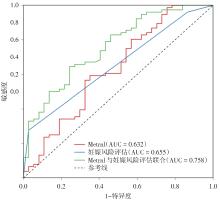
Fig.1
ROC curves of serum Metrnl levels and pregnancy risk assessment for predicting APO"
| [1] |
MITURSKI, A, GĘCA, T, STUPAK, A, et al. Influence of Pre-Pregnancy Obesity on Carbohydrate and Lipid Metabolism with Selected Adipokines in the Maternal and Fetal Compartment[J].Nutrients,2023,15(9):2130.doi:10.3390/nu15092130 .
doi: 10.3390/nu15092130 |
| [2] |
ZHANG Y, LAN X, CAI C, et al. Associations between Maternal Lipid Profiles and Pregnancy Complications: A Prospective Population-Based Study[J].Am J Perinatol,2021,38(8):834-840.doi:10.1055/s-0039-3402724 .
doi: 10.1055/s-0039-3402724 |
| [3] |
王桃,宋成文,魏华芳,等. 高三酰甘油血症对甲状腺功能正常的妊娠晚期孕妇不良妊娠结局的影响[J]. 中华内分泌代谢杂志,2025,41(7):546-551. doi:10.3760/cma.j.cn311282-20250113-00023 .
doi: 10.3760/cma.j.cn311282-20250113-00023 |
| [4] |
LI Z, GAO Z, SUN T, et al. Meteorin-like/Metrnl, a novel secreted protein implicated in inflammation, immunology, and metabolism: A comprehensive review of preclinical and clinical studies[J].Front Immunol,2023,14(1):1098570.doi:10.3389/fimmu.2023.1098570 .
doi: 10.3389/fimmu.2023.1098570 |
| [5] |
DING X, CHANG X, WANG J, et al. Serum Metrnl levels are decreased in subjects with overweight or obesity and are independently associated with adverse lipid profile[J].Front Endocrinol (Lausanne),2022,13(1):938341.doi:10.3389/fendo. 2022. 938341 .
doi: 10.3389/fendo. 2022. 938341 |
| [6] |
XU T Y, QING S L, ZHAO J X, et al. Metrnl deficiency retards skin wound healing in mice by inhibiting AKT/eNOS signaling and angiogenesis[J].Acta Pharmacol Sin,2023,44(9):1790-1800.doi:10.1038/s41401-023-01090-x .
doi: 10.1038/s41401-023-01090-x |
| [7] |
唐正和,刘翠明,马学芹,等. 妊娠期糖尿病患者血清Metrnl、FABP4水平变化及临床意义[J]. 中国计划生育和妇产科,2023,15(1):73-76.doi:10.3969/j.issn.1674-4020.2023.01.18 .
doi: 10.3969/j.issn.1674-4020.2023.01.18 |
| [8] |
刘俊,田福林,陈琳,等. 妊娠早期正常高值血压和1级高血压与孕产妇子痫前期及妊娠不良结局的关系[J]. 实用医学杂志, 2025, 41(10): 1555-1562.doi:10.3969/j.issn.1006-5725.2025.10.018 .
doi: 10.3969/j.issn.1006-5725.2025.10.018 |
| [9] |
肖燕璇,张立力,黎嘉琪,等. 单胎子痫前期孕妇产前体质量指数与母婴结局关系探讨[J]. 实用医学杂志, 2023, 39(18): 2357-2361.doi:10.3969/j.issn.1006-5725.2023.18.012 .
doi: 10.3969/j.issn.1006-5725.2023.18.012 |
| [10] |
中国研究型医院学会糖尿病学专业委员会. 中国妊娠期糖尿病母儿共同管理指南(2024版)[J]. 中华糖尿病杂志,2024,16(12):1324-1345.doi:10.3760/cma.j.cn115791-20240918-00561 .
doi: 10.3760/cma.j.cn115791-20240918-00561 |
| [11] |
中国高血压防治指南修订委员会,高血压联盟(中国,中国医疗保健国际交流促进会高血压病学分会 等. 中国高血压防治指南(2024年修订版)[J]. 中华高血压杂志(中英文), 2024,32(7):603-700. doi: 10.16439/j.issn.1673-7245.2024.07.002 .
doi: 10.16439/j.issn.1673-7245.2024.07.002 |
| [12] |
中华医学会妇产科学分会产科学组,中华医学会围产医学分会. 妊娠期肝内胆汁淤积症临床诊治和管理指南(2024版)[J]. 中华妇产科杂志,2024,59(2):97-107.doi:10.3760/cma.j.cn112141-20230914-00099 .
doi: 10.3760/cma.j.cn112141-20230914-00099 |
| [13] | 孔北华,马丁,段涛. 妇产科学[M]. 10版.北京:人民卫生出版社,2024:131-153. |
| [14] |
袁仙仙,李静,王佳,等. 妊娠期血脂异常患病率及妊娠早期血脂水平预测价值研究[J]. 中国全科医学,2024,27(6):670-678. doi:10.12114/j.issn.1007-9572.2023.0349 .
doi: 10.12114/j.issn.1007-9572.2023.0349 |
| [15] |
JIN W Y, LIN S L, HOU R L, et al. Associations between maternal lipid profile and pregnancy complications and perinatal outcomes: A population-based study from China[J].BMC Pregnancy Childbirth,2016,16(1): 60.doi:10.1186/s12884-016-0852-9 .
doi: 10.1186/s12884-016-0852-9 |
| [16] |
WIZNITZER A, MAYER A, NOVACK V, et al. Association of lipid levels during gestation with preeclampsia and gestational diabetes mellitus: A population-based study[J]. Am J Obstet Gynecol,2009,201(5):482-488.doi:10.1016/j.ajog.2009.05.032 .
doi: 10.1016/j.ajog.2009.05.032 |
| [17] |
DRESNER A, LAURENT D, MARCUCCI M, et al. Effects of free fatty acids on glucose transport and IRS-1-associated phosphatidylinositol 3-kinase activity[J]. J Clin Invest,1999,103(2):253-259.doi:10.1172/JCI5001 .
doi: 10.1172/JCI5001 |
| [18] |
DEJA S, FLETCHER J A, KIM C W, et al. Hepatic malonyl-CoA synthesis restrains gluconeogenesis by suppressing fat oxidation, pyruvate carboxylation, and amino acid availability[J].Cell Metab,2024,36(5):1088-1104.doi:10.1016/j.cmet.2024.02.004 .
doi: 10.1016/j.cmet.2024.02.004 |
| [19] |
KAJITA K, ISHII I, MORI I, et al. Sphingosine 1-phosphate regulates obesity and glucose homeostasis[J].Int J Mol Sci,2024,25(2):932.doi:10.3390/ijms25020932 .
doi: 10.3390/ijms25020932 |
| [20] |
DONG W, HU C, HU M, et al. Metrnl:A promising biomarker and therapeutic target for cardiovascular and metabolic diseases[J].Cell Commun Signal,2024,22(1):389. doi:10.1186/s12964-024-01767-768 .
doi: 10.1186/s12964-024-01767-768 |
| [21] |
BAE J Y. Aerobic exercise increases meteorin‐like protein in muscle and adipose tissue of chronic high‐fat diet‐induced obese mice[J]. Biomed Res Int,2018, 2018(1): 6283932.doi:10.1155/2018/6283932 .
doi: 10.1155/2018/6283932 |
| [22] |
ZHOU Y, HU L, ZHUANG R, et al. METRNL represses beta-to-alpha cell trans-differentiation to maintain beta cell function under diabetic metabolic stress in mice[J].Diabetologia,2025,68(8):1769-1788.doi:10.1007/s00125-025-06459-7 .
doi: 10.1007/s00125-025-06459-7 |
| [23] |
LI Z Y, SONG J, ZHENG S L, et al. Adipocyte Metrnl antagonizes insulin resistance through PPARγ signaling[J].Diabetes,2015, 64(12): 4011-4022.doi:10.2337/db15-0274 .
doi: 10.2337/db15-0274 |
| [24] |
LEE J O, BYUN W S, KANG M J, et al. The myokine meteorin-like (Metrnl) improves glucose tolerance in both skeletal muscle cells and mice by targetingAMPKα2[J]. FEBS J,2020,287(10):2087-2104.doi:10.1111/febs.15301 .
doi: 10.1111/febs.15301 |
| [25] |
杨彬冰,吴晓丽. 早孕期孕妇首次妊娠风险评估及风险因素分析[J]. 中国妇幼保健,2022,37(20):3815-3819.doi:10.19829/j.zgfybj.issn.1001-4411.2022.20.037 .
doi: 10.19829/j.zgfybj.issn.1001-4411.2022.20.037 |
| [26] |
唐文佩,李笑天. 子痫-子痫前期的早期认知与概念演变[J].中华围产医学杂志,2024,27(11):965-969.doi:10.3760/cma.j.cn113903-20240803-00546 .
doi: 10.3760/cma.j.cn113903-20240803-00546 |
| [27] | WEI Z, MU M, LI M, et al. Color Doppler ultrasound detection of hemodynamic changes in pregnant women with GDM and analysis of their influence on pregnancy outcomes[J].Am J Transl Res,2021,13(4):3330. |
| [28] |
CAO X Y, LI M Y, SHAO C X, et al. Fatty Acid Metabolism Disruptions: A Subtle yet Critical Factor in Adverse Pregnancy Outcomes[J].Int J Biol Sci,2024,20(15):6018-6037.doi:10.7150/ijbs.103404 .
doi: 10.7150/ijbs.103404 |
| [29] |
PENG H, WEI M, HUANG L,et al. Maternal obesity inhibits placental angiogenesis by down-regulating the SIRT1/PGC-1α pathway[J]. Ann Transl Med,2022,10(8):446.doi:10.21037/atm-22-1221 .
doi: 10.21037/atm-22-1221 |
| [30] |
GUO J, QIU H, WANG J, et al. Correlation between lipid metabolism levels and pregnancy outcomes[J].Front Med (Lausanne),2025,12(1):1530525.doi:10.3389/fmed.2025.1530525 .
doi: 10.3389/fmed.2025.1530525 |
| [31] |
CHEN D X, FENG Y Y, WANG H Y, et al. Metrnl ameliorates myocardial ischemia-reperfusion injury by activating AMPK-mediated M2 macrophage polarization[J].Mol Med,2025,31(1): 98. doi:10.1186/s10020-025-01150-4 .
doi: 10.1186/s10020-025-01150-4 |
| [32] |
李春华,司津歌,曹伍兰. MiRNA-21-5p靶向调节SATB1参与妊娠滋养层细胞的增殖和迁移作用的研究[J]. 中国妇产科临床杂志,2024,25(5):433-437.doi:10.13390/j.issn.1672-1861. 2024.05.013 .
doi: 10.13390/j.issn.1672-1861. 2024.05.013 |
| [1] | Xiujie WANG,Guodong ZHANG,Zhenguo QIAO,Qiyuan SUN,Gengxu LI,Guojie ZHAI,Xuehua JIAO. Study of the diagnostic value of serum adhesion factors and the triglyceride-glucose index for carotid artery lesions in elderly hypertensive patients with metabolically associated fatty liver disease [J]. The Journal of Practical Medicine, 2026, 42(4): 603-610. |
| [2] | Liuhua HUANG,Ning ZHOU,Zicong ZHOU,Qinghua WU,Weiwei XIAO,Chenguang SHEN,Li ZHU,Wei ZHAO. A study on the association between gestational diabetes mellitus and group B streptococcus infection [J]. The Journal of Practical Medicine, 2026, 42(2): 342-347. |
| [3] | Li WEI,Ziyi LIN,Zhen CHEN,Hejing SUN,Min DONG. Risk stratification value of TyG-BMI for immune-related adverse events in cancer patients treated with immune checkpoint inhibitors [J]. The Journal of Practical Medicine, 2026, 42(1): 12-20. |
| [4] | Wei LIU,Jun HOU,Longquan TANG,Peng ZHOU,Yan ZHONG,Qinyan LUO,Xiaoyu KUANG,Hua LIU,Ziqing XIONG,Wei XIONG,Chenggao WU,Aiping. LE. Analysis of influencing factors of blood transfusion in children with traumatic brain injury and construction of prediction model: A multi⁃center retrospective study [J]. The Journal of Practical Medicine, 2025, 41(4): 553-560. |
| [5] | Le WU,Runlu GENG,Jingjiang ZHOU,Li LI,Lei XU,Jie KANG,Bin LU,Ying YE,Hongning YANG,Weichao. DING. Efficacy of HP in series with CRRT integrated combined blood purification under extracorporeal citrate anticoagulation in the treatment of severe HTG⁃AP [J]. The Journal of Practical Medicine, 2025, 41(4): 561-568. |
| [6] | Dawei WANG,Zheng ZHENG,Yuxiang SHENG,Zhiran LI,Shaohua HUANGFU,Bin. JIANG. Risk factors for multidrug⁃resistant bacterial infections in perianal abscesses and the construction of a nomogram prediction model [J]. The Journal of Practical Medicine, 2025, 41(24): 3897-3903. |
| [7] | Luxing LU,Jing XIE,Yi XIANG,Yuhua ZHENG,Tinchun WU,Dawei LV,Tao. XU. The relationship between hemorheology and carotid atherosclerosis [J]. The Journal of Practical Medicine, 2025, 41(19): 3041-3045. |
| [8] | Shuting ZHENG,Xixi LIU,Shiyang CHEN,Peiqian LAI,Chunhong GUO,Shaohua. CHEN. Latent profiles analysis and influencing factors of Health⁃Promoting Lifestyle in patients with conservative treatment of Lumbar Disc Herniation [J]. The Journal of Practical Medicine, 2025, 41(19): 3052-3059. |
| [9] | Lili SU,Nuo LI,Wei FANG,Menghua CHEN,Sina QIN,Yegui YANG. Association between residual cholesterol and metabolic associated fatty liver disease risk at different triglyceride levels [J]. The Journal of Practical Medicine, 2025, 41(17): 2676-2682. |
| [10] | Yunfang ZHANG,Zheng LI,Xiaogai NIE,Yun GUAN,Qi CHEN,Yong YUAN. D⁃dimer/Alb ratio, IL⁃6 and FDP jointly predict poor outcomes post type A dissection [J]. The Journal of Practical Medicine, 2025, 41(17): 2755-2760. |
| [11] | Haihong WANG,Cui ZHAO,Yishan LI,Shuying. CHEN. Expression of serum miR-15a, miR-195-5p, miR-33 in patients with gestational diabetes and their relationship with maternal and infant outcomes [J]. The Journal of Practical Medicine, 2025, 41(16): 2533-2540. |
| [12] | Hong ZHANG,Rong ZHANG,Pengcheng YANG,Liyan LUO,Wenlong ZHANG,Yurong CHENG,Wenlin LIU,Wenbin. DONG. Construction of risk prediction model for preterm infant respiratory distress syndrome in Dali Prefecture [J]. The Journal of Practical Medicine, 2025, 41(15): 2342-2348. |
| [13] | Huangjunqing LIAO,Jiadong CAO,Zhichao WANG,Qiuhong ZHANG,Jianfu ZHOU,Songtao XIANG. Establishment and validation of a predictive model for the stone⁃free rateafter flexible ureteroscopy for lower pole calculi [J]. The Journal of Practical Medicine, 2025, 41(13): 1979-1986. |
| [14] | Shouping LIU,Yinlin TANG,Yanfang CHENG,Qian ZHOU. Analysis of coagulation and fibrinolysis biomarkers for prognostic assessment and clinical efficacy evaluation in patients with intracerebral hemorrhage [J]. The Journal of Practical Medicine, 2025, 41(12): 1846-1852. |
| [15] | Jun LIU,Fulin TIAN,Lin CHEN,Jian. LI. The relationship between normal high blood pressure and grade 1 hypertension in early pregnancy and maternal preeclampsia and adverse pregnancy outcomes [J]. The Journal of Practical Medicine, 2025, 41(10): 1555-1562. |
| Viewed | ||||||
|
Full text |
|
|||||
|
Abstract |
|
|||||
