

The Journal of Practical Medicine ›› 2026, Vol. 42 ›› Issue (9): 1545-1551.doi: 10.3969/j.issn.1006-5725.2026.09.008
• Oncology: Diagnosis, Treatment and Prevention • Previous Articles
Qiuhong LIN,Chunguang DONG,Jiahui HAN,Hongpeng DONG,Shujia ZHANG( )
)
Received:2026-01-09
Online:2026-05-10
Published:2026-04-29
Contact:
Shujia ZHANG
E-mail:1609835624@qq.com
CLC Number:
Qiuhong LIN,Chunguang DONG,Jiahui HAN,Hongpeng DONG,Shujia ZHANG. The prognostic value of p16 protein expression in predicting outcomes of comprehensive treatment for locally advanced laryngeal and hypopharyngeal carcinoma[J]. The Journal of Practical Medicine, 2026, 42(9): 1545-1551.
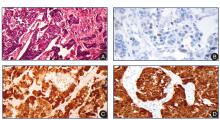
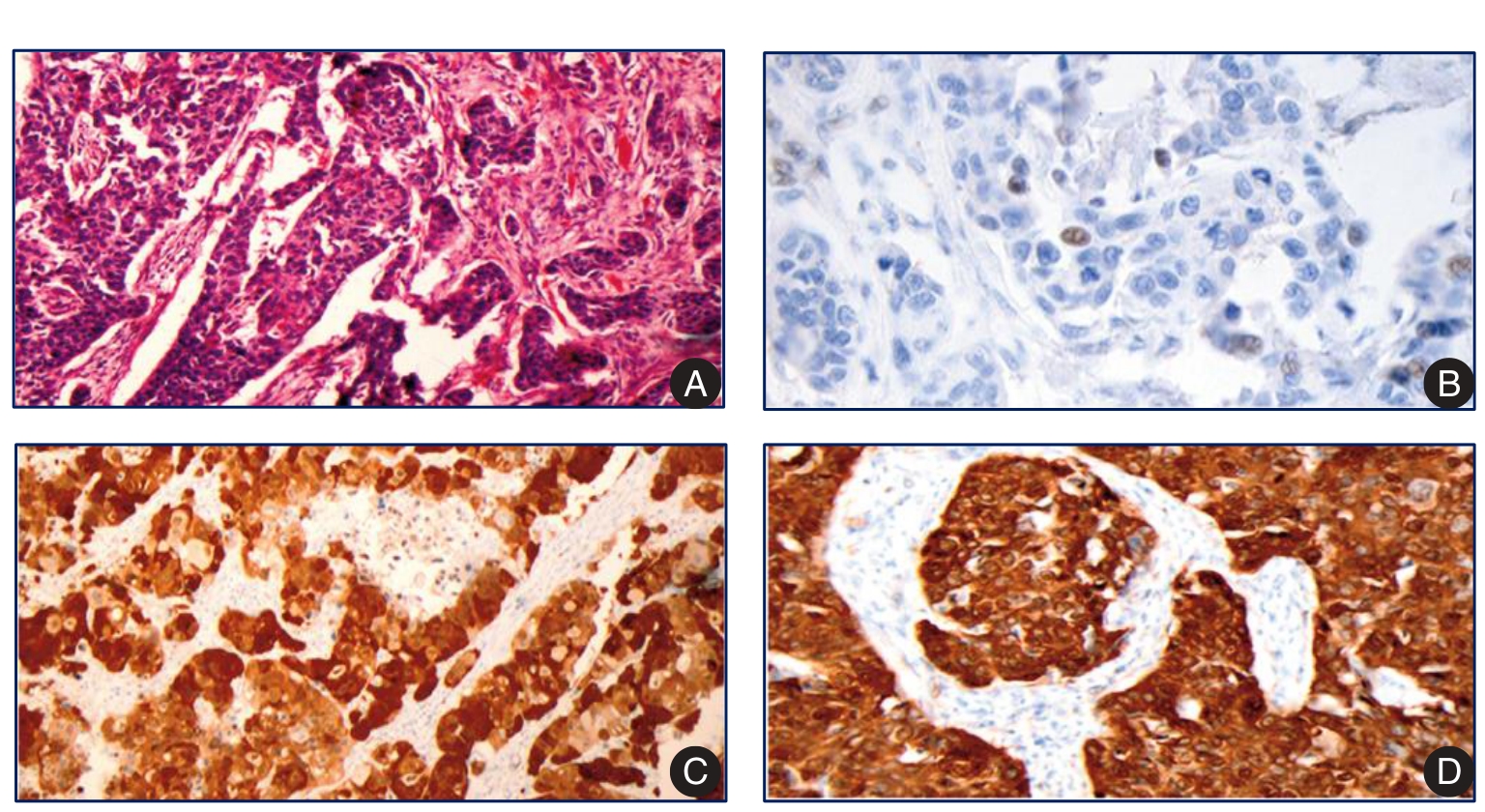
Fig.1
HE staining and IHC detection of p16 expression in tumor tissue"

Tab.1
Comparison of clinicopathological characteristics between the two groups"
| 临床特征 | p16阳性组(n = 31) | p16阴性组(n = 87) | χ2值 | P值 |
|---|---|---|---|---|
| 年龄 | 0.151 | 0.698 | ||
| < 60岁 | 18(58.06) | 47 (54.02) | ||
| ≥ 60岁 | 13(41.94) | 40 (45.08) | ||
| 性别 | 0.153 | 0.696 | ||
| 男 | 27(87.10) | 78(89.66) | ||
| 女 | 4(12.90) | 9(10.34) | ||
| 吸烟史 | 26(83.87) | 70(80.46) | 0.175 | 0.675 |
| 吸烟年限 | 0.001 | 0.969 | ||
| ≥ 10年 | 12(38.71) | 32(36.78) | ||
| < 10年 | 14(45.16) | 38(43.68) | ||
| 饮酒量 | 0.204 | 0.652 | ||
| ≥ 40 g/d | 10(32.26) | 32(36.79) | ||
| < 40 g/d | 21(67.74) | 55(63.21) | ||
| 原发部位 | 0.179 | 0.672 | ||
| 喉 | 24(77.42) | 64(73.56) | ||
| 下咽 | 7(22.58) | 23(26.44) | ||
| TNM分期 | 5.814 | 0.016 | ||
| Ⅲ期 | 10(32.26) | 52(59.77) | ||
| ⅣA期 | 21(67.74) | 35(40.23) | ||
| 肿瘤最大径 | 0.527 | 0.468 | ||
| ≥ 2 cm | 14(45.16) | 43(49.43) | ||
| < 2 cm | 17(54.84) | 44(51.57) | ||
| 分化程度 | 7.255 | 0.007 | ||
| 低分化 | 16(51.61) | 22(25.29) | ||
| 中分化/高分化 | 15(48.39) | 65(74.71) | ||
| 淋巴结转移 | 26(83.87) | 52(59.77) | 5.925 | 0.014 |
| 治疗方案 | 0.490 | 0.484 | ||
| CCRT | 12(38.71) | 40(45.98) | ||
| 手术±辅助 | 19(61.29) | 47(51.02) |
Tab.2
Comparison of survival outcomes between the two groups"
| 指标 | p16阳性组(n = 31) | p16阴性组(n = 87) | Log-rank χ2值 | P值 |
|---|---|---|---|---|
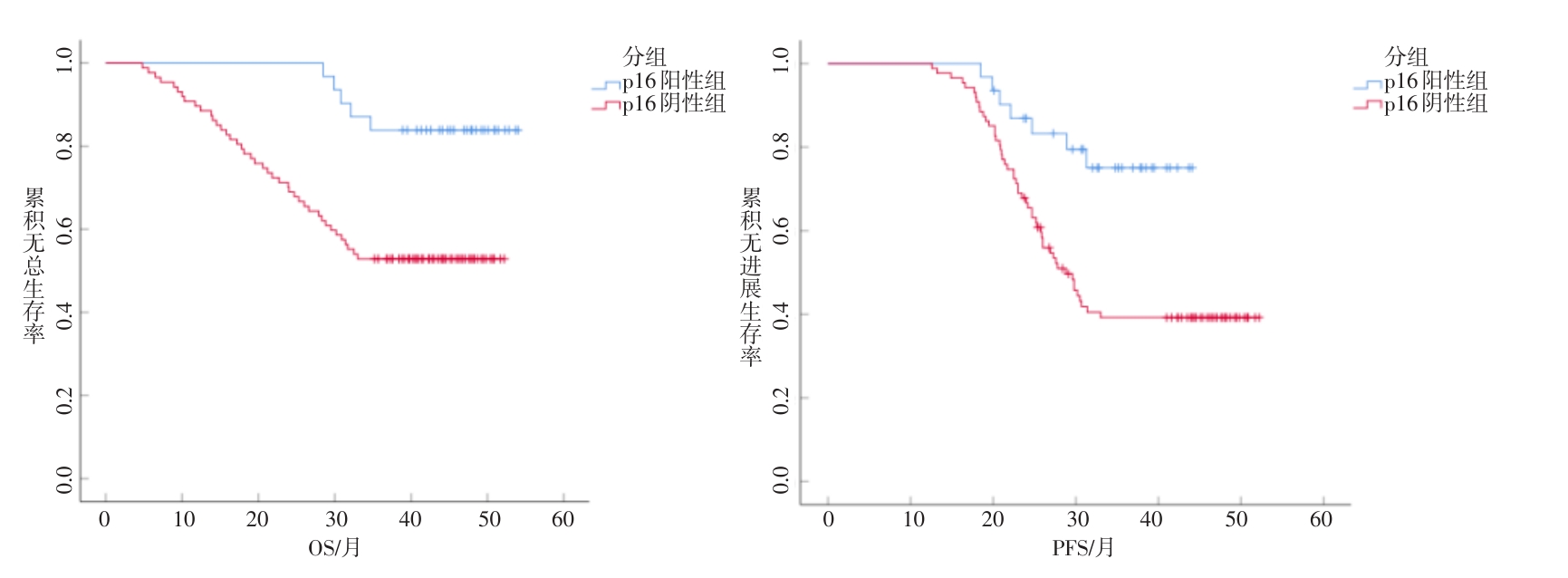
| 中位OS | 未达到 | 36.90(33.29 ~ 40.51) | 9.667 | 0.002 |
| 中位PFS | 39.14(35.88 ~ 42.39) | 34.68(31.56 ~ 37.81) | 9.347 | 0.002 |
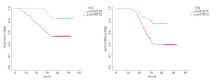
Fig.2
Overall survival and progression-free survival of patients with different p16 protein expression"
Tab.3
Cox multivariate regression analysis of prognostic factors"
| 变量 | OS | PFS | ||
|---|---|---|---|---|
| HR(95%CI) | P值 | HR(95%CI) | P值 | |
| 年龄(≥ 60岁 vs. < 60岁) | 1.21(0.70 ~ 2.09) | 0.511 | 1.16(0.62 ~ 1.89) | 0.539 |
| 吸烟年限(≥10年 vs. <10年) | 1.87(1.32 ~ 3.87) | 0.025 | 1.23(1.13 ~ 2.09) | 0.035 |
| 饮酒量(≥ 40 g/d vs. <40 g/d) | 1.79(1.24 ~ 3.69) | 0.032 | 1.17(1.09 ~ 1.97) | 0.041 |
| 原发部位(下咽 vs. 喉) | 1.33(0.72 ~ 2.47) | 0.367 | 1.29(0.64 ~ 2.26) | 0.371 |
| TNM分期(ⅣA期 vs. Ⅲ期) | 1.45(0.82 ~ 2.57) | 0.201 | 1.38(0.84 ~ 2.28) | 0.204 |
| 淋巴结转移(有 vs. 无) | 2.02(1.25 ~ 4.43) | 0.017 | 1.95(1.17 ~ 4.26) | 0.011 |
| 分化程度(低分化vs. 中高分化) | 1.62(1.12 ~ 3.63) | 0.025 | 1.89(1.21 ~ 4.11) | 0.023 |
| p16蛋白表达(阴性 vs. 阳性) | 2.58(1.75 ~ 5.78) | 0.021 | 2.32(1.36 ~ 4.66) | 0.018 |
| 治疗方案(手术±辅助 vs. CCRT) | 0.85(0.48 ~ 1.51) | 0.584 | 0.88(0.53 ~ 1.47) | 0.629 |
| [1] |
SANGAL N R, XU K, KAKI P, et al. Laryngeal squamous cell carcinoma incidence and survival trends in the United States: A population-based analysis of two decades[J]. Head Neck, 2025, 47(7): 1816-1830. doi:10.1002/hed.28077 .
doi: 10.1002/hed.28077 |
| [2] |
KNOPF A, KETTERER M C, HOFFMANN T K, et al. Treatment regimens for laryngeal and hypopharyngeal squamous cell carcinoma: A “real life” multicenter study of 2307 patients[J]. Eur Arch Otorhinolaryngol, 2025, 282(12): 6609-6621. doi:10.1007/s00405-024-08990-6 .
doi: 10.1007/s00405-024-08990-6 |
| [3] |
DE FRANÇA G M, SILVA W R DA, SANTOS MEDEIROS C K, et al. Five-year survival and prognostic factors for oropharyngeal squamous cell carcinoma: Retrospective cohort of a cancer center[J]. Oral Maxillofac Surg, 2022, 26(2): 261-269. doi:10.1007/s10006-021-00986-4 .
doi: 10.1007/s10006-021-00986-4 |
| [4] |
TURNER B, MACKAY C, TAYLOR S M, et al. Five-year survival outcomes in oropharyngeal squamous cell carcinoma following transoral laser microsurgery[J]. Laryngoscope Investig Otolaryngol, 2022, 8(1): 125-134. doi:10.1002/lio2.994 .
doi: 10.1002/lio2.994 |
| [5] |
COSTANTINO A, MAGNUSON J S, ALAMOUDI U, et al. Prognostic significance of human papillomavirus genotypes in oropharyngeal squamous cell carcinoma[J]. Laryngoscope, 2025, 135(2): 695-704. doi:10.1002/lary.31775 .
doi: 10.1002/lary.31775 |
| [6] |
DE ABREU M, DE ARAUJO OLIVEIRA D M, BASTOS B C, et al. Overall and disease-free survival in patients with HPV-positive and HPV-negative oropharyngeal cancer[J]. Einstein São Palo, 2025,23: eAO1525. doi:10.31744/einstein_journal/2025ao1525 .
doi: 10.31744/einstein_journal/2025ao1525 |
| [7] |
PATEL E J, OLIVER J R, JACOBSON A S, et al. Human papillomavirus in patients with hypopharyngeal squamous cell carcinoma[J]. Otolaryngol Head Neck Surg, 2022, 166(1): 109-117. doi:10.1177/01945998211004586 .
doi: 10.1177/01945998211004586 |
| [8] |
BURR A R, HARARI P M, KO H C, et al. HPV impacts survival of stage IVC non-oropharyngeal HNSCC cancer patients[J]. Otorhinolaryngol Head Neck Surg, 2018, 3(1): 10.15761/OHNS.1000160. doi:10.15761/OHNS.1000160 .
doi: 10.15761/OHNS.1000160 |
| [9] |
LEWIS J S Jr, BEADLE B, BISHOP J A, et al. Human papillomavirus testing in head and neck carcinomas: Guideline update[J]. Arch Pathol Lab Med, 2025, 149(6): e115-e150. doi:10.5858/arpa.2024-0388-CP .
doi: 10.5858/arpa.2024-0388-CP |
| [10] | 中国临床肿瘤学会. 2025 CSCO 头颈部肿瘤诊疗指南[M]. 北京:人民卫生出版社,2025. |
| [11] |
HUANG S H, O’SULLIVAN B. Overview of the 8th edition TNM classification for head and neck cancer[J]. Curr Treat Options Oncol, 2017, 18(7): 40. doi:10.1007/s11864-017-0484-y .
doi: 10.1007/s11864-017-0484-y |
| [12] |
李恒勇, 杨宋, 周凯, 等. 336例HPV相关性与非相关性口咽鳞癌患者生存分析[J]. 中国口腔颌面外科杂志, 2022, 20(4): 378-383. doi:10.19438/j.cjoms.2022.04.011 .
doi: 10.19438/j.cjoms.2022.04.011 |
| [13] |
杨一帆, 王茹, 房居高, 等. 中晚期下咽癌诱导化疗筛选综合治疗的单臂前瞻性研究: 单中心260例报告[J]. 中华耳鼻咽喉头颈外科杂志, 2020, 55(12): 1143-1153. doi:10.3760/cma.j.cn115330-20200417-00306 .
doi: 10.3760/cma.j.cn115330-20200417-00306 |
| [14] |
沈宇杰, 王天, 龚洪立, 等. 诱导化疗敏感性对局晚期下咽癌的预后影响: 单中心回顾性队列研究[J]. 中华耳鼻咽喉头颈外科杂志, 2025, 60(10): 1215-1222. doi:10.3760/cma.j.cn115330-20241210-00688 .
doi: 10.3760/cma.j.cn115330-20241210-00688 |
| [15] |
吴淋蓉, 林晨, 黄钧涛, 等. 人乳头状瘤病毒感染与喉咽鳞状细胞癌相关性的Meta分析及生物信息学分析[J]. 中国耳鼻咽喉头颈外科, 2022, 29(12): 810-816. doi:10.16066/j.1672-7002.2022.12.017 .
doi: 10.16066/j.1672-7002.2022.12.017 |
| [17] |
KIYUNA A, IKEGAMI T, UEHARA T, et al. High-risk type human papillomavirus infection and p16 expression in laryngeal cancer[J]. Infect Agent Cancer, 2019, 14: 8. doi:10.1186/s13027-019-0224-y .
doi: 10.1186/s13027-019-0224-y |
| [18] |
CHEN X, GAO L, STURGIS E M, et al. HPV16 DNA and integration in normal and malignant epithelium: Implications for the etiology of laryngeal squamous cell carcinoma[J]. Ann Oncol, 2017, 28(5): 1105-1110. doi:10.1093/annonc/mdx027 .
doi: 10.1093/annonc/mdx027 |
| [19] |
宋成, 张韶凯, 乔友林. 人乳头状瘤病毒感染对头颈部肿瘤的影响[J]. 中华肿瘤杂志, 2023, 45(1): 39-43. doi:10.3760/cma.j.cn112152-20211130-00884 .
doi: 10.3760/cma.j.cn112152-20211130-00884 |
| [20] |
GONZÁLEZ-GONZÁLEZ R, ORTIZ-SARABIA G, MOLINA-FRECHERO N, et al. Epithelial-mesenchymal transition associated with head and neck squamous cell carcinomas: A review[J]. Cancers, 2021, 13(12): 3027. doi:10.3390/cancers13123027 .
doi: 10.3390/cancers13123027 |
| [21] |
SYRJÄNEN S, SYRJÄNEN K. HPV-associated benign squamous cell papillomas in the upper aero-digestive tract and their malignant potential[J]. Viruses, 2021, 13(8): 1624. doi:10.3390/v13081624 .
doi: 10.3390/v13081624 |
| [22] |
SUBRAMANIAM R M, DEMORA L, YAO M, et al. (18)F-FDG PET/CT prediction of treatment outcomes in human papillomavirus-positive, locally advanced oropharyngeal cancer patients receiving deintensified therapy: Results from NRG-HN002[J]. J Nucl Med, 2023, 64(3): 362-367. doi:10.2967/jnumed.122.264424 .
doi: 10.2967/jnumed.122.264424 |
| [23] |
ZHOU C, PARSONS J L. The radiobiology of HPV-positive and HPV-negative head and neck squamous cell carcinoma[J]. Expert Rev Mol Med, 2020, 22: e3. doi:10.1017/erm.2020.4 .
doi: 10.1017/erm.2020.4 |
| [24] |
HEWAVISENTI R, FERGUSON A, WANG K, et al. CD103+ tumor-resident CD8+ T cell numbers underlie improved patient survival in oropharyngeal squamous cell carcinoma[J]. J Immunother Cancer, 2020, 8(1): e000452. doi:10.1136/jitc-2019-000452 .
doi: 10.1136/jitc-2019-000452 |
| [25] |
WANG S, PANG X, TONG L, et al. LncRNA SELL/L-selectin promotes HPV-positive HNSCC progression and drives fucoidan-mediated therapeutic strategies[J]. Acta Biomater, 2023, 167: 436-448. doi:10.1016/j.actbio.2023.06.011 .
doi: 10.1016/j.actbio.2023.06.011 |
| [26] |
SHEN K A, LEE J J, CHENG S Y, et al. Enhanced glycolysis and nicotinamide metabolism in HPV-positive head and neck cancer[J]. Sci Rep, 2025, 15(1): 42714. doi:10.1038/s41598-025-26690-x .
doi: 10.1038/s41598-025-26690-x |
| [27] |
HARRINGTON K J, BURTNESS B, GREIL R, et al. Pembrolizumab with or without chemotherapy in recurrent or metastatic head and neck squamous cell carcinoma: Updated results of the phase III KEYNOTE-048 study[J]. J Clin Oncol, 2023, 41(4): 790-802. doi:10.1200/JCO.21.02508 .
doi: 10.1200/JCO.21.02508 |
| [28] |
PATEL R R, LUDMIR E B, AUGUSTYN A, et al. De-intensification of therapy in human papillomavirus associated oropharyngeal cancer: A systematic review of prospective trials[J]. Oral Oncol,2020,103:104608.doi:10.1016/j.oraloncology.2020.104608 .
doi: 10.1016/j.oraloncology.2020.104608 |
| [29] |
WONG E T, HUANG S H, O’SULLIVAN B, et al. Head and neck imaging surveillance strategy for HPV-positive oropharyngeal carcinoma following definitive (chemo)radiotherapy[J]. Radiother Oncol,2021,157:255-262.doi:10.1016/j.radonc.2021.02.005 .
doi: 10.1016/j.radonc.2021.02.005 |
| Viewed | ||||||
|
Full text |
|
|||||
|
Abstract |
|
|||||
