

The Journal of Practical Medicine ›› 2026, Vol. 42 ›› Issue (5): 750-758.doi: 10.3969/j.issn.1006-5725.2026.05.004
• Oncology: Diagnosis, Treatment and Prevention • Previous Articles
Bin YU1,Jian ZHOU1,Tian TIAN1( ),Fusheng WANG2
Received:2025-12-11
Online:2026-03-10
Published:2026-03-09
Contact:
Tian TIAN
E-mail:tiannt@qq.com
CLC Number:
Bin YU,Jian ZHOU,Tian TIAN,Fusheng WANG. The efficacy of bevacizumab combined with chemotherapy in the treatment of postoperative patients with oligometastatic colorectal cancer and its impact on mpfs median progression-free survival[J]. The Journal of Practical Medicine, 2026, 42(5): 750-758.
Tab.1
Comparison of baseline data between the two groups"
| 项目 | 联合组 (n = 30) | 化疗组 (n = 72) | χ2/t值 | P值 |
|---|---|---|---|---|
| 性别/[例(%)] | 0.031 | 0.860 | ||
| 男 | 22(73.33) | 54(75.00) | ||
| 女 | 8(26.67) | 18(25.00) | ||
| 年龄/岁 | 58.61 ± 5.96 | 58.86 ± 6.34 | 0.185 | 0.854 |
| 体质量/kg | 62.57 ± 15.71 | 61.98 ± 18.26 | 0.155 | 0.877 |
| ECOG评分/[例(%)] | 0.006 | 0.997 | ||
| 0分 | 9(30.00) | 22(30.56) | ||
| 1分 | 15(50.00) | 36(50.00) | ||
| ≥ 2分 | 6(20.00) | 14(19.44) | ||
| 转移灶数目/个 | 2.01 ± 0.51 | 1.98 ± 0.47 | 0.286 | 0.775 |
| 转移灶最大径/mm | 37.11 ± 5.26 | 36.97 ± 6.17 | 0.109 | 0.914 |
| 转移灶部位/[例(%)] | 0.180 | 0.981 | ||
| 肺 | 14(46.67) | 32(44.44) | ||
| 肝 | 9(30.00) | 21(29.17) | ||
| 骨/脊椎 | 4(13.33) | 12(16.67) | ||
| 其他 | 3(10.00) | 7(9.72) |
Tab.2
Comparison of tumor control between the two groups"
| 项目 | 联合组(n = 30) | 化疗组(n = 72) | χ2/Z值 | P值 |
|---|---|---|---|---|
| CR | 0(0.00) | 0(0.00) | 2.112 | 0.034 |
| PR | 18(60.00) | 29(40.28) | ||
| SD | 7(23.33) | 16(22.22) | ||
| PD | 5(16.67) | 27(37.50) | ||
| ORR | 18(60.00) | 29(40.28) | 3.315 | 0.068 |
| DCR | 25(83.33) | 45(62.50) | 4.269 | 0.039 |
Tab.3
Comparison of serum marker levels between the two groups"
| 组别 | 例数 | CEA/(ng/mL) | CA199/(U/mL) | PLR | |||
|---|---|---|---|---|---|---|---|
| 治疗前 | 治疗结束 | 治疗前 | 治疗结束 | 治疗前 | 治疗结束 | ||
| 联合组 | 30 | 38.96 ± 10.25 | 12.63 ± 4.02* | 99.56 ± 20.14 | 30.25 ± 10.01* | 244.36 ± 50.79 | 170.26 ± 38.39* |
| 化疗组 | 72 | 37.75 ± 9.78 | 19.52 ± 6.24* | 101.75 ± 23.69 | 42.26 ± 9.87* | 250.74 ± 48.93 | 218.14 ± 26.17* |
| t值 | 0.561 | 5.576 | 0.444 | 5.576 | 0.593 | 7.289 | |
| P值 | 0.576 | < 0.001 | 0.658 | < 0.001 | 0.554 | < 0.001 | |
Tab.4
Comparison of the incidence of toxic and side"
| 毒副反应 | 联合组 (n = 30) | 化疗组 (n = 72) | χ2值 | P值 |
|---|---|---|---|---|
| 恶心呕吐 | ||||
| 1—2级 | 14(46.67) | 32(44.44) | 0.042 | 0.837 |
| 3—4级 | 1(3.33) | 3(4.17) | 0.131 | 0.717 |
| 腹泻 | ||||
| 1—2级 | 11(36.67) | 25(34.72) | 0.035 | 0.851 |
| 3—4级 | 1(3.33) | 2(2.78) | 0.242 | 0.623 |
| 食欲不振 | ||||
| 1—2级 | 10(33.33) | 23(31.94) | 0.019 | 0.891 |
| 3—4级 | 0(0.00) | 1(1.39) | 0.206 | 0.650 |
| 骨髓抑制 | ||||
| 1—2级 | 15(50.00) | 38(52.78) | 0.066 | 0.798 |
| 3—4级 | 2(6.67) | 4(5.56) | 0.060 | 0.807 |
| 神经毒性 | ||||
| 1—2级 | 12(40.00) | 28(38.89) | 0.011 | 0.917 |
| 3—4级 | 2(6.67) | 5(6.94) | 0.144 | 0.705 |
| 高血压 | ||||
| 1—2级 | 5(16.67) | 7(9.72) | 0.984 | 0.321 |
| 3—4级 | 1(3.33) | 0(0.00) | 0.206 | 0.650 |
| 蛋白尿 | ||||
| 1—2级 | 4(13.33) | 2(2.78) | 2.568 | 0.109 |
| 3—4级 | 0(0.00) | 0(0.00) | - | - |
Tab.5
Comparison of PFS and OS between the two groups during follow-up"
| 组别 | PFS | OS | ||||||
|---|---|---|---|---|---|---|---|---|
| 均值 | 95%CI | 中位数 | 95%CI | 均值 | 95%CI | 中位数 | 95%CI | |
| 联合组(n = 30) | 24.14 | 20.87 ~ 27.42 | 27.80 | 23.69 ~ 31.91 | 28.72 | 26.45 ~ 30.99 | 32.10 | 28.78 ~ 35.42 |
| 化疗组(n = 72) | 16.05 | 13.38 ~ 18.71 | 8.300 | 6.84 ~ 9.76 | 21.50 | 19.49 ~ 23.51 | 23.70 | 21.58 ~ 25.82 |
| Log-rank χ2值 | 10.020 | 15.444 | ||||||
| P值 | 0.002 | < 0.001 | ||||||
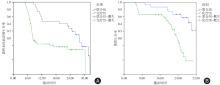
Fig.1
Two groups of follow?up survival curves"
Tab.6
Comparison of serum biomarker levels at the end of treatment among oligometastatic colorectal cancer patients with different prognoses"
| 血清标志物 | 进展组 (n = 62) | 无进展组(n = 40) | t值 | P值 |
|---|---|---|---|---|
| CEA/(ng/mL) | 20.06 ± 6.25 | 13.52 ± 4.56 | 5.706 | < 0.001 |
| CA199/(U/mL) | 42.15 ± 9.25 | 33.42 ± 10.94 | 4.329 | < 0.001 |
| PLR | 217.52 ± 37.69 | 183.19 ± 17.48 | 5.392 | < 0.001 |
| LMR | 3.11 ± 1.07 | 3.70 ± 1.04 | 2.749 | 0.007 |
| CRP/ALB | 0.69 ± 0.20 | 0.55 ± 0.19 | 3.519 | 0.001 |
Tab.7
Correlation between serum markers at the end oftreatment and survival prognosis in patients witholigometastatic colorectal cancer"
| 血清标志物 | mPFS | 中位OS | ||
|---|---|---|---|---|
| r | P值 | r | P值 | |
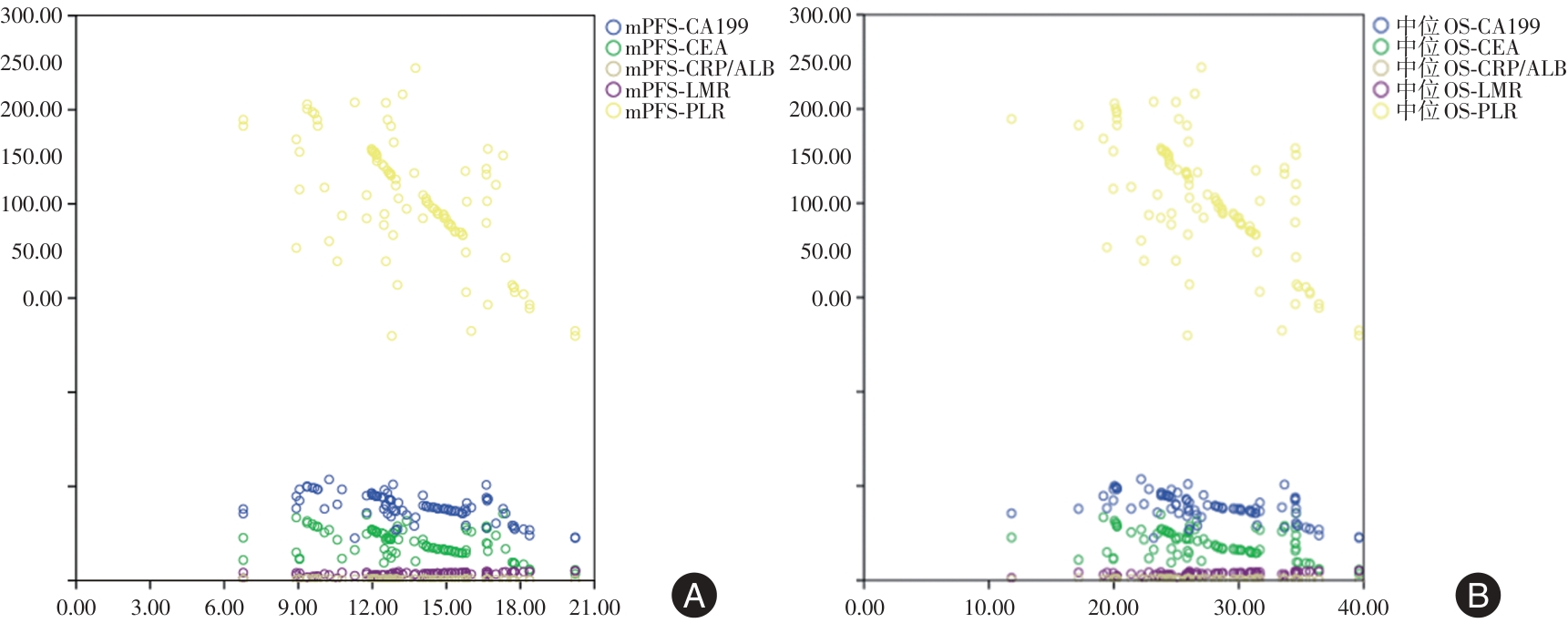
| CEA | -0.439 | < 0.001 | -0.437 | < 0.001 |
| CA199 | -0.579 | < 0.001 | -0.559 | < 0.001 |
| PLR | -0.628 | < 0.001 | -0.637 | < 0.001 |
| LMR | 0.608 | < 0.001 | 0.630 | < 0.001 |
| CRP/ALB | -0.587 | < 0.001 | -0.565 | < 0.001 |
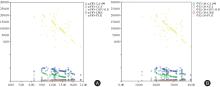
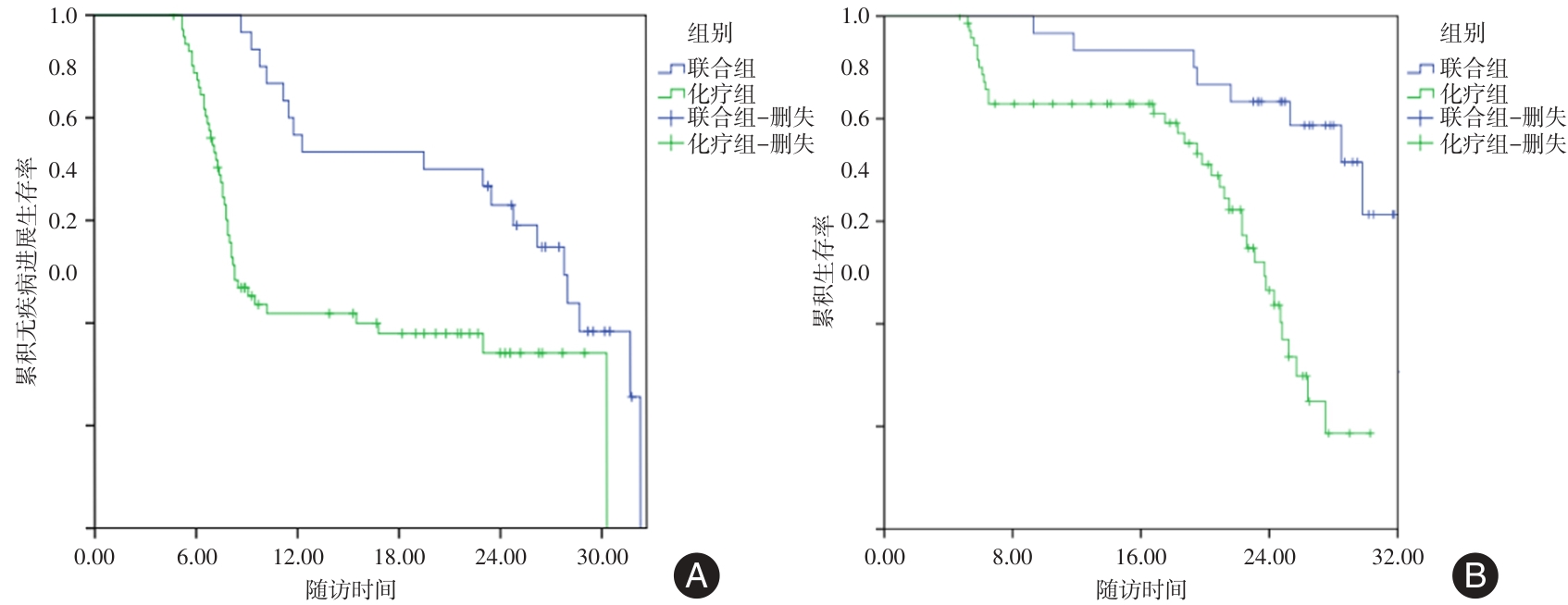
Fig.2
Scatter plots of the correlation between PFS, OS and serum markers"
Tab.8
Univariate and multivariate Cox regression analysis of prognostic factors in patients with oligometastatic colorectal cancer"
| 变量 | 赋值 | 单因素 | 多因素 | ||||
|---|---|---|---|---|---|---|---|
| HR | 95%CI | P值 | HR | 95%CI | P值 | ||
| 治疗方案 | FOLFOX化疗= 1,贝伐珠单抗+ FOLFOX化疗= 0 | 2.568 | 1.387 ~ 4.752 | 0.003 | 0.389 | 0.208 ~ 0.728 | 0.003 |
| 治疗结束CEA | 连续变量(实测值) | 1.987 | 1.301 ~ 3.025 | 0.001 | 1.789 | 1.156 ~ 2.765 | 0.009 |
| 治疗结束CA199 | 连续变量(实测值) | 1.892 | 1.215 ~ 2.956 | 0.005 | 1.456 | 0.932 ~ 2.278 | 0.098 |
| 治疗结束PLR | 连续变量(实测值) | 1.678 | 1.162 ~ 2.421 | 0.006 | 1.321 | 0.923 ~ 1.895 | 0.125 |
| 治疗结束LMR | 连续变量(实测值) | 0.498 | 0.301 ~ 0.825 | 0.007 | 0.589 | 0.356 ~ 0.978 | 0.041 |
| 治疗结束CRP/ALB | 连续变量(实测值) | 1.795 | 1.187 ~ 2.712 | 0.006 | 1.423 | 1.121 ~ 2.198 | 0.038 |
| [1] |
XIA C, DONG X, LI H, et al. Cancer statistics in China and United States, 2022: Profiles, trends, and determinants[J]. Chin Med J (Engl), 2022, 135(5): 584-590. doi: 10.1097/CM9.0000000000002108 .
doi: 10.1097/CM9.0000000000002108 |
| [2] |
SHAUKAT A, KAHI C J, BURKE C A, et al. ACG Clinical Guidelines: Colorectal Cancer Screening 2021[J]. Am J Gastroenterol, 2021, 116(3): 458-479. doi: 10.14309/ajg. 0000000000001122 .
doi: 10.14309/ajg. 0000000000001122 |
| [3] |
WU M, WU X, WANG X, et al. IDO1/COX2 Expression Is Associated with Poor Prognosis in Colorectal Cancer Liver Oligometastases[J]. J Pers Med, 2023, 13(3): 496. doi: 10.3390/jpm13030496 .
doi: 10.3390/jpm13030496 |
| [4] |
LI B, WEI Z, WANG Z, et al. Fusobacterium nucleatum induces oxaliplatin resistance by inhibiting ferroptosis through E-cadherin/β-catenin/GPX4 axis in colorectal cancer[J]. Free Radic Biol Med, 2024, 220: 125-138. doi: 10.1016/j.freeradbiomed. 2024. 04.226 .
doi: 10.1016/j.freeradbiomed. 2024. 04.226 |
| [5] |
JUŘICA J, ŠUVEROVÁ P, GONĚC R, et al. High vs. low-dose leucovorin in regimens with fluorouracil in colorectal cancer therapy[J]. Ceska Slov Farm, 2023, 72(3): 107-112. doi:10.5817/csf2023-3-107
doi: 10.5817/csf2023-3-107 |
| [6] |
LENZ H J, PARIKH A, SPIGEL D R, et al. Modified FOLFOX6 plus bevacizumab with and without nivolumab for first-line treatment of metastatic colorectal cancer: Phase 2 results from the CheckMate 9X8 randomized clinical trial[J]. J Immunother Cancer, 2024, 12(3): e008409. doi: 10.1136/jitc-2023-008409 .
doi: 10.1136/jitc-2023-008409 |
| [7] |
ROSSINI D, ANTONIOTTI C, LONARDI S, et al. Upfront Modified Fluorouracil, Leucovorin, Oxaliplatin, and Irinotecan Plus Panitumumab Versus Fluorouracil, Leucovorin, and Oxaliplatin Plus Panitumumab for Patients With RAS/BRAF Wild-Type Metastatic Colorectal Cancer: The Phase Ⅲ TRIPLETE Study by GONO[J]. J Clin Oncol, 2022, 40(25): 2878-2888. doi: 10.1200/JCO.22.00839 .
doi: 10.1200/JCO.22.00839 |
| [8] |
WANG F, JIN Y, WANG M, et al. Combined anti-PD-1, HDAC inhibitor and anti-VEGF for MSS/pMMR colorectal cancer: A randomized phase 2 trial[J]. Nat Med, 2024, 30(4): 1035-1043. doi: 10.1038/s41591-024-02813-1 .
doi: 10.1038/s41591-024-02813-1 |
| [9] |
AHN D H, BARZI A, RIDINGER M, et al. Onvansertib in Combination with FOLFIRI and Bevacizumab in Second-Line Treatment of KRAS-Mutant Metastatic Colorectal Cancer: A Phase Ib Clinical Study[J]. Clin Cancer Res, 2024, 30(10): 2039-2047. doi: 10.1158/1078-0432 .
doi: 10.1158/1078-0432 |
| [10] |
中华人民共和国国家卫生健康委员会. 中国结直肠癌诊疗规范(2020版)[J]. 中华消化外科杂志, 2020, 19(6): 563-588. doi: 10.3760/cma.j.cn115610-20200504-00348 .
doi: 10.3760/cma.j.cn115610-20200504-00348 |
| [11] |
ARAS M, ERDIL T Y, DANE F, et al. Comparison of WHO, RECIST 1.1, EORTC, and PERCIST criteria in the evaluation of treatment response in malignant solid tumors[J]. Nucl Med Commun, 2016, 37(1): 9-15. doi: 10.1097/MNM. 0000000000000401 .
doi: 10.1097/MNM. 0000000000000401 |
| [12] |
FREITES-MARTINEZ A, SANTANA N, ARIAS-SANTIAGO S, et al. Using the Common Terminology Criteria for Adverse Events (CTCAE-Version 5.0) to Evaluate the Severity of Adverse Events of Anticancer Therapies[J]. Actas Dermosifiliogr (Engl Ed), 2021, 112(1): 90-92. doi: 10.1016/j.ad.2019.05.009 .
doi: 10.1016/j.ad.2019.05.009 |
| [13] |
NESS R M, LLOR X, ABBASS M A, et al. NCCN Guidelines® Insights: Colorectal Cancer Screening, Version 1.2024[J]. J Natl Compr Canc Netw, 2024, 22(7): 438-446. doi: 10.6004/jnccn. 2024.0047 .
doi: 10.6004/jnccn. 2024.0047 |
| [14] |
SUYDAM C R, SCHLUSSEL A T. Management of Oligometastatic Colorectal Cancer[J]. Surg Clin North Am, 2024, 104(3): 619-629. doi: 10.1016/j.suc.2023.11.011 .
doi: 10.1016/j.suc.2023.11.011 |
| [15] |
CARCONI C, CERRETI M, ROBERTO M, et al. The management of oligometastatic disease in colorectal cancer: Present strategies and future perspectives[J]. Crit Rev Oncol Hematol, 2023, 186: 103990. doi: 10.1016/j.critrevonc.2023.103990 .
doi: 10.1016/j.critrevonc.2023.103990 |
| [16] |
郑凯, 张天可, 付文政. XPC基因遗传变异对接受奥沙利铂辅助化疗方案的Ⅲ期结直肠癌患者的神经毒性及预后的影响[J]. 实用医学杂志, 2021, 37(10): 1301-1306. doi:10.3969/j.issn. 1006-5725.2021.10.014 .
doi: 10.3969/j.issn. 1006-5725.2021.10.014 |
| [17] |
WANG H, ZHENG J, PAN J, et al. Neoadjuvant triple-modality therapy with immune checkpoint blockade, anti-angiogenesis, and chemotherapy enhances pathologic response and survival in locally advanced and metastatic colorectal cancer: A multicenter cohort study[J]. Int J Colorectal Dis, 2025, 40(1): 154. doi: 10.1007/s00384-025-04945-3 .
doi: 10.1007/s00384-025-04945-3 |
| [18] |
MILLER E D, HITCHCOCK K E, ROMESSER P B. Oligometastatic Colorectal Cancer: A Review of Definitions and Patient Selection for Local Therapies[J]. J Gastrointest Cancer, 2023, 54(4): 1116-1127. doi: 10.1007/s12029-022-00900-5 .
doi: 10.1007/s12029-022-00900-5 |
| [19] |
YANG L, XIE H J, LI Y Y, et al. Molecular mechanisms of platinum‑based chemotherapy resistance in ovarian cancer (Review)[J]. Oncol Rep, 2022, 47(4): 82. doi: 10.3892/or. 2022. 8293 .
doi: 10.3892/or. 2022. 8293 |
| [20] |
DE BAERE T, TSELIKAS L, DELPLA A, et al. Thermal ablation in the management of oligometastatic colorectal cancer[J]. Int J Hyperthermia, 2022, 39(1): 627-632. doi: 10.1080/02656736.2021.1941311 .
doi: 10.1080/02656736.2021.1941311 |
| [21] |
CHEN Y W, MCKAY R R. Mitigating the Risk of Skeletal Events in Metastatic Renal Cell Carcinoma[J]. Eur Urol Focus, 2025, 11(3): 425-428. doi: 10.1016/j.euf.2025.04.007 .
doi: 10.1016/j.euf.2025.04.007 |
| [22] |
ZHENG Y, ZHOU R, CAI J, et al. Matrix Stiffness Triggers Lipid Metabolic Cross-talk between Tumor and Stromal Cells to Mediate Bevacizumab Resistance in Colorectal Cancer Liver Metastases[J]. Cancer Res, 2023, 83(21): 3577-3592. doi: 10.1158/0008-5472 .
doi: 10.1158/0008-5472 |
| [23] |
WANG J, LIU C, WANG P, et al. Bioengineered Tumor-Derived Extracellular Vehicles Suppressed Colorectal Cancer Liver Metastasis and Bevacizumab Resistance[J]. Adv Sci (Weinh), 2025, 12(23): e2417714. doi: 10.1002/advs.202417714 .
doi: 10.1002/advs.202417714 |
| [24] |
TAKAKURA Y, SHINOZAKI K, IKEDA S, et al. Preoperative Versus Postoperative Chemotherapy With CAPOX Plus Bevacizumab for Resectable Colorectal Liver Metastases: A Randomized Phase II Trial (HiSCO-01)[J]. Ann Gastroenterol Surg, 2025, 9(6): 1253-1262. doi: 10.1002/ags3.70035 .
doi: 10.1002/ags3.70035 |
| [25] |
BOND M J G, BOLHUIS K, LOOSVELD O J L, et al. First-Line Systemic Treatment for Initially Unresectable Colorectal Liver Metastases: Post Hoc Analysis of the CAIRO5 Randomized Clinical Trial[J]. JAMA Oncol, 2025, 11(1): 36-45. doi: 10.1001/jamaoncol.2024.5174 .
doi: 10.1001/jamaoncol.2024.5174 |
| [26] |
LIU X, CHEN Z, YAN P, et al. Treatment mechanism and research progress of bevacizumab for glioblastoma[J]. Am J Cancer Res, 2025, 15(4): 1874-1901. doi: 10.62347/RNUE7193 .
doi: 10.62347/RNUE7193 |
| [27] |
OHISHI T, KANEKO M K, YOSHIDA Y, et al. Current Targeted Therapy for Metastatic Colorectal Cancer[J]. Int J Mol Sci, 2023, 24(2): 1702. doi: 10.3390/ijms24021702 .
doi: 10.3390/ijms24021702 |
| [28] |
ELSAYED A, PLÜSS L, NIDEROEST L, et al. Optimizing the Design and Geometry of T Cell-Engaging Bispecific Antibodies Targeting CEA in Colorectal Cancer[J]. Mol Cancer Ther, 2024, 23(7): 1010-1020. doi: 10.1158/1535-7163 .
doi: 10.1158/1535-7163 |
| [29] |
WANG K, MA L, CHEN L, et al. The clinical value of a nomogram constructed from CEA, CA199, PT, FIB, tumor differentiation and TNM stage in colorectal cancer[J]. Cancer Biomark, 2023, 38(4): 537-549. doi: 10.3233/CBM-230116 .
doi: 10.3233/CBM-230116 |
| [30] |
张昊晨, 周欣毅, 富栋梁, 等. rigosertib联合化疗对Kirsten大鼠肉瘤病毒癌基因同源物突变型结直肠癌小鼠的疗效和不良反应[J]. 中华肿瘤杂志, 2023, 45(2): 138-145. doi: 10.3760/cma.j.cn112152-20210514-00379 .
doi: 10.3760/cma.j.cn112152-20210514-00379 |
| [31] |
MISIEWICZ A, DYMICKA-PIEKARSKA V. Fashionable, but What is Their Real Clinical Usefulness? NLR, LMR, and PLR as a Promising Indicator in Colorectal Cancer Prognosis: A Systematic Review[J]. J Inflamm Res, 2023, 16: 69-81. doi: 10.2147/JIR.S391932 .
doi: 10.2147/JIR.S391932 |
| [32] |
GAWIŃSKI C, MICHALSKI W, MRÓZ A, et al. Correlation between Lymphocyte-to-Monocyte Ratio (LMR), Neutrophil-to-Lymphocyte Ratio (NLR), Platelet-to-Lymphocyte Ratio (PLR) and Tumor-Infiltrating Lymphocytes (TILs) in Left-Sided Colorectal Cancer Patients[J]. Biology (Basel), 2022, 11(3): 385. doi: 10.3390/biology11030385 .
doi: 10.3390/biology11030385 |
| [33] |
FENG J, WANG L, WANG L, et al. Clinical significance of Osaka prognostic score based on nutritional and inflammatory status in patients with esophageal squamous cell carcinoma[J]. BMC Cancer, 2022, 22(1): 284. doi: 10.1186/s12885-022-09406-6 .
doi: 10.1186/s12885-022-09406-6 |
| [34] |
张旭, 张庆, 郭帅, 等. 联合贝伐珠单抗的新辅助治疗对局部晚期直肠癌的疗效与安全性分析[J]. 中国普通外科杂志, 2024, 33(10): 1623-1632. doi: 10.7659/j.issn.1005-6947. 2024.10.009 .
doi: 10.7659/j.issn.1005-6947. 2024.10.009 |
| [35] |
王翠翠, 乔万通, 姚俊英, 等. 营养控制状态评分联合预后营养指数评估老年结直肠癌患者合并贫血风险的临床应用价值[J]. 实用医学杂志, 2025, 41(17): 2696-2704. doi: 10.3969/j.issn.1006-5725.2025.17.013 .
doi: 10.3969/j.issn.1006-5725.2025.17.013 |
| Viewed | ||||||
|
Full text |
|
|||||
|
Abstract |
|
|||||
