

The Journal of Practical Medicine ›› 2026, Vol. 42 ›› Issue (8): 1421-1427.doi: 10.3969/j.issn.1006-5725.2026.08.016
• Treatise: Clinical Practice • Previous Articles
Xiaoming GUO,Zhiyong CAO,Zhenhui LU,Jinyu GU,Can XING,Xiangyang ZHU( )
)
Received:2025-12-04
Online:2026-04-25
Published:2026-04-28
Contact:
Xiangyang ZHU
E-mail:sjnkzxy@163.com
CLC Number:
Xiaoming GUO,Zhiyong CAO,Zhenhui LU,Jinyu GU,Can XING,Xiangyang ZHU. Mediating effect of sleep quality on the relationship between cerebral small vessel disease and cognitive function among older adults in Nantong[J]. The Journal of Practical Medicine, 2026, 42(8): 1421-1427.
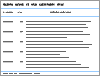
Tab.1
Comparison of baseline characteristics between CI and non-CI groups"
| 变量 | 所有患者 | CI组 | 非CI组 | t/χ2/Z值 | P值 |
|---|---|---|---|---|---|
| (n = 412) | (n = 192) | (n = 220) | |||
| 年龄/岁 | 68.73 ± 5.81 | 70.13 ± 5.97 | 67.51 ± 5.38 | 4.652 | < 0.001 |
| 男性/[例(%)] | 212(51.5) | 103(53.6) | 109(49.5) | 0.690 | 0.406 |
| 受教育年限/年 | 8.99 ± 3.09 | 8.26 ± 3.32 | 9.63 ± 2.72 | -4.613 | < 0.001 |
| 血管危险因素 | |||||
| BMI/(kg/m2) | 24.74 ± 3.39 | 25.01 ± 3.60 | 24.50 ± 3.18 | 1.541 | 0.124 |
| 高血压/[例(%)] | 263(63.8) | 133(69.3) | 130(59.1) | 4.602 | 0.032 |
| 糖尿病/[例(%)] | 140(34.0) | 77(40.1) | 63(28.6) | 6.010 | 0.014 |
| 高脂血症/[例(%)] | 150(36.4) | 81(42.2) | 69(31.4) | 5.188 | 0.023 |
| 吸烟/[例(%)] | 125(30.3) | 64(33.3) | 61(27.7) | 1.525 | 0.217 |
| 饮酒/[例(%)] | 143(34.7) | 73(38.0) | 70(31.8) | 1.741 | 0.187 |
| HAMA[M(P25,P75)]/分 | 4(2, 5) | 4(3, 6) | 4(2, 5) | -1.690 | 0.091 |
| HAMD-17[M(P25,P75)]/分 | 3(2, 4) | 3(2, 5) | 3(2, 4) | -0.734 | 0.463 |
| CSVD影像学标志物/[例(%)] | |||||
| 腔隙 | 271(65.8) | 140(72.9) | 131(59.5) | 8.143 | 0.004 |
| 中-重度WMH | 189(45.9) | 118(61.5) | 71(32.3) | 35.172 | < 0.001 |
| CMB | 128(31.1) | 72(37.5) | 56(25.5) | 6.946 | 0.008 |
| > 10个BG-EPVS | 162(39.3) | 90(46.9) | 72(32.7) | 8.601 | 0.003 |
| CSVD负担[M(P25,P75)]/分 | 2.00(1.00,3.00) | 2.00(1.00,3.00) | 1.50(1.00,2.00) | -5.900 | < 0.001 |
| PSQI/分 | 7.28 ± 4.00 | 9.01 ± 4.40 | 5.78 ± 2.90 | 8.659 | < 0.001 |
| MoCA/分 | 22.67 ± 5.77 | 18.05 ± 5.48 | 26.70 ± 1.14 | -21.453 | < 0.001 |
Tab.2
Multiple linear regression analysis model with the MoCA score as the dependent variable"
| MoCA评分 | 未调整模型 | 调整后模型# | |||||
|---|---|---|---|---|---|---|---|
| β | 95%CI | P值 | β | 95%CI | P值 | ||
| CSVD负担 | -0.671 | -0.743 ~ -0.599 | < 0.001 | -0.599 | -0.668 ~ -0.530 | < 0.001 | |
| 腔隙数量 | -0.351 | -0.442 ~ -0.260 | < 0.001 | -0.284 | -0.368 ~ -0.200 | < 0.001 | |
| WMH Fazekas评分 | -0.500 | -0.584 ~ -0.416 | < 0.001 | -0.420 | -0.500 ~ -0.340 | < 0.001 | |
| CMB数量 | -0.310 | -0.402 ~ -0.218 | < 0.001 | -0.258 | -0.343~ -0.174 | < 0.001 | |
| BG-EPVS数量 | -0.398 | -0.487 ~ -0.309 | < 0.001 | -0.378 | -0.458 ~ -0.299 | < 0.001 | |
| PSQI评分 | -0.541 | -0.622 ~ -0.459 | < 0.001 | -0.453 | -0.532 ~ -0.374 | < 0.001 | |
Tab.3
Multiple linear regression analysis model with the PSQI score as the dependent variable"
| PSQI评分 | 未调整模型 | 调整后模型# | |||||
|---|---|---|---|---|---|---|---|
| β | 95%CI | P值 | β | 95%CI | P值 | ||
| CSVD负担 | 0.349 | 0.259~ 0.440 | < 0.001 | 0.305 | 0.212 ~ 0.399 | < 0.001 | |
| 腔隙数量 | 0.143 | 0.047 ~ 0.239 | 0.004 | 0.106 | 0.011 ~ 0.202 | 0.029 | |
| WMH Fazekas评分 | 0.293 | 0.200 ~ 0.386 | < 0.001 | 0.247 | 0.152 ~ 0.341 | < 0.001 | |
| CMB数量 | 0.133 | 0.037 ~ 0.230 | 0.007 | 0.101 | 0.005 ~ 0.196 | 0.039 | |
| BG-EPVS数量 | 0.239 | 0.144 ~ 0.333 | < 0.001 | 0.227 | 0.134 ~ 0.320 | < 0.001 | |
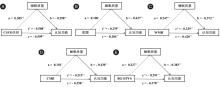
Fig.1
Path diagram of the mediating effect of sleep quality on the relationship between CSVD and cognitive function"
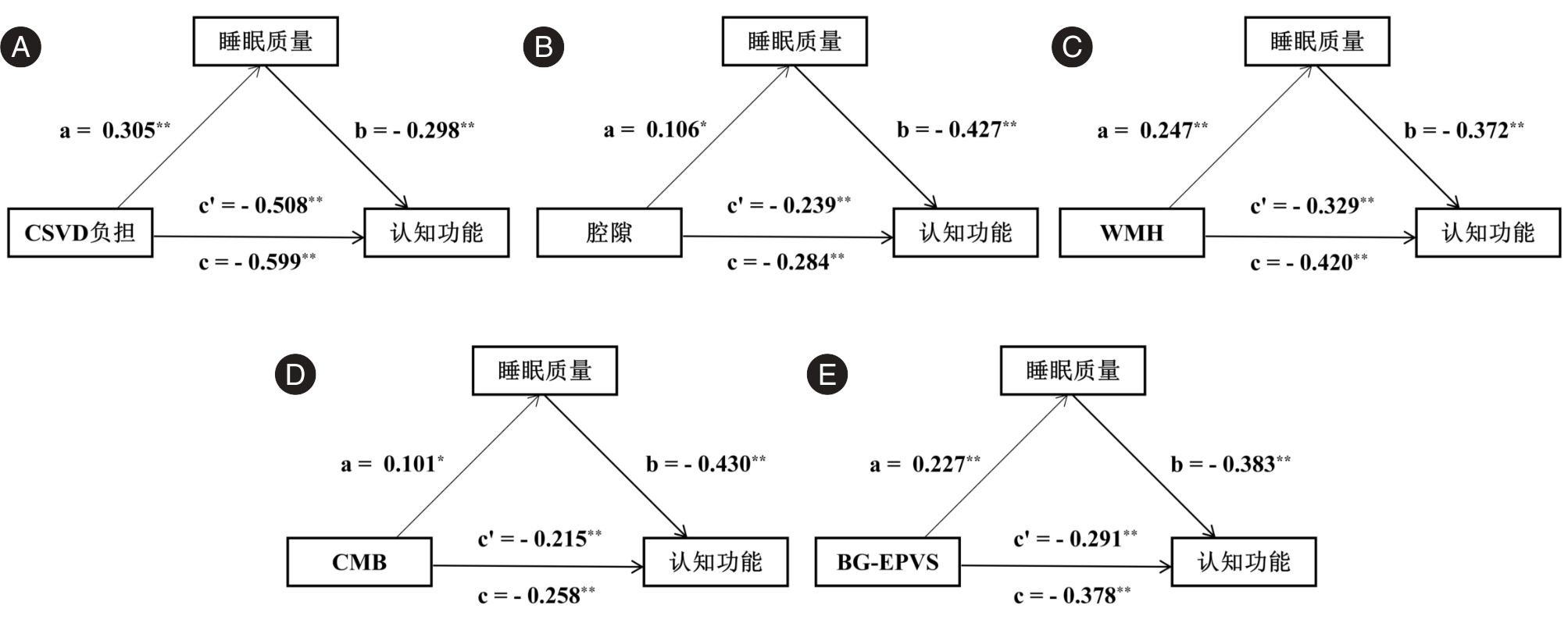
Tab.4
Analysis of the mediating effect of sleep quality on the relationship between CSVD and cognitive function"
| 中介路径 | 效应类型 | β | Boot SE | Bootstrap 95%CI | 效应占比/% | |
|---|---|---|---|---|---|---|
| 下限 | 上限 | |||||
| CSVD负担→睡眠质量→认知功能 | 总效应 | -0.599 | 0.035 | -0.668 | -0.530 | - |
| 直接效应 | -0.508 | 0.034 | -0.574 | -0.442 | 84.8 | |
| 间接效应 | -0.091 | 0.020 | -0.134 | -0.056 | 15.2 | |
| 腔隙→睡眠质量→认知功能 | 总效应 | -0.284 | 0.043 | -0.368 | -0.200 | ? |
| 直接效应 | -0.239 | 0.038 | -0.313 | -0.165 | 84.2 | |
| 间接效应 | -0.045 | 0.020 | -0.086 | -0.009 | 15.8 | |
| WMH→睡眠质量→认知功能 | 总效应 | -0.420 | 0.041 | -0.500 | -0.340 | - |
| 直接效应 | -0.329 | 0.038 | -0.403 | -0.254 | 78.3 | |
| 间接效应 | -0.091 | 0.022 | -0.137 | -0.053 | 21.7 | |
| CMB→睡眠质量→认知功能 | 总效应 | -0.258 | 0.043 | -0.343 | -0.174 | - |
| 直接效应 | -0.215 | 0.038 | -0.290 | -0.140 | 83.3 | |
| 间接效应 | -0.043 | 0.021 | -0.084 | -0.003 | 16.7 | |
| BG-EPVS→睡眠质量→认知功能 | 总效应 | -0.378 | 0.041 | -0.458 | -0.298 | - |
| 直接效应 | -0.291 | 0.037 | -0.365 | -0.217 | 77.0 | |
| 间接效应 | -0.087 | 0.022 | -0.133 | -0.046 | 23.0 | |
| [1] |
SEMYACHKINA-GLUSHKOVSKAYA O, POSTNOV D, PENZEL T, et al. Sleep as a novel biomarker and a promising therapeutic target for cerebral small vessel disease: A review focusing on Alzheimer's disease and the blood-brain barrier[J]. Int J Mol Sci, 2020, 21(17): 6293. doi:10.3390/ijms21176293 .
doi: 10.3390/ijms21176293 |
| [2] |
中国研究型医院学会脑小血管病专业委员会《中国脑小血管病诊治专家共识》编写组. 中国脑小血管病诊治专家共识2021[J]. 中国卒中杂志, 2021, 16(7): 716-726. doi:10.3969/j.issn.1673-5765.2021.07.013 .
doi: 10.3969/j.issn.1673-5765.2021.07.013 |
| [3] |
黄翌, 卢显晶, 王晗. 南通市连续三次人口普查老龄化率位居全国第一的原因、趋势、对策及对其他地区的启示[J]. 老龄科学研究, 2023, 11(1): 44-55. doi:10.3969/j.issn.2095-5898.2023.01.006 .
doi: 10.3969/j.issn.2095-5898.2023.01.006 |
| [4] |
马晓蓉, 张静宜, 宗运之, 等. 无创呼吸机治疗对阻塞性睡眠呼吸暂停低通气综合征患者骨钙素和认知功能障碍的影响[J]. 实用医学杂志, 2023, 39(2): 249-254. doi:10.3969/j.issn.1006-5725.2023.02.021 .
doi: 10.3969/j.issn.1006-5725.2023.02.021 |
| [5] |
MENG W, GAO T, ZHONG Y, et al. Association between sleep and cognition of older adults in rural areas: A cross-sectional study[J]. Inquiry, 2023, 60: 00469580231171820. doi:10.1177/00469580231171820 .
doi: 10.1177/00469580231171820 |
| [6] |
SARSEMBAYEVA D, SCHREUDER M J, HUISMAN M, et al. Individual sleep problems are associated with an accelerated decline in multiple cognitive functions in older adults[J]. J Sleep Res, 2025, 34(5): e70067. doi:10.1111/jsr.70067 .
doi: 10.1111/jsr.70067 |
| [7] |
ZHAO J, KONG Q, ZHOU X, et al. Differences in gray matter volume in cerebral small vessel disease patients with and without sleep disturbance[J]. Brain Sci, 2023, 13(2): 294. doi:10.3390/brainsci13020294 .
doi: 10.3390/brainsci13020294 |
| [8] |
ZHAO J, KONG Q, WANG M, et al. Association of excessive daytime sleepiness with cerebral small vessel disease in community-dwelling older adults[J]. Nat Sci Sleep, 2022, 14: 765-773. doi:10.2147/NSS.S357586 .
doi: 10.2147/NSS.S357586 |
| [9] |
WANG J, LIU S, ZHAO C, et al. Effects of trazodone on sleep quality and cognitive function in arteriosclerotic cerebral small vessel disease comorbid with chronic insomnia[J]. Front Psychiatry, 2020, 11: 620. doi:10.3389/fpsyt.2020.00620 .
doi: 10.3389/fpsyt.2020.00620 |
| [10] |
DEL BRUTTO O H, MERA R M, ZAMBRANO M, et al. Poor sleep quality and silent markers of cerebral small vessel disease: A population-based study in community-dwelling older adults (The Atahualpa Project)[J]. Sleep Med, 2015, 16(3): 428-431. doi:10.1016/j.sleep.2014.10.023 .
doi: 10.1016/j.sleep.2014.10.023 |
| [11] |
YANG S, YIN J, QIN W, et al. Poor sleep quality associated with enlarged perivascular spaces in patients with lacunar stroke[J]. Front Neurol, 2022, 12: 809217. doi:10.3389/fneur.2021.809217 .
doi: 10.3389/fneur.2021.809217 |
| [12] |
LI X, QIN R R, CHEN J, et al. Neuropsychiatric symptoms and altered sleep quality in cerebral small vessel disease[J]. Front Psychiatry, 2022, 13: 882922. doi:10.3389/fpsyt.2022.882922 .
doi: 10.3389/fpsyt.2022.882922 |
| [13] |
ZUURBIER L A, IKRAM M A, LUIK A I, et al. Cerebral small vessel disease is related to disturbed 24-h activity rhythms: A population-based study[J]. Eur J Neurol, 2015, 22(11): 1482-1487. doi:10.1111/ene.12775 .
doi: 10.1111/ene.12775 |
| [14] |
张莉, 傅蕴婷. 脑小血管病患者血清磷酸化Tau蛋白-181、γ-谷氨酰转肽酶、沉默信息调节因子1与睡眠障碍的相关性[J]. 实用医学杂志, 2025, 41(12): 1867-1872. doi:10.3969/j.issn.1006-5725.2025.12.014 .
doi: 10.3969/j.issn.1006-5725.2025.12.014 |
| [15] |
STAALS J, MAKIN S D J, DOUBAL F N, et al. Stroke subtype, vascular risk factors, and total MRI brain small-vessel disease burden[J]. Neurology, 2014, 83(14): 1228-1234. doi:10.1212/WNL.0000000000000837 .
doi: 10.1212/WNL.0000000000000837 |
| [16] |
路桃影, 李艳, 夏萍, 等. 匹兹堡睡眠质量指数的信度及效度分析[J]. 重庆医学, 2014, 43(3): 260-263. doi:10.3969/j.issn.1671-8348.2014.03.002 .
doi: 10.3969/j.issn.1671-8348.2014.03.002 |
| [17] |
JIA X, WANG Z, HUANG F, et al. A comparison of the Mini-Mental State Examination (MMSE) with the Montreal Cognitive Assessment (MoCA) for mild cognitive impairment screening in Chinese middle-aged and older population: A cross-sectional study[J]. BMC Psychiatry, 2021, 21(1): 485. doi:10.1186/s12888-021-03495-6 .
doi: 10.1186/s12888-021-03495-6 |
| [18] |
CAI Y, ZHANG Y, LENG S, et al. The relationship between inflammation, impaired glymphatic system, and neurodegenerative disorders: A vicious cycle[J]. Neurobiol Dis, 2024, 192: 106426. doi:10.1016/j.nbd.2024.106426 .
doi: 10.1016/j.nbd.2024.106426 |
| [19] |
ANG P S, ZHANG D M, AZIZI S A, et al. The glymphatic system and cerebral small vessel disease[J]. J Stroke Cerebrovasc Dis, 2024, 33(3): 107557. doi:10.1016/j.jstrokecerebrovasdis.2024.107557 .
doi: 10.1016/j.jstrokecerebrovasdis.2024.107557 |
| [20] |
HAYDEN M R. Brain endothelial cell activation and dysfunction associate with and contribute to the development of enlarged perivascular spaces and cerebral small vessel disease[J]. Histol Histopathol, 2024, 39(12): 1565-1586. doi:10.14670/HH-18-792 .
doi: 10.14670/HH-18-792 |
| [21] |
TANG J, ZHANG M, LIU N, et al. The association between glymphatic system dysfunction and cognitive impairment in cerebral small vessel disease[J]. Front Aging Neurosci, 2022, 14: 916633. doi:10.3389/fnagi.2022.916633 .
doi: 10.3389/fnagi.2022.916633 |
| [1] | Jing ZHANG,Liyuan ZHANG,Yulei RAN,Weibiao LI,Xianhui GUO. Effects of Congqi Shoushen Tuina method on emotion and sleep quality in patients with generalized anxiety disorder [J]. The Journal of Practical Medicine, 2026, 42(6): 1035-1040. |
| [2] | Yang OU,Shouzhu XU,Siyao ZENG,Jiebing HE,Sijia GUO,Yang ZHOU,Xiaoming CHEN. Resting-sate functional magnetic resonance imaging brain functional connectivity analysis in cognitive impairment of hypoxia-related diseases: A review [J]. The Journal of Practical Medicine, 2026, 42(6): 1097-1104. |
| [3] | Zhongyi MIAO,Mingming ZHANG,Yana GAO,Qunzhen LI,Xuena DONG,Rong ZHANG,Qianyu HAN,Lihua REN. The therapeutic effect of nasal cavity volume expansion surgery combined with modified uvulopalatopharyngoplasty on OSAHS patients with multi-level obstruction [J]. The Journal of Practical Medicine, 2026, 42(3): 432-437. |
| [4] | Qiaolin ZHANG,Guihong XU,Cheng HANG,Mingming DING,Lamei YU. The mediating role of sleep quality in adolescents between rumination and depressive symptoms [J]. The Journal of Practical Medicine, 2026, 42(3): 497-503. |
| [5] | Yanhong JIANG,Yiyin XU,Ruotong LIAO,Lijun WEI,Xuewei CAO,Minqing LI,Jinhui LIAO,Jiajie HUANG,Xingli CHEN. An empirical study on the impact of single-dose and multiple-dose antibiotic regimens on nursing workload and medical costs in total joint arthroplasty: A nursing-led systematic review [J]. The Journal of Practical Medicine, 2026, 42(2): 311-319. |
| [6] | Sheng NONG,Zhanxiong LI,Qi ZHANG,Zhendong LU,Minping HONG,Wubiao CHEN,Zilin LIU. Predictive performance of an interpretable BPNN model for axillary lymph node burden in breast cancer patients with 1 ~ 2 sentinel lymph node positive [J]. The Journal of Practical Medicine, 2026, 42(1): 45-55. |
| [7] | Abudimijiti XIEYIDAI,Xiangxin SONG,Aizezi DILIREBA,Yibulaiyin HASIYETI. Research on the correlation between specific indicators of serum ferroptosis and Alzheimer′s disease [J]. The Journal of Practical Medicine, 2026, 42(1): 94-100. |
| [8] | Mengqi XU,Aijun. ZHANG. The effect of ozone autohemotherapy on serum Lp(a),sleep quality,and heart rate variability in postmenopausal patients with hypercholesterolemia [J]. The Journal of Practical Medicine, 2025, 41(24): 3913-3919. |
| [9] | Yuying SONG,Saimaiti KHALIBINUR,Xu ZHOU,Xiangxin SONG,Yidai Abdigiti XIE,Aizezi DILRABA,Yibulayin. HASYATI. Quantitative susceptibility mapping analysis of brain iron deposition characteristics and their correlation with cognitive function in Alzheimer's disease patients [J]. The Journal of Practical Medicine, 2025, 41(20): 3267-3275. |
| [10] | Xingyu CHEN,Ying XIAO,Hualiang LIN,Lawrence Lam.. Study on the association between gaseous pollutants and cardiovascular disease hospitalization, hospitalization costs, and hospitalization days in seven cities of Guangdong province [J]. The Journal of Practical Medicine, 2025, 41(2): 278-287. |
| [11] | Jinzhou JING,Zelin LI,Zhengyi LUO,Yuying. HU. Gut microbiota dysbiosis in adolescent socially isolated mice with cognitive impairment and identification of key pathogenic microbial communities [J]. The Journal of Practical Medicine, 2025, 41(19): 3000-3007. |
| [12] | Caiai SONG,Hailin JIA,Xin LIU,Lili ZHANG,Yunshu ZHANG,Keqing. LI. Distinct sleep spindle activity patterns in cognitive subtypes of first-episode schizophrenia [J]. The Journal of Practical Medicine, 2025, 41(16): 2541-2548. |
| [13] | Mingbo LIU,Xinye HE,Xiaohong YANG,Zengwu. WANG. Interpretation of annual report on cardiovascular health and diseases in China 2024 [J]. The Journal of Practical Medicine, 2025, 41(14): 2111-2131. |
| [14] | Bin LI,Min HU,Luodong YANG,Ziwei ZHANG,Yuanyuan HU,Guiqing. ZHANG. Relationship between myelin changes in cerebellar gray matter and cognitive function in PTSD [J]. The Journal of Practical Medicine, 2025, 41(14): 2183-2190. |
| [15] | Xiaomei BAO,Yu LIU,Chengcheng JIN,Luping. WANG. Effects of different dose dexmedetomidine combined with sufentanil on perioperative analgesia and sleep quality in patients with oral cancer [J]. The Journal of Practical Medicine, 2025, 41(14): 2250-2257. |
| Viewed | ||||||
|
Full text |
|
|||||
|
Abstract |
|
|||||
