

The Journal of Practical Medicine ›› 2026, Vol. 42 ›› Issue (8): 1361-1366.doi: 10.3969/j.issn.1006-5725.2026.08.008
• Chronic Disease Control • Previous Articles Next Articles
Xiaosong LI1,Jinjin YIN2,Kaihong GUI1,Wei XUE1,Junlai SONG1( )
)
Received:2025-12-17
Online:2026-04-25
Published:2026-04-28
Contact:
Junlai SONG
E-mail:18934630305@163.com
CLC Number:
Xiaosong LI,Jinjin YIN,Kaihong GUI,Wei XUE,Junlai SONG. Effect of preoperative ozone joint injection combined with high tibial osteotomy on postoperative functional recovery and inflammatory regulation in patients with knee osteoarthritis[J]. The Journal of Practical Medicine, 2026, 42(8): 1361-1366.
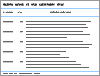
Tab.1
Comparison of baseline data between the two groups"
| 特征 | A组(n = 47) | B组(n = 46) | t/χ2值 | P值 |
|---|---|---|---|---|
| 性别(男/女) | 24/23 | 19/27 | 0.891 | 0.345 |
| 年龄( | 65.48 ± 2.85 | 64.39 ± 3.13 | 1.757 | 0.082 |
| 病程( | 4.87 ± 1.25 | 4.59 ± 1.36 | 1.034 | 0.304 |
| Kellgren-Lawrence分级(Ⅲ/Ⅳ级)/例 | 20/27 | 22/24 | 0.261 | 0.609 |
Tab.2
Comparison of joint function between the two groups"
| 组别 | WOMAC/分 | HSS评分/分 | MPTA/° | ROM/° | ||||
|---|---|---|---|---|---|---|---|---|
| 术前 | 术后5周 | 术前 | 术后5周 | 术前 | 术后5周 | 术前 | 术后5周 | |
| A组(n = 47) | 65.58 ± 5.89 | 34.43 ± 2.31* | 56.47 ± 3.96 | 81.96 ± 2.14* | 91.58 ± 1.24 | 88.26 ± 0.95* | 134.25 ± 2.34 | 141.63 ± 1.25* |
| B组(n = 46) | 64.97 ± 6.12 | 41.52 ± 3.69* | 56.88 ± 2.87 | 77.45 ± 1.97* | 91.81 ± 1.11 | 90.21 ± 0.87* | 135.11 ± 3.59 | 138.54 ± 1.13* |
| t值 | 0.490 | 11.132 | 0.571 | 10.544 | 0.942 | 10.327 | 1.371 | 12.497 |
| P值 | 0.625 | < 0.001 | 0.570 | < 0.001 | 0.349 | < 0.001 | 0.174 | < 0.001 |
Tab.3
Comparison of gait recovery between the two groups"
| 组别 | 步长/cm | 步速/(cm/s) | 步频/(步/min) | |||
|---|---|---|---|---|---|---|
| 术前 | 术后5周 | 术前 | 术后5周 | 术前 | 术后5周 | |
| A组(n = 47) | 32.58 ± 4.56 | 60.28 ± 3.87* | 80.35 ± 5.25 | 98.52 ± 2.69* | 84.69 ± 2.41 | 105.24 ± 2.13* |
| B组(n = 46) | 32.96 ± 5.13 | 56.31 ± 4.34* | 79.83 ± 5.14 | 94.35 ± 3.36* | 85.12 ± 1.69 | 101.31 ± 1.47* |
| t值 | 0.378 | 4.658 | 0.483 | 6.614 | 0.994 | 10.334 |
| P值 | 0.706 | < 0.001 | 0.631 | < 0.001 | 0.323 | < 0.001 |
Tab.4
Comparison of serum indexes between the two groups"
| 组别 | IL-1β/(pg/mL) | IL-6/(pg/mL) | IL-8/(mg/L) | IL-10/(pg/mL) | ||||
|---|---|---|---|---|---|---|---|---|
| 术前 | 术后5周 | 术前 | 术后5周 | 术前 | 术后5周 | 术前 | 术后5周 | |
| A组(n = 47) | 22.52 ± 6.98 | 13.25 ± 5.12* | 211.45 ± 52.36 | 82.21 ± 25.36* | 20.36 ± 2.69 | 7.58 ± 1.16* | 15.23 ± 3.12 | 28.65 ± 4.21* |
| B组(n = 46) | 21.84 ± 7.56 | 16.17 ± 6.11* | 209.58 ± 47.41 | 98.63 ± 24.58* | 20.87 ± 3.16 | 8.36 ± 1.52* | 14.89 ± 3.05 | 22.34 ± 3.87* |
| t值 | 0.451 | 2.500 | 0.180 | 3.170 | 0.839 | 2.786 | 0.531 | 7.521 |
| P值 | 0.653 | 0.014 | 0.857 | 0.002 | 0.404 | 0.007 | 0.597 | < 0.001 |
Tab.5
Comparison of knee pain between the two groups"
| 组别 | VAS | |||
|---|---|---|---|---|
| 术前 | 术后5周 | 术后1个月 | 术后6个月 | |
| A组(n = 47) | 6.11 ± 0.85 | 4.25 ± 0.26*# | 2.76 ± 0.51*# | 1.46 ± 0.25*# |
| B组(n = 46) | 6.09 ± 0.78 | 4.89 ± 0.14* | 3.87 ± 0.58* | 2.18 ± 0.19* |
Tab.6
Comparison on the incidence of postoperative complications between the two groups"
| 组别 | 关节粘连 | 下肢深静脉血栓 | 切口感染 | 总并发症发生 |
|---|---|---|---|---|
| A组(n = 47) | 1(2.13) | 2(4.26) | 1(2.13) | 4(8.51) |
| B组(n = 46) | 1(2.17) | 3(6.52) | 3(6.52) | 7(15.22) |
| χ2值 | 1.003 | |||
| P值 | 0.317 |
| [1] |
MOON H S, CHOI C H, JUNG M, et al. The Effect of Cartilage Lesion in the Lateral Compartment of the Knee on the Surgical Outcome of Medial Open-Wedge High Tibial Osteotomy[J]. J Knee Surg, 2021, 34(5):538-545.doi: 10.1055/s-0039-1697623 .
doi: 10.1055/s-0039-1697623 |
| [2] |
MURRAY R, WINKLER P W, SHAIKH H S, et al. High Tibial Osteotomy for Varus Deformity of the Knee[J]. J Am Acad Orthop Surg Glob Res Rev, 2021, 5(7):e21.00141. doi: 10.5435/JAAOSGlobal-D-21-00141 .
doi: 10.5435/JAAOSGlobal-D-21-00141 |
| [3] |
PULLEN W M, SLONE H, ABRAMS G, et al. High Tibial Osteotomy in Knee Reconstruction and Joint Preservation[J]. J Am Acad Orthop Surg, 2024, 32(13):577-586. doi: 10.5435/JAAOS-D-23-00323 .
doi: 10.5435/JAAOS-D-23-00323 |
| [4] |
JI C, CHENG J, SU H, et al. Relationship between high-sensitivity C-reactive protein to lymphocyte ratio (hs-CLR) and incision complications following medial opening-wedge high tibial osteotomy for knee osteoarthritis[J]. BMC Surg, 2025, 25(1):230. doi: 10.1186/s12893-025-02968-9 .
doi: 10.1186/s12893-025-02968-9 |
| [5] |
CHOI K Y, KIM M S, IN Y. The Effectiveness and Safety of Tibial-Sided Osteotomy for Fibula Untethering in Lateral Close-Wedge High Tibial Osteotomy: A Novel Technique with Video Illustration[J]. Medicina (Kaunas), 2025, 61(1):91. doi: 10.3390/medicina61010091 .
doi: 10.3390/medicina61010091 |
| [6] |
田明月, 丁小芬, 韩松辰, 等. 臭氧水对膝关节骨关节炎关节软骨修复作用及对NF-κB信号通路的影响[J]. 中华骨科杂志, 2021, 41(23): 1717-1725. doi:10.3760/cma.j.cn121113-20201229-00762 .
doi: 10.3760/cma.j.cn121113-20201229-00762 |
| [7] |
SCONZA C, DI MATTEO B, QUEIRAZZA P, et al. Ozone Therapy versus Hyaluronic Acid Injections for Pain Relief in Patients with Knee Osteoarthritis: Preliminary Findings on Molecular and Clinical Outcomes from a Randomized Controlled Trial[J]. Int J Mol Sci, 2023, 24(10): 8788. doi: 10.3390/ijms24108788 .
doi: 10.3390/ijms24108788 |
| [8] |
中华医学会骨科学分会关节外科学组. 骨关节炎诊疗指南(2018年版)[J]. 中华骨科杂志, 2018, 38(12):705-715.doi:10.3760/cma.j.issn.0253-2352.2018.12.001 .
doi: 10.3760/cma.j.issn.0253-2352.2018.12.001 |
| [9] |
严攀, 刘波, 阴俊, 等. 西安大略和麦克马斯特大学骨关节炎指数用于膝退行性骨关节炎患者评定的反应度研究[J].中国康复医学杂志, 2016, 31(2): 215-216. doi:10.3969/j.issn.1001-1242.2016.02.019 .
doi: 10.3969/j.issn.1001-1242.2016.02.019 |
| [10] |
FU X, SHE Y, JIN G, et al. Comparison of robotic-assisted total knee arthroplasty: An updated systematic review and meta-analysis[J]. J Robot Surg, 2024, 18(1):292. doi: 10.1007/s11701-024-02045-y .
doi: 10.1007/s11701-024-02045-y |
| [11] |
顾旭, 郑欣, 史思峰, 等. 膝关节单髁置换后早期步态的稳定性[J]. 中国组织工程研究, 2024, 28(12): 1875-1879. doi:10.12307/2024.024 .
doi: 10.12307/2024.024 |
| [12] |
SHAFSHAK T S, ELNEMR R. The Visual Analogue Scale Versus Numerical Rating Scale in Measuring Pain Severity and Predicting Disability in Low Back Pain[J]. J Clin Rheumatol, 2021, 27(7):282-285. doi: 10.1097/RHU.0000000000001320 .
doi: 10.1097/RHU.0000000000001320 |
| [13] |
STEVENSON R D M, CHOWDHURY E A, LOBO J, et al. Influence of the intelligent knee osteoarthritis lifestyle app (iKOALA) on knee joint pain[J]. BMC Musculoskelet Disord, 2024, 25(1):90.doi: 10.1186/s12891-024-07198-3 .
doi: 10.1186/s12891-024-07198-3 |
| [14] |
PALMER J, GETGOOD A, LOBENHOFFER P, et al. Medial opening wedge high tibial osteotomy for the treatment of medial unicompartmental knee osteoarthritis: A state-of-the-art review[J]. J ISAKOS, 2024, 9(1):39-52. doi: 10.1016/j.jisako.2023.10.004 .
doi: 10.1016/j.jisako.2023.10.004 |
| [15] |
ZHANG B, QIAN H, WU H, et al. Unicompartmental knee arthroplasty versus high tibial osteotomy for medial knee osteoarthritis: A systematic review and meta-analysis[J]. J Orthop Surg (Hong Kong), 2023, 31(1):10225536231162829. doi: 10.1177/10225536231162829 .
doi: 10.1177/10225536231162829 |
| [16] |
ALIYEV D, AKKEMIK U, ASIK I. Efficacy of an Intra-articular Ozone Injection for Chronic Knee Pain Due to Osteoarthritis[J]. Altern Ther Health Med, 2023, 29(1):24-28. PMID: .
pmid: 36239567 |
| [17] |
SUN P, XU W, ZHAO X, et al. Ozone induces autophagy by activating PPARγ/mTOR in rat chondrocytes treated with IL-1β[J]. J Orthop Surg Res, 2022, 17(1):351. doi: 10.1186/s13018-022-03233-y .
doi: 10.1186/s13018-022-03233-y |
| [18] |
NEGISHI Y, ADILI A, DE VEGA S, et al. IL-6 Reduces Spheroid Sizes of Osteophytic Cells Derived from Osteoarthritis Knee Joint via Induction of Apoptosis[J]. Am J Pathol, 2024, 194(1):135-149. doi: 10.1016/j.ajpath.2023.10.005 .
doi: 10.1016/j.ajpath.2023.10.005 |
| [19] |
JACOB J, AGGARWAL A, AGGARWAL A, et al. Senescent chondrogenic progenitor cells derived from articular cartilage of knee osteoarthritis patients contributes to senescence-associated secretory phenotype via release of IL-6 and IL-8[J]. Acta Histochem, 2022, 124(3): 151867. doi: 10.1016/j.acthis.2022.151867 .
doi: 10.1016/j.acthis.2022.151867 |
| [20] |
吕青, 翟生, 黄涛. 1,25(OH)2D3通过上调IL-10受体抑制软骨细胞凋亡缓解骨关节炎的分子机制研究[J]. 广西医科大学学报, 2023, 40(10): 1692-1698. doi:10.16190/j.cnki.45-1211/r.2023.10.015 .
doi: 10.16190/j.cnki.45-1211/r.2023.10.015 |
| [21] |
ZHU X, ZHAO Q, WANG P, et al. Ozone rectal insufflation attenuates lung inflammation by inhibiting the TLR4/NF-κB pathway through upregulation of Nrf2 in mice with COPD-like pathology[J]. Int Immunopharmacol, 2025, 10(167):115676. doi: 10.1016/j.intimp.2025.115676 .
doi: 10.1016/j.intimp.2025.115676 |
| [22] | ZHANG Y, ZHANG B, LI W, et al. Effects of joint irrigation combined with ozone injection on bone metabolism, inflammatory factors, and joint function in knee osteoarthritis[J]. Am J Transl Res, 2023, 15(1):213-222. |
| [23] |
ATA E, ÖZGÜÇ S, TEMEL M H, et al. The impact of ex vivo ozone injection into the synovial fluid in patients with knee osteoarthritis: A controlled clinical trial[J]. Arch Rheumatol, 2024, 39(3): 459-466. doi: 10.46497/ArchRheumatol.2024.10375 .
doi: 10.46497/ArchRheumatol.2024.10375 |
| [24] |
UNLU E, GÜL SATAR N Y, ONGUNCAN O, et al. Chondroprotective effects of ozone and hyaluronic acid in rat knee osteoarthritis: Comparison of intra-articular and systemic administration[J]. Res Vet Sci, 2025, 9(193): 105798.doi: 10.1016/j.rvsc.2025.105798 .
doi: 10.1016/j.rvsc.2025.105798 |
| [25] |
陈付艳, 周鑫, 吴帮启,等.射频针刀联合臭氧注射治疗膝骨性关节炎的临床疗效 [J]. 实用医学杂志, 2022, 38(3): 335-339.doi: 10.3969/j.issn.1006-5725.2022.03.014 .
doi: 10.3969/j.issn.1006-5725.2022.03.014 |
| [26] |
ZHANG J, GUO Y, LU B, et al. Efficacy of ultrasound-guided intra-articular injection in the treatment of knee osteoarthritis in early and middle stages: A network meta-analysis[J]. Front Med (Lausanne), 2025,6(12):1700950. doi: 10.3389/fmed.2025.1700950 .
doi: 10.3389/fmed.2025.1700950 |
| [27] |
AKHAVANAKBARI G, ASAYESHI M, NOKTEHSANJ R, et al. Comparing the efficacy of combining ozone therapy with hyaluronic acid versus using hyaluronic acid alone for pain relief in patients with knee osteoarthritis: A randomized clinical trial[J]. Complement Ther Med, 2025, 93:103238.doi: 10.1016/j.ctim.2025.103238 .
doi: 10.1016/j.ctim.2025.103238 |
| [28] |
NAZARIEH M, GHANNADI S, et al. The effect of intra-articular ozone injection combined with home-based exercise on pain and function in daily living activities of patients with mild to moderate knee osteoarthritis, a randomized double-blinded controlled clinical trial[J]. J Bodyw Mov Ther,2024,38:541-548. doi: 10.1016/j.jbmt.2024.03.066 .
doi: 10.1016/j.jbmt.2024.03.066 |
| [29] |
ARJMANDDOUST Z, NAZARI A, MOEZY A. Efficacy of two doses of intra-articular ozone therapy for pain and functional mobility in knee osteoarthritis: A double-blind randomized trial[J]. Adv Rheumatol, 2025, 65(1):11. doi: 10.1186/s42358-025-00443-w .
doi: 10.1186/s42358-025-00443-w |
| Viewed | ||||||
|
Full text |
|
|||||
|
Abstract |
|
|||||
