

The Journal of Practical Medicine ›› 2026, Vol. 42 ›› Issue (4): 595-602.doi: 10.3969/j.issn.1006-5725.2026.04.008
• Chronic Disease Control • Previous Articles
Jun YIN1( ),Jing LI1,Lin LIU1,Yue LI2,Tao HUANG1
Received:2025-11-05
Online:2026-02-25
Published:2026-02-25
Contact:
Jun YIN
E-mail:yindd6266@163.com
CLC Number:
Jun YIN,Jing LI,Lin LIU,Yue LI,Tao HUANG. The effect of low-energy laser combined with vitamin therapy on burning mouth syndrome and its influence on the levels of AMS, MMP-9 and SIgA in saliva[J]. The Journal of Practical Medicine, 2026, 42(4): 595-602.

Tab.1
Comparison of three groups of general data"
| 组别 | 例数 | 性别/[例(%)] | 年龄(x ± s)/岁 | 病程/年 | BMI/(kg/m2) | VAS | |
|---|---|---|---|---|---|---|---|
| 男 | 女 | ||||||
| 低能量激光组 | 58 | 17(29.31) | 41(70.69) | 64.15 ± 5.31 | 5.39 ± 1.10 | 22.88 ± 1.34 | 5.03 ± 0.76 |
| 维生素组 | 58 | 15(25.86) | 43(74.14) | 64.17 ± 5.06 | 5.43 ± 1.17 | 23.06 ± 1.22 | 4.95 ± 0.90 |
| 联合组 | 58 | 14(24.14) | 44(75.86) | 63.95 ± 4.25 | 5.41 ± 1.15 | 22.98 ± 1.20 | 4.98 ± 0.88 |
| χ2 /F值 | 0.414 | 0.036 | 0.018 | 0.300 | 0.131 | ||
| P值 | 0.813 | 0.965 | 0.982 | 0.742 | 0.877 | ||
Tab.2
Comparison of therapeutic effects between the three groups of patients after two courses of treatment"
| 组别 | 例数 | 显效 | 有效 | 无效 | 总有效率 |
|---|---|---|---|---|---|
| 低能量激光组 | 58 | 33(56.9) | 13(22.41) | 12(20.69) | 46(79.31)? |
| 维生素组 | 58 | 30(51.72) | 14(24.14) | 14(24.14) | 44(75.86)? |
| 联合组 | 58 | 38(65.52) | 17(29.31) | 3(5.17) | 55(94.83) |
| χ2 值 | 8.524 | ||||
| P值 | 0.014 |
Tab.3
Comparison of saliva secretion and pain between the three groups of patients before treatment andafter two courses of treatment"
| 组别 | 例数 | 静息状态下唾液流量/(mL/min) | 刺激状态下唾液流量/(mL/min) | VAS/分 | |||
|---|---|---|---|---|---|---|---|
| 治疗前 | 治疗2个疗程后 | 治疗前 | 治疗2个疗程后 | 治疗前 | 治疗2个疗程后 | ||
| 低能量激光组 | 58 | 0.14 ± 0.04 | 0.17 ± 0.05?# | 1.02 ± 0.14 | 1.07 ± 0.12?# | 5.03 ± 0.76 | 2.23 ± 0.72?# |
| 维生素组 | 58 | 0.15 ± 0.05 | 0.18 ± 0.05?# | 0.98 ± 0.13 | 1.09 ± 0.11?# | 4.95 ± 0.90 | 2.37 ± 0.75?# |
| 联合组 | 58 | 0.14 ± 0.04 | 0.22 ± 0.06? | 1.01 ± 0.15 | 1.17 ± 0.12? | 4.98 ± 0.88 | 1.73 ± 0.56? |
| F值 | 1.018 | 14.163 | 1.278 | 11.912 | 0.131 | 14.125 | |
| P值 | 0.364 | < 0.001 | 0.281 | < 0.001 | 0.877 | < 0.001 | |
Tab.4
Comparison of the saliva level of indexs between the three groups of patients before treatment andafter two courses of treatment"
| 组别 | 例数 | AMS/(ng/mL) | MMP-9/(μg/L) | SIgA/(mg/L) | |||
|---|---|---|---|---|---|---|---|
| 治疗前 | 治疗2个疗程后 | 治疗前 | 治疗2个疗程后 | 治疗前 | 治疗2个疗程后 | ||
| 低能量激光组 | 58 | 8 141.07 ± 1 326.31 | 8 422.98 ± 810.17?# | 657.02 ± 50.25 | 540.87 ± 47.15?# | 121.15 ± 21.26 | 153.18 ± 28.32?# |
| 维生素组 | 58 | 8 138.08 ± 1 354.30 | 8 431.03 ± 937.18?# | 660.98 ± 59.28 | 542.85 ± 49.14?# | 120.18 ± 22.30 | 152.67 ± 25.25?# |
| 联合组 | 58 | 8 132.12 ± 1 542.27 | 8 895.01 ± 837.20? | 661.05 ± 50.27 | 510.76 ± 44.12? | 122.20 ± 23.25 | 168.15 ± 26.26? |
| F值 | 0.001 | 5.684 | 0.108 | 8.546 | 0.119 | 6.320 | |
| P值 | 0.999 | 0.004 | 0.898 | < 0.001 | 0.888 | 0.002 | |
Tab.5
Comparison of serum levels of BDNF, IL-6 and TNF-α between the three groupsof patients before treatment and after two courses of treatment"
| 组别 | 例数 | BDNF(μg/L) | IL-6(ng/L) | TNF-α(pg/mL) | |||
|---|---|---|---|---|---|---|---|
| 治疗前 | 治疗2个疗程后 | 治疗前 | 治疗2个疗程后 | 治疗前 | 治疗2个疗程后 | ||
| 低能量激光组 | 58 | 257.07 ± 54.40 | 328.66 ± 53.63?# | 21.32 ± 4.36 | 6.12 ± 1.46?# | 8.18 ± 2.17 | 6.21 ± 1.55?# |
| 维生素组 | 58 | 256.21 ± 56.27 | 331.38 ± 54.45?# | 20.73 ± 4.51 | 6.08 ± 1.17?# | 7.98 ± 2.13 | 6.25 ± 1.13?# |
| 联合组 | 58 | 258.84 ± 61.24 | 383.23 ± 57.77? | 21.89 ± 5.59 | 5.42 ± 1.15? | 8.34 ± 2.35 | 5.57 ± 1.35? |
| F值 | 0.032 | 17.927 | 0.829 | 5.575 | 0.383 | 4.605 | |
| P值 | 0.969 | < 0.001 | 0.438 | 0.005 | 0.682 | 0.011 | |
Tab.6
Comparison of scores of anxiety, depression and sleep between the three groups of patients"
| 组别 | 例数 | GAD-7 | PHQ-9 | PSQI | |||
|---|---|---|---|---|---|---|---|
| 治疗前 | 治疗2个疗程后 | 治疗前 | 治疗2个疗程后 | 治疗前 | 治疗2个疗程后 | ||
| 低能量激光组 | 58 | 7.53 ± 1.34 | 3.05 ± 0.90?# | 5.95 ± 1.46 | 2.40 ± 0.66?# | 7.42 ± 1.34 | 6.48 ± 1.42?# |
| 维生素组 | 58 | 7.54 ± 1.34 | 3.11 ± 0.93?# | 5.84 ± 1.35 | 2.38 ± 0.70?# | 7.46 ± 1.35 | 6.46 ± 1.55?# |
| 联合组 | 58 | 7.49 ± 1.39 | 2.53 ± 0.82? | 6.08 ± 1.36 | 1.97 ± 0.45? | 7.34 ± 1.30 | 5.49 ± 1.58? |
| t值 | 0.022 | 7.541 | 0.433 | 9.085 | 0.122 | 8.058 | |
| P值 | 0.978 | 0.001 | 0.649 | < 0.001 | 0.885 | < 0.001 | |
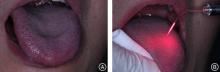
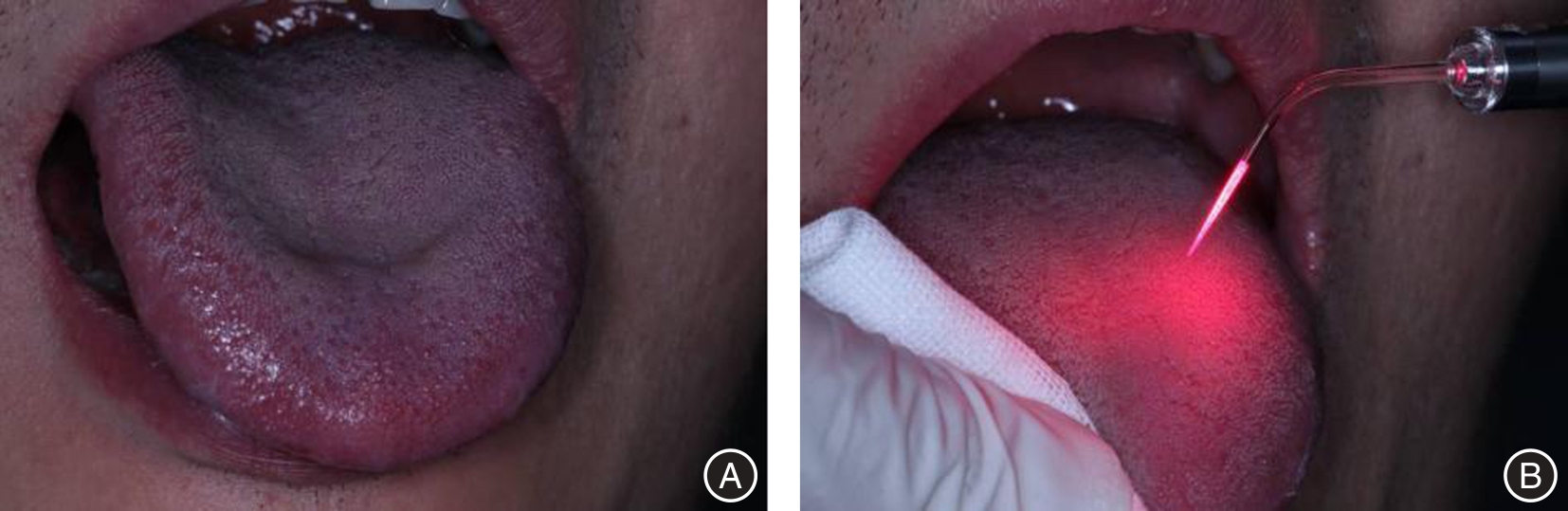
Fig.1
The effect pictures of a patient with burning mouth syndrome treated withlow-energy laser combined with vitamin therapy"
| [1] |
DE LIMA-SOUZA R A, PÉREZ-DE-OLIVEIRA M E, NORMANDO A G C, et al. Clinical and epidemiological profile of burning mouth syndrome patients following the International Headache Society classification: A systematic review and meta-analysis[J]. Oral Surg Oral Med Oral Pathol Oral Radiol, 2024, 137(2): 119-135. doi:10.1016/j.oooo.2023.10.002 .
doi: 10.1016/j.oooo.2023.10.002 |
| [2] |
KHAWAJA S N, ALASWAITI O F, SCRIVANI S J. Burning mouth syndrome[J]. Dent Clin North Am, 2023, 67(1): 49-60. doi:10.1016/j.cden.2022.07.004 .
doi: 10.1016/j.cden.2022.07.004 |
| [3] |
FERNÁNDEZ-AGRA M, GONZÁLEZ-SERRANO J, DE PEDRO M, et al. Salivary biomarkers in burning mouth syndrome: A systematic review and meta-analysis[J]. Oral Dis, 2023, 29(7): 2600-2613. doi:10.1111/odi.14390 .
doi: 10.1111/odi.14390 |
| [4] |
TAN H L, SMITH J G, HOFFMANN J, et al. A systematic review of treatment for patients with burning mouth syndrome[J]. Cephalalgia, 2022, 42(2): 128-161. doi:10.1177/03331024211036152 .
doi: 10.1177/03331024211036152 |
| [5] |
李莹, 李清, 王璇, 等. 原发性灼口综合征的研究进展[J]. 实用医学杂志, 2022, 38(19): 2486-2490. doi:10.3969/j.issn. 1006-5725.2022.19.021 .
doi: 10.3969/j.issn. 1006-5725.2022.19.021 |
| [6] |
HE M, HUOSHEN W, LI X, et al. Salivary and serum biomarkers to evaluate psychological disorders in burning mouth syndrome: A systematic review and meta-analysis[J]. J Oral Pathol Med, 2024, 53(3): 182-192. doi:10.1111/jop.13526 .
doi: 10.1111/jop.13526 |
| [7] | 陈谦明. 口腔黏膜病学[M]. 3版. 北京: 人民卫生出版社, 2008: 160-162. |
| [8] |
LEBEL A, SILVA VIEIRA D DA, BOUCHER Y. Topical amitriptyline in burning mouth syndrome: A retrospective real-world evidence study[J]. Headache, 2024, 64(9): 1167-1173. doi:10.1111/head.14818 .
doi: 10.1111/head.14818 |
| [9] | 倪博然, 赵进喜, 黄为钧, 等. 基于视觉模拟评分法探究中医临床疗效评价新方法[J]. 中华中医药杂志, 2021, 36(1): 288-292. |
| [10] |
NAGAMINE T. Mechanisms of drug-associated burning mouth syndrome[J]. J Clin Psychopharmacol, 2024, 44(6): 578-579. doi:10.1097/JCP.0000000000001915 .
doi: 10.1097/JCP.0000000000001915 |
| [11] |
ZOLOTAREVA A A. Medically unexplained symptoms among adults from Russia: An assessment using the patient health questionnaire-15[J]. Psychol Russ, 2023, 16(2): 33-47. doi:10.11621/pir.2023.0203 .
doi: 10.11621/pir.2023.0203 |
| [12] |
田丽, 徐静, 王怀谷, 等. 优化脉冲技术联合低能量CO2点阵激光对面颈部瘢痕早期干预的临床效果[J]. 实用医学杂志, 2022, 38(15): 1919-1924. doi:10.3969/j.issn.1006-5725. 2022. 15.013 .
doi: 10.3969/j.issn.1006-5725. 2022. 15.013 |
| [13] |
GARCIA MARTINEZ A, LOPEZ-JORNET P, PARDO MARIN L, et al. Burning mouth syndrome treated with low-level laser and clonazepam: A randomized, single-blind clinical trial[J]. Biomedicines, 2024, 12(5): 1048. doi:10.3390/biomedicines 12051048 .
doi: 10.3390/biomedicines 12051048 |
| [14] |
LI X, LI Q, LI J, et al. The improvement of pain symptoms in patients with burning mouth syndrome through combined laser and medication therapy[J]. Technol Health Care, 2024, 32(S1): 501-509. doi:10.3233/THC-248044 .
doi: 10.3233/THC-248044 |
| [15] |
张颖, 叶赛, 孙洪, 等. 基于炎症因子和心理评分的灼口综合征临床评估模型初探[J]. 中华口腔医学杂志, 2025, 60(3): 232-238. doi:10.3760/cma.j.cn112144-20241211-00469 .
doi: 10.3760/cma.j.cn112144-20241211-00469 |
| [16] |
GE X L, SUN C, ZHAO R, et al. Comparative efficacy of low-level diode laser therapy with different wavelengths in burning mouth syndrome: A randomized, single-blind trial[J]. Lasers Med Sci, 2025, 40(1): 165. doi:10.1007/s10103-025-04403-0 .
doi: 10.1007/s10103-025-04403-0 |
| [17] |
童熹, 濮莉莉, 吕辰翼, 等. 唾液皮质醇、分泌型免疫球蛋白A水平在老年灼口综合征患者认知功能中的临床价值[J]. 中国医药导报, 2022, 19(16): 98-101. doi: 10.3969/j.issn.1673-7210.2022.16.026 .
doi: 10.3969/j.issn.1673-7210.2022.16.026 |
| [18] |
THAKKAR J P, LANE C J. Hyposalivation and xerostomia and burning mouth syndrome: medical management[J]. Oral Maxillofac Surg Clin North Am, 2022, 34(1):135-146. doi: 10.1016/j.coms.2021.08.002 .
doi: 10.1016/j.coms.2021.08.002 |
| [19] |
LU C, YANG C, LI X, et al. Effects of low-level laser therapy on burning pain and quality of life in patients with burning mouth syndrome: A systematic review and meta-analysis[J]. BMC Oral Health, 2023, 23(1): 734. doi:10.1186/s12903-023-03441-w .
doi: 10.1186/s12903-023-03441-w |
| [20] |
CAMOLESI G C V, MARICHALAR-MENDÍA X, PADÍN-IRUEGAS M E, et al. Efficacy of photobiomodulation in reducing pain and improving the quality of life in patients with idiopathic burning mouth syndrome. A systematic review and meta-analysis[J]. Lasers Med Sci, 2022, 37(4): 2123-2133. doi:10.1007/s10103-022-03518-y .
doi: 10.1007/s10103-022-03518-y |
| [21] |
PEREIRA S R, TELLO VELASQUEZ J, DUGGAN S, et al. Recent advances in the understanding of the aetiology and therapeutic strategies in burning mouth syndrome: Focus on the actions of cannabinoids[J]. Eur J Neurosci, 2022, 55(4): 1032-1050. doi:10.1111/ejn.14712 .
doi: 10.1111/ejn.14712 |
| [22] |
FINFTER O, KIZEL L, CZERNINSKI R, et al. Photobiomodulation alleviates Burning Mouth Syndrome pain: Immediate and weekly outcomes explored[J]. Oral Dis, 2024, 30(7): 4668-4676. doi:10.1111/odi.14900 .
doi: 10.1111/odi.14900 |
| [23] |
CHRISTY J, NOORANI S, SY F, et al. Efficacy of alpha-lipoic acid in patients with burning mouth syndrome compared to that of placebo or other interventions: A systematic review with meta-analyses[J]. J Dent Anesth Pain Med, 2022, 22(5): 323-338. doi:10.17245/jdapm.2022.22.5.323 .
doi: 10.17245/jdapm.2022.22.5.323 |
| [24] |
GREMEAU-RICHARD C, PIONCHON P, MULLIEZ A, et al. Enhanced pain facilitation rather than impaired pain inhibition in burning mouth syndrome female patients[J]. J Headache Pain, 2022, 23(1): 143. doi:10.1186/s10194-022-01516-7 .
doi: 10.1186/s10194-022-01516-7 |
| [25] |
MAROTTA B M, SUGAYA N N, HANNA R, et al. Efficacy of 660 nm photobiomodulation in burning mouth syndrome management: A single-blind quasi-experimental controlled clinical trial[J]. Photobiomodul Photomed Laser Surg, 2024, 42(3): 225-229. doi:10.1089/photob.2023.0158 .
doi: 10.1089/photob.2023.0158 |
| [26] |
SANTOS MEDEIROS C K, DO CARMO PESSOA NOGUEIRA SERRÃO M, DE LIMA A A S, et al. Comparative analysis of photobiomodulation therapy and transcutaneous electrical nerve stimulation for burning mouth: A randomized clinical trial[J]. Clin Oral Investig, 2023, 27(10): 6157-6165. doi:10.1007/s00784-023-05232-7 .
doi: 10.1007/s00784-023-05232-7 |
| [27] |
KHEMISS M, DAMMAK N, LAJILI O, et al. Efficacy of laser therapy on primary burning mouth syndrome: A systematic review[J]. J Oral Facial Pain Headache, 2024, 38(1): 17-31. doi:10.22514/jofph.2024.003 .
doi: 10.22514/jofph.2024.003 |
| [28] |
LONČAR-BRZAK B, ŠKRINJAR I, BRAILO V, et al. Burning mouth syndrome (BMS)-treatment with verbal and written information, B vitamins, probiotics, and low-level laser therapy: A randomized clinical trial[J]. Dent J, 2022, 10(3): 44. doi:10.3390/dj10030044 .
doi: 10.3390/dj10030044 |
| [29] |
OKUHARA M R, TREVISANI V F M, MACEDO C R. Effects of photobiomodulation on burning mouth syndrome: A systematic review and meta-analysis[J]. J Oral Rehabil, 2025, 52(4): 540-553. doi:10.1111/joor.13931 .
doi: 10.1111/joor.13931 |
| Viewed | ||||||
|
Full text |
|
|||||
|
Abstract |
|
|||||
