

The Journal of Practical Medicine ›› 2026, Vol. 42 ›› Issue (4): 655-662.doi: 10.3969/j.issn.1006-5725.2026.04.016
• Emerging Technologies and Applications in Clinical Practice • Previous Articles
Shaosong SUN,Shaoyu ZHU,Xingchen ZHANG,Bin DENG( )
)
Received:2025-11-05
Online:2026-02-25
Published:2026-02-25
Contact:
Bin DENG
E-mail:xyfydb1983@126.com
CLC Number:
Shaosong SUN,Shaoyu ZHU,Xingchen ZHANG,Bin DENG. Comparison on the effect and complications of different timing of CRPP in the treatment of children with humeral supracondylar fractures[J]. The Journal of Practical Medicine, 2026, 42(4): 655-662.

Tab.1
Comparison of baseline data between the two groups"
| 项目 | 早期组(n = 58) | 延期组(n = 42) | t/χ2值 | P值 |
|---|---|---|---|---|
| 性别 | 1.751 | 0.186 | ||
| 男 | 34(58.62) | 19(45.24) | ||
| 女 | 24(41.38) | 23(54.76) | ||
| 年龄(x ± s)/岁 | 6.82 ± 1.31 | 7.21 ± 1.19 | 1.526 | 0.130 |
| 骨折患侧(左/右) | 0.164 | 0.685 | ||
| 左 | 30(51.72) | 20(47.62) | ||
| 右 | 28(48.28) | 22(52.38) | ||
| Gartland分型 | 0.365 | 0.546 | ||
| Ⅱ型 | 31(53.45) | 25(59.52) | ||
| Ⅲ型 | 27(46.55) | 17(40.48) | ||
| 受伤原因 | 1.451 | 0.694 | ||
| 摔伤 | 19(32.76) | 14(33.33) | ||
| 运动伤 | 21(36.21) | 11(26.19) | ||
| 交通事故 | 12(20.69) | 12(28.57) | ||
| 其他 | 6(10.34) | 5(11.90) | ||
| 受伤至手术时间(x ± s)/h | 8.26 ± 1.35 | 17.53 ± 2.64 | 22.946 | < 0.001 |
Tab.2
Comparison of perioperative indexes and fracture healing time between the two groups"
| 指标 | 早期组(n = 58) | 延期组(n = 42) | t/Z值 | P值 |
|---|---|---|---|---|
| 手术时间/min | 35.61 ± 4.27 | 46.32 ± 4.58 | 12.031 | < 0.001 |
| 术中出血量/mL | 6.29 ± 1.05 | 8.46 ± 1.36 | 9.003 | < 0.001 |
| 术中透视次数[M(P25,P75)]/次 | 5(4,6) | 7(6,9) | 6.842 | < 0.001 |
| 住院时间/d | 3.80 ± 0.82 | 4.12 ± 1.14 | 1.633 | 0.106 |
| 骨折愈合时间/周 | 5.38 ± 1.16 | 5.67 ± 1.25 | 1.194 | 0.235 |
Tab.3
Comparison of elbow range of motion and imaging indexes between the two groups"
| 组别 | 肘关节活动度 | Baumann角 | 提携角 |
|---|---|---|---|
| 早期组(n = 58) | 142.61 ± 12.35 | 70.18 ± 4.21 | 13.75 ± 2.07 |
| 延期组(n = 42) | 139.24 ± 10.17 | 71.56 ± 3.42 | 12.07 ± 2.42 |
| t值 | 1.448 | 1.747 | 1.510 |
| P值 | 0.151 | 0.084 | 0.134 |
Tab.4
Comparison on good rates of curative effect between the two groups"
| 组别 | 优 | 良 | 可 | 差 | 优良率 |
|---|---|---|---|---|---|
| 早期组(n = 58) | 21(36.21) | 16(27.59) | 18(31.03) | 3(5.17) | 94.83 |
| 延期组(n = 42) | 12(28.57) | 13(30.95) | 9(21.43) | 8(19.05) | 80.95 |
| χ2值 | 4.790 | ||||
| P值 | 0.029 |
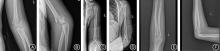
Fig.1
X-ray films of a child in early group"
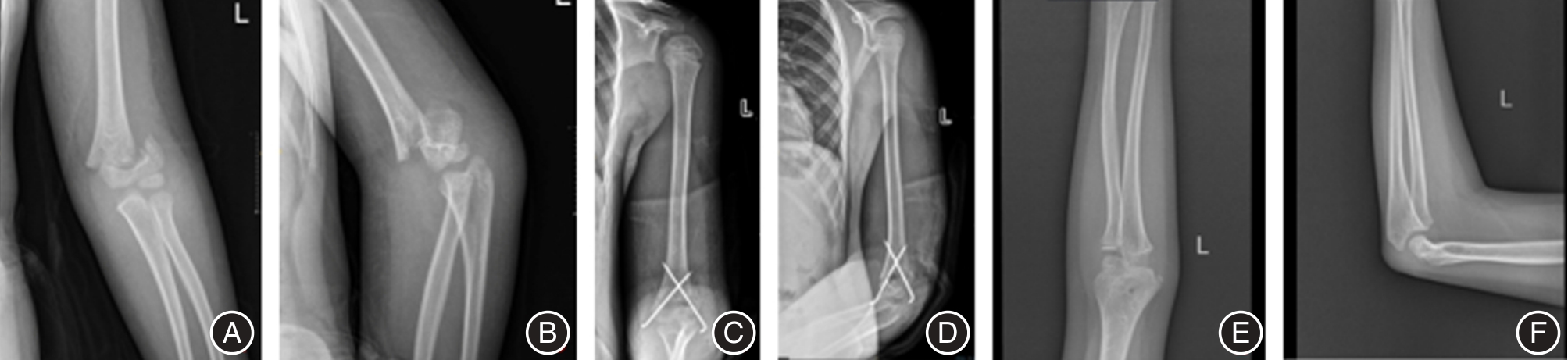

Fig.2
X-ray films of a child in delayed group"

Tab.5
Comparison on the incidence of complications between the two groups"
| 组别 | 针道感染 | 肘内翻畸形 | 医源性神经损伤 | 总发生率/% |
|---|---|---|---|---|
| 早期组(n = 58) | 2(3.45) | 3(5.17) | 1(1.72) | 10.34 |
| 延期组(n = 42) | 4(9.52) | 9(21.43) | 3(7.14) | 38.10 |
| χ2值 | - | 6.06 | - | 10.932 |
| P/FisherP值 | 0.235 | 0.014 | 0.307 | 0.001 |
Tab.6
Univariate logistic regression analysis on the factors influencing postoperative curative effect"
| 因素 | β | SE | Wald χ2 | OR | 95%CI | P值 |
|---|---|---|---|---|---|---|
| 手术时机 | 0.875 | 0.420 | 4.340 | 2.399 | 1.053 ~ 5.464 | 0.038 |
| 手术时间 | -0.917 | 0.406 | 5.101 | 0.400 | 0.180 ~ 0.886 | 0.024 |
| 术中出血量 | -1.293 | 0.611 | 4.478 | 0.274 | 0.083 ~ 0.909 | 0.035 |
| 术中透视次数 | -1.146 | 0.503 | 5.191 | 0.318 | 0.119 ~ 0.852 | 0.023 |
| 性别 | 0.674 | 0.421 | 2.563 | 1.962 | 0.860 ~ 4.478 | 0.110 |
| 年龄 | 0.723 | 0.418 | 2.992 | 2.061 | 0.908 ~ 4.675 | 0.084 |
| 骨折患侧 | 0.638 | 0.522 | 1.494 | 1.893 | 0.680 ~ 5.265 | 0.222 |
| Gartland分型 | 0.804 | 0.497 | 2.617 | 2.234 | 0.844 ~ 5.919 | 0.106 |
| 受伤至手术时间 | 0.751 | 0.414 | 3.291 | 2.119 | 0.941 ~ 4.770 | 0.070 |
Tab.7
Multivariate logistic regression analysis on the factors influencing postoperative curative effect"
| 因素 | β | SE | Wald χ2 | OR | 95%CI | P值 |
|---|---|---|---|---|---|---|
| 手术时机 | 1.264 | 0.593 | 4.543 | 3.540 | 1.107 ~ 11.317 | 0.034 |
| 手术时间 | -0.741 | 0.469 | 2.496 | 0.477 | 0.190 ~ 1.195 | 0.115 |
| 术中出血量 | -0.859 | 0.543 | 2.503 | 0.424 | 0.146 ~ 1.228 | 0.114 |
| 术中透视次数 | -0.928 | 0.561 | 2.736 | 0.395 | 0.132 ~ 1.187 | 0.099 |
| [1] |
DUFFY S, FLANNERY O, GELFER Y, et al. Overview of the contemporary management of supracondylar humeral fractures in children[J]. Eur J Orthop Surg Traumatol, 2021, 31(5): 871-881. doi: 10.1007/s00590-021-02932-2 .
doi: 10.1007/s00590-021-02932-2 |
| [2] |
ALAYED Y, ALRASHEDAN B S, ALMISFER S K, et al. Impact of Preoperative Neuropraxia on Surgical Duration Following Pediatric Supracondylar Fracture of the Humerus: A Retrospective Cohort Study[J]. J Brachial Plex Peripher Nerve Inj, 2023, 18(1): e27-e31. doi: 10.1055/s-0043-1771012 .
doi: 10.1055/s-0043-1771012 |
| [3] |
MUSLU O, CENGIZ T, AYDIN ŞIMŞEK Ş, et al. Radiological and Clinical Outcomes of Pediatric Patients With a Supracondylar Humerus Fracture Surgically Treated With Closed Reduction and Percutaneous Pinning[J]. Cureus, 2023, 15(11): e49358. doi: 10.7759/cureus.49358 .
doi: 10.7759/cureus.49358 |
| [4] |
COUPAL S, LUKAS K, PLINT A, et al. Management of Gartland Type 1 Supracondylar Fractures: A Systematic Review[J]. Front Pediatr, 2022, 10: 863985. doi: 10.3389/fped. 2022. 863985 .
doi: 10.3389/fped. 2022. 863985 |
| [5] |
REHM A, SEAH M, KABWAMA S, et al. Conservative versus surgical treatment of Gartland type II supracondylar humeral fractures in children[J]. J Pediatr Orthop B, 2024, 33(6): 607-608. doi: 10.1097/BPB.0000000000001194 .
doi: 10.1097/BPB.0000000000001194 |
| [6] |
ALI S, KUMAR S, NATH R, et al. Prospective Study of Functional and Radiological Outcome after Operative Management of Supracondylar Fracture Humerus in Children[J]. J Orthop Case Rep, 2025, 15(3): 257-264. doi: 10.13107/jocr.2025.v15.i03. 5406 .
doi: 10.13107/jocr.2025.v15.i03. 5406 |
| [7] |
ABOUSALEH M A, ZEIDAN A A, MUKHTAR I, et al. Comparative Effectiveness of Closed Reduction With Percutaneous Pinning and Open Reduction With Internal Fixation in the Operative Management of Pediatric Type III Supracondylar Fractures[J]. Cureus, 2022, 14(2): e22707. doi: 10.7759/cureus.22707 .
doi: 10.7759/cureus.22707 |
| [8] |
BARIK S, GARG V, SINHA S K, et al. A Meta-Analysis on Comparison of Open vs Closed Reduction of Gartland Type 3 Supracondylar Humerus Fractures in Children[J]. Acta Chir Orthop Traumatol Cech, 2023,90(3):198-205. PMID:. doi:10.55095/achot2023/023
doi: 10.55095/achot2023/023 pmid: 37395427 |
| [9] |
ULUS S A, AKAR M S. Comparison of complications and results of early vs. delayed surgery for pediatric supracondylar humeral fractures[J]. Eur Rev Med Pharmacol Sci, 2023, 27(24): 11764-11770. doi: 10.26355/eurrev_202312_34774 .
doi: 10.26355/eurrev_202312_34774 |
| [10] |
PRABHAKAR P, HO C A. Delaying Surgery in Type III Supracondylar Humerus Fractures Does Not Lead to Longer Surgical Times or More Difficult Reduction[J]. J Orthop Trauma, 2019, 33(8): e285-e290. doi: 10.1097/BOT.0000000000001491 .
doi: 10.1097/BOT.0000000000001491 |
| [11] |
HAN Q L, WANG Y H, LIU F. Comparison of complications and results of early versus delayed surgery for Gartland type III supracondylar humeral fractures in pediatric patients[J]. Orthop Surg, 2011, 3(4): 242-6. doi: 10.1111/j.1757-7861.2011.00153.x .
doi: 10.1111/j.1757-7861.2011.00153.x |
| [12] | 孙振球, 徐勇勇. 医学统计学[M]. 北京:人民卫生出版社, 2014. |
| [13] |
ZENG T, WANG L G, LIU W Q. Our experience with a modified prying-up technique for closed reduction of irreducible supracondylar humeral fractures[J]. Sci Rep, 2024, 14(1): 23048. doi: 10.1038/s41598-024-74467-5 .
doi: 10.1038/s41598-024-74467-5 |
| [14] |
YÜZÜGÜLDÜ U, YEŞIL M, ÖZCAN Ö, et al. Reliability of radiographic union score and correlation of clinical outcomes in children operated for supracondylar humerus fracture: A prospective study[J]. J Child Orthop, 2025, 19(3): 221-228. doi: 10.1177/18632521251331773 .
doi: 10.1177/18632521251331773 |
| [15] |
JOSHI P, DAWADI P, RANA K, et al. Epidemiological and Clinical Pattern of Pediatric Supracondylar Fracture of Humerus in A Provincial Hospital: A Descriptive Cross-sectional Study[J]. JNMA J Nepal Med Assoc, 2021, 59(233): 12-14. doi: 10.31729/jnma.6047 .
doi: 10.31729/jnma.6047 |
| [16] |
FAMILIARI F, ZAPPIA A, GASPARINI G, et al. Pediatric Supracondylar Humerus Fracture: When Should We Surgically Treat A Case-Series[J]. J Clin Med, 2025, 14(1): 237. doi: 10.3390/jcm14010237 .
doi: 10.3390/jcm14010237 |
| [17] |
ALSHAYNAWI S O, ALSHOMRANY A A, ALSHEBROMI A, et al. A Systemic Review of Adolescent Supracondylar Fractures: What Is the Surgical Treatment, Open Reduction With Internal Fixation (ORIF) or Closed Reduction With Percutaneous Pinning (CRPP) [J].Cureus, 2024,16(4): e58123. doi: 10.7759/cureus.58123 .
doi: 10.7759/cureus.58123 |
| [18] |
OKKAOGLU M C, OZDEMIR F E, OZDEMIR E, et al. Is there an optimal timing for surgical treatment of pediatric supracondylar humerus fractures in the first 24 hours [J]. J Orthop Surg Res, 2021, 16(1): 484. doi: 10.1186/s13018-021-02638-5 .
doi: 10.1186/s13018-021-02638-5 |
| [19] |
俞皋, 单斌斌, 邹承达, 等. 早期闭合复位经皮克氏针固定治疗小儿肱骨髁上骨折[J]. 中国微创外科杂志, 2025, 25(6): 348-353. doi:10.3969/j.issn.1009-6604.2025.06.005 .
doi: 10.3969/j.issn.1009-6604.2025.06.005 |
| [20] |
潘天龙 侯相华, 张敬东. 手术时机对闭合复位经皮克氏针内固定术治疗儿童肱骨髁上骨折疗效影响的研究[J]. 中国修复重建外科杂志, 2025, 39(5): 569-573. doi:10.7507/1002-1892.202503106 .
doi: 10.7507/1002-1892.202503106 |
| [21] |
WANG Q, WANG Y, HE M, et al. Research: Construction and validation of elbow function prediction model after supracondylar humerus fracture in children[J]. Medicine (Baltimore), 2023, 102(52): e36775. doi: 10.1097/MD.0000000000036775 .
doi: 10.1097/MD.0000000000036775 |
| [22] |
沈濬, 徐大鹏, 王晓东, 等. 儿童移位肱骨髁上骨折手术时间的多中心分析[J]. 中国矫形外科杂志, 2024, 32(4): 308-313.doi:10.3977/j.issn.1005-8478.2024.04.04 .
doi: 10.3977/j.issn.1005-8478.2024.04.04 |
| [23] |
詹翼, 贝朝涌. 儿童肱骨髁上骨折相关的神经损伤研究进展[J]. 中国临床解剖学杂志, 2021, 39(1): 115-117. doi:10. 13418/j.issn.1001-165x.2021.01.023 .
doi: 10. 13418/j.issn.1001-165x.2021.01.023 |
| [24] |
CHAUDHRY S. Value-Driven Pediatric Supracondylar Humerus Fracture Care: Implementing Evidence-Based Practices[J]. J Am Acad Orthop Surg Glob Res Rev, 2024, 8(4): e24.00058. doi: 10.5435/JAAOSGlobal-D-24-00058 .
doi: 10.5435/JAAOSGlobal-D-24-00058 |
| [25] |
ERDOĞAN F, ÖZTÜRK Ö, CENGIZ T,et al. The Impact of Surgical Timing on Complications and Clinical Outcomes in Surgery for Displaced Pediatric Supracondylar Humerus Fracture[J]. Ortop Traumatol Rehabil, 2024, 26(6): 257-263. doi: 10.5604/01.3001.0055.0633 .
doi: 10.5604/01.3001.0055.0633 |
| [26] |
GUPTA S K, ESPOSITO E R, PHILLIPS R, et al. Effect of Antibiotic Prophylaxis on Infection Rates in Pediatric Supracondylar Humerus Fractures Treated with Closed Reduction and Percutaneous Pinning: A Prospective Double-Blinded Randomized Controlled Trial[J]. J Am Acad Orthop Surg, 2024, 32(9): 410-416. doi: 10.5435/JAAOS-D-23-00795 .
doi: 10.5435/JAAOS-D-23-00795 |
| [27] |
SUGANUMA S, TADA K, YASUTAKE H, et al. Timing of Surgery for Pediatric Supracondylar Humerus Fractures and Early Postoperative Results[J]. J Hand Surg Asian Pac Vol, 2020, 25(2): 226-231. doi: 10.1142/S2424835520500277 .
doi: 10.1142/S2424835520500277 |
| Viewed | ||||||
|
Full text |
|
|||||
|
Abstract |
|
|||||
