

The Journal of Practical Medicine ›› 2025, Vol. 41 ›› Issue (23): 3638-3644.doi: 10.3969/j.issn.1006-5725.2025.23.002
• Feature Reports:Musculoskeletal Diseases • Previous Articles
Rong LIN,Gang. LIU( )
)
Received:2025-07-25
Online:2025-12-10
Published:2025-12-18
Contact:
Gang. LIU
E-mail:lg2781@smu.edu.cn
CLC Number:
Rong LIN,Gang. LIU. The effect of resistance exercise regulation of Piezo1 on myoblasts in skeletal muscles in elderly mice[J]. The Journal of Practical Medicine, 2025, 41(23): 3638-3644.

Fig.1
Mouse resistance motion and motor function detection equipment"

Tab.1
Comparison of grip strength, rod latency time xˉ±s"
| 组别 | 抓力/N | 转棒力竭时间/s |
|---|---|---|
| 青年对照组 | 1.802 ± 0.089 | 248.100 ± 46.900 |
| 衰老对照组 | 0.982 ± 0.145△△△ | 107.400 ± 66.730△△△ |
| 衰老+运动组 | 1.570 ± 0.218▲▲ | 204.200 ± 73.690▲▲▲ |
| 衰老+运动+抑制剂组 | 0.988 ± 0.115○○○ | 88.500 ± 18.230○○○ |
| F值 | 77.28 | 18.88 |
| P值 | < 0.001 | < 0.001 |

Fig.2
Images of hematoxylin-eosin staining of skeletal muscle from each group of mice (scale 50 μm)"


Fig.3
Images of sirius red staining in skeletal muscle of each group of mice (scale 50 μm)"


Fig.4
Comparison of skeletal muscle cell aging levels in each group of mice (scale 50 μm)"

Fig.5
Images of various composed muscle cells SA-B-Gal (scale 100 μm)"
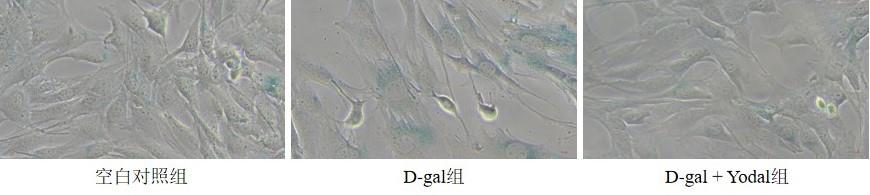
Tab.2
Comparison of SA-B-Gal positive staining rate and average fluorescence intensity of p21 in small muscle cells"
| 组别 | SA-β-Gal阳性/% | p21平均荧光强度/a.u. |
|---|---|---|
| 空白对照组 | 0.051 ± 0.026 | 0.242 ± 0.086 |
| D-gal组 | 0.319 ± 0.116△△△ | 0.547 ± 0.115△△△ |
| D-gal + Yoda1组 | 0.104 ± 0.041▲▲▲ | 0.190 ± 0.074▲▲▲ |
| F值 | 34.36 | 38.44 |
| P值 | < 0.001 | < 0.001 |
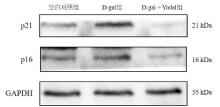
Fig.6
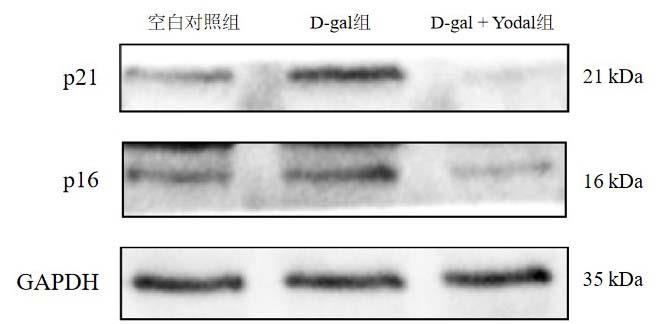
Images of aging protein bands in various muscle cells"
Tab.3
Comparison of the expression levels of p16, p21 proteins in myoblasts"
| 组别 | p16 | p21 |
|---|---|---|
| 空白对照组 | 0.472 ± 0.121 | 0.242 ± 0.086 |
| D-gal组 | 1.316 ± 0.139△△△ | 0.547 ± 0.115△△△ |
| D-gal + Yoda1组 | 0.396 ± 0.130▲▲▲ | 0.190 ± 0.074▲▲▲ |
| F值 | 138.7 | 38.44 |
| P值 | < 0.001 | < 0.001 |
Fig 7
Fluorescence images of p21 cell immunofluorescence staining in various constituent muscle cells"
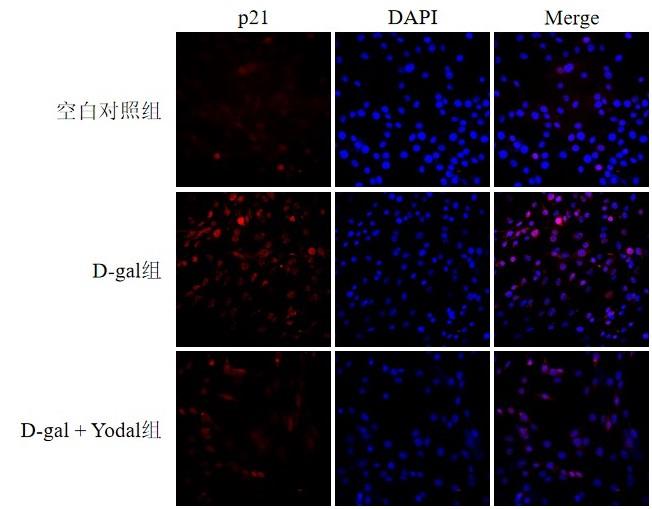
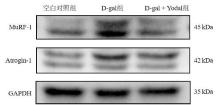
Fig.8
Images of atrophy protein bands in various muscle cells"
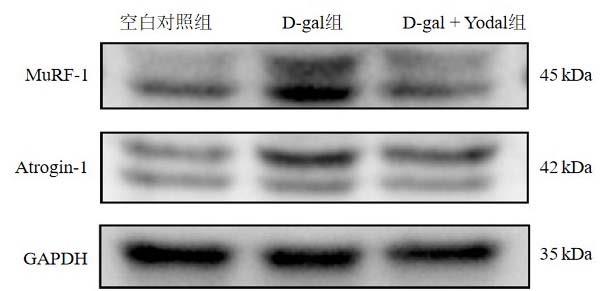
Tab.4
Comparison of the expression levels of Atrogin-1, and MuRF-1 proteins in myoblasts"
| 组别 | Atrogin-1 | MuRF-1 |
|---|---|---|
| 空白对照组 | 0.630 ± 0.122 | 0.566 ± 0.111 |
| D-gal组 | 1.293 ± 0.133△△△ | 1.293 ± 0.187△△△ |
| D-gal + Yoda1组 | 0.828 ± 0.108▲▲▲ | 0.733 ± 0.123▲▲▲ |
| F值 | 70.72 | 63.04 |
| P值 | < 0.001 | < 0.001 |
| [1] |
MARZETTI E. Musculoskeletal aging and sarcopenia in the elderly[J]. Int J Mol Sci, 2022, 23(5):2808. doi:10.3390/ijms23052808
doi: 10.3390/ijms23052808 |
| [2] |
MELLEN R H, GIROTTO O S, MARQUES E B, et al. Insights into pathogenesis, nutritional and drug approach in sarcopenia: A systematic review[J]. Biomedicines, 2023, 11(1): 136. doi:10.3390/biomedicines11010136
doi: 10.3390/biomedicines11010136 |
| [3] |
ZHANG F, LI W. Vitamin D and sarcopenia in the senior people: A review of mechanisms and comprehensive prevention and treatment strategies[J]. Ther Clin Risk Manag, 2024, 20: 577-595. doi:10.2147/tcrm.s471191
doi: 10.2147/tcrm.s471191 |
| [4] |
KUNZ H E, MICHIE K L, GRIES K J, et al. A randomized trial of the effects of dietary n3-PUFAs on skeletal muscle function and acute exercise response in healthy older adults[J]. Nutrients, 2022, 14(17): 3537. doi:10.3390/nu14173537
doi: 10.3390/nu14173537 |
| [5] | 王坤, 罗炯, 刘立, 等. 老年人肌少症的成因、评估及应对[J]. 中国组织工程研究, 2019, 23(11): 1767-1773. |
| [6] |
YAMADA M, LEE W J, AKISHITA M, et al. Clinical practice for sarcopenia in Asia: Online survey by the Asian Working Group for Sarcopenia[J]. Arch Gerontol Geriatr, 2023, 115: 105132. doi:10.1016/j.archger.2023.105132
doi: 10.1016/j.archger.2023.105132 |
| [7] |
SHEN Y, SHI Q, NONG K, et al. Exercise for sarcopenia in older people: A systematic review and network meta‐analysis[J]. J Cachexia Sarcopenia Muscle, 2023, 14(3): 1199-1211. doi:10.1002/jcsm.13225
doi: 10.1002/jcsm.13225 |
| [8] | 海鹏程, 梁艳虹. 《老年人肌少症门诊管理规范中国专家共识(2024版)》解读[J]. 河北医科大学学报, 2025, 46(5): 502-506. |
| [9] | 龚丽景, 潘秀清, 付鹏宇. 不同运动模式缓解衰老性骨骼肌萎缩的研究进展[J]. 山东体育学院学报, 2023, 39(2): 84-91. |
| [10] |
PETERSON D M, RHEA R M, SEN A, et al. Resistance exercise for muscular strength in older adults: A meta-analysis[J]. Ageing Res Rev, 2010, 9(3): 226-237. doi:10.1016/j.arr.2010.03.004
doi: 10.1016/j.arr.2010.03.004 |
| [11] | 潘冬, 杨加玲, 田卫, 等. 抗阻运动激活衰老大鼠骨骼肌卫星细胞:脂联素受体1途径的作用[J]. 中国组织工程研究, 2026, 30(7): 1736-1746. |
| [12] |
LEI L, WEN Z, CAO M, et al. The emerging role of Piezo1 in the musculoskeletal system and disease[J]. Theranostics, 2024, 14(10): 3963-3983. doi:10.7150/thno.96959
doi: 10.7150/thno.96959 |
| [13] |
DIENES B, BAZSÓ T, SZABÓ L, et al. The role of the Piezo1 mechanosensitive channel in the musculoskeletal system[J]. Int J Mol Sci, 2023, 24(7): 6513. doi:10.3390/ijms24076513
doi: 10.3390/ijms24076513 |
| [14] |
PENG Y, DU J, GÜNTHER S, et al. Mechano-signaling via Piezo1 prevents activation and p53-mediated senescence of muscle stem cells[J]. Redox Biol, 2022, 52: 102309. doi:10.1016/j.redox.2022.102309
doi: 10.1016/j.redox.2022.102309 |
| [15] |
ZHANG Y, LV L, ZHOU Z, et al. Piezo1 facilitates the initiation and progression of renal fibrosis by mediating cell apoptosis and mitochondrial dysfunction[J]. Ren Fail, 2024, 46(2): 2415519. doi:10.1080/0886022x.2024.2415519
doi: 10.1080/0886022x.2024.2415519 |
| [16] |
ZHANG M, WANG Q R, HOU X, et al. Blockage of mechanosensitive Piezo1 channel alleviates the severity of experimental malaria-associated acute lung injury[J]. Parasit Vectors, 2024, 17(1): 46. doi:10.1186/s13071-024-06144-5
doi: 10.1186/s13071-024-06144-5 |
| [17] |
LEE Y J, KIM G H, JEONG H J, et al. Activation of the apelin/APJ system by vitamin D attenuates age-related muscle atrophy[J]. Life Sci, 2024, 359: 123205. doi:10.1016/j.lfs.2024.123205
doi: 10.1016/j.lfs.2024.123205 |
| [18] |
KANG T, YANG Z, ZHOU M, et al. The role of the Piezo1 channel in osteoblasts under cyclic stretching: A study on osteogenic and osteoclast factors[J]. Arch Oral Biol, 2024, 163: 105963. doi:10.1016/j.archoralbio.2024.105963
doi: 10.1016/j.archoralbio.2024.105963 |
| [19] |
GUO A, HUANG K, LU Q, et al. TRIM16 facilitates SIRT‐1‐dependent regulation of antioxidant response to alleviate age‐related sarcopenia[J]. J Cachexia Sarcopenia Muscle, 2024, 15(5): 2056-2070. doi:10.1002/jcsm.13553
doi: 10.1002/jcsm.13553 |
| [20] |
HORNBERGER T A Jr, FARRAR R P. Physiological Hypertrophy of the FHL Muscle Following 8 Weeks of Progressive Resistance Exercise in the Rat[J]. Can J Appl Physiol, 2004, 29(1): 16-31. doi:10.1139/h04-002
doi: 10.1139/h04-002 |
| [21] |
NOURI H, SHEIKHOLESLAMI-VATANI D, MOLOUDI M R. Changes in UPR-PERK pathway and muscle hypertrophy following resistance training and creatine supplementation in rats[J]. J Physiol Biochem, 2021, 77(2): 331-339. doi:10.1007/s13105-021-00801-4
doi: 10.1007/s13105-021-00801-4 |
| [22] | 刘瑞玲, 李先辉, 伍方佳, 等. 姜黄素联合抗阻运动干预对非酒精性脂肪性肝病的改善作用及对肠道菌群的影响[J]. 食品与发酵工业, 2024, 24(5): 68-81. |
| [23] | 穆光宗, 张团. 我国人口老龄化的发展趋势及其战略应对[J]. 华中师范大学学报(人文社会科学版), 2011, 50(5): 29-36. |
| [24] | 王秋硕.老年肌少症的影响因素及干预措施的研究进展[J]. 黑龙江科学, 2025, 16(2): 70-72. |
| [25] |
SAYER A A, CRUZ-JENTOFT A. Sarcopenia definition, diagnosis and treatment: Consensus is growing[J]. Age Ageing, 2022, 51(10): afac220. doi:10.1093/ageing/afac220
doi: 10.1093/ageing/afac220 |
| [26] | 张磊, 李静, 刘青叶. 运动干预改善老年人肌少症的研究进展[J]. 中国老年学杂志, 2025, 45(7): 1769-1773. |
| [27] | 朱珠, 刘敏. 老年肌少症研究进展[J]. 临床医学进展, 2025, 15: 139. |
| [28] | 杨士芳, 高兴林, 李静, 等. 慢性阻塞性肺疾病合并肌少症的研究进展[J]. 实用医学杂志, 2024, 40(9): 1181-1185. |
| [29] |
SAYER A A, COOPER R, ARAI H, et al. Sarcopenia[J]. Nat Rev Dis Primers, 2024, 10(1): 68. doi:10.1038/s41572-024-00550-w
doi: 10.1038/s41572-024-00550-w |
| [30] | 吴雨杰, 阮琳乔, 杨毅茹, 等. 渐进性抗阻训练治疗老年性肌少症的研究进展[J]. 现代医药卫生, 2022, 38(16): 2780-2784. |
| [31] |
THIEN N D, HAI-NAM N, ANH D T, et al. Piezo1 and its inhibitors: Overview and perspectives[J]. Eur J Med Chem, 2024, 273: 116502. doi:10.1016/j.ejmech.2024.116502
doi: 10.1016/j.ejmech.2024.116502 |
| [32] |
LEI L, WEN Z, CAO M, et al. The emerging role of Piezo1 in the musculoskeletal system and disease[J]. Theranostics, 2024, 14(10): 3963. doi:10.7150/thno.96959
doi: 10.7150/thno.96959 |
| [33] |
SHARMA A, BHATTACHARYYA J, SUKUMAR P, et al. PIEZO1 activity promotes stemness in mesenchymal stem cells under shear stress and enhances protection of leukemia cells[J]. Sci Rep, 2025, 15(1): 24244. doi:10.1038/s41598-025-09549-z
doi: 10.1038/s41598-025-09549-z |
| [34] |
DONG M, MATURANA A D. Effects of aging on calcium channels in skeletal muscle[J]. Front Mol Biosci, 2025, 12: 1558456. doi:10.3389/fmolb.2025.1558456
doi: 10.3389/fmolb.2025.1558456 |
| Viewed | ||||||
|
Full text |
|
|||||
|
Abstract |
|
|||||
