实用医学杂志 ›› 2026, Vol. 42 ›› Issue (8): 1421-1427.doi: 10.3969/j.issn.1006-5725.2026.08.016

• 论著·临床实践 • 上一篇    

睡眠质量在南通市老年人脑小血管病与认知功能间的中介效应

郭啸鸣,曹志勇,陆珍辉,顾津瑜,邢灿,朱向阳()   

  1. 南通市第一人民医院神经内科 (江苏 南通 226000 )
  • 收稿日期:2025-12-04 出版日期:2026-04-25 发布日期:2026-04-28
  • 通讯作者: 朱向阳 E-mail:sjnkzxy@163.com
  • 基金资助:
    国家重点研发计划(2022YFC2405600);南通市社会民生科技计划项目(MSZ2024090);南通市卫生健康委科研项目(MS2024029)

Mediating effect of sleep quality on the relationship between cerebral small vessel disease and cognitive function among older adults in Nantong

Xiaoming GUO,Zhiyong CAO,Zhenhui LU,Jinyu GU,Can XING,Xiangyang ZHU()   

  1. Department of Neurology,Nantong First People's Hospital,Nantong 226000,Jiangsu,China
  • Received:2025-12-04 Online:2026-04-25 Published:2026-04-28
  • Contact: Xiangyang ZHU E-mail:sjnkzxy@163.com

摘要:

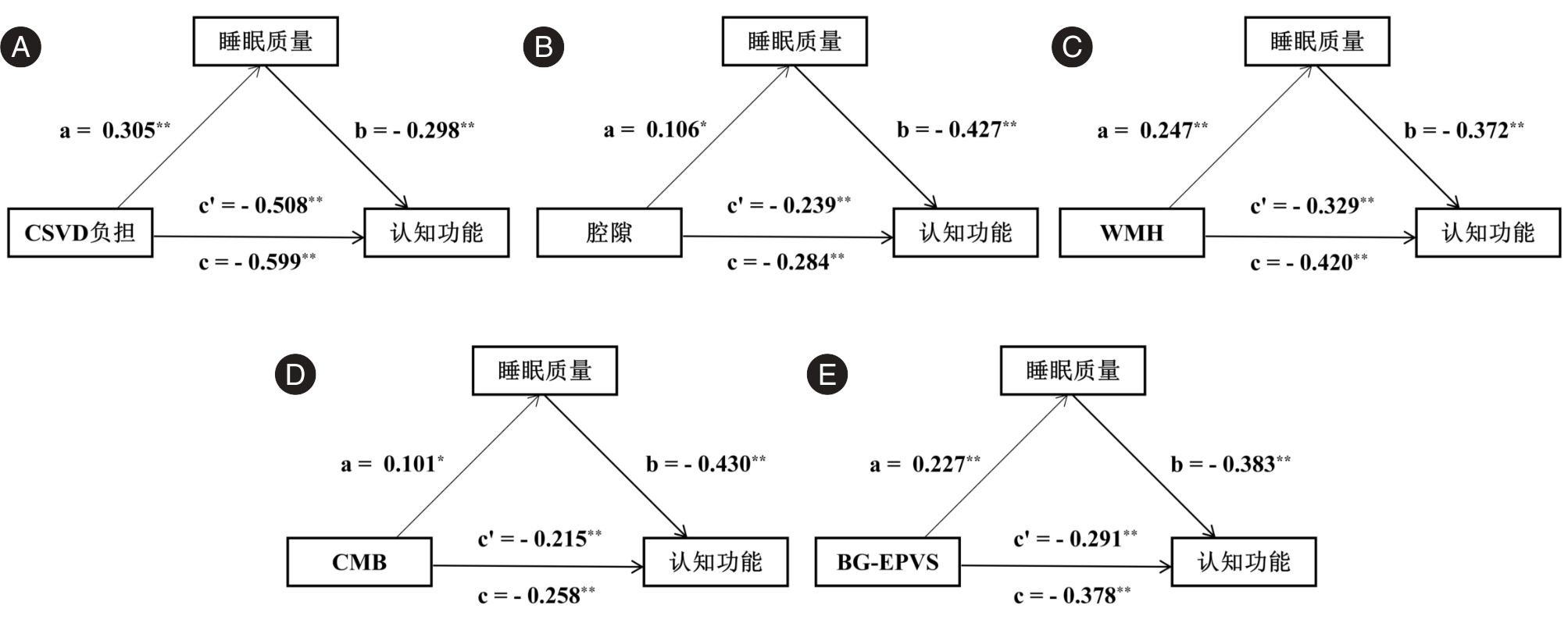
目的 探讨睡眠质量在南通市老年人脑小血管病(cerebral small vessel disease, CSVD)与认知功能间的中介效应。 方法 回顾性分析2024年3月至2025年3月在南通市第一人民医院神经内科住院的412例南通市60岁及以上CSVD患者的临床资料。采用蒙特利尔认知评估量表(Montreal Cognitive Assessment, MoCA)评估认知功能,根据结果分为认知障碍(cognitive impairment, CI)组和非CI组进行比较。采用匹兹堡睡眠质量指数量表(Pittsburgh Sleep Quality Index, PSQI)评估睡眠质量。采用多元线性回归分析确定关键变量之间的关系。通过宏程序PROCESS 4.1插件中的Model 4进行睡眠质量在CSVD与认知功能间的中介效应分析,使用Bootstrap法进行中介效应验证。 结果 CI患者192例(46.6%),非CI患者220例(53.4%),CI组与非CI组患者相比,CSVD负担较重、腔隙、中-重度白质高信号(white matter hyperintensities, WMH)、脑微出血(cerebral microbleed, CMB)、>10个基底节区-血管周围间隙扩大(basal ganglia-enlarged perivascular spaces, BG-EPVS)比例较高、PSQI评分较高,差异均有统计学意义(均P < 0.05或P < 0.001)。在调整协变量年龄、性别、受教育年限、汉密尔顿焦虑量表(Hamilton Anxiety Scale, HAMA)评分、17项-汉密尔顿抑郁量表(Hamilton Depression Rating Scale-17, HAMD-17)评分及血管危险因素后,CSVD负担、腔隙数量、CMB数量、BG-EPVS数量、WMH严重程度与MoCA评分均呈显著负相关(均P < 0.001),与PSQI评分均呈显著正相关(均P < 0.05或P < 0.001);PSQI评分与MoCA评分呈显著负相关(P < 0.001)。中介效应分析结果表明,睡眠质量在CSVD与认知功能关系中起部分中介效应,其在CSVD负担、腔隙、WMH、CMB、BG-EPVS与认知功能关系中的中介效应占比分别为15.2%、15.8%、21.7%、16.7%、23.0%,经Bootstrap检验(5 000次),95%CI的上、下限均不包含0,中介效应显著。 结论 睡眠质量在南通市老年人CSVD导致CI的过程中起着部分中介效应,改善睡眠质量可能有助于降低CSVD-CI的发生风险。

关键词: 脑小血管病, 认知, 睡眠质量, 中介效应, 负担

Abstract:

Objective To explore the mediating effect of sleep quality on the relationship between cerebral small vessel disease (CSVD) and cognitive function among the older adults in Nantong. Methods A total of 412 patients aged 60 years or above with CSVD admitted to the Department of Nantong First People's Hospital in Nantong from March 2024 to March 2025 were enrolled in this retrospective study. Based on the cognitive function assessed by the Montreal Cognitive Assessment (MoCA), patients were divided into the cognitive impairment (CI) group and the non-CI group for comparison. Sleep quality was evaluated using the Pittsburgh Sleep Quality Index (PSQI). Multiple linear regression analysis was conducted to determine the relationships among key variables. The mediating effect of sleep quality between CSVD and cognitive function was analyzed using Model 4 of the PROCESS macro version 4.1, and the mediating effect was validated through the Bootstrap method. Results There were 192 patients (46.6%) with CI, and 220 patients (53.4%) without CI. Patients in the CI group presented a greater burden of CSVD, higher proportions of lacunes, moderate-to-severe white matter hyperintensities (WMH), cerebral microbleed (CMB), and basal ganglia-enlarged perivascular spaces (BG-EPVS) exceeding 10, as well as elevated PSQI scores compared to the non-CI group. All these differences were statistically significant (all P < 0.05 or P < 0.001). After adjusting for covariates such as age, sex, years of education, Hamilton Anxiety Scale (HAMA) scores, Hamilton Depression Rating Scale-17 (HAMD-17) scores, and vascular risk factors, the CSVD burden, the number of lacunes, the number of CMB, the number of BG-EPVS, and the severity of WMH were all significantly negatively correlated with Montreal Cognitive Assessment (MoCA) scores (all P < 0.001), and significantly positively correlated with PSQI scores (all P < 0.05 or P < 0.001). Additionally, PSQI scores were significantly negatively correlated with MoCA scores (P < 0.001). Mediated effect analysis indicated that sleep quality plays a partial mediating role in the relationship between CSVD and cognitive function. The mediating effect ratios in the relationships between CSVD burden, lacunes, WMH, CMB, BG-EPVS and cognitive function are 15.2%, 15.8%, 21.7%, 16.7% and 23.0% respectively. In the Bootstrap test (5 000 times), neither the upper nor the lower limit of the 95% confidence interval contains 0, suggesting that the mediating effect is significant. Conclusions Sleep quality plays a partial mediating role in the process by which CSVD leads to CI among the elderly in Nantong. Enhancing sleep quality may be beneficial in reducing the risk of developing CSVD-CI.

Key words: cerebral small vessel disease, cognitive, sleep quality, mediating effect, burden

中图分类号: