

The Journal of Practical Medicine ›› 2026, Vol. 42 ›› Issue (14): 2649-2656.doi: 10.3969/j.issn.1006-5725.2026.14.018
• Treatise:Mechanism and Practice • Previous Articles
Hang WU,Qiang LI,Haitao YUAN,Peng GU,Xiongwei DENG( )
)
Received:2026-05-07
Online:2026-07-25
Published:2026-08-05
Contact:
Xiongwei DENG
E-mail:dengxiongwei1130@163.com
CLC Number:
Hang WU,Qiang LI,Haitao YUAN,Peng GU,Xiongwei DENG. A biomechanical efficacy comparison study on two types of fibular groove deepening surgeries for treating fibular tendon dislocation based on plantar pressure analysis[J]. The Journal of Practical Medicine, 2026, 42(14): 2649-2656.
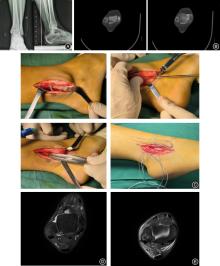
Fig.1
Typical case in the modified group (sub?cortical drilling and pressurization technique)"

Tab.1
Comparison of preoperative and 12-month postoperative clinical scores between the two groups"
| 项目 | 组别 | 术前 | 术后12月 | 组内配对t值 | P值 | 组间t值 | 组间P值 |
|---|---|---|---|---|---|---|---|
| AOFAS评分 | 改良组 | 64.22 ± 5.85 | 92.51 ± 4.38 | 22.18 | < 0.001 | 0.525 | 0.602 |
| 常规组 | 65.10 ± 6.23 | 91.85 ± 4.71 | 18.93 | < 0.001 | |||
| VAS评分 | 改良组 | 6.82 ± 1.13 | 1.22 ± 0.85 | 19.84 | < 0.001 | 0.829 | 0.411 |
| 常规组 | 6.50 ± 1.30 | 1.42 ± 0.92 | 16.53 | < 0.001 |
Tab.2
Comparison of SI-PP in the metatarsal area during the propulsion phase between the two groups of patients (x ± s)/%"
| 足底区域 | 改良组 | 常规组 | t值 | P值 |
|---|---|---|---|---|
| M1 | 95.62 ± 4.23 | 94.15 ± 5.88 | 1.073 | 0.284 |
| M2-M3 | 98.20 ± 3.15 | 97.51 ± 4.45 | 0.660 | 0.512 |
| M4 | 92.52 ± 5.12 | 85.33 ± 7.84 | 2.500 | 0.015 |
| M5 | 90.85 ± 6.20 | 83.10 ± 8.59 | 2.377 | 0.021 |
Tab.3
Comparison of SI-PTI in the main areas of the foot between the two groups of patients"
| 足底区域 | 改良组 | 常规组 | t值 | P值 |
|---|---|---|---|---|
| 后足区 | 103.22 ± 8.75 | 112.43 ± 10.32 | 2.206 | 0.032 |
| 中足区 | 98.45 ± 6.57 | 96.25 ± 7.49 | 1.120 | 0.412 |
| 前足总体 | 97.12 ± 5.91 | 91.55 ± 9.23 | 1.767 | 0.081 |
| M1-M3 | 101.80 ± 6.84 | 100.21 ± 7.62 | 0.63. | 0.531 |
| M4-M5 | 93.45 ± 7.30 | 84.22 ± 9.10 | 2.735 | 0.008 |
Tab.4
Comparison of pressure center trajectory parameters between the two groups of patients"
| 参数 | 改良组 | 常规组 | t值 | P值 |
|---|---|---|---|---|
| 冠状面(内外)最大摆动幅度/cm | 1.20 ± 0.42 | 1.75 ± 0.68 | 2.330 | 0.024 |
| 矢状面(前后)最大位移/cm | 24.30 ± 2.83 | 25.11 ± 3.25 | 0.710 | 0.481 |
| CoP速度/(cm/s) | 8.60 ± 1.21 | 9.32 ± 1.55 | 1.435 | 0.156 |
| 步长对称性指数/% | 97.87 ± 3.29 | 94.25 ± 4.62 | 2.076 | 0.042 |
| 步宽/cm | 9.40 ± 1.81 | 10.24 ± 2.15 | 1.262 | 0.213 |
Tab.5
Comparison of gait cycle parameters between the two groups of patients"
| 参数 | 改良组 | 常规组 | t值 | P值 |
|---|---|---|---|---|
| 支撑相时间/% | 61.21 ± 2.82 | 62.80 ± 3.44 | 1.547 | 0.127 |
| 摆动相时间/% | 38.83 ± 2.85 | 37.20 ± 3.45 | 1.258 | 0.127 |
| 双支撑期时间/% | 11.47 ± 1.60 | 13.20 ± 2.13 | 2.134 | 0.038 |
| 推进期PP时间/(% GC) | 48.22 ± 3.13 | 45.60 ± 3.81 | 1.710 | 0.091 |
| 步速/(m/s) | 1.28 ± 0.12 | 1.22 ± 0.14 | 1.442 | 0.152 |
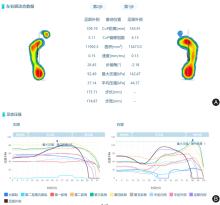
Fig.2
Dynamic gait analysis images of patients in the modified group at 12 months after surgery"
| [1] |
PARK S H, CHOI Y R, LEE J, et al. Treatment of recurrent peroneal tendon dislocation by peroneal retinaculum reattachment without fibular groove deepening[J]. J Foot Ankle Surg, 2021, 60(5): 994-997. doi:10.1053/j.jfas.2020.04.027 .
doi: 10.1053/j.jfas.2020.04.027 |
| [2] |
NISHIMURA A, NAKAZORA S, SENGA Y, et al. Anatomic features of patients with recurrent peroneal tendon dislocation[J]. Am J Sports Med, 2023, 51(5): 1312-1318. doi:10.1177/03635465231158100 .
doi: 10.1177/03635465231158100 |
| [3] |
HOSACK T, PERKINS O, BLEIBLEH S, et al. Snapping ankles: Peroneal tendon subluxation and dislocation[J]. Br J Hosp Med, 2023, 84(10): 1-7. doi:10.12968/hmed.2022.0257 .
doi: 10.12968/hmed.2022.0257 |
| [4] |
LUI T H, CHOI Y H. Endoscopic retrofibular groove deepening for management of type A intrasheath peroneal tendon subluxation[J]. Arthrosc Tech, 2024, 13(12): 103148. doi:10.1016/j.eats. 2024.103148 .
doi: 10.1016/j.eats. 2024.103148 |
| [5] |
KARUNAKARAN A, PATEL S, BHATIA D. Indirect fibular groove deepening: A simple approach for guiding drill direction during intramedullary reaming-a technical tip[J]. Ann Ital Chir, 2025, 96(5): 789-795. DOI: 10.62713/aic.3456 .
doi: 10.62713/aic.3456 |
| [6] |
SAMAILA E M, AUREGLI L, MALUTA T, et al. Retromalleolar groove deepening in recurrent peroneal tendon dislocation: Short- and medium-term functional outcomes[J]. Appl Sci, 2023, 13(20): 11468. doi:10.3390/app132011468 .
doi: 10.3390/app132011468 |
| [7] |
MYERSON M S, KADAKIA A. Peroneal tendon disorders: Current concepts[J]. J Bone Joint Surg Am, 2023, 105(14): 1122-1130. doi: 10.2106/JBJS.23.00234 .
doi: 10.2106/JBJS.23.00234 |
| [8] |
ZHANG P, LI S, LIU Y, et al. Modified posterior fibular groove deepening procedure with repair of the superior peroneal retinaculum for peroneal tendon subluxation[J]. Int Orthop, 2023, 47(5): 1259-1265. doi:10.1007/s00264-023-05750-9 .
doi: 10.1007/s00264-023-05750-9 |
| [9] |
BARG A, HORISBERGER M, HINTERMANN B. Updates in peroneal tendon pathology: Diagnosis and treatment[J]. Foot Ankle Clin, 2024, 29(3): 401-418. doi: 10.1016/j.fcl.2024. 01.003 .
doi: 10.1016/j.fcl.2024. 01.003 |
| [10] |
SEO S G, LEE D Y, KIM E J. Plantar pressure analysis as a prognostic tool in foot and ankle surgery: a systematic review[J]. Foot Ankle Surg, 2024, 30(2): 112-119. doi: 10.1016/j.fas. 2023.11.005 .
doi: 10.1016/j.fas. 2023.11.005 |
| [11] |
CHEN T L, WANG Y, PENG Y, et al. Dynamic finite element analyses to compare the influences of customised total talar replacement and total ankle arthroplasty on foot biomechanics during gait[J]. J Orthop Transl, 2023, 38: 32-43. doi:10.1016/j.jot.2022.07.013 .
doi: 10.1016/j.jot.2022.07.013 |
| [12] |
POL F, BAHARLOUEI H, TAHERI A, et al. Foot and ankle biomechanics during walking in older adults: A systematic review and meta-analysis of observational studies[J]. Gait Posture, 2021, 89: 14-24. doi:10.1016/j.gaitpost.2021.06.018 .
doi: 10.1016/j.gaitpost.2021.06.018 |
| [13] |
ZHANG P, LI S S, LIU Y, et al. Innovative percutaneous subcortical drilling and pressing technique for peroneal groove deepening: Biomechanical advantages and clinical outcomes[J]. Int Orthop, 2023, 47(4):945-952. doi: 10.1007/s00264-023-05724-5 .
doi: 10.1007/s00264-023-05724-5 |
| [14] |
MONTEIRO R L, FERREIRA J S S P, SILVA É Q, et al. Effects of foot-ankle exercises on foot-ankle kinematics, plantar pressure, and gait kinetics in people with diabetic neuropathy: Secondary outcomes from a randomized controlled trial[J]. Braz J Phys Ther, 2023, 27(3): 100517. doi:10.1016/j.bjpt.2023. 100517 .
doi: 10.1016/j.bjpt.2023. 100517 |
| [15] |
CHEN J L, DAI Y N, GRIMALDI N S, et al. Plantar pressure-based insole gait monitoring techniques for diseases monitoring and analysis: A review[J]. Adv Mater Technol, 2022, 7: 2100566. doi:10.1002/admt.202100566 .
doi: 10.1002/admt.202100566 |
| [16] |
LIM E. Peroneal tendon dislocation[J]. Orthop J Phys Med, 2024, 12(): 2325967124S00375. doi:10.1177/2325967124s00375 .
doi: 10.1177/2325967124s00375 |
| [17] |
CONNER B C, FANG Y, LERNER Z F. Under pressure: Design and validation of a pressure-sensitive insole for ankle plantar flexion biofeedback during neuromuscular gait training[J]. J NeuroEngineering Rehabil, 2022, 19(1): 135. doi:10.1186/s12984-022-01119-y .
doi: 10.1186/s12984-022-01119-y |
| [18] |
WANG Y, QI Y, MA B, et al. Three-dimensional gait analysis of orthopaedic common foot and ankle joint diseases[J]. Front Bioeng Biotechnol, 2024, 12: 1303035. doi:10.3389/fbioe.2024. 1303035 .
doi: 10.3389/fbioe.2024. 1303035 |
| [19] |
NAKAMURA S, TANAKA Y, OKAMOTO R. Biomechanical analysis of gait symmetry after peroneal tendon repair: A prospective cohort study[J]. Gait Posture, 2025, 105: 45-52. doi: 10.1016/j.gaitpost.2024.07.012 .
doi: 10.1016/j.gaitpost.2024.07.012 |
| [20] |
任彦宇. 腓骨肌腱脱位的手术治疗进展[J]. 临床个性化医学, 2025, 4(2): 213-218. doi:10.12677/jcpm.2025.42166 .
doi: 10.12677/jcpm.2025.42166 |
| [21] |
倪曲波, 吕佳豪, 陈廖斌. 腓骨肌腱滑脱症的诊治现状[J]. 临床外科杂志, 2025, 33(4): 353-356. doi:10.3969/j.issn.1005-6483.20250331 .
doi: 10.3969/j.issn.1005-6483.20250331 |
| [22] |
侯宗辰, 敖英芳, 胡跃林, 等. 慢性踝关节不稳患者足底压力特征及相关因素分析[J]. 北京大学学报(医学版), 2021, 53(2): 279-285. doi:10.19723/j.issn.1671-167X.2021.02.008 .
doi: 10.19723/j.issn.1671-167X.2021.02.008 |
| [23] |
李玉周, 王婧怡, 胡英琪. 前交叉韧带重建术后短期足底压力分布及平衡特征研究[J]. 体育科学, 2020, 40(5): 52-59. doi:10.16469/j.css.202005005 .
doi: 10.16469/j.css.202005005 |
| [24] |
王奇奇, 徐朱杰, 冯德宏, 等. 步态分析在前交叉韧带损伤中的应用[J]. 实用骨科杂志, 2021, 27(12): 1112-1116. doi:10.13795/j.cnki.sgkz.2021.12.011 .
doi: 10.13795/j.cnki.sgkz.2021.12.011 |
| [25] |
汤运启, 任慧, 邹利民, 等. 不稳定鞋对下肢生物力学影响的研究进展[J]. 皮革科学与工程, 2023, 33(6): 59-65. doi:10.19677/j.issn.1004-7964.2023.06.009 .
doi: 10.19677/j.issn.1004-7964.2023.06.009 |
| [26] |
刘钦华, 赵功赫, 初心, 等. 儿童鞋中后底硬度对跑步过程中下肢生物力学影响[J]. 皮革科学与工程, 2021, 31(6): 53-58. doi:10.19677/j.issn.1004-7964.2021.06.010 .
doi: 10.19677/j.issn.1004-7964.2021.06.010 |
| [27] |
张清悦, 钱竞光. 偏瘫步态分析与仿真研究进展[J]. 力学与实践, 2021, 43(3): 327-334. doi:10.6052/1000-0879-20-168 .
doi: 10.6052/1000-0879-20-168 |
| [28] |
赵碎浪, 祁子芮, 曹中华, 等. 3D打印支撑鞋垫对扁平足足底压力分布的影响[J]. 皮革科学与工程, 2022, 32(3): 85-89. doi:10.19677/j.issn.1004-7964.2022.03.0016 .
doi: 10.19677/j.issn.1004-7964.2022.03.0016 |
| [29] |
刘珺, 郭军涛, 李毅, 等. 足底压力分布测量装置在军事训练中的应用探讨[J]. 医疗卫生装备, 2021, 42(10): 73-78. doi:10.19745/j.1003-8868.2021216 .
doi: 10.19745/j.1003-8868.2021216 |
| [30] |
ALTUN A, DIXON S, NUNNS M, et al. How do neuromuscular characteristics of the peroneal muscles differ in adults with and without chronic ankle instability? A systematic review with meta-analysis[J]. Gait Posture, 2025, 117: 352-362.doi:10.1016/j.gaitpost.2025.01.019 .
doi: 10.1016/j.gaitpost.2025.01.019 |
| [31] |
KO D, CHOI Y, LEE K. Effects of Peroneus Brevis versus Peroneus Longus Muscle Training on Muscle Function in Chronic Ankle Instability: A Randomized Controlled Trial[J]. Healthcare (Basel), 2024, 12(5): 547.doi:10.3390/healthcare12050547 .
doi: 10.3390/healthcare12050547 |
| [32] |
王静, 王晖, 苗宇宽, 等. 2型糖尿病周围神经病变患者足底动静态压力参数比较及相关因素分析[J]. 实用医学杂志, 2025, 41(4): 522-528. doi:10.3969/j.issn.1006-5725.2025. 04.009 .
doi: 10.3969/j.issn.1006-5725.2025. 04.009 |
| [33] |
CHINITZ N, BOHL D D, REDDY M, et al. Preoperative Gait Analysis of Peroneal Tendon Tears[J]. Foot Ankle Int, 2022, 43(2): 230-237.doi:10.1177/10711007211036876 .
doi: 10.1177/10711007211036876 |
| [1] | Fuwei PAN,Min ZHANG,Zhengyan LI,Jiehang LU,Yuqi CHEN,Pei LI,Hongsheng ZHAN. Study on clinical therapeutic effect mechanism of Shi's trauma manipulation on knee osteoarthritis based on human biomechanics [J]. The Journal of Practical Medicine, 2026, 42(5): 768-776. |
| [2] | Yuze FENG,Qiqi KONG,Daohai XIONG. Research progress on the multidimensional mechanisms of core training in the treatment of chronic nonspecific low back pain [J]. The Journal of Practical Medicine, 2025, 41(22): 3625-3630. |
| [3] | Junlin GAO,Guangjie YIN,Chao MENG,Chunlei XIU,Liying HUANG,Tian. TIAN. Establishment of animal models of rat abdominal wall with implantation of polypropylene mesh and mersilene tape and comparative study on their biomechanical properties and histocompatibility [J]. The Journal of Practical Medicine, 2025, 41(10): 1496-1501. |
| [4] | Bangjun CHENG,Yanfeng HUANG,Yi. LUO. A biomechanical comparison of three types of internal fixation for posterior malleolar fracture [J]. The Journal of Practical Medicine, 2024, 40(8): 1137-1141. |
| [5] |
ZOU Hanyu, CHEN Xiang, ZHAO Lijuan, ZHANG Guohui, ZHANG Hong..
Mechanism of traction in the treatment of cervical radiculopathy:a review of literature [J]. The Journal of Practical Medicine, 2023, 39(7): 793-797. |
| Viewed | ||||||
|
Full text |
|
|||||
|
Abstract |
|
|||||
