

The Journal of Practical Medicine ›› 2026, Vol. 42 ›› Issue (14): 2640-2648.doi: 10.3969/j.issn.1006-5725.2026.14.017
• Treatise:Mechanism and Practice • Previous Articles
Suya GU( ),Huangming HE,Zhiting GUO,Jianjiu ZHU,Mingxian LIAO,Jinwang DENG
Received:2026-04-24
Online:2026-07-25
Published:2026-08-05
Contact:
Suya GU
E-mail:8085870@qq.com
CLC Number:
Suya GU,Huangming HE,Zhiting GUO,Jianjiu ZHU,Mingxian LIAO,Jinwang DENG. Application of ultrasound-guided C5 nerve root block plus cervical nerve pathway block in anesthesia for clavicle fracture surgery[J]. The Journal of Practical Medicine, 2026, 42(14): 2640-2648.
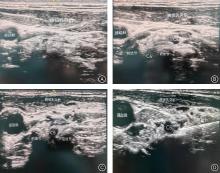
Fig.1
Ultrasound-guided C5 cervical nerve root block"
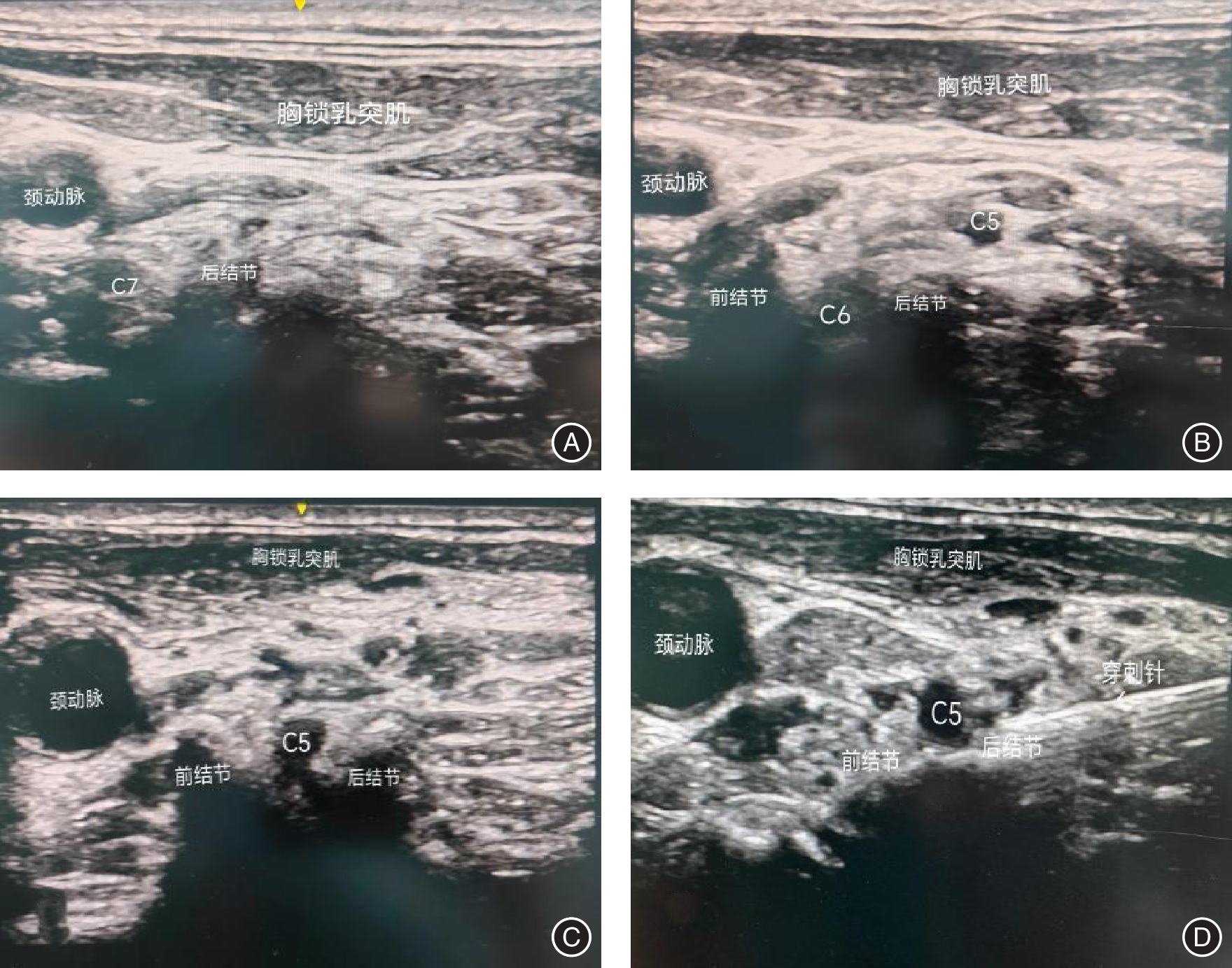
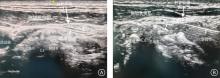
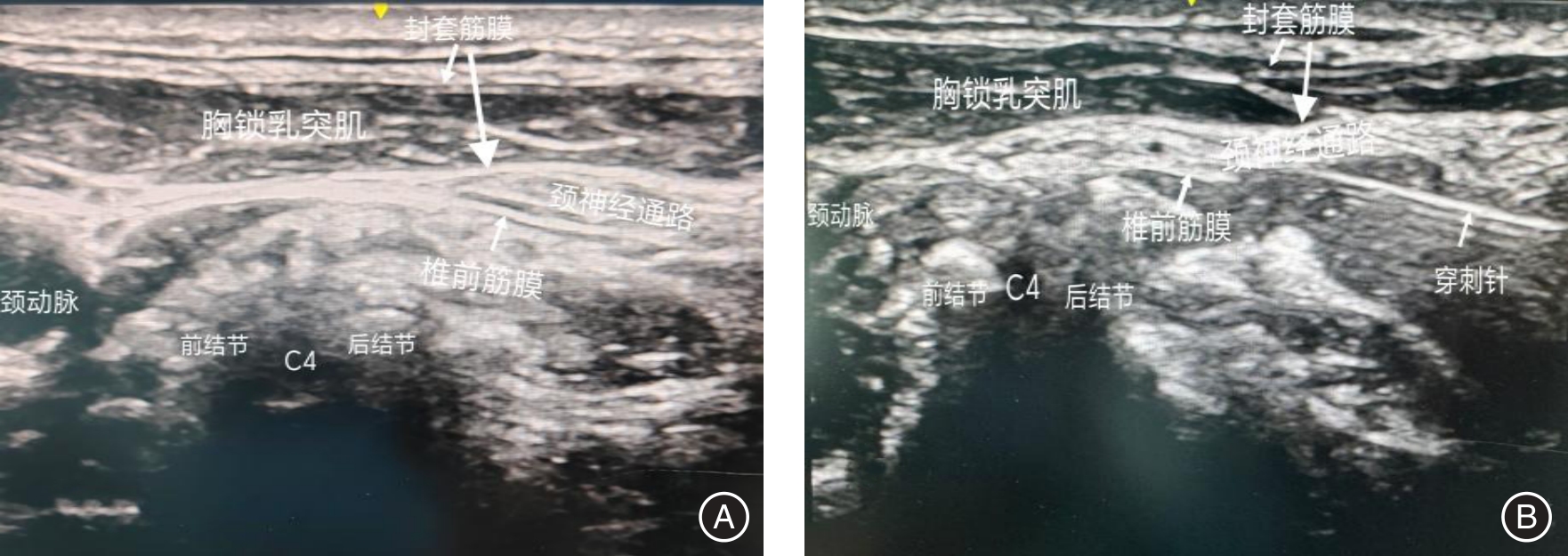
Fig.2
Ultrasound-guided the cervical nerve pathway block"
Tab.1
Comparison of general data among three groups of patients"
| 项目 | C5C组(n = 30) | C5S组(n = 30) | IS组(n = 30) | F/χ2值 | P值 |
|---|---|---|---|---|---|
| 性别/[例(%)] | 3.154 | 0.207 | |||
| 男 | 24(80.0) | 19(63.3) | 18(60.0) | ||
| 女 | 6(20.0) | 11(36.7) | 12(40.0) | ||
| 年龄/岁 | 44.70 ± 13.80 | 47.57 ± 11.90 | 47.37 ± 13.13 | 0.649 | 0.635 |
| 体质量/kg | 61.47 ± 10.89 | 67.20 ± 11.79 | 65.97 ± 15.53 | 1.643 | 0.199 |
| 身高/m | 1.65 ± 0.06 | 1.64 ± 0.08 | 1.64 ± 0.10 | 0.275 | 0.760 |
| 手术时间/min | 83.13 ± 47.05 | 83.90 ± 40.69 | 80.33 ± 36.95 | 0.061 | 0.891 |
Tab.2
Comparison of anesthetic effects among the three groups of patients"
| 项目 | C5C组(n =30) | C5S组(n =30) | IS组(n =30) | H/χ2值 | P值 |
|---|---|---|---|---|---|
| 阻滞起效时间(x ± s)/min | 6.13 ± 3.32 | 21.73 ± 5.99 | 18.60 ± 6.74 | 56.382 | < 0.001 |
| 舒芬太尼使用量[M(P25,P75)]/μg | 0.00(0.00, 0.00) | 10.00(10.00, 20.00) | 5.00(0.00, 10.00) | 35.771 | < 0.001 |
| 有追加局部麻醉 | 2(6.7) | 8(26.7) | 1(3.3) | 8.907 | 0.012 |
| 改全身麻醉 | 0(0.0) | 0(0.0) | 0(0.0) | - | - |
Tab.3
Comparison of ropivacaine dosage per unit body weight among the three groups"
| 组别 | 总剂量/mg | 体质量/kg | 单位体质量剂量/(mg/kg) |
|---|---|---|---|
| C5C组 | 60 | 61.47 ± 10.89 | 1.006 ± 0.178 |
| C5S组 | 60 | 67.20 ± 11.79 | 1.225 ± 0.203 |
| IS组 | 80 | 65.97 ± 15.53 | 1.276 ± 0.294 |
| F值 | 11.619 | ||
| P值 | <0.001 |
Tab.4
Comparison of blood pressures at the onset of nerve block anesthesia with those before the procedure in the three patient groups (x ± s)/mmHg"
| 组别 | 指标 | 阻滞前 | 阻滞后 | 差值D | 95%CI | t值 | P值 |
|---|---|---|---|---|---|---|---|
| C5C组(n = 30) | SBP | 136.07 ± 17.69 | 136.63 ± 17.66 | 0.57 ± 9.34 | -2.89 ~ 4.03 | 0.332 | 0.742 |
| DBP | 86.63 ± 9.45 | 87.57 ± 11.22 | 0.93 ± 6.84 | -1.61 ~ 3.48 | 0.748 | 0.461 | |
| C5S组(n = 30) | SBP | 136.77 ± 20.64 | 135.80 ± 16.60 | -0.97 ± 17.66 | -7.59 ~ 5.65 | -0.300 | 0.767 |
| DBP | 85.03 ± 8.48 | 85.67 ± 9.62 | 0.63 ± 8.76 | -2.66 ~ 3.93 | 0.396 | 0.695 | |
| IS组(n = 30) | SBP | 136.47 ± 17.96 | 134.00 ± 18.85 | -2.47 ± 12.36 | -7.11 ~ 2.17 | -1.093 | 0.284 |
| DBP | 82.67 ± 8.50 | 82.50 ± 9.32 | -0.17 ± 7.27 | -3.00 ~ 2.66 | -0.126 | 0.901 |
Tab.5
Comparison of modified MBS scores of upper limb motor function at different time points after block in three groups of patients [M(P25,P75)]/分"
| 组别 | 术毕 | 术后6 h | 术后12 h | ||||||||
|---|---|---|---|---|---|---|---|---|---|---|---|
| 屈肘 | 屈腕 | 屈指 | 屈肘 | 屈腕 | 屈指 | 屈肘 | 屈腕 | 屈指 | |||
| C5C组(n = 30) | 4(4,4) | 4(4,4) | 4(4,4) | 4(4,4) | 4(4,4) | 4(4,4) | 4(4,4) | 4(4,4) | 4(4,4) | ||
| C5S组(n = 30) | 4(4,4) | 4(4,4) | 4(4,4) | 4(4,4) | 4(4,4) | 4(4,4) | 4(4,4) | 4(4,4) | 4(4,4) | ||
| IS组(n = 30) | 2(2,3) | 2(1.75,3) | 3(2,3) | 2(2,3) | 2(1.75,3) | 3(2,3) | 4(4,4) | 4(4,4) | 4(4,4) | ||
| H值 | 62.3 | 78.0 | 83.6 | 80.9 | 82.9 | 81.3 | 4.0 | - | 2.0 | ||
| P值 | < 0.001 | < 0.001 | < 0.001 | < 0.001 | < 0.001 | < 0.001 | 0.132 | 0.372 | |||
Tab.6
Comparison of diaphragm mobility (forced breathing) among the three groups of patients"
| 组别 | 阻滞前膈肌活动度 (x ± s)/cm | 阻滞后膈肌活动度 (x ± s)/cm | 膈肌活动度下降率 [M(P25,P75)]/% | 膈肌部分 麻痹0级 | 膈肌部分 麻痹1级 | 膈肌部分 麻痹2级 |
|---|---|---|---|---|---|---|
| C5C组(n = 30) | 3.39 ± 1.15 | 3.27 ± 1.13 | 3.01(0.00, 8.20) | 29(96.7) | 1(3.3) | 0(0.0) |
| C5S组(n = 30) | 3.87 ± 1.11 | 3.63 ± 1.11 | 6.16(1.50, 11.80) | 28(93.3) | 2(6.7) | 0(0.0) |
| IS组(n = 30) | 4.08 ± 2.40 | 2.46 ± 1.02 | 44.95(28.10, 62.50) | 16(53.3) | 11(36.7) | 3(10.0) |
| P值 | 0.260 | < 0.001 | < 0.001 | < 0.001 | < 0.001 | < 0.001 |
| H/χ2值 | 4.1 | 16.1 | 36.9 | 22.772 | 15.395 | - |
| [1] |
郑宪友. 锁骨骨折治疗: 2023美国骨科医师学会(AAOS)临床实践指南解读[J]. 中国修复重建外科杂志, 2024, 38(8): 942-946.doi:10.7507/1002-1892.202404101 .
doi: 10.7507/1002-1892.202404101 |
| [2] |
LEURCHARUSMEE P, MAIKONG N, KANTAKAM P, et al. Innervation of the clavicle: A cadaveric investigation[J]. Reg Anesth Pain Med, 2021, 46(12): 1076-1079. doi:10.1136/rapm-2021-103197 .
doi: 10.1136/rapm-2021-103197 |
| [3] |
胡灼军,王彬彬,李汝琳,等.超声引导下肌间沟臂丛神经阻滞联合颈浅丛神经阻滞在锁骨骨折术中的应用效果[J].临床医学研究与实践,2023,8(13):78-81.doi:10.19347/j.cnki.2096-1413.202313021 .
doi: 10.19347/j.cnki.2096-1413.202313021 |
| [4] |
ACHARYA R, BANERJEE S, SRIRAMKA B. Ultrasound-guided inter-scalene brachial plexus block with superficial cervical plexus block compared with general anesthesia in patients undergoing clavicular surgery: A comparative analysis[J]. Anesth Essays Res, 2019, 13(1): 149. doi:10.4103/aer.aer_185_18 .
doi: 10.4103/aer.aer_185_18 |
| [5] |
董如建, 黄依馨. 锁骨骨折内固定术中应用臂丛神经与颈中间丛神经联合阻滞的临床效果分析[J]. 浙江创伤外科, 2022, 27(6): 1181-1183. doi:10.3969/j.issn.1009-7147.2022. 06.075 .
doi: 10.3969/j.issn.1009-7147.2022. 06.075 |
| [6] |
AHMADZADEH S, NACCARI B P, AMEDIO L S, et al. Efficacy of suprascapular versus interscalene block for post-operative pain management in shoulder surgeries: A narrative review[J]. Curr Pain Headache Rep, 2025, 30(1): 13. doi:10.1007/s11916-025-01443-7 .
doi: 10.1007/s11916-025-01443-7 |
| [7] |
XU G, SU P, CAI B, et al. Ultrasound-guided superficial cervical plexus block combined with clavipectoral fascial plane block or interscalene brachial plexus block in clavicle surgery: A single-centre, double-blind, randomized controlled trial[J]. J Clin Monit Comput, 2023, 37(4): 985-992. doi:10.1007/s10877-022-00968-1 .
doi: 10.1007/s10877-022-00968-1 |
| [8] |
李沛函, 王雪娟, 李成文, 等. 颈浅丛阻滞联合颈5神经根阻滞或胸锁筋膜平面阻滞在锁骨骨折内固定术中的应用效果[J]. 中国临床新医学, 2024, 17(12): 1357-1362. doi:10.3969/j.issn.1674-3806.2024.12.08 .
doi: 10.3969/j.issn.1674-3806.2024.12.08 |
| [9] |
辛佳映, 李成文, 宋成伟, 等. 超声引导下颈5与颈6神经根阻滞联合颈浅丛阻滞在锁骨骨折手术中的应用效果[J]. 临床麻醉学杂志, 2020, 36(5): 429-432. doi:10.12089/jca.2020.05.003 .
doi: 10.12089/jca.2020.05.003 |
| [10] |
CHOQUET O, DADURE C, CAPDEVILA X. Ultrasound-guided deep or intermediate cervical plexus block: The target should be the posterior cervical space[J]. Anesth Analg, 2010, 111(6): 1563-1564. doi:10.1213/ane.0b013e3181f1d48f .
doi: 10.1213/ane.0b013e3181f1d48f |
| [11] |
JIANG F, LI N N, ZHANG Y, et al. Modified longitudinal intermediate cervical plexus block for supraclavicular nerve analgesia: A randomized, double-blind trial in healthy volunteers[J]. BMC Anesthesiol, 2026, 26(1): 214. doi:10.1186/s12871-026-03723-0 .
doi: 10.1186/s12871-026-03723-0 |
| [12] |
HAN J, XU Y, SHAN Y, et al. Could C3, 4, and 5 nerve root block be a better alternative to interscalene block plus intermediate cervical plexus block for patients undergoing surgery for midshaft and medial clavicle fractures?A randomized controlled trial[J]. Clin Orthop Relat Res, 2023, 481(4): 798-807. doi:10. 1097/corr.0000000000002479 .
doi: 10. 1097/corr.0000000000002479 |
| [13] |
张弛, 李筱, 魏祥, 等. 超声引导下肌间沟与腋路臂丛神经阻滞对终末期肾病患者动静脉内瘘成形术通畅率的影响[J]. 实用医学杂志, 2025, 41(9): 1293-1298. doi:10.3969/j.issn. 1006-5725.2025.09.004 .
doi: 10.3969/j.issn. 1006-5725.2025.09.004 |
| [14] |
罗雀华, 陈亮, 舒海华, 等. 锁骨上入路臂丛神经阻滞技术体系: 精准阻滞已向临床迈进[J]. 实用医学杂志, 2023, 39(16): 2013-2016. doi:10.3969/j.issn.1006-5725.2023.16.001 .
doi: 10.3969/j.issn.1006-5725.2023.16.001 |
| [15] |
BERGMANN L, MARTINI S, KESSELMEIER M, et al. Phrenic nerve block caused by interscalene brachial plexus block: Breathing effects of different sites of injection[J]. BMC Anesthesiol, 2016, 16(1): 45. doi:10.1186/s12871-016-0218-x .
doi: 10.1186/s12871-016-0218-x |
| [16] |
NEAL J M, BRULL R, HORN J L, et al. The second American society of regional anesthesia and pain medicine evidence-based medicine assessment of ultrasound-guided regional anesthesia: Executive summary[J]. Reg Anesth Pain Med, 2016, 41(2): 181-194. doi:10.1097/aap.0000000000000331 .
doi: 10.1097/aap.0000000000000331 |
| [17] |
DONG X, WU C L, YADEAU J T. Clinical care pathways for ambulatory total shoulder arthroplasty[J]. Curr Opin Anaesthesiol, 2022, 35(5): 634-640. doi:10.1097/aco.0000000000001174 .
doi: 10.1097/aco.0000000000001174 |
| [18] |
KIM H Y, SOH E Y, LEE J, et al. Incidence of hemi-diaphrag⁃matic paresis after ultrasound-guided intermediate cervical plexus block: A prospective observational study[J]. J Anesth, 2020, 34(4): 483-490. doi:10.1007/s00540-020-02770-2 .
doi: 10.1007/s00540-020-02770-2 |
| [19] |
顾仕贤, 谢力, 龚晓毅, 等. 超声引导下颈中间丛神经阻滞在锁骨内固定术中的应用[J]. 中国临床研究, 2019, 32(11): 1526-1529. doi:10.13429/j.cnki.cjcr.2019.11.017 .
doi: 10.13429/j.cnki.cjcr.2019.11.017 |
| [20] |
张辉明, 郑妹萍, 彭珍珠. 肌间沟臂丛神经阻滞联合颈中间丛神经阻滞应用于锁骨骨折内固定术中的效果[J]. 中外医学研究, 2023, 21(24): 6-10. doi:10.14033/j.cnki.cfmr.2023.24.002 .
doi: 10.14033/j.cnki.cfmr.2023.24.002 |
| [21] |
LEMKE E, JOHNSTON D F, BEHRENS M B, et al. Neurological injury following peripheral nerve blocks: A narrative review of estimates of risks and the influence of ultrasound guidance[J]. Reg Anesth Pain Med, 2024, 49(2): 122-132. doi:10.1136/rapm-2023-104855 .
doi: 10.1136/rapm-2023-104855 |
| Viewed | ||||||
|
Full text |
|
|||||
|
Abstract |
|
|||||
