

The Journal of Practical Medicine ›› 2026, Vol. 42 ›› Issue (10): 1762-1769.doi: 10.3969/j.issn.1006-5725.2026.10.010
• Chronic Disease Control • Previous Articles
Lihong LUO1,2,Xianbao KUANG1,Hongli GU1,Zhen LI1( )
)
Received:2026-02-10
Online:2026-05-25
Published:2026-05-27
Contact:
Zhen LI
E-mail:38228508@qq.com
CLC Number:
Lihong LUO,Xianbao KUANG,Hongli GU,Zhen LI. The relationship between left heart contrast echocardiography indexes (LVESV, LVEF, LVEDV) and grading of cardiac function and their evaluation value for anti-heart failure effect in patients with chronic heart failure[J]. The Journal of Practical Medicine, 2026, 42(10): 1762-1769.
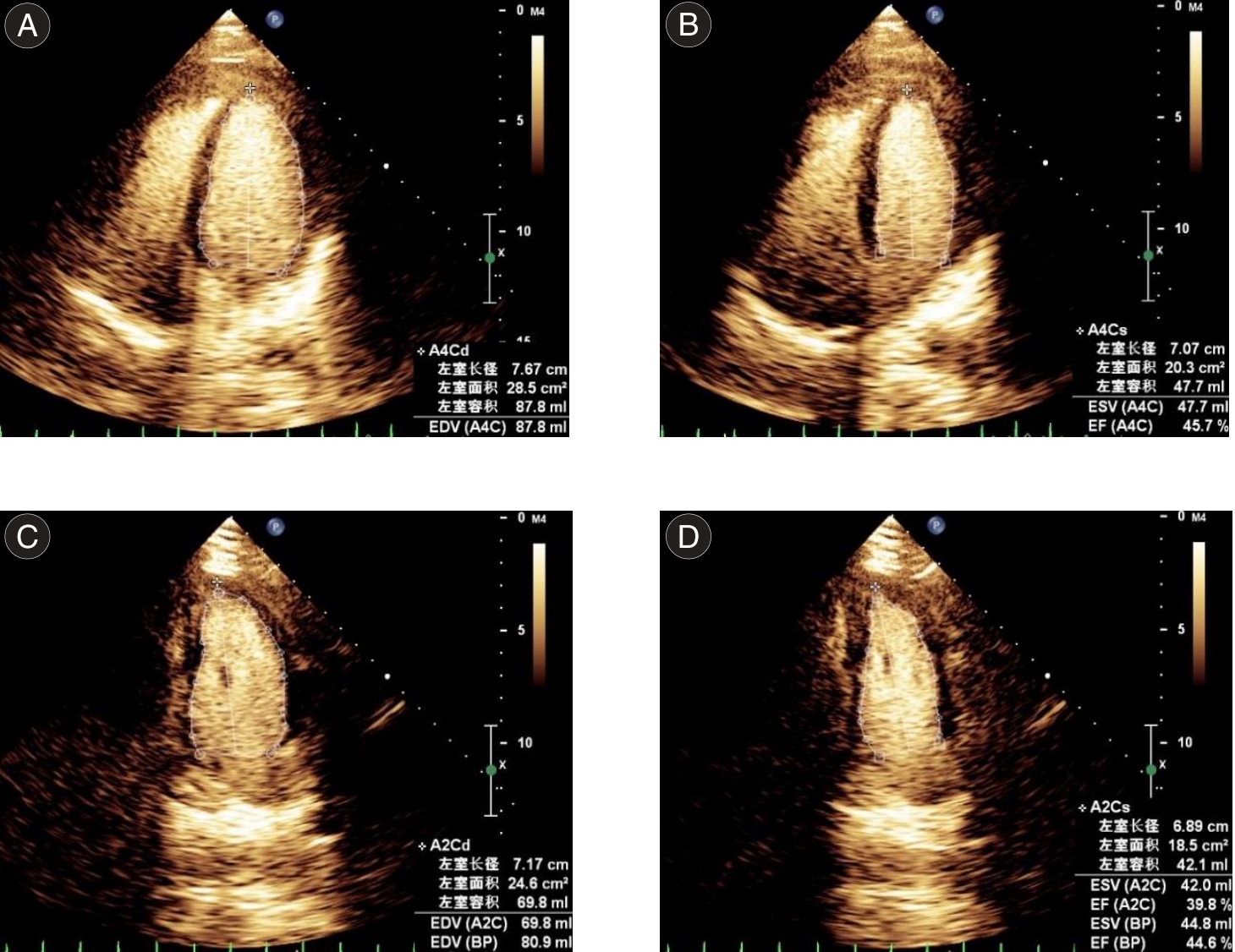
Fig.1
Images of left heart contrast echocardiography in CHF patients"

Tab.1
Comparison of routine ultrasound and left heart contrast echocardiography indexes"
| 指标 | 常规超声 | 左心超声造影 | Z/χ2 /t值 | P值 |
|---|---|---|---|---|
| 心尖部图像质量 | 6.912 | < 0.001 | ||
| 1分 | 14(13.73) | 0(0.00) | ||
| 2分 | 24(23.53) | 2(1.96) | ||
| 3分 | 28(27.45) | 14(13.73) | ||
| 4分 | 20(19.60) | 47(46.07) | ||
| 5分 | 16(15.69) | 39(38.24) | ||
| 特殊结构检出 | ||||
| 心尖血栓 | 2(1.96) | 9(8.82) | 4.708 | 0.030 |
| 室壁瘤 | 3(2.94) | 10(9.80) | 3.954 | 0.047 |
| 肌小梁过度 | 6(5.88) | 15(14.71) | 4.300 | 0.038 |
| 心尖肥厚 | 1(0.98) | 5(4.90) | 2.747 | 0.097 |
| 左心功能指标 | ||||
| LVESV(x ± s)/mL | 51.13 ± 12.24 | 54.56 ± 14.59 | 5.304 | < 0.001 |
| LVEF(x ± s)/% | 46.89 ± 6.25 | 45.75 ± 5.26 | 2.775 | 0.007 |
| LVEDV(x ± s)/mL | 95.18 ± 13.96 | 98.98 ± 18.30 | 4.590 | < 0.001 |
Tab.2
Comparison of routine ultrasound and left heart contrast echocardiography indexes among CHF patients with different cardiac function grading"
| 组别 | 例数 | 常规超声LVESV/mL | 造影LVESV/mL | 常规超声LVEF/% | 造影LVEF/% | 常规超声LVEDV/mL | 造影LVEDV/mL |
|---|---|---|---|---|---|---|---|
| Ⅳ级组 | 27 | 64.70 ± 8.29*# | 67.67 ± 10.46*# | 41.66 ± 4.86*# | 41.48 ± 2.98*# | 110.78 ± 9.67*# | 115.26 ± 13.40*# |
| Ⅲ级组 | 40 | 51.33 ± 8.49* | 55.08 ± 11.98* | 45.98 ± 4.76* | 44.98 ± 3.76* | 94.63 ± 9.63* | 99.05 ± 15.50* |
| Ⅱ级组 | 35 | 40.43 ± 6.73 | 43.86 ± 11.40 | 51.89 ± 4.85 | 49.91 ± 5.11 | 83.77 ± 8.60 | 86.34 ± 14.40 |
| F值 | 72.420 | 33.339 | 35.550 | 33.315 | 64.410 | 29.904 | |
| P值 | < 0.001 | < 0.001 | < 0.001 | < 0.001 | < 0.001 | < 0.001 |
Tab.3
Comparison of left heart contrast echocardiography indexes in CHF patients with different anti-heart failure effect after treatment"
| 组别 | 例数 | ΔLVESV/mL | ΔLVEF/% | ΔLVEDV/mL |
|---|---|---|---|---|
| 有效组 | 79 | 9.38 ± 2.86 | 6.03 ± 1.38 | 7.73 ± 2.46 |
| 无效组 | 23 | 7.41 ± 1.98 | 3.57 ± 0.73 | 6.18 ± 1.70 |
| t值 | 3.100 | 8.219 | 2.824 | |
| P值 | 0.003 | < 0.001 | 0.006 |
Tab.4
Evaluation value of left heart contrast echocardiography for anti-heart failure effect in CHF patients"
| 指标 | 截断值 | AUC | 95%CI | P值 | 敏感度/% | 特异度/% |
|---|---|---|---|---|---|---|
| ΔLVESV | 8.66 mL | 0.720 | 0.611 ~ 0.828 | 0.001 | 57.00 | 82.61 |
| ΔLVEF | 4.51% | 0.976 | 0.927 ~ 1.000 | < 0.001 | 100.00 | 95.65 |
| ΔLVEDV | 6.90 mL | 0.696 | 0.580 ~ 0.811 | 0.004 | 69.62 | 65.22 |
| [1] |
莫乔莹, 朱芳一, 祝存奎, 等. 基于GNRI评分构建慢性心力衰竭患者营养不良风险的列线图模型[J]. 实用医学杂志, 2025, 41(5):691-698. doi: 10.3969/j.issn.1006-5725.2025.05.011 .
doi: 10.3969/j.issn.1006-5725.2025.05.011 |
| [2] |
ZHANG L, ONO Y, QIAO Q, et al. Trends in heart failure prevalence in Japan 2014-2019: A report from healthcare administration databases[J]. ESC Heart Fail, 2023, 10(3):1996-2009. doi: 10.1002/ehf2.14321 .
doi: 10.1002/ehf2.14321 |
| [3] |
NAGUEH S F, SANBORN D Y, OH J K, et al. Recommendations for the Evaluation of Left Ventricular Diastolic Function by Echocardiography and for Heart Failure With Preserved Ejection Fraction Diagnosis: An Update From the American Society of Echocardiography[J]. J Am Soc Echocardiogr, 2025, 38(7):537-569. doi: 10.1016/j.echo.2025.03.011 .
doi: 10.1016/j.echo.2025.03.011 |
| [4] |
BECHER H, ALHUMAID W, WINDRAM J, et al. Contrast Echocardiography in Heart Failure: Update 2023[J]. Curr Heart Fail Rep, 2024, 21(2):63-72. doi: 10.1007/s11897-024-00647-z .
doi: 10.1007/s11897-024-00647-z |
| [5] |
ZEB I, UQAILY R, GONUGUNTLA K, et al. Multimodality assessment of high- vs. low-gradient aortic stenosis using echocardiography and cardiac CT[J]. J Cardiovasc Comput Tomogr, 2023, 17(6):421-428. doi: 10.1016/j.jcct.2023.09.002 .
doi: 10.1016/j.jcct.2023.09.002 |
| [6] |
CHRISTA M, MÜNTZE J, LENGENFELDER B, et al. Contrast-enhanced ultrasound for non-invasive differential diagnosis of unclear left atrial mass[J]. Int J Cardiovasc Imaging, 2023, 39(11):2173-2174. doi: 10.1007/s10554-023-02926-7 .
doi: 10.1007/s10554-023-02926-7 |
| [7] |
ANSARI U, JANSSEN S, BAUMANN S, et al. Sparse 3D contrast-enhanced whole-heart imaging for coronary artery evaluation[J]. Herz, 2023, 48(1):55-63. doi: 10.1007/s00059-021-05091-6 .
doi: 10.1007/s00059-021-05091-6 |
| [8] |
中华医学会心血管病学分会, 中国医师协会心血管内科医师分会, 中国医师协会心力衰竭专业委员会, 等. 中国心力衰竭诊断和治疗指南2024[J]. 中华心血管病杂志, 2024, 52(3):235-275. doi: 10.3760/cma.j.cn112148-20231101-00405 .
doi: 10.3760/cma.j.cn112148-20231101-00405 |
| [9] |
朱天刚, 靳文英, 张梅, 等. 心脏超声增强剂临床应用规范专家共识[J]. 中华医学超声杂志(电子版), 2019, 16(10):731-734. doi: 10.3877/cma.j.issn.1672-6448.2019.10.004 .
doi: 10.3877/cma.j.issn.1672-6448.2019.10.004 |
| [10] |
SCHOU M, PETRIE M C, BORLAUG B A, et al. Semaglutide and NYHA Functional Class in Obesity-Related Heart Failure With Preserved Ejection Fraction: The STEP-HFpEF Program[J]. J Am Coll Cardiol, 2024, 84(3):247-257. doi: 10.1016/j.jacc.2024.04.038 .
doi: 10.1016/j.jacc.2024.04.038 |
| [11] |
LI T, JIANG Y L, KANG J, et al. Prevalence and risk factors of frailty in older patients with chronic heart failure: a systematic review and meta-analysis[J]. Aging Clin Exp Res, 2023, 35(12):2861-2871. doi: 10.1007/s40520-023-02587-5 .
doi: 10.1007/s40520-023-02587-5 |
| [12] |
SAVARESE G, BECHER P M, LUND L H, et al. Global burden of heart failure: a comprehensive and updated review of epidemiology[J]. Cardiovasc Res, 2023, 118(17):3272-3287. doi: 10.1093/cvr/cvac013 .
doi: 10.1093/cvr/cvac013 |
| [13] |
OBOKATA M, SORIMACHI H, HARADA T, et al. Epidemiology, Pathophysiology, Diagnosis, and Therapy of Heart Failure With Preserved Ejection Fraction in Japan[J]. J Card Fail, 2023, 29(3):375-388. doi: 10.1016/j.cardfail.2022.09.018 .
doi: 10.1016/j.cardfail.2022.09.018 |
| [14] |
WU B, YANG Y, ZHAO P. Application of Routine Echocardiography Combined with Contrast-Enhanced Echocardiography in the Diagnosis of Endomyocardial Fibrosis[J]. Discov Med, 2023, 35(179):1052-1063. doi: 10.24976/Discov.Med.202335179.101 .
doi: 10.24976/Discov.Med.202335179.101 |
| [15] |
ZHANG M, CHEN X, YANG F, et al. Evaluation of Left Ventricular Mass in Different Cardiac Geometry Using Three-Dimensional Contrast-Enhanced Echocardiography[J]. Int Heart J, 2023, 64(5):885-893. doi: 10.1536/ihj.22-663 .
doi: 10.1536/ihj.22-663 |
| [16] |
LEE K C, LIU S, CALLAHAN P, et al. Routine Use of Contrast on Admission Transthoracic Echocardiography for Heart Failure Reduces the Rate of Repeat Echocardiography during Index Admission[J]. J Am Soc Echocardiogr, 2021, 34(12):1253-1261. doi: 10.1016/j.echo.2021.07.008 .
doi: 10.1016/j.echo.2021.07.008 |
| [17] |
GUI H Y, LIU S W, ZHU D F. Interaction between the left ventricular ejection fraction and left ventricular strain and its relationship with coronary stenosis[J]. World J Clin Cases, 2023, 11(10):2246-2253. doi: 10.12998/wjcc.v11.i10.2246 .
doi: 10.12998/wjcc.v11.i10.2246 |
| [18] |
CHIORESCU R M, LAZAR R D, RUDA A, et al. Current Insights and Future Directions in the Treatment of Heart Failure with Preserved Ejection Fraction[J]. Int J Mol Sci, 2023, 25(1):440. doi: 10.3390/ijms25010440 .
doi: 10.3390/ijms25010440 |
| [19] |
SCHMIDT A F, FINAN C, VAN SETTEN J, et al. A Mendelian randomization analysis of cardiac MRI measurements as surrogate outcomes for heart failure and atrial fibrillation[J]. Commun Med (Lond), 2025, 5(1):130. doi: 10.1038/s43856-025-00855-1 .
doi: 10.1038/s43856-025-00855-1 |
| [20] |
ZHANG Y, LI S Y, LU T T, et al. Volume and function changes of left atrium and left ventricle in patients with ejection fraction preserved heart failure measured by a three dimensional dynamic heart model[J]. Int J Cardiovasc Imaging, 2024, 40(3):509-516. doi: 10.1007/s10554-023-03018-2 .
doi: 10.1007/s10554-023-03018-2 |
| [21] |
METRA M, TOMASONI D, ADAMO M, et al. Worsening of chronic heart failure: Definition, epidemiology, management and prevention. A clinical consensus statement by the Heart Failure Association of the European Society of Cardiology[J]. Eur J Heart Fail, 2023, 25(6):776-791. doi: 10.1002/ejhf.2874 .
doi: 10.1002/ejhf.2874 |
| [22] |
ZHANG X, WANG N, FU P, et al. Dapagliflozin Attenuates Heart Failure With Preserved Ejection Fraction Remodeling and Dysfunction by Elevating β-Hydroxybutyrate-activated Citrate Synthase[J]. J Cardiovasc Pharmacol, 2023, 82(5):375-388. doi: 10.1097/FJC.0000000000001474 .
doi: 10.1097/FJC.0000000000001474 |
| [23] |
YANG H R, XU X D, SHAIKH A S, et al. Efficacy and Safety of Sacubitril/Valsartan Compared With ACEI/ARB on Health-Related Quality of Life in Heart Failure Patients: A Meta-Analysis[J]. Ann Pharmacother, 2023, 57(8):907-917. doi: 10.1177/10600280221140575 .
doi: 10.1177/10600280221140575 |
| [24] |
CHATUR S, BELDHUIS I E, CLAGGETT B L, et al. Sacubitril/Valsartan in Patients With Heart Failure and Deterioration in eGFR to <30 mL/min/1.73 m2 [J]. JACC Heart Fail, 2024, 12(10):1692-1703. doi: 10.1016/j.jchf.2024.03.014 .
doi: 10.1016/j.jchf.2024.03.014 |
| [25] |
HUANG C W, YU A S, ZHOU H, et al. Comparative Effectiveness of Bisoprolol, Carvedilol, and Metoprolol Succinate in Patients with Heart Failure and CKD[J]. Clin J Am Soc Nephrol, 2025, 20(1):136-138. doi: 10.2215/CJN.0000000000000562 .
doi: 10.2215/CJN.0000000000000562 |
| [26] |
ELSHAHAT A, ABDELAZIZ A, MANSOUR A, et al. Eplerenone vs Spironolactone and Cardiac Remodeling in Heart Failure With Reduced Ejection Fraction: A Meta-Analysis[J]. Mayo Clin Proc, 2025, 100(3):572-576. doi: 10.1016/j.mayocp.2024.11.009 .
doi: 10.1016/j.mayocp.2024.11.009 |
| [27] |
CHATUR S, VADUGANATHAN M, CLAGGETT B L, et al. Dapagliflozin in Patients With Heart Failure and Deterioration in Renal Function[J]. J Am Coll Cardiol, 2023, 82(19):1854-1863. doi: 10.1016/j.jacc.2023.08.026 .
doi: 10.1016/j.jacc.2023.08.026 |
| Viewed | ||||||
|
Full text |
|
|||||
|
Abstract |
|
|||||
