

The Journal of Practical Medicine ›› 2026, Vol. 42 ›› Issue (2): 311-319.doi: 10.3969/j.issn.1006-5725.2026.02.017
• Feature Reports:Orthopedics • Previous Articles
Yanhong JIANG1,Yiyin XU1,Ruotong LIAO1,Lijun WEI1,Xuewei CAO2,Minqing LI3,Jinhui LIAO1,Jiajie HUANG4,Xingli CHEN1( )
)
Received:2025-09-01
Revised:2025-11-14
Accepted:2025-11-27
Online:2026-01-25
Published:2026-01-22
Contact:
Xingli CHEN
E-mail:420497017@qq.com
CLC Number:
Yanhong JIANG,Yiyin XU,Ruotong LIAO,Lijun WEI,Xuewei CAO,Minqing LI,Jinhui LIAO,Jiajie HUANG,Xingli CHEN. An empirical study on the impact of single-dose and multiple-dose antibiotic regimens on nursing workload and medical costs in total joint arthroplasty: A nursing-led systematic review[J]. The Journal of Practical Medicine, 2026, 42(2): 311-319.
Tab.1
Comparison of two groups of general data"
| 项目 | 单次组(n = 972) | 多次组(n = 976) | t/χ2值 | P值 |
|---|---|---|---|---|
| 年龄/岁 | 67.50 ± 9.551 | 67.97 ± 9.104 | -1.125 | 0.261 |
| 住院时间/d | 7.33 ± 3.021 | 7.22 ± 2.813 | 0.800 | 0.424 |
| BMI/(kg/m2) | 25.655 ± 3.734 | 25.437 ± 3.676 | 1.300 | 0.194 |
| 性别/例 | 1.182 | 0.277 | ||
| 女 | 748 | 771 | ||
| 男 | 224 | 205 | ||
| 糖尿病史/例 | 0.173 | 0.678 | ||
| 合并 | 836 | 833 | ||
| 未合并 | 136 | 14 | ||
| 吸烟史/例 | 0.464 | 0.486 | ||
| 有 | 24 | 29 | ||
| 无 | 948 | 947 | ||
| 出院血白蛋白计量/例 | 0.308 | 0.579 | ||
| > 35 g/L | 72 | 66 | ||
| < 35 g/L | 900 | 910 |
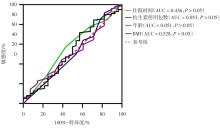
Fig.1
ROC curve analysis of predictive factors for PJI risk"
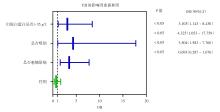
Fig.2
Forest plot of multivariate logistic regression analysis for factors influencing prosthetic joint infection"
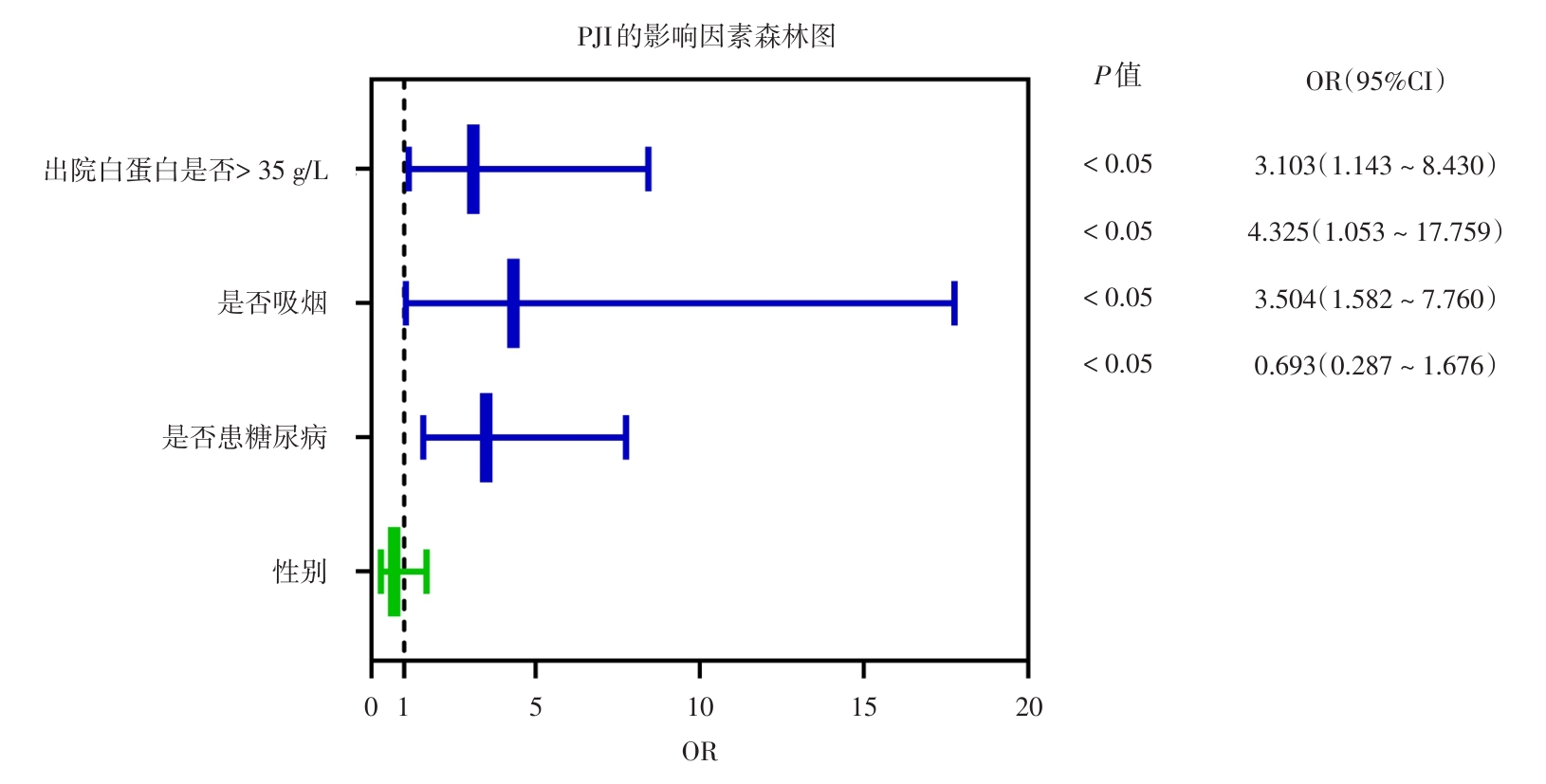
Fig.3
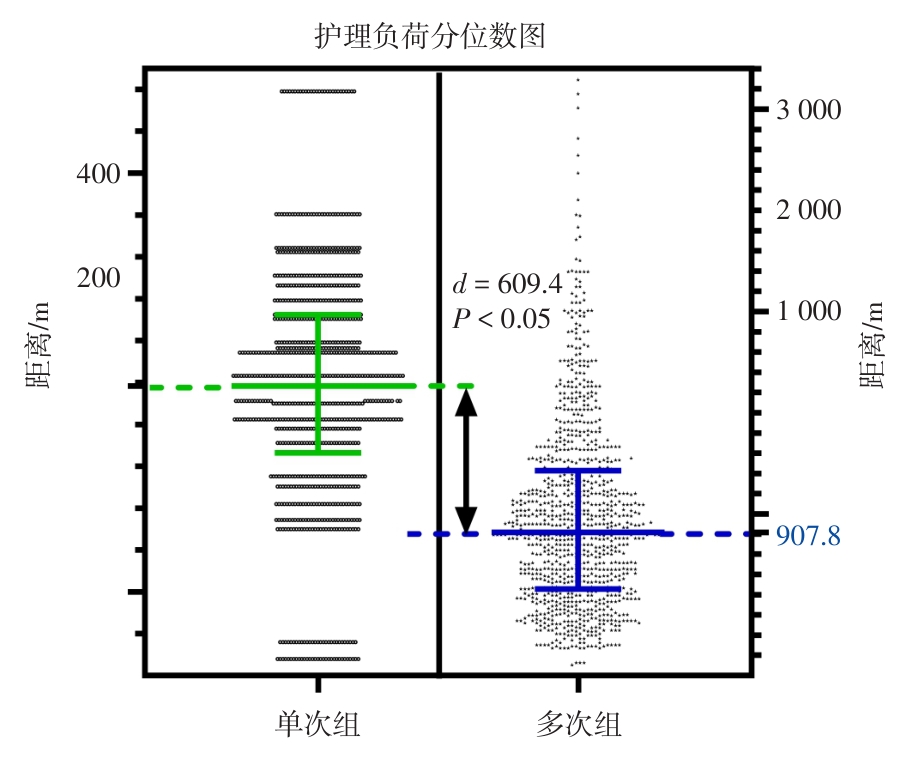
Quantile plot of infusion costs in the single-dose and multiple-dose groups"
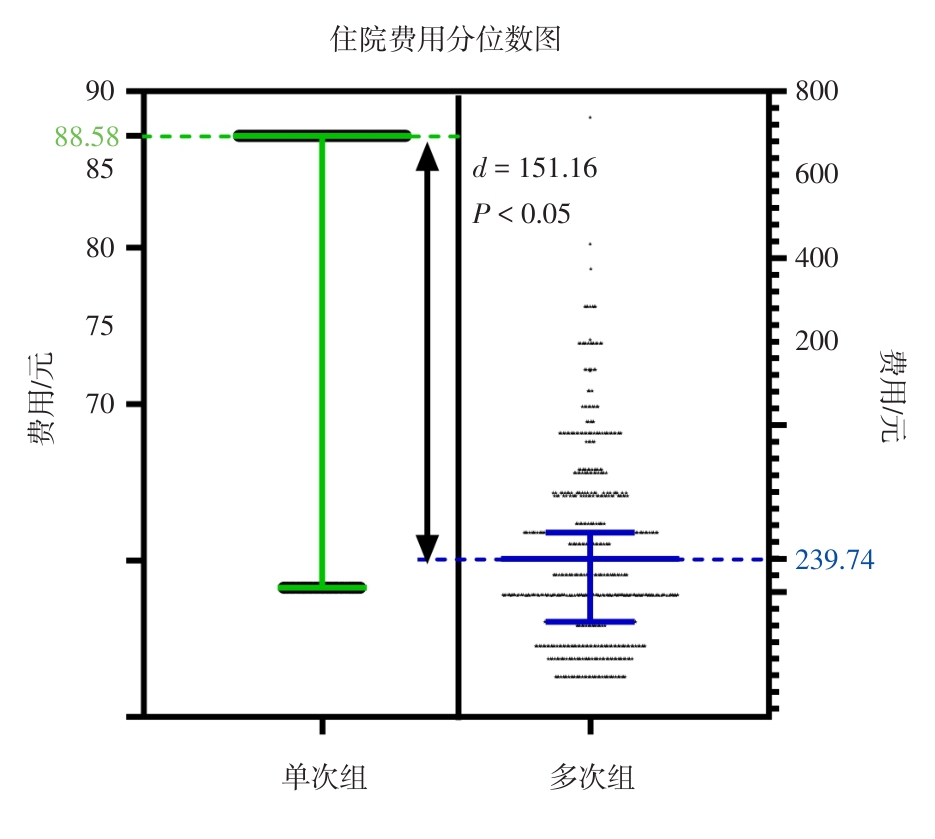
Fig.4
Quantile plot of nursing workload in the single-dose and multiple-dose groups"
Tab.2
Comparison of baseline characteristics between the two groups in cefuroxime sodium subgroup after primary hip arthroplasty"
| 因素 | 多次组(n = 24) | 单次组(n = 20) | t/χ2/Z值 | P值 |
|---|---|---|---|---|
| 年龄/岁 | 64.04 ± 14.669 | 56.65 ± 14.280 | 1.684 | 0.100 |
| 性别(女)/例 | 17 | 11 | 1.182 | 0.277 |
| 胸片肺部炎症(阴性)/例 | 22 | 16 | 1.261 | 0.264 |
| 尿WBC阳性/例 | 5 | 3 | 0.178 | 0.673 |
| 合并患糖尿病/例 | 20 | 16 | 0.081 | 0.775 |
| 术前Hb/(g/L) | 128.96 ± 10.768 | 133.30 ± 14.729 | -1.128 | 0.266 |
| 术后3 h Hb | 108.88 ± 11.987 | 114.60 ± 17.893 | -1.265 | 0.213 |
| 术后第1天Hb | 106.04 ± 10.411 | 110.65 ± 16.259 | -1.094 | 0.282 |
| 出院前Hb | 99.006 ± 14.197 | 104.790 ± 16.471 | -1.251 | 0.218 |
| 入院白蛋白/(g/L) | 42.892 ± 4.538 | 43.175 ± 5.157 | 0.194 | 0.847 |
| 术后第1天白蛋白/(g/L) | 35.514 ± 4.505 | 35.535 ± 4.634 | -0.015 | 0.988 |
| 术后第3天白蛋白/(g/L) | 36.181 ± 3.019 | 36.749 ± 3.083 | -0.616 | 0.541 |
| 术前WBC[M(P25,P75)]/( | 6.46(5.47,7.70) | 6.29(5.29, 7.83) | -0.165 | 0.869 |
| 术前中性粒细胞计数[M(P25,P75)]/( | 4.44(3.50, 5.28) | 3.82(3.16,4.98) | -0.943 | 0.346 |
| 术前CRP[M(P25,P75)]/(mg/L) | 5.31(1.91, 13.37) | 6.99(1.71, 10.00) | -0.472 | 0.637 |
| 术前ESR[M(P25,P75)] | 37(25.25,51.75) | 34.5(26.25, 54.25) | -0.177 | 0.860 |
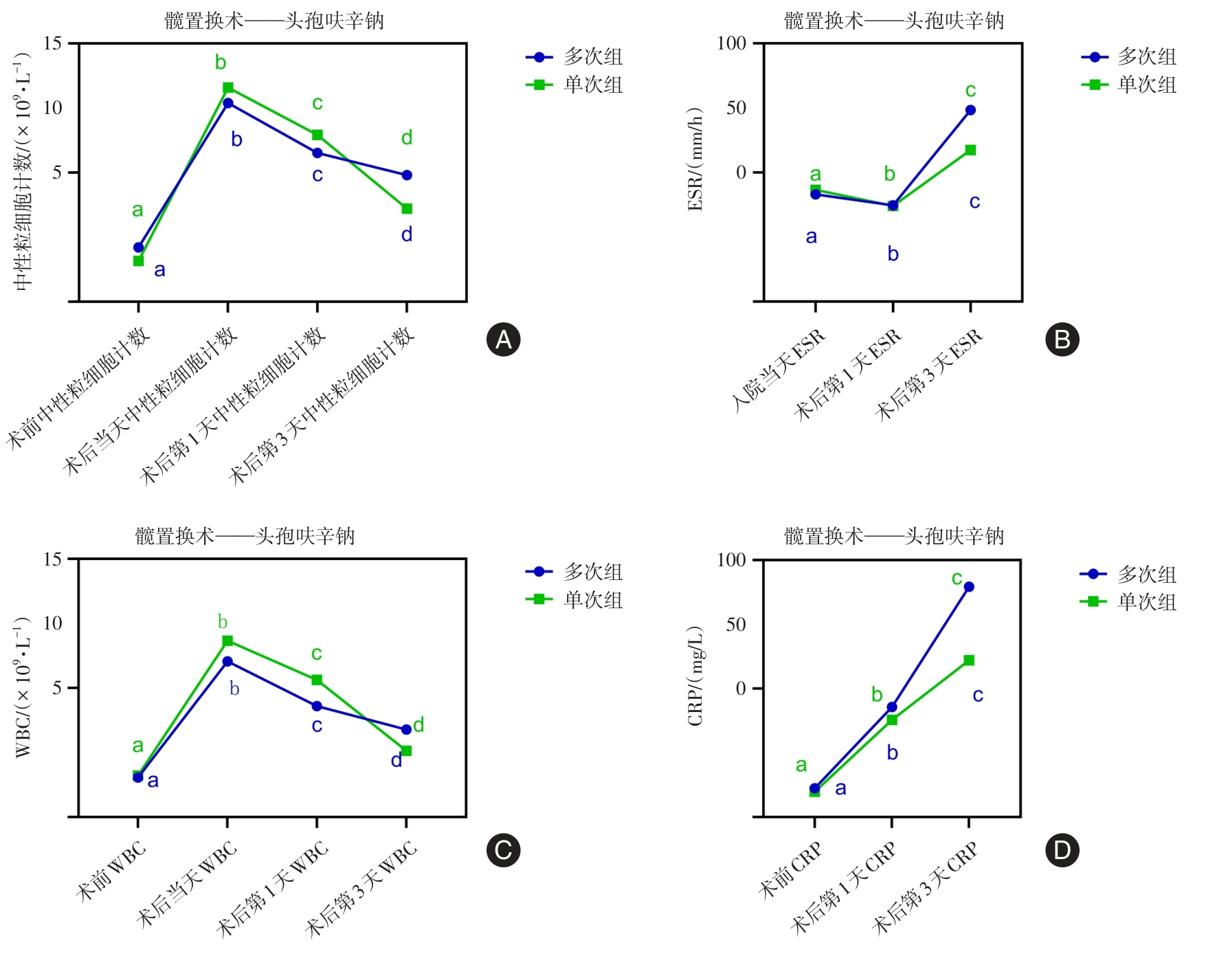
Fig.5
Impact of multiple-dose and single-dose regimens on postoperative inflammatory markers in primary hip arthroplasty-Cefuroxime sodium subgroup"
Tab.3
Comparison of general data between the two groups in cefazolin sodium subgroup after primary knee arthroplasty"
| 因素 | 多次组(n = 68) | 单次组(n = 62) | t/χ2/Z值 | P值 |
|---|---|---|---|---|
| 年龄/岁 | 67.49±7.735 | 68.26±6.191 | -0.625 | 0.533 |
| 性别(女)/例 | 55 | 55 | 1.526 | 0.217 |
| 胸片肺部炎症(阴性)/例 | 61 | 36 | 17.142 | 0.001 |
| 尿WBC阳性/例 | 16 | 22 | 2.240 | 0.134 |
| 合并患糖尿病/例 | 52 | 42 | 1.234 | 0.267 |
| 术前Hb/(g/L) | 130.19±12.096 | 129.1±12.010 | 0.487 | 0.627 |
| 术后3 h Hb | 121.57±13.931 | 118.4±11.315 | 1.380 | 0.170 |
| 术后第1天Hb | 124.24±12.741 | 120.3±12.187 | 1.793 | 0.075 |
| 出院前Hb | 114.29±11.101 | 112.2±11.470 | 1.044 | 0.299 |
| 入院白蛋白/(g/L) | 44.274±2.898 | 44.055±3.257 | 0.405 | 0.686 |
| 术后第1天白蛋白/(g/L) | 39.831±3.000 | 39.504±3.074 | 0.615 | 0.540 |
| 术后第3天白蛋白/(g/L) | 38.469±2.584 | 38.537±2.961 | -0.139 | 0.890 |
| 术前WBC[M(P25,P75)]/( | 6.47(5.63, 7.49) | 7.00(5.66, 8.29) | -1.412 | 0.158 |
| 术前中性粒细胞计数[M(P25,P75)]/( | 4.10(3.28, 4.96) | 4.47(3.41, 5.74) | -1.305 | 0.192 |
| 术前CRP[M(P25,P75)]/(mg/L) | 2.35(0.84, 6.08) | 6.60(1.81, 10.07) | -3558 | 0.001 |
| 术前ESR[M(P25,P75)] | 31(22.25, 48.00) | 32.5(21.00, 39.50) | 0.718 | 0.473 |
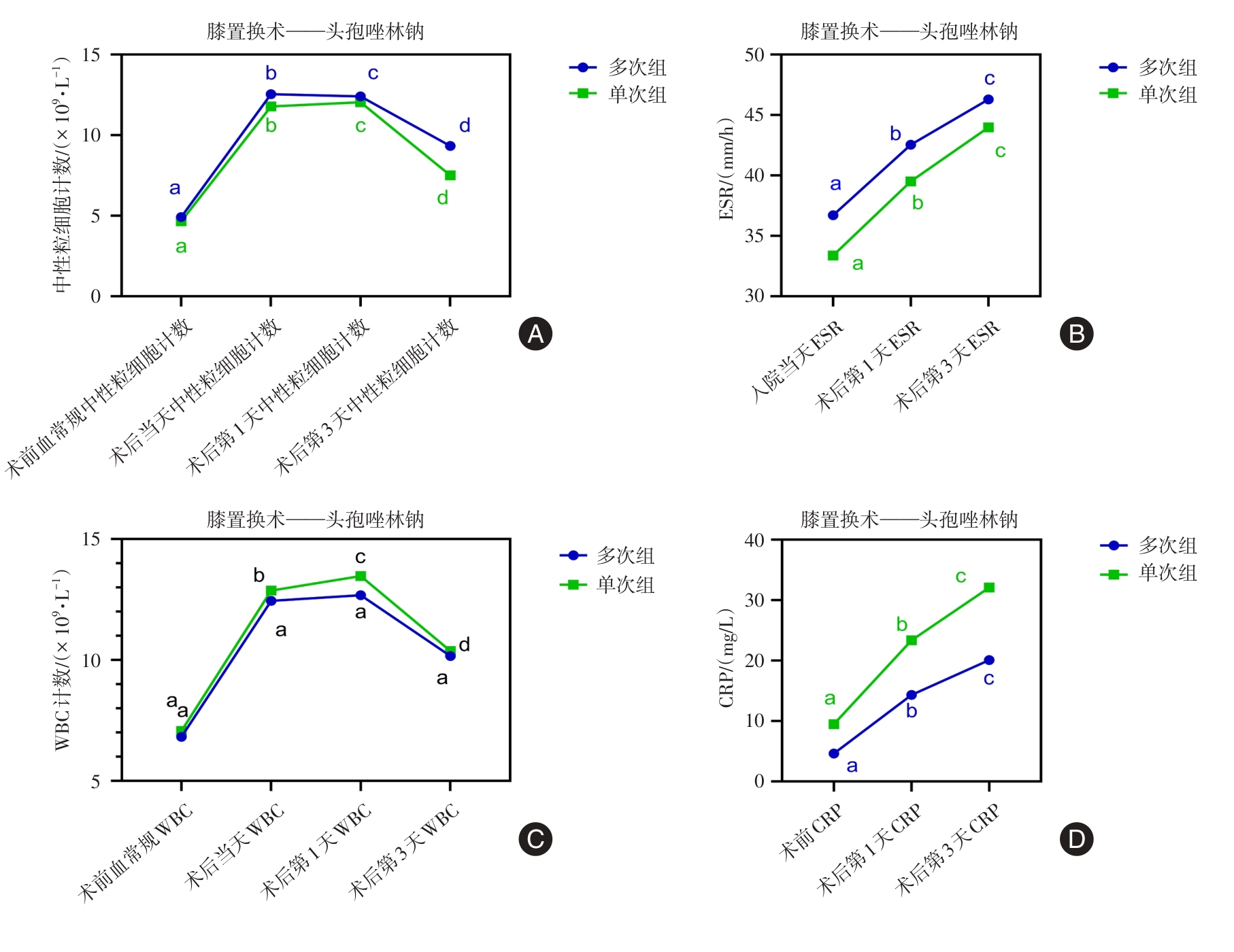
Fig.6
Impact of multiple?dose and single?dose regimens on postoperative inflammatory markers in primary knee arthroplasty?Cefazolin sodium subgroup"
Tab.4
Comparison of baseline characteristics betweenthe two groups in cefuroxime sodium subgroup after primary knee arthroplasty"
| 因素 | 多次组(n = 61) | 单次组(n = 68) | t/χ2/Z值 | P值 |
|---|---|---|---|---|
| 年龄/岁 | 67.70 ± 10.918 | 69.59 ± 6.447 | -1.207 | 0.230 |
| 性别(女)/例 | 54 | 62 | 0.250 | 0.617 |
| 胸片肺部炎症(阴性)/例 | 57 | 50 | 9.014 | 0.003 |
| 尿WBC阳性/例 | 20 | 20 | 0.171 | 0.679 |
| 合并患糖尿病/例 | 39 | 38 | 0.866 | 0.352 |
| 术前Hb/(g/L) | 131.48 ± 11.088 | 129.10 ± 12.370 | 1.142 | 0.256 |
| 术后3 h Hb | 119.85 ± 11.347 | 119.68 ± 11.932 | 0.086 | 0.932 |
| 术后第1天Hb | 121.80 ± 12.243 | 121.26 ± 12.882 | 0.243 | 0.809 |
| 出院前Hb | 114.827 ± 11.576 | 114.526 ± 11.986 | 0.145 | 0.885 |
| 入院白蛋白/(g/L) | 44.474 ± 5.040 | 44.382 ± 3.083 | 0.126 | 0.900 |
| 术后第1天白蛋白/(g/L) | 39.441 ± 4.176 | 39.708 ± 2.891 | -0.426 | 0.671 |
| 术后第3天白蛋白/(g/L) | 38.749 ± 3.309 | 38.490 ± 3.091 | 0.478 | 0.633 |
| 术前WBC[M(P25,P75)]/( | 6.37(5.36, 7.70) | 6.38(5.60,7.84) | -0.365 | 0.715 |
| 术前中性粒细胞计数[M(P25,P75)]/( | 4.38(3.56, 5.20) | 4.07(3.43, 5.12) | -1.076 | 0.282 |
| 术前CRP[M(P25,P75)]/(mg/L) | 3.61(1.29, 6.16) | 5.75(1.75, 10.00) | -1.798 | 0.072 |
| 术前ESR[M(P25,P75)] | 40.00(22.00,64.00) | 27.00(20.00,38.00) | -2.938 | 0.003 |
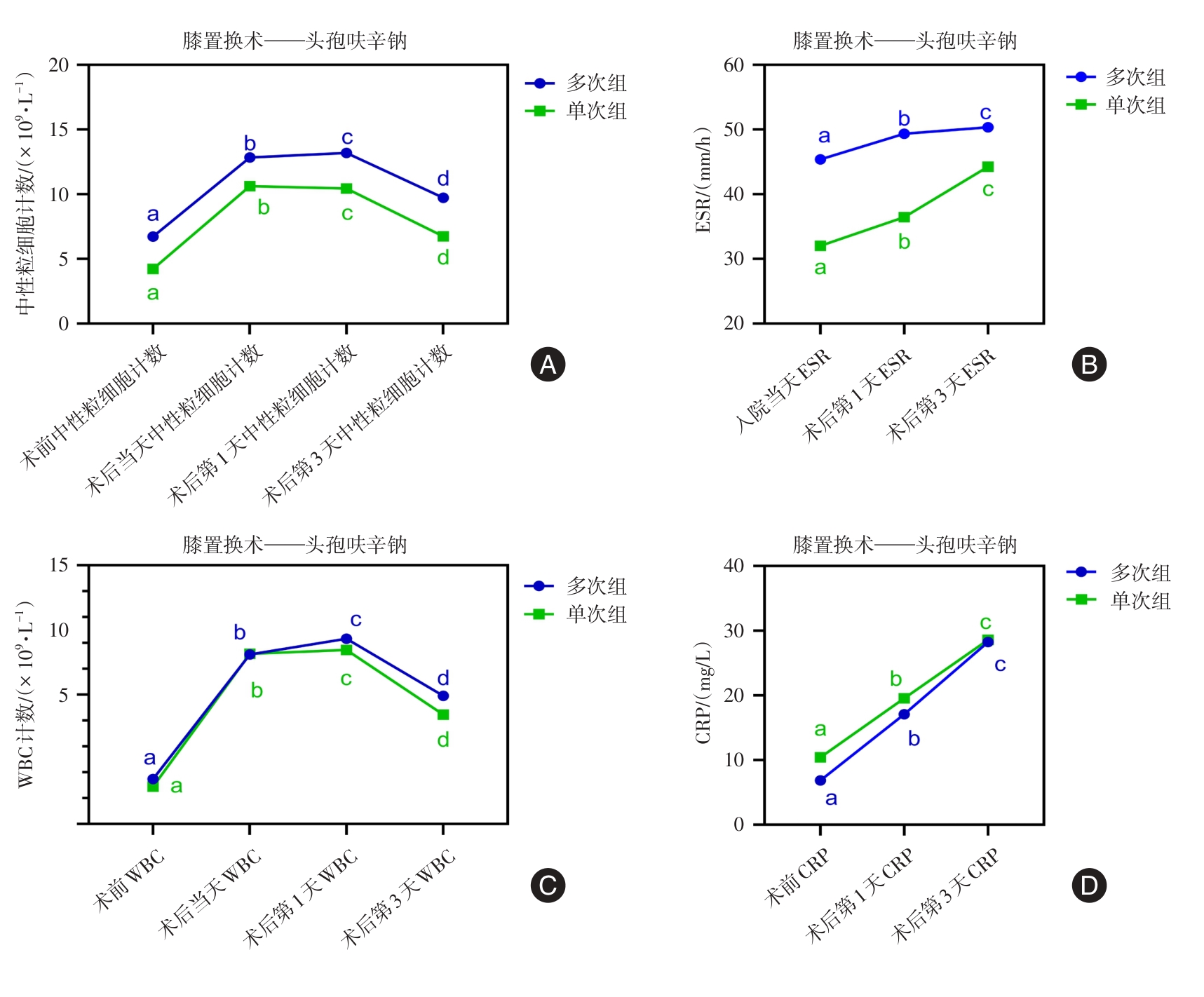
Fig.7
Impact of multiple?dose and single?dose regimens on postoperative inflammatory markers in primary knee arthroplasty?Cefuroxime sodium subgroup"
| [1] |
刘建, 高勇, 李红, 等. 可溶性尿激酶型纤溶酶原激活物受体对人工关节感染的诊断价值[J]. 实用医学杂志, 2018, 34(10): 1693-1697. doi:10.3969/j.issn.1006-5725.2018.10.029 .
doi: 10.3969/j.issn.1006-5725.2018.10.029 |
| [2] |
郭昶志, 孙涛, 韩殊曼, 等. 膝关节肿瘤假体发生周围感染的危险因素分析及血清D-二聚体、Toll样受体2的预测价值[J]. 实用医学杂志, 2024, 40(6): 814-819. doi:10.3969/j.issn. 1006-5725.2024.06.014 .
doi: 10.3969/j.issn. 1006-5725.2024.06.014 |
| [3] |
BERBERICH C, JOSSE J, RUIZ P S. Patients at a high risk of PJI: Can we reduce the incidence of infection using dual antibiotic-loaded bone cement?[J]. Arthroplasty, 2022, 4(1): 41. doi:10.1186/s42836-022-00142-7 .
doi: 10.1186/s42836-022-00142-7 |
| [4] |
VELTMAN E S, LENGUERRAND E, MOOJEN D J F, et al. Similar risk of complete revision for infection with single-dose versus multiple-dose antibiotic prophylaxis in primary arthroplasty of the hip and knee: Results of an observational cohort study in the Dutch Arthroplasty Register in 242, 179 patients[J]. Acta Orthop, 2020, 91(6): 794-800. doi:10.1080/17453674.2020. 1794096 .
doi: 10.1080/17453674.2020. 1794096 |
| [5] |
FERNANDES A, PARK J Y, LEIBOVITCH L, et al. Single-dose versus extended antibiotic prophylaxis in primary hip and knee arthroplasty: A systematic review and meta-analysis[J]. Cureus, 2024, 16(11): e74049. doi:10.7759/cureus.74049 .
doi: 10.7759/cureus.74049 |
| [6] |
CLASSEN D C, EVANS R S, PESTOTNIK S L, et al. The timing of prophylactic administration of antibiotics and the risk of surgical-wound infection[J]. N Engl J Med, 1992, 326(5): 281-286. doi:10.1056/NEJM199201303260501 .
doi: 10.1056/NEJM199201303260501 |
| [7] |
李月, 王建设. 2016—2018年南京市儿童医院小儿Ⅰ类切口手术围手术期抗菌药物使用合理性分析[J]. 现代药物与临床, 2020, 35(2): 345-348. doi:10.7501/j.issn.1674-5515. 2020.02.032 .
doi: 10.7501/j.issn.1674-5515. 2020.02.032 |
| [8] |
乔进, 赵彦, 陈霞, 等. 2017—2019年临床药师持续干预骨科清洁手术预防性使用抗菌药物的效果分析[J]. 检验医学与临床, 2021, 18(4): 506-509. doi:10.3969/j.issn.1672-9455.2021. 04.022 .
doi: 10.3969/j.issn.1672-9455.2021. 04.022 |
| [9] |
杨延良, 王顺利, 史炎鑫. 骨科清洁手术预防使用抗菌药物与术后感染的关系[J]. 临床骨科杂志, 2017, 20(4): 469-472. doi:10.3969/j.issn.1008-0287.2017.04.030 .
doi: 10.3969/j.issn.1008-0287.2017.04.030 |
| [10] |
罗瑶, 方心俞. 单髁置换术后假体周围感染预防中国专家共识[J]. 实用骨科杂志, 2025, 31(1): 1-14. doi:10.13795/j.cnki.sgkz.2025.01.013 .
doi: 10.13795/j.cnki.sgkz.2025.01.013 |
| [11] |
TAN T L, SHOHAT N, RONDON A J, et al. Perioperative antibiotic prophylaxis in total joint arthroplasty: A single dose is as effective as multiple doses[J]. J Bone Joint Surg Am, 2019, 101(5): 429-437. doi:10.2106/JBJS.18.00336 .
doi: 10.2106/JBJS.18.00336 |
| [12] |
CHRISTENSEN D D, MOSCHETTI W E, BROWN M G, et al. Perioperative antibiotic prophylaxis: Single and 24-hour antibiotic dosages are equally effective at preventing periprosthetic joint infection in total joint arthroplasty[J]. J Arthroplasty, 2021, 36(7S): S308-S313. doi:10.1016/j.arth.2021.02.037 .
doi: 10.1016/j.arth.2021.02.037 |
| [13] |
WYMENGA A, VAN HORN J, THEEUWES A, et al. Cefuroxime for prevention of postoperative coxitis. One versus three doses tested in a randomized multicenter study of 2, 651 arthroplasties[J]. Acta Orthop Scand, 1992, 63(1): 19-24. doi:10.3109/17453679209154842 .
doi: 10.3109/17453679209154842 |
| [14] |
NUSRATH S, NAIR A, DASU S, et al. Single-dose prophylactic antibiotic versus extended usage for four days in clean-contaminated oncological surgeries: A randomized clinical trial[J]. Indian J Surg Oncol, 2020, 11(3): 378-386. doi:10.1007/s13193-020-01163-x .
doi: 10.1007/s13193-020-01163-x |
| [15] |
BRATZLER D W, DELLINGER E P, OLSEN K M, et al. Clinical practice guidelines for antimicrobial prophylaxis in surgery[J]. Am J Health Syst Pharm, 2013, 70(3): 195-283. doi:10.2146/ajhp120568 .
doi: 10.2146/ajhp120568 |
| [16] |
World Health Organization. Global guidelines for the prevention of surgical site infection, 2nd ed.[EB/OL]. (2018). . doi:10.1016/j.jhin.2016.12.016
doi: 10.1016/j.jhin.2016.12.016 |
| [17] |
GUNTIN J, SERINO J, ROSSI D, et al. Hypoalbuminemia increases mortality after two-stage revision total joint arthroplasty[J]. Arch Bone Jt Surg, 2023, 11(3): 173-179. doi:10.22038/ABJS.2022.65148.3123 .
doi: 10.22038/ABJS.2022.65148.3123 |
| [18] |
SHIKDAR Y A, MOSLI H H, SHIKDAR N A, et al. Diabetes mellitus and related admission factors among hospitalized patients in king abdul-aziz university hospital in Jeddah, Saudi Arabia[J]. Cureus, 2022, 14(5): e25312. doi:10.7759/cureus.25312 .
doi: 10.7759/cureus.25312 |
| [19] |
WANG L, LU H, DONG X, et al. The effect of nurse staffing on patient-safety outcomes: A cross-sectional survey[J]. J Nurs Manag, 2020, 28(7): 1758-1766. doi:10.1111/jonm.13138 .
doi: 10.1111/jonm.13138 |
| [20] |
WANG L, CHEN H, WAN Q, et al. Effects of self-rated workload and nurse staffing on work engagement among nurses: A cross-sectional survey[J]. J Nurs Manag, 2021, 29(5): 1329-1337. doi:10.1111/jonm.13274 .
doi: 10.1111/jonm.13274 |
| Viewed | ||||||
|
Full text |
|
|||||
|
Abstract |
|
|||||
