

The Journal of Practical Medicine ›› 2026, Vol. 42 ›› Issue (8): 1341-1346.doi: 10.3969/j.issn.1006-5725.2026.08.005
• Chronic Disease Control • Previous Articles
Guoqiu WANG1,3,Liyong GE1,3,Anning ZENG3,Qinyu YANG3,Wei LI1,2( )
)
Received:2025-12-08
Online:2026-04-25
Published:2026-04-28
Contact:
Wei LI
E-mail:liwei249188@sina.com
CLC Number:
Guoqiu WANG,Liyong GE,Anning ZENG,Qinyu YANG,Wei LI. Predictive value of combined pulmonary artery pulsatility index and myocardial microcirculation indicators for major adverse cardiovascular events in elderly patients with chronic heart failure with reduced ejection fraction[J]. The Journal of Practical Medicine, 2026, 42(8): 1341-1346.
Tab.1
Comparison of baseline data between the two groups"
| 指标 | MACE组(n = 32) | 非MACE组(n = 76) | t/χ2值 | P值 |
|---|---|---|---|---|
| 年龄/岁 | 75.65 ± 7.14 | 71.29 ± 5.83 | 3.315 | 0.001 |
| 性别/[例(%)] | 0.072 | 0.788 | ||
| 男 | 19(59.37) | 43(56.58) | ||
| 女 | 13(40.63) | 33(43.42) | ||
| BMI/(kg/m2) | 24.02 ± 2.95 | 23.97 ± 2.64 | 0.087 | 0.931 |
| 吸烟史/[例(%)] | 21(65.63) | 46(60.53) | 0.249 | 0.618 |
| 饮酒史/[例(%)] | 20(62.50) | 48(63.16) | 0.004 | 0.948 |
| 高血压/[例(%)] | 22(68.75) | 48(63.16) | 0.309 | 0.578 |
| 糖尿病/[例(%)] | 14(43.75) | 29(38.15) | 0.294 | 0.588 |
| 冠心病/[例(%)] | 18(56.25) | 35(46.05) | 0.937 | 0.333 |
| 心房颤动/[例(%)] | 15(46.88) | 16(21.05) | 7.337 | 0.007 |
| NYHA分级/[例(%)] | 0.097 | 0.956 | ||
| Ⅱ级 | 4(12.50) | 11(14.47) | ||
| Ⅲ级 | 19(59.37) | 45(59.21) | ||
| Ⅳ级 | 9(28.13) | 20(26.32) | ||
| 心率/(次/min) | 82.24 ± 15.09 | 80.15 ± 12.49 | 0.746 | 0.458 |
| TC/(mmol/L) | 4.68 ± 1.12 | 4.53 ± 0.95 | 0.710 | 0.479 |
| TG/(mmol/L) | 1.99 ± 0.41 | 1.95 ± 0.35 | 0.515 | 0.608 |
| HDL-C/(mmol/L) | 1.11 ± 0.31 | 1.12 ± 0.34 | 0.143 | 0.886 |
| LDL-C/(mmol/L) | 2.98 ± 0.49 | 3.15 ± 0.58 | 1.453 | 0.149 |
| AST/(U/L) | 30.65 ± 5.06 | 31.27 ± 5.45 | 0.551 | 0.583 |
| ALT/(U/L) | 22.94 ± 4.15 | 23.11 ± 4.39 | 0.187 | 0.852 |
| 血肌酐/(mg/L) | 1.68 ± 0.34 | 1.74 ± 0.49 | 0.631 | 0.529 |
| NT-proBNP/(pg/mL) | 2 301.36 ± 273.64 | 2 243.48 ± 241.35 | 1.093 | 0.277 |
Tab.2
Comparison of PAPi, total myocardial ischemia burden and CSI score between the two groups"
| 指标 | MACE组(n = 32) | 非MACE组(n = 76) | t值 | P值 |
|---|---|---|---|---|
| PAPi | 2.19 ± 0.54 | 3.08 ± 0.71 | 6.353 | < 0.001 |
缺血总负荷/ [mm/(min·24 h)] | 58.02 ± 10.39 | 39.27 ± 8.64 | 9.686 | < 0.001 |
| CSI评分/分 | 1.49 ± 0.37 | 1.21 ± 0.23 | 4.774 | < 0.001 |
Tab.3
Multivariate logistic regression analysis of MACE in elderly patients with HFrEF"
| 指标 | β | SE | wald χ2 | OR值 | 95%CI | P值 |
|---|---|---|---|---|---|---|
| 年龄 | 0.032 | 0.021 | 2.390 | 1.033 | 0.991 ~ 1.076 | 0.132 |
| 心房颤动 | 0.729 | 0.452 | 2.605 | 2.074 | 0.855 ~ 5.030 | 0.107 |
| PAPi | -0.257 | 0.089 | 8.369 | 0.773 | 0.649 ~ 0.920 | 0.004 |
| 心肌缺血总负荷 | 0.745 | 0.216 | 11.905 | 2.107 | 1.380 ~ 3.218 | 0.001 |
| CSI评分 | 0.863 | 0.312 | 7.656 | 2.371 | 1.286 ~ 4.370 | 0.006 |
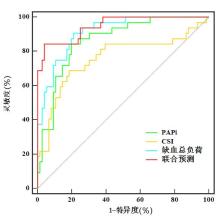
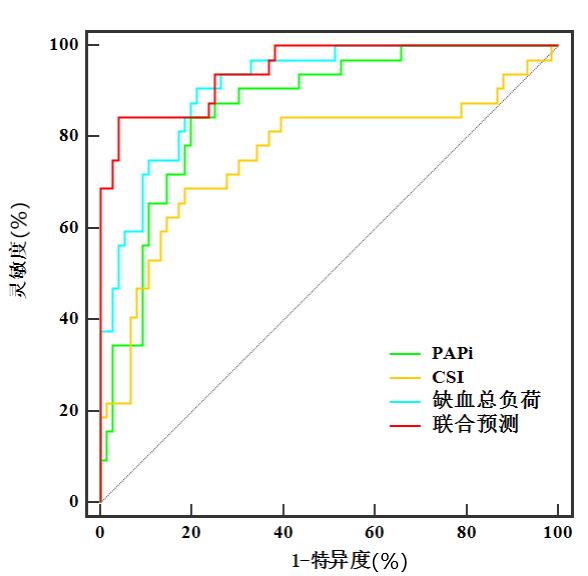
Fig.1
ROC curves of each index and combined detection for predicting the occurrence of MACE in elderly HFrEF patients"
| [1] |
HEIDENREICH P A, BOZKURT B, AGUILAR D, et al. 2022 AHA/ACC/HFSA guideline for the management of heart failure: A Report of the American College of Cardiology/American Heart Association Joint Committee on clinical practice guidelines[J]. Circulation, 2022, 145(18): e895-e1032.doi: 10.1161/CIR.0000000000001063 .
doi: 10.1161/CIR.0000000000001063 |
| [2] |
KANG K, WANG Q, LI Y, et al. Global and Chinese perspectives on the growing burden of heart failure: Trends, gender, and age-related differences (1990-2021) based on GBD 2021 data[J]. BMC Cardiovasc Disord, 2025, 25(1): 510.doi: 10.1186/s12872-025-04954-8 .
doi: 10.1186/s12872-025-04954-8 |
| [3] |
HELBITZ A, NADARAJAH R, MU L, et al. Identification, characterisation and outcomes of pre-atrial fibrillation in heart failure with reduced ejection fraction[J]. ESC Heart Fail, 2025, 12(5): 3688-3696.doi: 10.1002/ehf2.15347 .
doi: 10.1002/ehf2.15347 |
| [4] |
ROSANO G M C, TEERLINK J R, KINUGAWA K, et al. The use of left ventricular ejection fraction in the diagnosis and management of heart failure. A clinical consensus statement of the Heart Failure Association (HFA) of the ESC, the Heart Failure Society of America (HFSA), and the Japanese Heart Failure Society (JHFS)[J]. Eur J Heart Fail, 2025, 27(7):1174-1187.doi: 10.1002/ejhf.3646 .
doi: 10.1002/ejhf.3646 |
| [5] |
伍鑫,丁戈琦,李禄丰,等. 血清可溶性生长刺激表达因子2、氨基末端B型脑钠肽前体及超声心动图参数与急性心肌梗死后心力衰竭患者心肌重塑的关系[J]. 实用医学杂志, 2025, 41(19): 3034-3040.doi:10.3969/j.issn.1006-5725.2025.19.011 .
doi: 10.3969/j.issn.1006-5725.2025.19.011 |
| [6] |
SONG C, YUAN S, CUI K, et al. Prognostic value of N-terminal Pro-B-Type natriuretic peptide in patients with intermediate coronary lesions[J]. Front Cardiovasc Med, 2022, 9: 903757.doi:10.1016/j.amjcard.2006.12.071 .
doi: 10.1016/j.amjcard.2006.12.071 |
| [7] |
ESSANDOH M, KUMAR N, HUSSAIN N, et al. Pulmonary artery pulsatility index as a predictor of right ventricular failure in left ventricular assist device recipients: A systematic review[J]. J Heart Lung Transplant, 2022, 41(8): 1114-1123.doi: 10.1016/j.healun.2022.04.007 .
doi: 10.1016/j.healun.2022.04.007 |
| [8] |
YILDIZ O, BAYDAR O. Prognostic value of pulmonary artery pulsatility index in chronic heart failure patients with reduced ejection fraction[J]. Acta Cardiol, 2022, 77(5): 408-415.doi: 10.1080/00015385.2021 .
doi: 10.1080/00015385.2021 |
| [9] |
LI Y, YU J, WANG Y. Mechanism of Coronary Microcirculation Obstruction after Acute Myocardial Infarction and Cardioprotective Strategies[J]. Rev Cardiovasc Med, 2024, 25(10): 367.doi: 10.31083/j.rcm2510367 .
doi: 10.31083/j.rcm2510367 |
| [10] |
BEGHINI A, SAMMARTINO A M, PAPP Z, et al. 2024 update in heart failure[J]. ESC Heart Fail, 2025, 12(1): 8-42.doi: 10.1002/ehf2.14857 .
doi: 10.1002/ehf2.14857 |
| [11] |
LYHNE M D, YURIDITSKY E, ZOCHIOS V, et al. Pulmonary artery pulsatility index in acute and chronic pulmonary embolism[J]. Medicina (Kaunas), 2025, 61(2): 363.doi: 10.3390/medicina61020363 .
doi: 10.3390/medicina61020363 |
| [12] |
WEN Y, ZHANG Y, LV Q, et al. The effect of individual exercise rehabilitation program on ischemic burden and cardiac function in patients with ischemic non-obstructive coronary heart disease: A randomized parallel controlled clinical trial[J]. Front Cardiovasc Med, 2025, 12: 1421923.doi: 10.3389/fcvm.2025.1421923 .
doi: 10.3389/fcvm.2025.1421923 |
| [13] |
靳文英,朱天刚,王岚,等. 急性心肌梗死患者介入术后早期超声心肌灌注评分与心功能的相关性[J]. 中国超声医学杂志, 2022, 38(4): 398-401.doi:10.3969/j.issn.1002-0101.2022.04.010
doi: 10.3969/j.issn.1002-0101.2022.04.010 |
| [14] |
HEIDENREICH P. Heart failure management guidelines: New recommendations and implementation[J]. J Cardiol, 2024, 83(2):67-73.doi: 10.1016/j.jjcc.2023.10.009 .
doi: 10.1016/j.jjcc.2023.10.009 |
| [15] |
GUAZZI M, NAEIJE R. Right heart phenotype in heart failure with preserved ejection fraction[J]. Circ Heart Fail, 2021, 14(4): e007840.doi: 10.1161/CIRCHEARTFAILURE.120.007840 .
doi: 10.1161/CIRCHEARTFAILURE.120.007840 |
| [16] |
JUDINA A, NIGLAS M, LEONOV V, et al. Pulmonary hypertension-associated right ventricular cardiomyocyte remodelling reduces treprostinil function[J]. Cells, 2023, 12(23): 2764.doi: 10.3390/cells12232764 .
doi: 10.3390/cells12232764 |
| [17] |
LYHNE M D, YURIDITSKY E, ZOCHIOS V, et al. Pulmonary artery pulsatility index in acute and chronic pulmonary embolism[J]. Medicina (Kaunas), 2025, 61(2): 363.doi: 10.3390/medicina61020363 .
doi: 10.3390/medicina61020363 |
| [18] |
MONTEAGUDO-VELA M, TINDALE A, MONGUIÓ-SANTÍN E, et al. Right ventricular failure: Current strategies and future development[J]. Front Cardiovasc Med, 2023, 10: 998382.doi: 10.3389/fcvm.2023.998382 .
doi: 10.3389/fcvm.2023.998382 |
| [19] |
陈亚南,郭秋红,姜涛,等. 冠心舒通胶囊对急性ST段抬高型心肌梗死急诊介入术后微循环功能以及预后的影响[J]. 实用医学杂志, 2021, 37(5): 671-675.doi:10.3969/j.issn.1006-5725.2021.05.022 .
doi: 10.3969/j.issn.1006-5725.2021.05.022 |
| [20] |
ZERN E K, WANG D, RAMBARAT P, et al. Association of pulmonary artery pulsatility index with adverse cardiovascular events across a hospital-based sample[J]. Circ Heart Fail, 2022, 15(2): e009085.doi: 10.1161/CIRCHEARTFAILURE.121.009085 .
doi: 10.1161/CIRCHEARTFAILURE.121.009085 |
| [21] |
KUMAR R, SAFDAR U, YAQOOB N, et al. Assessment of the prognostic performance of TIMI, PAMI, CADILLAC and GRACE scores for short-term major adverse cardiovascular events in patients undergoing emergent percutaneous revascularisation: A prospective observational study[J]. BMJ Open, 2025, 15(3): e091028.doi: 10.1136/bmjopen-2024-091028 .
doi: 10.1136/bmjopen-2024-091028 |
| [22] |
IANNACCONE M, SŁAWEK-SZMYT S, GAMARDELLA M, et al. The role of Pulmonary Artery Pulsatility Index to assess the outcomes following catheter directed therapy in patients with intermediate-to-high and high-risk pulmonary embolism[J]. Cardiovasc Revasc Med, 2026,82: 57-61.doi: 10.1016/j.carrev.2025.02.002 .
doi: 10.1016/j.carrev.2025.02.002 |
| [23] |
NICOLAU A M, SILVA P G, MEJÍA H P G, et al. Molecular Mechanisms of Microvascular Obstruction and Dysfunction in Percutaneous Coronary Interventions: From Pathophysiology to Therapeutics-A Comprehensive Review[J]. Int J Mol Sci 2025, 26(14): 6835.doi: 10.3390/ijms26146835 .
doi: 10.3390/ijms26146835 |
| [24] |
SEN P, WANG L, D'AMBROSIO L, et al. Coronary microvascular disease in heart failure with preserved ejection fraction[J]. Physiol Rep, 2025, 13(16): e70521.doi: 10.14814/phy2.70521 .
doi: 10.14814/phy2.70521 |
| [25] |
SINGH A, ASHRAF S, IRFAN H, et al. Heart failure and microvascular dysfunction: An in-depth review of mechanisms, diagnostic strategies, and innovative therapies[J]. Ann Med Surg (Lond), 2024, 87(2):616-626. doi: 10.1097/MS9.0000000000002971 .
doi: 10.1097/MS9.0000000000002971 |
| Viewed | ||||||
|
Full text |
|
|||||
|
Abstract |
|
|||||
