

The Journal of Practical Medicine ›› 2026, Vol. 42 ›› Issue (4): 579-587.doi: 10.3969/j.issn.1006-5725.2026.04.006
• Chronic Disease Control • Previous Articles
Chulei ZHENG1,Wenbin ZHANG2,Suwan HU3,Qi ZHANG3,Cunming LIU3,Chun YANG3( ),Siqi YANG3,Jinwen LI1
Received:2025-11-21
Online:2026-02-25
Published:2026-02-25
Contact:
Chun YANG
E-mail:chunyang@njmu.edu.cn
CLC Number:
Chulei ZHENG,Wenbin ZHANG,Suwan HU,Qi ZHANG,Cunming LIU,Chun YANG,Siqi YANG,Jinwen LI. Effect of dexmedetomidine assisted deep brain stimulation on cAMP/PKA signaling pathway in elderly patients with Parkinson′s disease[J]. The Journal of Practical Medicine, 2026, 42(4): 579-587.
Tab.1
Comparison of two groups of general data"
| 组别 | 例数 | 性别/[例(%)] | 年龄/岁 | BMI/(kg/m2) | 病程/年 | ASA分级/[例(%)] | ||
|---|---|---|---|---|---|---|---|---|
| 男 | 女 | Ⅱ级 | Ⅲ级 | |||||
| A组 | 75 | 40(53.33) | 35(46.67) | 72.09 ± 0.87 | 22.85 ± 1.12 | 7.33 ± 0.63 | 46(61.33) | 29(38.67) |
| B组 | 75 | 39(52.00) | 36(48.00) | 71.93 ± 0.91 | 22.76 ± 1.09 | 7.51 ± 0.58 | 43(57.33) | 32(42.67) |
| χ2 /t值 | 0.027 | 1.101 | 0.499 | 1.820 | 0.249 | |||
| P值 | 0.870 | 0.273 | 0.619 | 0.071 | 0.618 | |||
Tab.2
Comparison of perioperative related indexes between the two groups"
| 组别 | 例数 | 手术时间 | 术中出血量/mL | 拔管时间 | 细胞电位诱导时间 | 细胞电位出现时间 | 意识消失时间 | 自主呼吸恢复时间 |
|---|---|---|---|---|---|---|---|---|
| A组 | 75 | 212.57 ± 6.75 | 50.21 ± 4.35 | 13.52 ± 1.44 | 7.06 ± 0.87 | 2.13 ± 0.55 | 2.16 ± 0.47 | 10.33 ± 1.29 |
| B组 | 75 | 191.76 ± 6.24 | 49.02 ± 4.13 | 13.47 ± 1.37 | 6.85 ± 0.91 | 2.09 ± 0.49 | 1.07 ± 0.35 | 8.05 ± 1.55 |
| t值 | 19.605 | 1.718 | 0.218 | 1.445 | 0.470 | 16.109 | 9.792 | |
| P值 | < 0.001 | 0.088 | 0.828 | 0.151 | 0.639 | < 0.001 | < 0.001 |
Tab.3
Comparison of STN frequency, bilateral STN electrophysiological signal length andcoordinate error between two groups"
| 组别 | 例数 | STN频率/Hz | 双侧STN电生理信号长度/mm | 坐标误差/mm |
|---|---|---|---|---|
| A组 | 75 | 55.24 ± 7.12 | 6.05 ± 1.14 | 0.96 ± 0.22 |
| B组 | 75 | 54.86 ± 7.33 | 6.14 ± 1.08 | 0.94 ± 0.19 |
| t值 | 0.322 | 0.496 | 0.596 | |
| P值 | 0.748 | 0.620 | 0.552 |
Tab.4
Comparison of perioperative hemodynamics between the two groups"
| 时间 | 组别 | 例数 | MAP/(mmHg) | HR/(次/min) | SpO2/% | BIS |
|---|---|---|---|---|---|---|
| T0 | A组 | 75 | 97.96 ± 5.83 | 80.33 ± 4.75 | 101.96 ± 7.45 | 81.03 ± 3.22 |
| B组 | 75 | 97.92 ± 5.91 | 80.35 ± 4.81 | 101.92 ± 7.38 | 81.08 ± 3.18 | |
| t值 | 0.042 | 0.026 | 0.033 | 0.096 | ||
| P值 | 0.967 | 0.980 | 0.974 | 0.924 | ||
| T1 | A组 | 75 | 70.52 ± 5.02? | 64.83 ± 4.33? | 102.02 ± 8.33 | 49.37 ± 2.33? |
| B组 | 75 | 86.33 ± 5.04? | 74.02 ± 4.27? | 102.07 ± 8.75 | 49.28 ± 2.38? | |
| t值 | 19.248 | 13.087 | 0.036 | 0.234 | ||
| P值 | < 0.001 | < 0.001 | 0.971 | 0.815 | ||
| T2 | A组 | 75 | 70.13 ± 6.33? | 63.11 ± 4.22? | 101.55 ± 6.75 | 53.02 ± 2.02?# |
| B组 | 75 | 87.02 ± 6.41? | 72.35 ± 4.03? | 101.43 ± 6.83 | 53.11 ± 2.05?# | |
| t值 | 16.237 | 13.714 | 0.108 | 0.271 | ||
| P值 | < 0.001 | < 0.001 | 0.914 | 0.787 |
Tab.5
Comparison of brain injury between the two groups"
| 时间 | 组别 | 例数 | S-100β(μg/L) | NSE(ng/mL) | Hcy(μmol/L) | UA(μmol/L) |
|---|---|---|---|---|---|---|
| 术前1 h | A组 | 75 | 1.15 ± 0.33 | 12.86 ± 1.44 | 15.02 ± 2.57 | 275.83 ± 25.88 |
| B组 | 75 | 1.17 ± 0.28 | 12.75 ± 1.51 | 14.96 ± 2.63 | 276.02 ± 26.13 | |
| t值 | 0.400 | 0.457 | 0.141 | 0.045 | ||
| P值 | 0.690 | 0.649 | 0.888 | 0.964 | ||
| 术后1 d | A组 | 75 | 2.22 ± 0.41? | 17.85 ± 1.35? | 29.24 ± 2.88? | 223.48 ± 13.59? |
| B组 | 75 | 1.65 ± 0.38? | 14.33 ± 0.96? | 20.37 ± 2.63? | 251.38 ± 10.66? | |
| t值 | 8.830 | 18.402 | 19.696 | 13.989 | ||
| P值 | < 0.001 | < 0.001 | < 0.001 | < 0.001 |
Tab.6
Comparison of Ramsay sedation score"
| 时间 | 组别 | 例数 | Ramsay镇静评分 |
|---|---|---|---|
| 入手术室时 | A组 | 75 | 1.13 ± 0.22 |
| B组 | 75 | 1.11 ± 0.19 | |
| t值 | 0.596 | ||
| P值 | 0.552 | ||
| 手术开始前 | A组 | 75 | 2.53 ± 0.28? |
| B组 | 75 | 2.58 ± 0.31? | |
| t值 | 1.037 | ||
| P值 | 0.302 | ||
| 术中定位测试时 | A组 | 75 | 3.77 ± 0.37?# |
| B组 | 75 | 4.59 ± 0.22?# | |
| t值 | 16.497 | ||
| P值 | < 0.001 | ||
| 手术结束时 | A组 | 75 | 3.81 ± 0.58?# |
| B组 | 75 | 4.67 ± 0.90?# | |
| t值 | 6.956 | ||
| P值 | < 0.001 |
Tab.7
Comparison of UPDRS scores between two groups"
| 时间 | 组别 | 例数 | 单侧开状态 | 单侧关状态 | 双侧开状态 | 双侧关状态 |
|---|---|---|---|---|---|---|
| 术前1 h | A组 | 75 | 51.67 ± 4.35 | 64.82 ± 0.33 | 55.35 ± 3.06 | 67.33 ± 0.56 |
| B组 | 75 | 51.88 ± 4.26 | 64.79 ± 0.25 | 55.29 ± 3.12 | 67.24 ± 0.61 | |
| t值 | 0.299 | 0.628 | 0.119 | 0.941 | ||
| P值 | 0.766 | 0.531 | 0.906 | 0.348 | ||
| 术后2周 | A组 | 75 | 34.52 ± 3.52? | 41.77 ± 2.89? | 31.57 ± 2.72? | 32.35 ± 2.02? |
| B组 | 75 | 28.88 ± 1.33? | 37.69 ± 1.63? | 26.68 ± 2.69? | 27.99 ± 2.06? | |
| t值 | 12.980 | 10.649 | 11.070 | 13.087 | ||
| P值 | < 0.001 | < 0.001 | < 0.001 | < 0.001 |
Tab.8
Comparison of cognitive function between two groups"
| 时间 | 组别 | 例数 | MoCA |
|---|---|---|---|
| 术前1 h | A组 | 75 | 13.96 ± 2.13 |
| B组 | 75 | 14.03 ± 2.11 | |
| t值 | 0.202 | ||
| P值 | 0.840 | ||
| 术后2周 | A组 | 75 | 20.37 ± 1.58? |
| B组 | 75 | 24.35 ± 0.93? | |
| t值 | 18.800 | ||
| P值 | < 0.001 |
Tab.9
Comparison of cAMP/PKA signal pathways between two groups"
| 时间 | 组别 | 例数 | cAMP | PKA |
|---|---|---|---|---|
| 术前1 h | A组 | 75 | 95.48 ± 5.87 | 9.03 ± 2.48 |
| B组 | 75 | 95.63 ± 6.52 | 8.96 ± 2.51 | |
| t值 | 0.148 | 0.172 | ||
| P值 | 0.882 | 0.864 | ||
| 术后2周 | A组 | 75 | 103.15 ± 9.33? | 11.02 ± 3.42? |
| B组 | 75 | 107.12 ± 12.01? | 14.21 ± 4.15? | |
| t值 | 2.261 | 5.137 | ||
| P值 | 0.025 | < 0.001 |
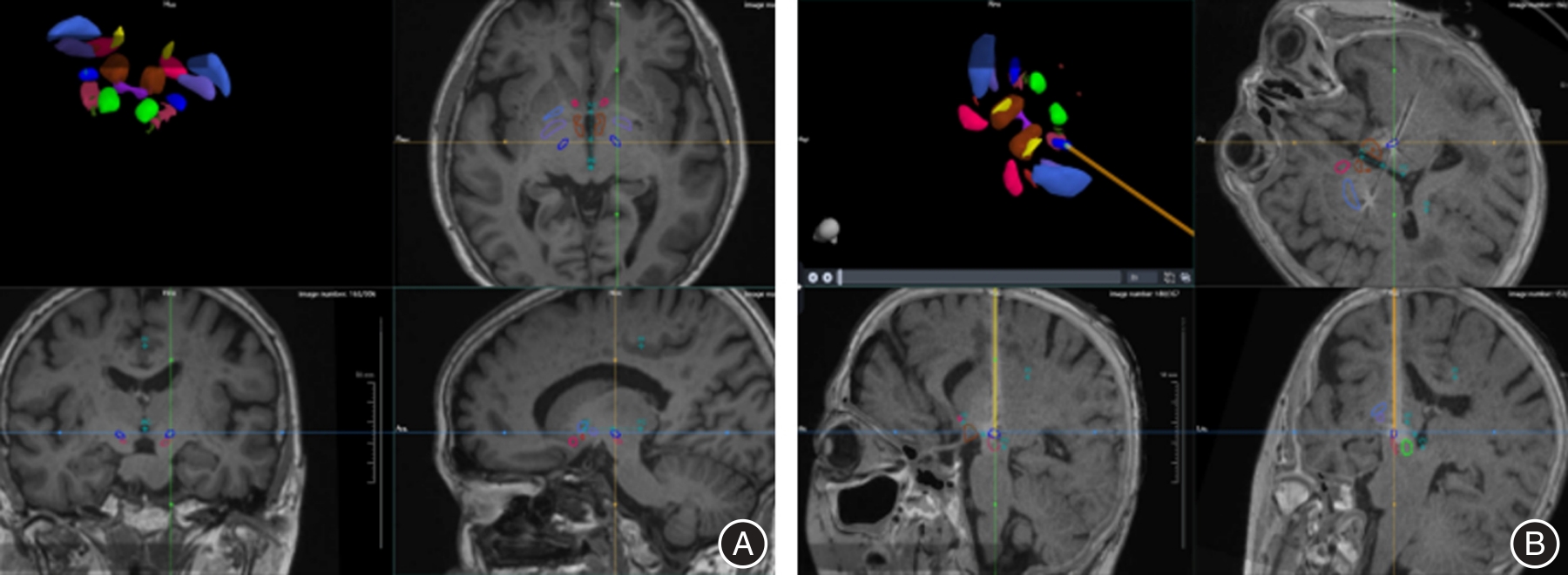
Fig.1
The picture of one typical case"
| [1] |
ANTENUCCI P, COLUCCI F, GOZZI A, et al. Rechargeable and Nonrechargeable Implantable Pulse Generators for Deep Brain Stimulation in Parkinson′s Disease: Long‐Term Experience[J]. Front Neurol, 2025, 2025(1): 6097313-6097313. doi: 10.1155/ANE/6097313 .
doi: 10.1155/ANE/6097313 |
| [2] |
LEE J E, PADILLA A H D, FOMENKO A, et al. Reduction of alpha synuclein oligomers in preclinical models of Parkinson's disease by electrical stimulation in vitro and deep brain stimulation in vivo[J]. Brain Stimul, 2024, 17(2): 166-175. doi: 10.1016/J.BRS.2024.02.005 .
doi: 10.1016/J.BRS.2024.02.005 |
| [3] |
SCHOEN D, DEUTSCH S, MEHTA J, et al. Boundary complexity of cortical and subcortical areas predicts deep brain stimulation outcomes in Parkinson′s disease[J]. Nat Commun, 2025, 16(1): 5590-5590. doi: 10.1038/S41467-025-60695-4 .
doi: 10.1038/S41467-025-60695-4 |
| [4] |
RAMÍREZ Z C, MORENO F C K, MORENO G, et al. The costs and benefits of deep brain stimulation in Parkinson's disease: A review and social network analysis[J]. Arq Neuropsiquiatr, 2025, 83(7): 1-11. doi: 10.1055/S-0045-1809996 .
doi: 10.1055/S-0045-1809996 |
| [5] |
AZGOMI F H, LOUIE H K, BATH E J, et al. Modeling and optimizing deep brain stimulation to enhance gait in Parkinson′s disease: Personalized treatment with neurophysiological insights[J]. NPJ Parkinsons Dis, 2025, 11(1): 173-173. doi: 10.1038/S41531-025-00990-5 .
doi: 10.1038/S41531-025-00990-5 |
| [6] |
熊赤, 陈鹏, 蒋曼丽, 等. 帕金森病脑深部电刺激术后基于微电极记录结果远程程控的临床疗效分析[J]. 中华神经外科杂志, 2024, 6(4): 329-334. doi: 10.3760/cma.j.cn112050-20231110-00159 .
doi: 10.3760/cma.j.cn112050-20231110-00159 |
| [7] |
LI Z, YANG H. Intraoperative relief of resting tremor by dexmedetomidine in a patient with Parkinson's disease: A case report[J]. Asian J Surg, 2024, 47(4): 1951-1952. doi: 10.1016/J.ASJSUR.2023.12.162 .
doi: 10.1016/J.ASJSUR.2023.12.162 |
| [8] |
中华医学会, 中华医学会杂志社, 中华医学会全科医学分会, 等. 帕金森病基层诊疗指南(2019年)[J]. 中华全科医师杂志, 2020, 19(1): 5-17. doi: 10.3760/cma.j.issn.1671-7368. 2020.01.003 .
doi: 10.3760/cma.j.issn.1671-7368. 2020.01.003 |
| [9] |
刘雨睿, 王勇, 李静静, 等. 2022年美国麻醉医师协会《困难气道管理实践指南》解读[J]. 临床麻醉学杂志, 2022, 38(6): 643-647. doi: 10.12089/jca.2022.06.016 .
doi: 10.12089/jca.2022.06.016 |
| [10] |
李其沛, 罗欣, 袁玉静, 等. 右美托咪定和舒芬太尼复合丙泊酚用于老年患者内镜逆行胰胆管造影术深度镇静的比较[J]. 临床麻醉学杂志, 2023, 39(12): 1282-1286. doi: 10.12089/jca.2023.12.009 .
doi: 10.12089/jca.2023.12.009 |
| [11] |
万赢, 肖仁清, 赵嘉豪, 等. 帕金森病运动并发症风险分层治疗方案的疗效评价[J]. 中华医学杂志, 2022, 102(7): 491-498. doi: 10.3760/cma.j.cn112137-20210930-02204 .
doi: 10.3760/cma.j.cn112137-20210930-02204 |
| [12] |
刘月, 刘琦, 董惠, 等. 基于蒙特利尔认知评定量表双阈值定义的卒中后认知“恢复者”神经心理学变化研究[J]. 中国全科医学, 2023, 26(27): 3417-3422. doi: 10.12114/j.issn.1007-9572.2022.0885 .
doi: 10.12114/j.issn.1007-9572.2022.0885 |
| [13] |
杨杰, 邓淑坤, 袁鹏, 等. 基于肠道菌群理论探讨益生菌联合运动康复在帕金森病患者中的疗效[J]. 实用医学杂志, 2025, 41(20): 3191-3197. doi: 10.3969/j.issn.1006-5725. 2025.20.007 .
doi: 10.3969/j.issn.1006-5725. 2025.20.007 |
| [14] |
SPAGNOLO D, SPITALE G. A Mixed-methods Study of Deep Brain Stimulation's Temporal Impact on Parkinson′s Disease Patients: Insights from Short-, Medium-, and Long-term Experiences[J]. Neuroethics, 2025, 18(2): 29-29. doi: 10.1007/S12152-025-09601-9 .
doi: 10.1007/S12152-025-09601-9 |
| [15] |
PIWOWARSKI K, SOBSTYL M, KARAMON K. Damage to the entire deep brain stimulation system after the standard replacement of an implantable pulse generator, probably due to self-injurious behavior in a patient with advanced Parkinson's disease[J]. Postep Psychiatr Neurol, 2025, 34(2): 124-129. doi: 10.5114/PPN.2025.151784 .
doi: 10.5114/PPN.2025.151784 |
| [16] |
RAGUŽ M, TARLE M, MARČINKOVIĆ P, et al. The Role of Preoperative Immunonutritional Scores in Predicting Complications After Subthalamic Nucleus Deep Brain Stimulation in Parkinson′s Disease[J]. J Clin Med, 2025, 14(11): 3811-3811. doi: 10.3390/JCM14113811 .
doi: 10.3390/JCM14113811 |
| [17] |
PETRALITO M, TEDESCO C, PUCCIARELLI G, et al. Education Programs for Patients With Parkinson's Disease Receiving Deep Brain Stimulation: A Scoping Review[J]. West J Nurs Res, 2025, 47(8): 786-796. doi: 10.1177/01939459251341814 .
doi: 10.1177/01939459251341814 |
| [18] |
LEE Y G, KWON Y H, PARK K, et al. Medication versus globus pallidus internus deep brain stimulation in Parkinson′s disease with deep learning video analysis of finger tapping[J]. Sci Rep, 2025, 15(1): 17557. doi: 10.1038/S41598-025-02098-5 .
doi: 10.1038/S41598-025-02098-5 |
| [19] |
谭丽, 马羽, 吴康, 等. 基于机器学习探讨经脑深部电刺激术治疗后帕金森病围手术期中医证候变化[J]. 中华中医药杂志, 2023, 38(12): 6128-6132. doi: 10.6038/cjg2024R0854 .
doi: 10.6038/cjg2024R0854 |
| [20] |
孟元元, 刘艳, 李俊, 等. 右美托咪定通过cGAS-STING通路介导的免疫调控机制对胃癌细胞恶性生物学行为的影响[J]. 中国免疫学杂志, 2024, 40(5): 945-951, 960. doi: 10.3969/j.issn.1000-484X.2024.05.008 .
doi: 10.3969/j.issn.1000-484X.2024.05.008 |
| [21] |
王晓宁, 张丽红, 张彤, 等. 持续输注超低剂量右美托咪定对老年CAS患者血流动力学和术后认知功能的影响[J]. 中国医科大学学报, 2024, 53(3): 193-197, 206. doi: 10.12007/j.issn.0258-4646.2024.03.001 .
doi: 10.12007/j.issn.0258-4646.2024.03.001 |
| [22] |
TAKAFUMI S, HIROFUMI S, YOSHIKI U, et al. Epiretinal Membrane Surgery for a Patient with Dyskinesia Related to Parkinson's Disease Using Intravenous Dexmedetomidine Administration[J]. Case Rep Ophthalmol, 2022, 13(3): 976-980. doi: 10.1159/000527157 .
doi: 10.1159/000527157 |
| [23] |
BAO-PING Z, LI W, XIAN-WEI W, et al. Dexmedetomidine protects against degeneration of dopaminergic neurons and improves motor activity in Parkinson's disease mice model[J]. Saudi J Biol Sci, 2021, 28(6): 3198-3203. doi: 10.1016/J.SJBS.2021.04.013 .
doi: 10.1016/J.SJBS.2021.04.013 |
| [24] |
余理想, 于振坤, 杨传宗, 等. 不同剂量瑞芬太尼联合右美托咪定对环杓关节脱位夹持式复位的影响[J]. 临床麻醉学杂志, 2024, 40(10): 1034-1038. doi: 10.12089/jca.2024.10.005 .
doi: 10.12089/jca.2024.10.005 |
| [25] |
MORGAN L, AMANDA D, KELLY R, et al. Treatment of Acute Delirium in a Patient with Parkinson's Disease by Transfer to the Intensive Care Unit and Administration of Dexmedetomidine[J]. J Mov Disord, 2020, 13(2): 159-162. doi: 10.14802/jmd.20005 .
doi: 10.14802/jmd.20005 |
| [26] |
ANTONIO M, MIGUEL V, ELENA C, et al. Effects of dexmedetomidine on subthalamic local field potentials in Parkinson's disease[J]. Br J Anaesth, 2021, 127(2): 245-253. doi: 10.1016/J.BJA.2021.01.036 .
doi: 10.1016/J.BJA.2021.01.036 |
| [27] |
JUNG J H, CHUNG S J, YOO H S, et al. Sex-specific association of urate and levodopa-induced dyskinesia in Parkinson's disease[J]. Eur J Neurol, 2020, 27(10): 1948-1956. doi: 10.1111/ene.14337 .
doi: 10.1111/ene.14337 |
| [28] |
朱美琳, 程莉莉, 董有静. 右美托咪定在脑电双频指数指导及全身麻醉下帕金森病脑深部电刺激术中的应用[J]. 中国医科大学学报, 2021, 50(3): 276-279. doi: 10.12007/j.issn.0258-4646.2021.03.019 .
doi: 10.12007/j.issn.0258-4646.2021.03.019 |
| Viewed | ||||||
|
Full text |
|
|||||
|
Abstract |
|
|||||
