

The Journal of Practical Medicine ›› 2026, Vol. 42 ›› Issue (7): 1158-1164.doi: 10.3969/j.issn.1006-5725.2026.07.006
• Feature Reports:Tuberculosis • Previous Articles
You ZHOU1,2,Jifei CHEN2,Xi HE2,Aimei LIU2,Xiaobing YANG2,Yifang HUANG1( )
)
Received:2025-09-17
Revised:2025-11-14
Accepted:2025-12-02
Online:2026-04-10
Published:2026-04-13
Contact:
Yifang HUANG
E-mail:YFY004462@sr.gxmu.edu.cn
CLC Number:
You ZHOU,Jifei CHEN,Xi HE,Aimei LIU,Xiaobing YANG,Yifang HUANG. Constructing a differential diagnosis model for lung cancer and pulmonary tuberculosis using machine learning[J]. The Journal of Practical Medicine, 2026, 42(7): 1158-1164.
Tab.1
Statistical analysis results of the test items for the two groups of cases"
| 检测项目 | 肺癌组(n = 263) | 肺结核组(n = 322) | Z值 | P值 |
|---|---|---|---|---|
| CA125/(U/mL) | 39.32(16.64,117.93) | 21.10(9.88,47.27) | -5.927 | < 0.001 |
| CEA/(ng/mL) | 5.55(2.60,34.33) | 2.34(1.62,3.33) | -10.783 | < 0.001 |
| CYFRA21-1/(ng/mL) | 9.71(4.50,29.58) | 2.22(1.67,3.20) | -15.748 | < 0.001 |
| NSE/(ng/mL) | 20.07(13.86,35.76) | 14.75(10.74,20.27) | -7.264 | < 0.001 |
| SCCA/(ng/mL) | 0.29(0.17,0.64) | 0.25(0.17,0.37) | -3.073 | 0.002 |
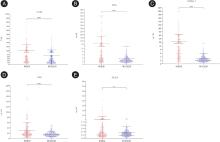
Fig.1
Differences in test results between the two groups"
Tab.2
Comparison of evaluation metrics for training and validation sets in random forest model"
| 指标 | 训练集(n = 469) | 验证集(n = 116) | χ2/Z值 | P值 |
|---|---|---|---|---|
| 疾病/例 | 0.001 | 0.975 | ||
| 肺癌 | 211 | 52 | ||
| 肺结核 | 258 | 64 | ||
| 性别/例 | 2.562 | 0.109 | ||
| 男 | 360 | 97 | ||
| 女 | 109 | 19 | ||
| 年龄/岁 | 59.00(51.00,68.00) | 60.50(54.00,68.00) | -1.990 | 0.843 |
| CA125/(U/mL) | 27.78(13.03,65.88) | 30.77(9.35,77.77) | -0.382 | 0.703 |
| CEA/(ng/mL) | 2.84(1.84,6.26) | 3.23(1.84,5.79) | -0.771 | 0.441 |
| CYFRA21-1/(ng/mL) | 3.28(1.97,8.81) | 3.53(2.00,9.81) | -0.316 | 0.752 |
| NSE/(ng/mL) | 16.21(11.75,25.47) | 16.47(11.36,23.62) | -0.221 | 0.825 |
| SCCA/(ng/mL) | 0.26(0.17,0.41) | 0.27(0.18,0.37) | -0.129 | 0.897 |
Fig.2
Feature variable selection and importance ranking"
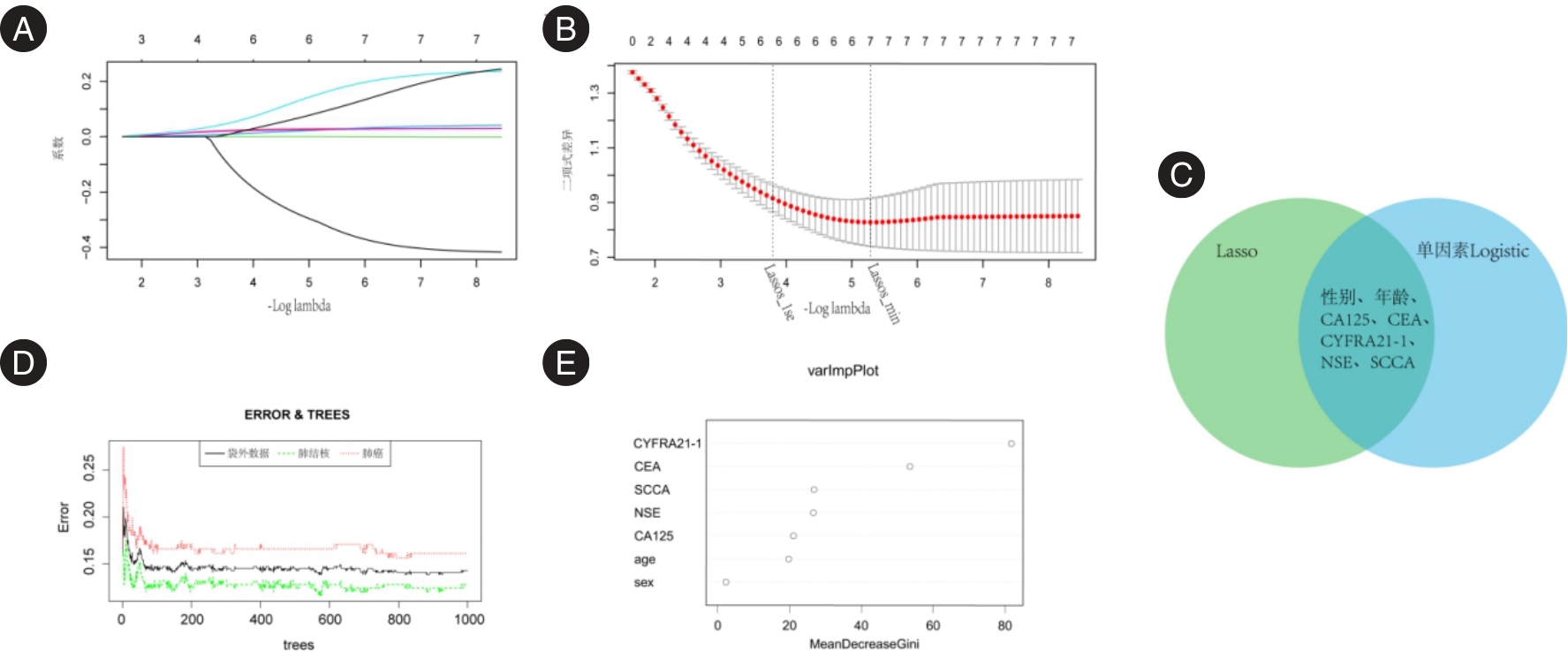
Tab.3
The results of variable selection through univariate logistic regression analysis"
| 变量 | β | S.E. | Wald | OR | 95%CI | P值 |
|---|---|---|---|---|---|---|
| 性别 | 0.704 | 0.231 | 9.323 | 2.022 | 1.287 ~ 3.178 | 0.002 |
| 年龄 | 0.043 | 0.008 | 32.870 | 1.044 | 1.029 ~ 1.060 | 0.000 |
| CA125 | 0.005 | 0.001 | 16.821 | 1.005 | 1.002 ~ 1.007 | 0.000 |
| CEA | 0.081 | 0.018 | 19.900 | 1.085 | 1.047 ~ 1.085 | 0.000 |
| CYFRA21-1 | 0.335 | 0.041 | 65.602 | 1.398 | 1.289 ~ 1.516 | 0.000 |
| NSE | 0.049 | 0.008 | 36.693 | 1.051 | 1.034 ~ 1.068 | 0.000 |
| SCCA | 0.852 | 0.236 | 13.004 | 2.344 | 1.475 ~ 3.724 | 0.000 |
Fig.3
The analysis results of the two prediction models on the training set and the validation set"
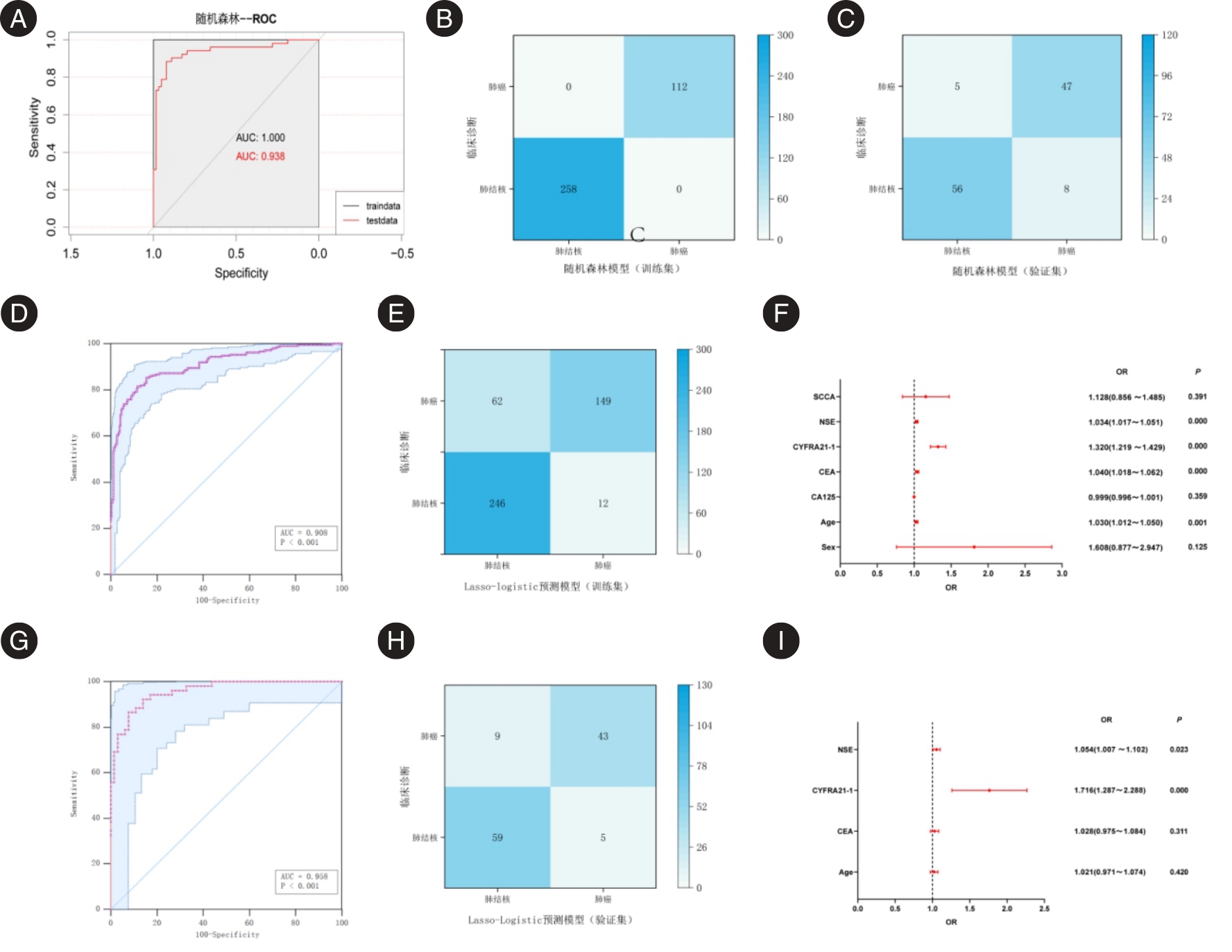
Tab.4
The validation results of the Lasso-logistic regression model and the random forest model on the testdata"
| 诊断模型 | AUC | 灵敏度/% | 特异度/% | 准确度 | 95%CI | 约登指数 | P值 |
|---|---|---|---|---|---|---|---|
| 随机森林模型 | 0.938 | 90.38 | 87.50 | 0.888 | 0.816 ~ 0.939 | 0.779 | < 0.000 1 |
| Lasso-logistic回归模型 | 0.958 | 86.54 | 92.19 | 0.879 | 0.903 ~ 0.986 | 0.787 | < 0.000 1 |
| [1] |
SUNG H, FERLAY J, SIEGEL R, et al. Global Cancer Statistics 2020: GLOBOCAN Estimates of Incidence and Mortality Worldwide for 36 Cancers in 185 Countries[J]. CA-Cancer J Clin, 2021, 71(3): 209-249. doi: 10.3322/caac.21660 .
doi: 10.3322/caac.21660 |
| [2] |
中华医学会肿瘤学分会. 中华医学会肺癌临床诊疗指南(2024版)[J]. 中华医学杂志, 2024, 104(34): 3175-3213. doi: 10.3760/cma.j.cn112137-20240511-01092 .
doi: 10.3760/cma.j.cn112137-20240511-01092 |
| [3] |
郑荣寿, 陈茹, 韩冰峰, 等. 2022年中国恶性肿瘤流行情况分析[J]. 中华肿瘤杂志, 2024, 46(3): 221-231. doi: 10.3760/cma.j.cn112152-20240119-00035 .
doi: 10.3760/cma.j.cn112152-20240119-00035 |
| [4] |
CHEN Z, WANG T, DU J, et al. Decoding the WHO global tuberculosis report 2024: A critical analysis of global and Chinese key data[J]. Zoonoses (Burlingt), 2025, 5(1): 1-16. doi: 10.15212/zoonoses-2024-0061 .
doi: 10.15212/zoonoses-2024-0061 |
| [5] |
PARKER C S, SIRACUSE C G, LITLE V R. Identifying lung cancer in patients with active pulmonary tuberculosis[J]. J Thorac Dis, 2018, 10(S28): S3392-S3397. doi: 10.21037/jtd.2018.07.11 .
doi: 10.21037/jtd.2018.07.11 |
| [6] |
郭成茂, 肖景兴, 王东, 等. PET/CT在肺癌诊断中的应用进展[J]. 海南医学, 2020, 31(1): 111-114. doi: 10.3969/j.issn.1003-6350.2020.01.032 .
doi: 10.3969/j.issn.1003-6350.2020.01.032 |
| [7] |
肺结核诊断W S288-2017[J]. 中国感染控制杂志, 2018, 17(7): 642-652. doi: 10.3969/j.issn.1671-9638.2018.07.019 .
doi: 10.3969/j.issn.1671-9638.2018.07.019 |
| [8] |
黄银霞, 潘丽萍, 张宗德. 结核病实验室诊断技术研究进展[J]. 北京医学, 2023, 45(10): 893-898. doi: 10.15932/j.0253-9713.2023.10.013 .
doi: 10.15932/j.0253-9713.2023.10.013 |
| [9] |
杨波, 陈洋, 关静文, 等. 五项肿瘤标志物与非小细胞肺癌患者临床病理特征及预后的相关性研究[J]. 广州医科大学学报, 2023, 51(1): 40-44. doi: 10.3969/j.issn.2095-9664.2023.01.07 .
doi: 10.3969/j.issn.2095-9664.2023.01.07 |
| [10] |
ZENG J, ZENG J, LIN K, et al. Development of a machine learning model to predict early recurrence for hepatocellular carcinoma after curative resection[J]. Hepatobil Surg Nutr, 2022, 11(2): 176-187. doi: 10.21037/hbsn-20-466 .
doi: 10.21037/hbsn-20-466 |
| [11] |
PERA M, GIBERT J, GIMENO M, et al. Machine learning risk prediction model of 90-day mortality after gastrectomy for cancer[J]. Ann Surg, 2022, 276(5): 776-783. doi: 10.1097/SLA.0000000000005616 .
doi: 10.1097/SLA.0000000000005616 |
| [12] |
中华医学会呼吸病学分会. 早期肺癌诊断中国专家共识(2023年版)[J]. 中华结核和呼吸杂志, 2023, 46(1): 1-18. doi: 10.3760/cma.j.cn112147-20220712-00592 .
doi: 10.3760/cma.j.cn112147-20220712-00592 |
| [13] |
李萍, 王学东, 建奇伟, 等. 血清肿瘤标志物在肺癌诊断中的价值[J]. 国际检验医学杂志, 2025, 46(13): 1586-1590, 1596. doi: 10.3969/j.issn.1673-4130.2025.13.009 .
doi: 10.3969/j.issn.1673-4130.2025.13.009 |
| [14] |
廉芳, 林翀, 李学鸿, 等. 血清肿瘤标志物在肺结核初治患者中的临床意义[J]. 中国热带医学, 2019, 19(7): 683-687. doi: 10.13604/j.cnki.46-1064/r.2019.07.20 .
doi: 10.13604/j.cnki.46-1064/r.2019.07.20 |
| [15] |
林梵, 张欢, 王卓才. 肿瘤标志物联合中性粒细胞/淋巴细胞比值在肺癌诊断中的应用价值[J]. 现代肿瘤医学, 2023, 31(1): 81-85. doi: 10.3969/j.issn.1672-4992.2023.01.014 .
doi: 10.3969/j.issn.1672-4992.2023.01.014 |
| [16] |
HUANG Y, MA S F, OLDHAM J M, et al. Machine Learning of Plasma Proteomics Classifies Diagnosis of Interstitial Lung Disease[J]. Am J Respir Crit Care Med, 2024, 210(4): 444-454. doi: 10.1164/rccm.202309-1692OC .
doi: 10.1164/rccm.202309-1692OC |
| [17] |
MEI J, DESROSIERS C, FRASNELLI J. Machine Learning for the Diagnosis of Parkinson's Disease: A Review of Literature[J]. Front Aging Neurosci, 2021, 13: 633752. doi: 10.3389/fnagi.2021.633752 .
doi: 10.3389/fnagi.2021.633752 |
| [18] |
吕勇峰, 王钰婧, 张乐怡, 等. 基于随机森林的冠状动脉狭窄风险识别模型[J]. 中山大学学报(医学科学版), 2025, 46(1): 138-146. doi: 10.13471/j.cnki.j.sun.yat-sen.univ(med.sci).2025.0116 .
doi: 10.13471/j.cnki.j.sun.yat-sen.univ(med.sci).2025.0116 |
| [19] |
NAIR S S, DEVI V N M, BHASI S. Enhanced lung cancer detection: Integrating improved random walker segmentation with artificial neural network and random forest classifier[J]. Heliyon,2024, 10(7): e29032. doi: 10.1016/j.heliyon.2024.e29032 .
doi: 10.1016/j.heliyon.2024.e29032 |
| [20] |
WANG W, YUAN H, HAN J,et al.PCLassoLog: A protein complex-based, group lasso-logistic model for cancer classification and risk protein complex discovery[J]. Comput Struct Biotechnol J, 2023, 21: 365-377. doi: 10.1016/j.csbj.2022.12.005 .
doi: 10.1016/j.csbj.2022.12.005 |
| [21] |
WEI S, ZHANG H, LI H, et al. Establishment and validation of predictive model of ARDS in critically ill patients[J]. J Transl Med, 2025, 23(1): 64. doi: 10.1186/s12967-024-06054-1 .
doi: 10.1186/s12967-024-06054-1 |
| [22] |
DUAN Y, DU Y, MU Y, et al. Development and validation of a novel predictive model for postpancreatectomy hemorrhage using lasso-logistic regression: An international multicenter observational study of 9631 pancreatectomy patients[J]. Int J Surg, 2025, 111(1): 791-806. doi: 10.1097/JS9.0000000000001883 .
doi: 10.1097/JS9.0000000000001883 |
| [23] |
SIEGEL R L, KRATZER T B, GIAQUINTO A N, et al. Cancer statistics, 2025[J]. CA Cancer J Clin, 2025, 75(1): 10-45. doi: 10.3322/caac.21871 .
doi: 10.3322/caac.21871 |
| [24] |
谢惠杰, 邹红, 吴赓, 等. 血常规炎症指标联合血清肿瘤标志物在肺癌诊断中的价值分析[J]. 检验医学与临床, 2023, 20(6): 758-763. doi: 10.3969/j.issn.1672-9455.2023.06.010 .
doi: 10.3969/j.issn.1672-9455.2023.06.010 |
| [25] |
李琛, 严磊, 鲁一帆, 等. 基于列线图探讨血清学标志物在肺癌和肺结核鉴别诊断价值[J]. 临床肺科杂志, 2023, 28(1): 16-20. doi: 10.3969/j.issn.1009-6663.2023.01.004 .
doi: 10.3969/j.issn.1009-6663.2023.01.004 |
| [26] |
冀波, 沈冬花, 赵冬雪, 等. 基于logistic回归与随机森林算法构建甲状腺乳头状癌颈部淋巴结转移预测模型的对比研究[J]. 临床超声医学杂志, 2024, 26(9): 735-740. doi: 10.3969/j.issn.1008-6978.2024.09.008 .
doi: 10.3969/j.issn.1008-6978.2024.09.008 |
| [27] |
TENG X, HAN K, JIN W, et al. Development and validation of an early diagnosis model for bone metastasis in non-small cell lung cancer based on serological characteristics of the bone metastasis mechanism[J]. EClinicalMedicine, 2024, 72: 102617. doi: 10.1016/j.eclinm.2024.102617 .
doi: 10.1016/j.eclinm.2024.102617 |
| Viewed | ||||||
|
Full text |
|
|||||
|
Abstract |
|
|||||
