

The Journal of Practical Medicine ›› 2026, Vol. 42 ›› Issue (7): 1149-1157.doi: 10.3969/j.issn.1006-5725.2026.07.005
• Feature Reports:Tuberculosis • Previous Articles
Yuan WANG,Zijie CHEN,Jieqing ZHONG,Yujie MO,Xiaoling QIN,Dongxu LIANG,Xiaojing GUO,Shiyi CHEN,Dan LUO( )
)
Received:2025-08-07
Revised:2025-09-25
Accepted:2025-09-30
Online:2026-04-10
Published:2026-04-13
Contact:
Dan LUO
E-mail:luodan2005@163.com
CLC Number:
Yuan WANG,Zijie CHEN,Jieqing ZHONG,Yujie MO,Xiaoling QIN,Dongxu LIANG,Xiaojing GUO,Shiyi CHEN,Dan LUO. Untargeted metabolomics-based discovery of potential biomarkersfor active pulmonary tuberculosis[J]. The Journal of Practical Medicine, 2026, 42(7): 1149-1157.
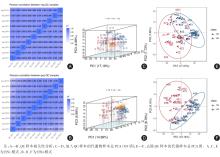
Fig.1
Quality assessment of metabolomics data and PCA analysis"
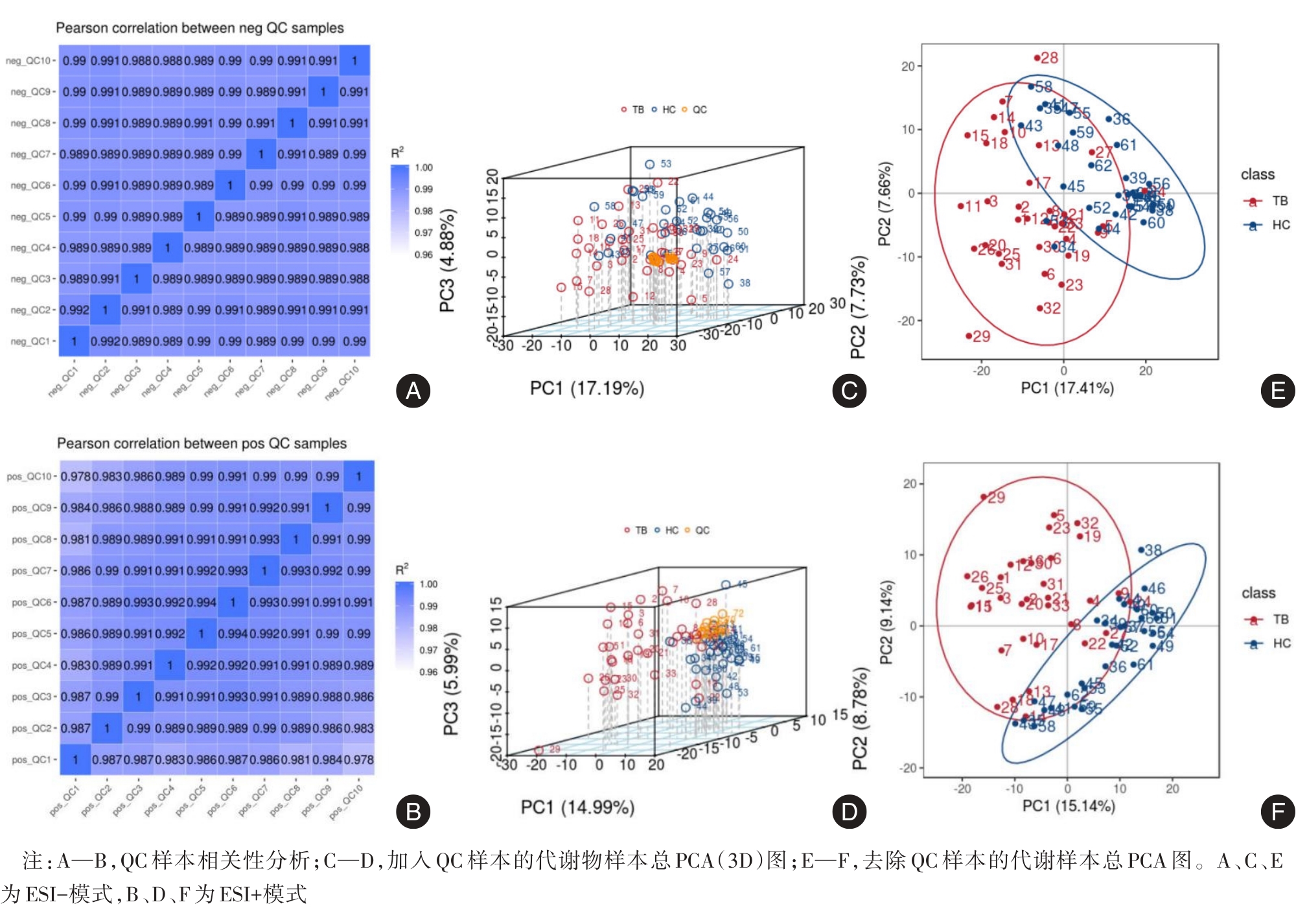
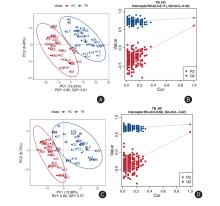
Fig.2
PLS-DA analysis and model validation of the metabolic profiles between the two groups"
Fig.3
Screening of differential metabolites and KEGG pathway enrichment analysis between groups"
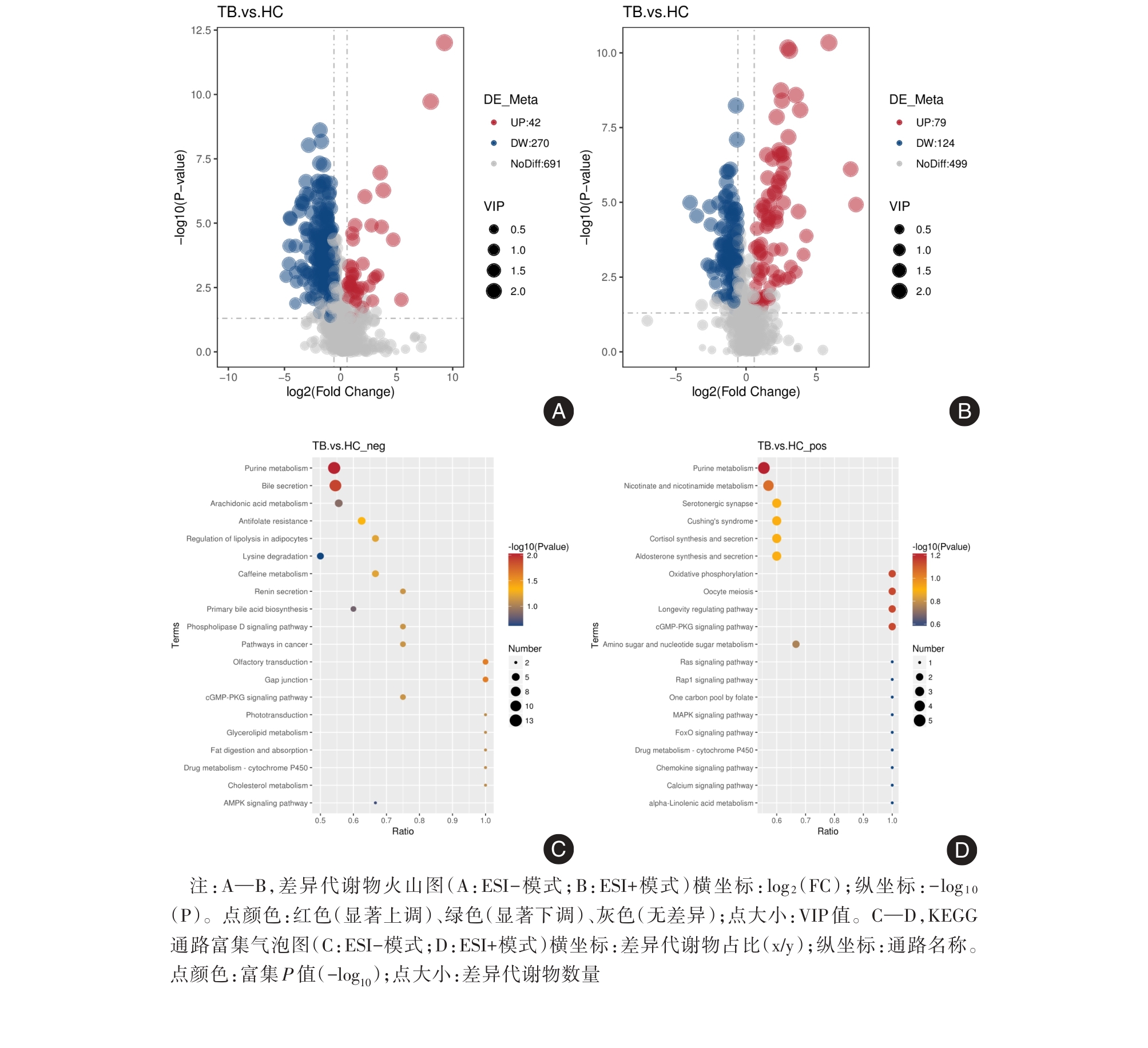
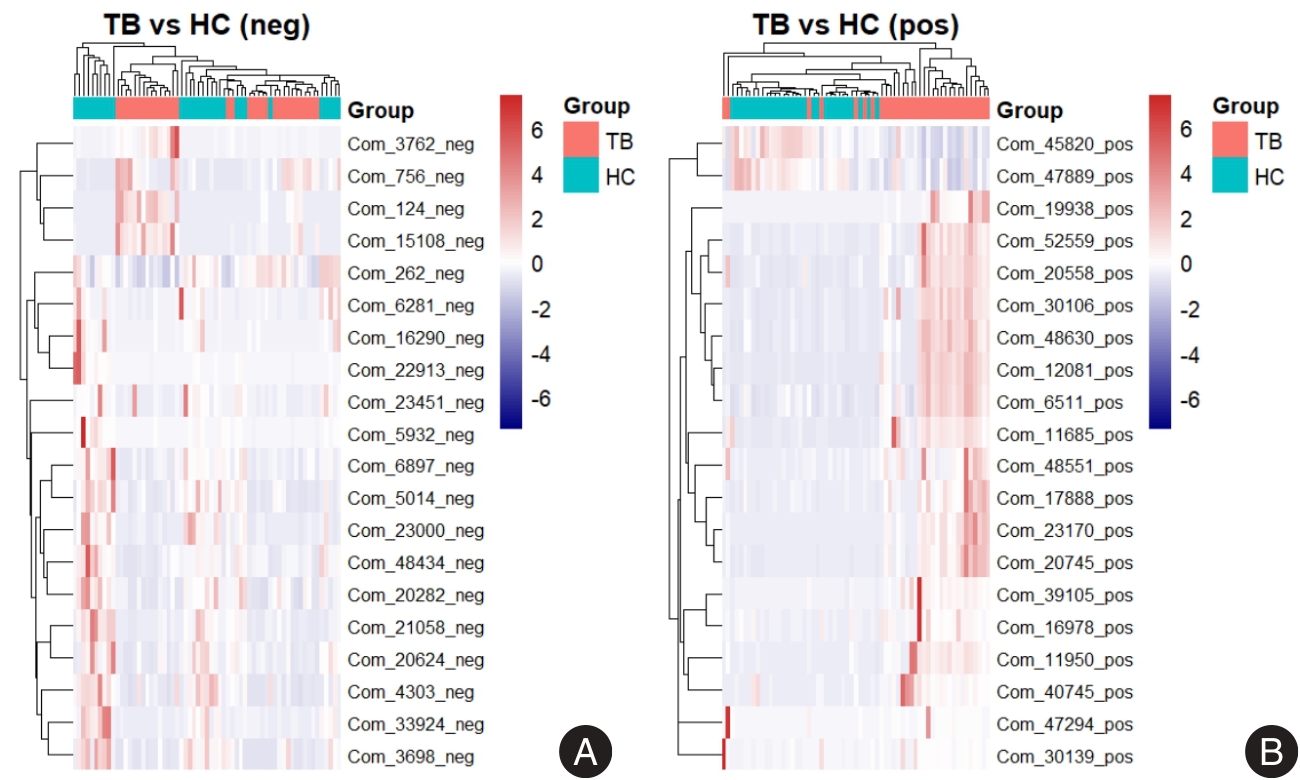
Fig.4
Cluster heatmap of the top 20 differential metabolites ranked by VIP scores"
Tab.1
Differential metabolites between TB and HC groups in ESI+ and ESI- modes"
| 离子模式 | 代谢物ID | 代谢物名称 | RT | m/z | FC | P值 | ROC | VIP | 变化趋势 |
|---|---|---|---|---|---|---|---|---|---|
| ESI- | Com_124_neg | Prostaglandin E2 | 6.2 | 775.4 | 263.0 | 0.000 | 0.911 | 2.25 | up |
| ESI- | Com_3762_neg | N-{3-[(3,5-difluorobenzyl)oxy]pyridin-2-yl}-4-pentylbenzenesulfonamide | 6.2 | 387.2 | 14.1 | 0.000 | 0.867 | 1.98 | up |
| ESI- | Com_6897_neg | Bicyclo Prostaglandin E2 | 6.3 | 445.1 | 0.3 | 0.000 | 0.908 | 1.93 | down |
| ESI- | Com_15108_neg | N'2-acetylpyridine-2-carbohydrazide | 6.0 | 369.2 | 11.6 | 0.000 | 0.805 | 1.91 | up |
| ESI- | Com_4303_neg | Indole-3-carboxaldehyde | 1.7 | 178.1 | 0.3 | 0.000 | 0.883 | 1.90 | down |
| ESI- | Com_21058_neg | LysoPC 12∶1 | 5.7 | 144.0 | 0.1 | 0.000 | 0.880 | 1.89 | down |
| ESI- | Com_33924_neg | LPE 16∶1 | 6.0 | 432.2 | 0.1 | 0.000 | 0.823 | 1.89 | down |
| ESI- | Com_23451_neg | LPE 12∶0 | 9.0 | 450.3 | 0.3 | 0.000 | 0.889 | 1.84 | down |
| ESI- | Com_23000_neg | 12-oxo Phytodienoic Acid | 7.6 | 396.2 | 0.3 | 0.000 | 0.849 | 1.84 | down |
| ESI- | Com_48434_neg | LPC 20∶4 | 7.1 | 291.2 | 0.4 | 0.000 | 0.884 | 1.84 | down |
| ESI- | Com_5014_neg | Kynurenic acid | 5.4 | 188.0 | 0.3 | 0.000 | 0.869 | 1.79 | down |
| ESI- | Com_16290_neg | D-Mannose 6-phosphate | 1.3 | 259.0 | 0.1 | 0.000 | 0.859 | 1.79 | down |
| ESI- | Com_6281_neg | D-Fructose 6-phosphate | 1.6 | 259.0 | 0.1 | 0.000 | 0.769 | 1.79 | down |
| ESI- | Com_5932_neg | 2'-Deoxyadenosine 5'-monophosphate | 1.9 | 330.1 | 0.1 | 0.000 | 0.858 | 1.78 | down |
| ESI- | Com_3698_neg | tetranor-PGFM | 5.5 | 311.2 | 0.2 | 0.000 | 0.840 | 1.77 | down |
| ESI- | Com_22913_neg | 4-chloro-2-(1H-pyrazol-3-yl)phenol | 3.5 | 193.0 | 0.1 | 0.000 | 0.846 | 1.77 | down |
| ESI- | Com_20624_neg | O-Aceyl-L-Serine | 5.1 | 146.0 | 0.3 | 0.000 | 0.852 | 1.75 | down |
| ESI- | Com_262_neg | Chenodeoxycholic Acid | 8.0 | 437.3 | 0.6 | 0.001 | 0.735 | 1.73 | down |
| ESI- | Com_756_neg | 5-Hydroxyindole-2-carboxylic acid | 2.4 | 176.0 | 4.5 | 0.000 | 0.824 | 1.73 | up |
| ESI- | Com_20282_neg | Tetrahydroaldosterone | 7.1 | 363.2 | 0.4 | 0.000 | 0.843 | 1.71 | down |
| ESI+ | Com_23170_pos | 17alpha-Ethinyl estradiol | 8.4 | 297.2 | 60.0 | 0.000 | 0.930 | 2.35 | up |
| ESI+ | Com_39105_pos | Biochanin A | 6.2 | 285.1 | 7.9 | 0.000 | 0.929 | 2.33 | up |
| ESI+ | Com_11950_pos | Hesperetin | 6.1 | 303.1 | 8.6 | 0.000 | 0.914 | 2.31 | up |
| ESI+ | Com_20745_pos | Isobutyl benzoate | 8.5 | 179.1 | 11.7 | 0.000 | 0.878 | 2.15 | up |
| ESI+ | Com_11685_pos | Diosmetin | 6.1 | 301.1 | 5.6 | 0.000 | 0.863 | 2.13 | up |
| ESI+ | Com_47294_pos | Apigenin | 6.1 | 271.1 | 14.5 | 0.000 | 0.895 | 2.09 | up |
| ESI+ | Com_40745_pos | 4',7-Dihydroxyflavanone | 6.1 | 240.1 | 4.5 | 0.000 | 0.873 | 2.08 | up |
| ESI+ | Com_16978_pos | Citrinin | 6.1 | 273.1 | 5.9 | 0.000 | 0.888 | 2.06 | up |
| ESI+ | Com_45820_pos | 3-Acetyl-2,5-dimethylfuran | 6.4 | 121.1 | 0.6 | 0.000 | 0.882 | 2.05 | down |
| ESI+ | Com_30139_pos | Obacunoic acid | 6.2 | 473.2 | 4.2 | 0.000 | 0.844 | 2.01 | up |
| ESI+ | Com_12081_pos | Purpurin | 6.1 | 257.0 | 8.1 | 0.000 | 0.816 | 2.00 | up |
| ESI+ | Com_48551_pos | PC(6∶0/7∶0) | 8.5 | 468.3 | 6.4 | 0.000 | 0.841 | 1.94 | up |
| ESI+ | Com_47889_pos | trans-2-Butene-1,4-dicarboxylic Acid | 4.9 | 145.0 | 0.6 | 0.000 | 0.859 | 1.94 | down |
| ESI+ | Com_30106_pos | dAMP | 6.2 | 332.1 | 5.3 | 0.000 | 0.813 | 1.90 | up |
| ESI+ | Com_52559_pos | ACar 22∶3 | 6.2 | 478.4 | 5.7 | 0.000 | 0.820 | 1.89 | up |
| ESI+ | Com_20558_pos | ACar 20∶6 | 6.2 | 444.3 | 5.1 | 0.000 | 0.827 | 1.89 | up |
| ESI+ | Com_6511_pos | Coenzyme Q1 | 6.1 | 251.1 | 2.8 | 0.000 | 0.836 | 1.87 | up |
| ESI+ | Com_19938_pos | (1R,2R)-trans-N-Boc-1,2-cyclohexanediamine | 4.8 | 215.2 | 175.8 | 0.000 | 0.751 | 1.87 | up |
| ESI+ | Com_48630_pos | 2,6-Di-tert-butyl-1,4-benzoquinone | 6.2 | 221.2 | 3.7 | 0.000 | 0.821 | 1.86 | up |
| ESI+ | Com_17888_pos | 3,4-Dimethylbenzoic acid | 8.6 | 151.1 | 6.6 | 0.000 | 0.823 | 1.85 | up |
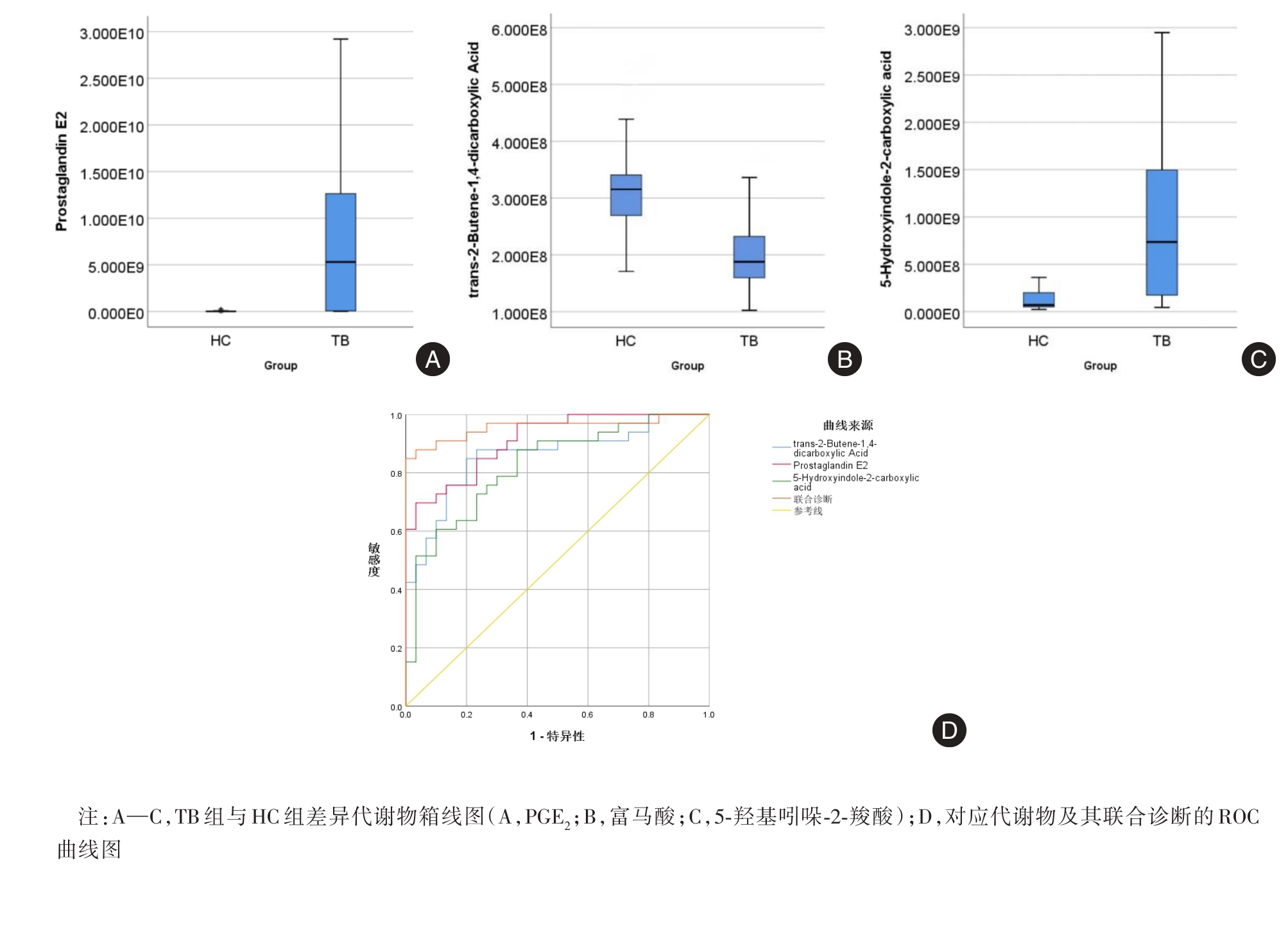
Fig.5
Differential metabolites between TB and HC groups and evaluation of their diagnostic efficacy"
| [1] |
李媛媛, 谢晶晶, 李树涛, 等. 2024年WHO全球结核病报告:全球与中国关键数据分析[J]. 新发传染病电子杂志, 2024, 9(6): 92-98. doi: 10.19871/j.cnki.xfcrbzz.2024.06.016 .
doi: 10.19871/j.cnki.xfcrbzz.2024.06.016 |
| [2] |
孙微, 麻斌喜, 郑甜, 等. 结核病诊断技术的研究进展[J]. 新疆医学, 2025, 55(3): 349-353. doi:10.3760/cma.j.issn.1001-5183.2025.03.120
doi: 10.3760/cma.j.issn.1001-5183.2025.03.120 |
| [3] |
DU PREEZ I, LOOTS D T. New sputum metabolite markers implicating adaptations of the host to Mycobacterium tuberculosis, and vice versa[J]. Tuberculosis, 2013, 93(3): 330-337. doi: 10.1016/j.tube.2013.02.008 .
doi: 10.1016/j.tube.2013.02.008 |
| [4] |
CHEN Y, WU Y, LV J, et al. Overall and individual associations between per- and polyfluoroalkyl substances and liver function indices and the metabolic mechanism[J]. Environment Int, 2024, 183: 108405. doi: 10.1016/j.envint.2023.108405 .
doi: 10.1016/j.envint.2023.108405 |
| [5] |
ISA F, COLLINS S, LEE M H, et al. Mass Spectrometric Identification of Urinary Biomarkers of Pulmonary Tuberculosis[J]. EBioMedicine, 2018, 31: 157-165. doi: 10.1016/j.ebiom.2018.04.014 .
doi: 10.1016/j.ebiom.2018.04.014 |
| [6] | 中华人民共和国国家卫生健康委员会. 肺结核诊断: WS 288—2017[EB/OL]. 北京: 中华人民共和国国家卫生健康委员会, 2017(2017-11-09)[2025-06-26]. . |
| [7] |
HONG Y, CHEN B, ZHAI X, et al. Integrated analysis of the gut microbiome and metabolome in a mouse model of inflammation-induced colorectal tumors[J]. Front Microbiol, 2022, 13: 1082835. doi: 10.3389/fmicb.2022.1082835 .
doi: 10.3389/fmicb.2022.1082835 |
| [8] |
LUO D, YANG B, QIN K, et al. Untargeted Metabolomics of Feces Reveals Diagnostic and Prognostic Biomarkers for Active Tuberculosis and Latent Tuberculosis Infection: Potential Application for Precise and Non-Invasive Identification[J]. Infect Drug Resist, 2023, 16: 6121-6138. doi: 10.2147/IDR.S422363 .
doi: 10.2147/IDR.S422363 |
| [9] |
WANT E J, WILSON I D, GIKA H, et al. Global metabolic profiling procedures for urine using UPLC-MS[J]. Nat Protoc, 2010, 5(6): 1005-1018. doi: 10.1038/nprot.2010.50 .
doi: 10.1038/nprot.2010.50 |
| [10] |
WU X, LIU K, WU Q, et al. Biomarkers of Metabolomics in Inflammatory Bowel Disease and Damp-Heat Syndrome: A Preliminary Study[J]. Evid Based Complement Alternat Med, 2022, 2022: 3319646. doi: 10.1155/2022/3319646 .
doi: 10.1155/2022/3319646 |
| [11] |
MURPHY R A, BUREYKO T F, MOURTZAKIS M, et al. Aberrations in plasma phospholipid fatty acids in lung cancer patients[J]. Lipids, 2012, 47(4): 363-369. doi: 10.1007/s11745-011-3641-2 .
doi: 10.1007/s11745-011-3641-2 |
| [12] |
KUHN T, FLOEGEL A, SOOKTHAI D, et al. Higher plasma levels of lysophosphatidylcholine 18:0 are related to a lower risk of common cancers in a prospective metabolomics study[J]. BMC Med, 2016, 14: 13. doi: 10.1186/s12916-016-0552-3 .
doi: 10.1186/s12916-016-0552-3 |
| [13] |
FENG S, DU Y, ZHANG L, et al. Analysis of serum metabolic profile by ultra-performance liquid chromatography-mass spectrometry for biomarkers discovery: Application in a pilot study to discriminate patients with tuberculosis[J]. Chin Med J (Engl), 2015, 128(2): 159-168. doi: 10.4103/0366-6999.149188 .
doi: 10.4103/0366-6999.149188 |
| [14] |
XIA Z, LI Y, YIN J, et al. Integrating Metabolomics and Gut Microbiota to Identify Key Biomarkers and Regulatory Pathways Underlying Metabolic Heterogeneity in Childhood Obesity[J]. Nutrients, 2025, 17(11): 1876. doi: 10.3390/nu17111876 .
doi: 10.3390/nu17111876 |
| [15] |
LI C, FAN J, SUN G, et al. Nrf2 pathway activation promotes the expression of genes related to glutathione metabolism in alcohol-exposed astrocytes[J]. PeerJ, 2024, 12: e17541. doi: 10.7717/peerj.17541 .
doi: 10.7717/peerj.17541 |
| [16] |
GUO Y, WAN S, HAN M, et al. Plasma Metabolomics Analysis Identifies Abnormal Energy, Lipid, and Amino Acid Metabolism in Abdominal Aortic Aneurysms[J]. Med Sci Monit, 2020, 26: e926766. doi: 10.12659/MSM.926766 .
doi: 10.12659/MSM.926766 |
| [17] |
AGRAWAL S, JASWAL K, SHIVER A L, et al. A genome-wide screen in Escherichia coli reveals that ubiquinone is a key antioxidant for metabolism of long-chain fatty acids[J]. J Biol Chem, 2017, 292(49): 20086-20099. doi: 10.1074/jbc.M117.806240 .
doi: 10.1074/jbc.M117.806240 |
| [18] |
蒋彩虹, 高子蕊, 郭丽凯, 等. 前列腺素E2在癌症发生发展中的研究进展[J]. 生理科学进展, 2018, 49(1): 53-57. doi: 10.3969/j.issn.0559-7765.2018.01.010 .
doi: 10.3969/j.issn.0559-7765.2018.01.010 |
| [19] |
刘彪. 血清微小RNA-27a、微小RNA-147、前列腺素E2水平与肺结核患者病情严重程度的关系研究[J]. 陕西医学杂志, 2025, 54(4): 510-514. doi: 10.3969/j.issn.1000-7377.2025.04.015 .
doi: 10.3969/j.issn.1000-7377.2025.04.015 |
| [20] |
吴显劲, 黄海勇, 萧乐瑶, 等. 巨噬细胞极化与结核分枝杆菌感染的研究进展[J]. 中国防痨杂志, 2023, 45(12): 1198-1204. doi: 10.19982/j.issn.1000-6621.20230265 .
doi: 10.19982/j.issn.1000-6621.20230265 |
| [21] |
PEURA A, TURPIN R, LIU R, et al. Soft matrix promotes immunosuppression in tumor-resident immune cells via COX-FGF2 signaling[J]. Nat Commun, 2025, 16(1): 4908. doi: 10.1038/s41467-025-60092-x .
doi: 10.1038/s41467-025-60092-x |
| [22] |
RUECKER N, JANSEN R, TRUJILLO C, et al. Fumarase Deficiency Causes Protein and Metabolite Succination and Intoxicates Mycobacterium tuberculosis[J]. Cell Chem Biol, 2017, 24(3): 306-315. doi: 10.1016/j.chembiol.2017.01.005 .
doi: 10.1016/j.chembiol.2017.01.005 |
| [23] |
CAI X, JIN J, YE H, et al. Altered serum metabolome is associated with disease activity and immune responses in rheumatoid arthritis[J]. Clin Rheumatol, 2024, 43(12): 3669-3678. doi: 10.1007/s10067-024-07201-1 .
doi: 10.1007/s10067-024-07201-1 |
| [24] |
VELAGAPUDI V R, HEZAVEH R, REIGSTAD C S, et al. The gut microbiota modulates host energy and lipid metabolism in mice[J]. J Lipid Res, 2010, 51(5): 1101-1112. doi: 10.1194/jlr.M002774 .
doi: 10.1194/jlr.M002774 |
| [25] |
ZHAO L, TANG S, CHEN F, et al. Regulation of macrophage polarization by targeted metabolic reprogramming for the treatment of lupus nephritis[J]. Mol Med, 2024, 30(1): 96. doi: 10.1186/s10020-024-00866-z .
doi: 10.1186/s10020-024-00866-z |
| [26] |
COLLINS J M, SIDDIQA A, JONES D P, et al. Tryptophan catabolism reflects disease activity in human tuberculosis[J]. JCI Insight, 2020, 5(10): e137131. doi: 10.1172/jci.insight.137131 .
doi: 10.1172/jci.insight.137131 |
| [27] |
ZHANG K, MISHRA A, JAGANNATH C. New insight into arginine and tryptophan metabolism in macrophage activation during tuberculosis[J]. Front Immunol, 2024, 15: 1363938. doi: 10.3389/fimmu.2024.1363938 .
doi: 10.3389/fimmu.2024.1363938 |
| [28] |
XUE C, LI G, ZHENG Q, et al. Tryptophan metabolism in health and disease[J]. Cell Metab, 2023, 35(8): 1304-1326. doi: 10.1016/j.cmet.2023.06.004 .
doi: 10.1016/j.cmet.2023.06.004 |
| [29] |
LU Z, ZHANG C, ZHANG J, et al. The Kynurenine Pathway and Indole Pathway in Tryptophan Metabolism Influence Tumor Progression[J]. Cancer Med, 2025, 14(6): e70703. doi: 10.1002/cam4.70703 .
doi: 10.1002/cam4.70703 |
| [30] |
BARAL T, JOHNSON A S, UNNIKRISHNAN M K, et al. Potential role of indole-3-propionic acid in tuberculosis: Current perspectives and future prospects[J]. Expert Opin Ther Targets,2025, 29(3): 171-178. doi: 10.1080/14728222.2025.2482548 .
doi: 10.1080/14728222.2025.2482548 |
| [1] | Shu ZHOU,Shuhan YANG,Zengxia WANG,Xuening WANG,Ruihan FENG,Lili PENG,Meiling YANG. The clinical application value of SAVE, APACHEⅡ score combined with circulating biomarkers in predicting the 90 day survival prognosis of patients with AMICS treated with VA-ECMO [J]. The Journal of Practical Medicine, 2026, 42(4): 698-705. |
| [2] | Wei TAO,Shifeng LIANG,Zhinong SHI,Zhen LI,Lunshan WANG. Effects of acupuncture on immune homeostasis and functional recovery in ischemic stroke rehabilitation patients [J]. The Journal of Practical Medicine, 2026, 42(2): 255-265. |
| [3] | Pao YU,Feng ZHU,Zi WANG,Yin ZHANG,Zheng GE,Bi ZHOU. Exploration of the application value of urinary ACE2 and PAX2 in early kidney injury of congenital kidney and urinary tract malformations [J]. The Journal of Practical Medicine, 2026, 42(1): 139-145. |
| [4] | Lu ZHAO,Huiwen ZHI,Yafeng LI. The role of biomarkers in the diagnosis and prediction of disease progression of IgA nephropathy [J]. The Journal of Practical Medicine, 2025, 41(9): 1267-1272. |
| [5] | Huimin HUANG,Chenxin LIU,Yanting FANG,Peiyan. ZHENG. Diagnostic value of KL⁃6 detection in children diagnostic value of KL⁃6 detection in children with idiopathic pulmonary hemosiderosis [J]. The Journal of Practical Medicine, 2025, 41(4): 594-599. |
| [6] | Zhao WANG,Jiepeng ZUO,Hang CHE,Lingyun REN,Zhe XU,Lei. WANG. Evaluation of plasma PPARγ as a potential diagnostic marker for female interstitial cystitis/painful bladder syndrome and its predictive model [J]. The Journal of Practical Medicine, 2025, 41(2): 258-263. |
| [7] | Yunfang ZHANG,Zheng LI,Xiaogai NIE,Yun GUAN,Qi CHEN,Yong YUAN. D⁃dimer/Alb ratio, IL⁃6 and FDP jointly predict poor outcomes post type A dissection [J]. The Journal of Practical Medicine, 2025, 41(17): 2755-2760. |
| [8] | Jingwen LAI,Yuchuan ZHAO,Zhuhua WU,Xunxun CHEN,Kehao PENG,Yuhui CHEN,Ran WEI,Xiaoyu LAI,Jingyu. WANG. Research advances and challenges in tuberculosis⁃associated extracellular vesicle biomarkers [J]. The Journal of Practical Medicine, 2025, 41(14): 2278-2284. |
| [9] | Shouping LIU,Yinlin TANG,Yanfang CHENG,Qian ZHOU. Analysis of coagulation and fibrinolysis biomarkers for prognostic assessment and clinical efficacy evaluation in patients with intracerebral hemorrhage [J]. The Journal of Practical Medicine, 2025, 41(12): 1846-1852. |
| [10] | Yuexian LYU,Xiu BI,Ying LIU,Shujing CUI,Lixin ZHAO,Ge GAO,Jianxia WANG,Juan LI,Jun LI. The efficacy of plasma gasdermin D C⁃terminal fragment in the early diagnosis of sepsis [J]. The Journal of Practical Medicine, 2025, 41(12): 1899-1906. |
| [11] | Xiao YANG,Tao WANG,Wei WANG,Yaohui PENG,Yan CHEN,Haiping ZENG,Bao YANG. Lipidomic profile of serum in colorectal cancer patients and its diagnostic significance [J]. The Journal of Practical Medicine, 2025, 41(11): 1742-1750. |
| [12] | Jiahui WANG,Ke ZHENG,Xuemei LI. Applications and advances of lipidomics in kidney disease [J]. The Journal of Practical Medicine, 2025, 41(1): 1-6. |
| [13] | Kaming YANG,Zhenlin LI,Wanwen LAO,Aixia ZHAI,Changlong. BI. Serological biomarkers for diagnosis of diabetes foot: A review of literature [J]. The Journal of Practical Medicine, 2024, 40(16): 2224-2228. |
| [14] | Jie YANG,Chunhong LI,Jingfei HUANG,Zhiwei CHEN,Lin. LIU. The expression and clinical significance of hsa_circ_0003922 in endometrioid carcinoma [J]. The Journal of Practical Medicine, 2024, 40(14): 1975-1980. |
| [15] | Chunling PAN,Xueli YI,Li SU,Shengshan YUAN,Guijiang WEI. Research progress of circrna and atherosclerotic ischemic stroke [J]. The Journal of Practical Medicine, 2024, 40(12): 1755-1761. |
| Viewed | ||||||
|
Full text |
|
|||||
|
Abstract |
|
|||||
