

The Journal of Practical Medicine ›› 2026, Vol. 42 ›› Issue (2): 327-333.doi: 10.3969/j.issn.1006-5725.2026.02.019
• Treatise: Clinical Practice • Previous Articles
Xin LIU1,Hongrui ZHANG1,Ying SHEN1( ),Yuqiao DIAO1,Tao FAN2
Received:2025-09-02
Revised:2025-10-17
Accepted:2025-10-17
Online:2026-01-25
Published:2026-01-22
Contact:
Ying SHEN
E-mail:ek66696446@163.com
CLC Number:
Xin LIU,Hongrui ZHANG,Ying SHEN,Yuqiao DIAO,Tao FAN. Correlation of serum lncRNA THRIL, lncRNA NEAT1 with the severity and prognosis of neonatal pneumonia[J]. The Journal of Practical Medicine, 2026, 42(2): 327-333.

Tab.1
Primer sequence"
| 引物名称 | 引物序列 |
|---|---|
| lncRNA THRIL | 上游引物:5′-AACTTCACAGGAACACTACACAAGA-3′ |
| 下游引物:5′-TAGGCAACAGAGCAAGACTTCATC-3′ | |
| lncRNA NEAT1 | 上游引物:5′-TGTCCCTCGGCTATGTCAGA-3′ |
| 下游引物:5′-GAGGGGACGTGTTTCCTGAG-3′ | |
| 甘油醛-3-磷酸脱氢酶 | 上游引物:5′-GAGTCCACTGGCGTCTTCAC-3′ |
| 下游引物:5′-ATCTTGAGGCTGTTGTCATATTCT-3′ |
Tab.2
Comparison of the differences of serum lncRNA THRIL, lncRNA NEAT1 between control group and observation group"
| 组别 | 例数 | lncRNA THRIL | lncRNA NEAT1 |
|---|---|---|---|
| 对照组 | 120 | 1.12 ± 0.27 | 1.05 ± 0.12 |
| 观察组 | 120 | 2.28 ± 0.49 | 2.22 ± 0.51 |
| t值 | 22.713 | 24.463 | |
| P值 | < 0.001 | < 0.001 |
Tab.3
Comparison of serum lncRNA THRIL, lncRNA NEAT1 in children with different disease severity"
| 组别 | 例数 | lncRNA THRIL | lncRNA NEAT1 |
|---|---|---|---|
| 轻症组 | 42 | 1.51 ± 0.29 | 1.12 ± 0.34 |
| 中症组 | 40 | 2.35 ± 0.45? | 2.21 ± 0.48? |
| 重症组 | 38 | 3.05 ± 0.76?# | 3.46 ± 0.76?# |
| F值 | 85.161 | 182.103 | |
| P值 | < 0.001 | < 0.001 |
Tab.4
Comparison of clinical data and immune and inflammatory indexes between good prognosis group and"
| 项目 | 预后良好组(n = 86) | 预后不良组(n = 34) | t/χ2 值 | P值 |
|---|---|---|---|---|
| 日龄(x ± s)/d | 12.66 ± 2.37 | 12.34±2.23 | 0.677 | 0.499 |
| 性别 | 0.859 | 0.354 | ||
| 男 | 51(59.30) | 17(50.00) | ||
| 女 | 35(40.70) | 17(50.00) | ||
| 出生体质量 | 2.116 | 0.146 | ||
| < 3 kg | 33(38.37) | 18(52.94) | ||
| ≥ 3 kg | 53(61.63) | 16(47.06) | ||
| 出生季节 | 0.119 | 0.730 | ||
| 春秋季 | 46(53.49) | 17(50.00) | ||
| 冬夏季 | 40(46.51) | 17(50.00) | ||
| 分娩方式 | 7.694 | 0.006 | ||
| 顺产 | 59(68.60) | 14(41.18) | ||
| 剖腹产 | 27(31.40) | 20(58.82) | ||
| 病因 | 0.479 | 0.489 | ||
| 吸入性肺炎 | 49(56.98) | 17(50.00) | ||
| 感染性肺炎 | 37(43.02) | 17(50.00) | ||
| sTREM-1(x ± s)/(ng/L) | 86.77 ± 19.48 | 103.52 ± 20.51 | 4.181 | < 0.001 |
| sIL-2R(x ± s)/(ng/L) | 328.62 ± 51.36 | 375.44 ± 57.65 | 4.345 | < 0.001 |
Tab.5
Comparison of the differences of serum lncRNA THRIL, lncRNA NEAT1 between good prognosis group and poor prognosis group"
| 组别 | 例数 | lncRNA THRIL | lncRNA NEAT1 |
|---|---|---|---|
| 预后良好组 | 86 | 1.98 ± 0.34 | 1.93 ± 0.42 |
| 预后不良组 | 34 | 3.04 ± 0.87 | 2.96 ± 0.74 |
| t值 | 9.635 | 9.605 | |
| P值 | < 0.001 | < 0.001 |
Tab.6
Influencing factors of poor prognosis in children with neonatal pneumonia"
| 指标 | β | SE | Wald | P值 | OR | 95%CI |
|---|---|---|---|---|---|---|
| sIL-2R | 0.670 | 0.262 | 6.537 | 0.010 | 1.954 | 1.169 ~ 3.265 |
| lncRNA THRIL | 0.716 | 0.353 | 4.113 | 0.043 | 2.046 | 1.024 ~ 4.087 |
| lncRNA NEAT1 | 0.868 | 0.416 | 4.349 | 0.037 | 2.381 | 1.054 ~ 5.381 |
Tab.7
Predictive value of serum lncRNA THRIL and lncRNA NEAT1 for poor prognosis in children with neonatal pneumonia"
| 变量 | AUC | 截断值 | 95%CI | 敏感度/% | 特异度/% | 约登指数 |
|---|---|---|---|---|---|---|
| lncRNA THRIL | 0.772 | 2.40 | 0.686 ~ 0.844 | 68.00 | 90.53 | 0.585 |
| lncRNA NEAT1 | 0.808 | 2.61 | 0.726 ~ 0.874 | 70.83 | 93.48 | 0.643 |
| 两者联合 | 0.930 | 0.869 ~ 0.969 | 91.89 | 88.66 | 0.806 |
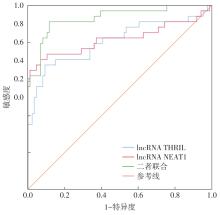
Fig.1
ROC curve of serum lncRNA THRIL, lncRNA NEAT1 and their combination in predicting poor prognosis in children with neonatal pneumonia"
| [1] |
LIU M, MO J, NONG C, et al. Association between lung ultrasound score and PaO2/FiO2 ratio in neonatal pneumonia: A prospective cohort study[J]. J Clin Ultrasound, 2025, 53(4):695-699. doi:10.1002/jcu.23928 .
doi: 10.1002/jcu.23928 |
| [2] |
EL-SHEIKH M, ELMAHDY H, NASSAR M, et al. Role of soluble triggering receptors expressed on myeloid cells-1 and 25-hydroxy vitamin D as early diagnostic markers of neonatal Ventilator-associated pneumonia: A prospective cohort study[J]. Pediatr Pulmonol, 2022, 57(9):2147-2153. doi:10.1002/ppul.26016 .
doi: 10.1002/ppul.26016 |
| [3] |
SKAKUN O, VANDZHURA Y, VANDZHURA I, et al. Impact of age on predictive capabilities of ferritin, ferritin-hemoglobin ratio, IL-6, and sIL-2R for COVID-19 severity and mortality[J]. Acta Medica (Hradec Kralove), 2024, 67(2):53-59. doi:10.14712/18059694.2024.20 .
doi: 10.14712/18059694.2024.20 |
| [4] |
NGUYEN T Q N, LE D Q, HOANG T M H, et al. Staphylococcus aureus pneumonia in neonates: Clinical patterns, laboratory findings and outcomes[J]. Pediatr Neonatol, 2025, 66(4):390-395. doi:10.1016/j.pedneo.2025.03.002 .
doi: 10.1016/j.pedneo.2025.03.002 |
| [5] |
JI J, HONG F, LIU Y, et al. Long noncoding RNA GAS5 contributes to mycoplasma pneumoniae pneumonia by regulating NF-κB via miR-29c/HMGB1 axis[J]. Tohoku J Exp Med, 2025, 264(4):193-202. doi:10.1620/tjem.2024.J067 .
doi: 10.1620/tjem.2024.J067 |
| [6] |
杨志勇, 刘维娜. lncRNA THRIL在ICU脓毒症患者血清中的表达水平及临床价值[J]. 检验医学与临床, 2023, 20(1):109-111. doi:10.3969/j.issn.1672-9455.2023.01.027 .
doi: 10.3969/j.issn.1672-9455.2023.01.027 |
| [7] |
WANG X, LI W, SUN S, et al. Inter-correlation of lncRNA THRIL with microRNA-34a and microRNA-125b and their relationship with childhood asthma risk, severity, and inflammation[J]. Allergol Immunopathol (Madr), 2023, 51(1):187-194. doi:10.15586/aei.v51i1.736 .
doi: 10.15586/aei.v51i1.736 |
| [8] |
GE S, HU J, GAO S, et al. LncRNA NEAT1: A novel regulator associated with the inflammatory response in acute respiratory distress syndrome[J]. Gene, 2023, 878:147582. doi:10.1016/j.gene.2023.147582 .
doi: 10.1016/j.gene.2023.147582 |
| [9] |
郝淑娟, 赵颖, 马彤辉, 等. 血清YKL-40、EGF表达水平与肺炎新生儿病情的关系及其对不良预后的预测价值分析[J]. 东南大学学报(医学版), 2022, 41(5):609-614. doi:10.3969/j.issn.1671-6264.2022.05.002 .
doi: 10.3969/j.issn.1671-6264.2022.05.002 |
| [10] | 邵肖梅, 叶鸿瑁, 丘小汕. 实用新生儿学(第5版)[M]. 北京: 人民卫生出版社, 2019: 575-578. |
| [11] |
杨胜权, 叶传芳, 韩坤. 外周血sIL-2R、降钙素原、miR-223水平与新生儿肺炎病情及转归的关系[J]. 临床和实验医学杂志, 2024, 23(19): 2089-2094. doi:10.3969/j.issn.1671-4695. 2024.1 9.019 .
doi: 10.3969/j.issn.1671-4695. 2024.1 9.019 |
| [12] |
ARI M, ARI H F, CENGIZ H. Advanced biomarkers for prognostic evaluation of pneumonia severity in pediatric intensive care: Focus on novel inflammatory and hematological ratios[J]. Ital J Pediatr, 2025, 51(1):168-180. doi:10.1186/s13052-025-01989-7 .
doi: 10.1186/s13052-025-01989-7 |
| [13] |
LI C, FENG X, YANG L, et al. Clinical utility of the Platelet-to-neutrophil ratio in differentiating sepsis from neonatal pneumonia: An observational study[J]. Ann Med, 2025, 57(1):2531252. doi:10.1080/07853890.2025.2531252 .
doi: 10.1080/07853890.2025.2531252 |
| [14] |
BONDAREV D J, RYAN R M, MUKHERJEE D. The spectrum of pneumonia among intubated neonates in the neonatal intensive care unit[J]. J Perinatol, 2024, 44(9): 1235-1243. doi:10.1038/s41372-024-01973-9 .
doi: 10.1038/s41372-024-01973-9 |
| [15] |
KHODAIR H A, ELMAHDY H S, ZIDAN L K, et al. Assessment of the role of probiotics in prevention of ventilator-associated pneumonia in neonates[J]. Eur J Pediatr, 2025, 184(9):597-606. doi:10.1007/s00431-025-06380-6 .
doi: 10.1007/s00431-025-06380-6 |
| [16] |
SONG X, GAO F, LI H, et al. Long noncoding RNA THRIL promotes foam cell formation and inflammation in macrophages[J]. Cell Biol Int, 2023, 47(1):156-166. doi:10.1002/cbin.11934 .
doi: 10.1002/cbin.11934 |
| [17] |
SHI Q, LI Z, DONG Y, et al. LncRNA THRIL, transcriptionally activated by AP-1 and stabilized by METTL14-mediated m6A modification, accelerates LPS-evoked acute injury in alveolar epithelial cells[J]. Int Immunopharmacol, 2023, 123:110740. doi:10.1016/j.intimp.2023.110740 .
doi: 10.1016/j.intimp.2023.110740 |
| [18] |
矫岩, 石岩, 韩文超, 等. lncRNA THRIL和miR-300在新生儿败血症患者中的临床意义[J]. 中国妇幼健康研究, 2022, 33(8):47-52. doi:10.3969/j.issn.1673-5293.2022.08.010 .
doi: 10.3969/j.issn.1673-5293.2022.08.010 |
| [19] |
ALDAKHEEL F M, SYED R, AHMED M, et al. Modulation of lncRNA NEAT1 overturns the macrophages based immune response in M. tuberculosis infected patients via miR-373 regulation[J]. J Appl Genet, 2024, 65(2):321-329. doi:10.1007/s13353-023-00808-1 .
doi: 10.1007/s13353-023-00808-1 |
| [20] |
许云春, 于馨雅, 王雅芝, 等. LncRNA NEAT1调控NF-κB信号通路对棕榈酸诱导的LO2细胞损伤与炎症反应的影响[J]. 实用医学杂志, 2023, 39(17):2164-2170. doi:10.3969/j.issn.1006-5725.2023.17.003 .
doi: 10.3969/j.issn.1006-5725.2023.17.003 |
| [21] |
GUO C, YU M, LIU J, et al. Molecular mechanism of Wilms tumour 1-associated protein in diabetes-related dry eye disease by mediating m6A methylation modification of lncRNA NEAT1[J]. J Drug Target, 2024, 32(2):200-212. doi:10.1080/1061186X.2023.2300682 .
doi: 10.1080/1061186X.2023.2300682 |
| [22] |
XU L, ZHANG L, XIANG Y, et al. Knockdown of lncRNA NEAT1 suppresses streptococcus pneumoniae-induced ferroptosis in alveolar epithelial cells by regulating the Nrf2-GPX4 pathway[J]. Toxicon, 2024, 243:107705. doi:10.1016/j.toxicon. 2024. 107705 .
doi: 10.1016/j.toxicon. 2024. 107705 |
| [23] |
屈菊梅, 冯成虎, 曹贝贝. 急性呼吸窘迫综合征新生儿血清LncRNA NEAT1、miR-129-5p水平与病情程度及预后的关系[J]. 中国妇幼健康研究, 2025, 36(5):31-37. doi:10.3969/j.issn.1673-5293.2025.05.005 .
doi: 10.3969/j.issn.1673-5293.2025.05.005 |
| [24] |
XU C, LUO L Y, WU B C, et al. Diagnostic values of soluble triggering receptor expressed on myeloid cells (sTREM-1) and interferon-inducible protein-10 (IP-10) for severe mycoplasma pneumoniae pneumonia in children[J]. Clinics (Sao Paulo), 2024, 79: 100361. doi:10.1016/j.clinsp.2024.100361 .
doi: 10.1016/j.clinsp.2024.100361 |
| [25] |
SCHUMACHER L, MÜLLER A, KOCH A, et al. Increased serum soluble interleukin-2 receptor concentrations are linked to high-sensitivity troponin T and disease progression in systemic sclerosis[J]. Clin Exp Rheumatol, 2025, 43(8):1446-1454. doi:10.55563/clinexprheumatol/re755k .
doi: 10.55563/clinexprheumatol/re755k |
| Viewed | ||||||
|
Full text |
|
|||||
|
Abstract |
|
|||||
