

The Journal of Practical Medicine ›› 2025, Vol. 41 ›› Issue (23): 3690-3696.doi: 10.3969/j.issn.1006-5725.2025.23.009
• Clinical Research • Previous Articles
Yebao WANG,Yongping LIN,Ling LIU,Jianmin. LI( )
)
Received:2025-09-09
Online:2025-12-10
Published:2025-12-18
Contact:
Jianmin. LI
E-mail:lijianmintzheart@163.com
CLC Number:
Yebao WANG,Yongping LIN,Ling LIU,Jianmin. LI. Correlation of serum miR‑210, TSG‑6 and CTRP3 with myocardial fibrosis and prognosis in patients with dilated cardiomyopathy[J]. The Journal of Practical Medicine, 2025, 41(23): 3690-3696.

Tab.1
Comparison of general information between the DCM group and the healthy control group"
| 组别 | 例数 | 性别(男/女)/例 | 年龄/岁 | 收缩压/mmHg | 舒张压/mmHg |
|---|---|---|---|---|---|
| DCM组 | 117 | 83/34 | 58.76 ± 10.24 | 127.16 ± 10.18 | 78.54 ± 8.27 |
| 健康对照组 | 58 | 41/17 | 57.92 ± 9.73 | 125.43 ± 11.64 | 76.35 ± 9.10 |
| t/χ2值 | 0.001 | 0.519 | 1.008 | 1.595 | |
| P值 | 0.973 | 0.604 | 0.315 | 0.113 | |
| 组别 | 例数 | 体质量指数/(kg/m2) | 基础心率/(次/min) | 吸烟/[例(%)] | 饮酒/[例(%)] |
| DCM组 | 117 | 22.43 ± 2.16 | 72.65 ± 10.04 | 35(29.91) | 29(24.79) |
| 健康对照组 | 58 | 22.75 ± 2.09 | 74.33 ± 9.82 | 12(20.69) | 10(17.24) |
| t/χ2值 | 0.932 | 1.050 | 1.680 | 1.275 | |
| P值 | 0.352 | 0.295 | 0.195 | 0.259 |
Tab.2
Comparison of serum miR-210, TSG-6, and CTRP3 levels between the DCM group and the healthy control group"
| 组别 | 例数 | miR-210 | TSG-6 /(ng/mL) | CTRP3 /(pg/mL) |
|---|---|---|---|---|
| DCM组 | 117 | 1.21 ± 0.30 | 196.50 ± 48.36 | 149.34 ± 37.18 |
| 健康对照组 | 58 | 0.92 ± 0.24 | 150.37 ± 39.12 | 180.27 ± 45.32 |
| t值 | 6.412 | 6.310 | 4.810 | |
| P值 | < 0.001 | < 0.001 | < 0.001 |
Tab.3
Comparison of PⅢNP, LVEF, and NT-proBNP between the DCM group and the healthy control group"
| 组别 | 例数 | PⅢNP /(ng/mL) | LVEF/% | NT-proBNP /(pg/mL) |
|---|---|---|---|---|
| DCM组 | 117 | 16.26 ± 4.10 | 36.14 ± 9.08 | 583.40 ± 147.63 |
| 健康对照组 | 58 | 12.33 ± 3.12 | 60.27 ± 10.43 | 195.26 ± 50.75 |
| t值 | 6.432 | 15.741 | 19.437 | |
| P值 | < 0.001 | < 0.001 | < 0.001 |
Tab.4
Comparison of serum miR-210, TSG-6, and CTRP3 levels between the fibrosis group and the non-fibrosis group"
| 组别 | 例数 | miR-210 | TSG-6/ (ng/mL) | CTRP3/ (pg/mL) |
|---|---|---|---|---|
| 纤维化组 | 96 | 1.24 ± 0.31 | 202.53 ± 50.18 | 145.73 ± 36.29 |
| 非纤维化组 | 21 | 1.08 ± 0.27 | 168.92 ± 43.67 | 165.84 ± 40.72 |
| t值 | 2.189 | 2.841 | 2.250 | |
| P值 | 0.031 | 0.005 | 0.026 |
Tab.5
Comparison of PⅢNP, LVEF, and NT-proBNP between the fibrosis group and the non-fibrosis group xˉ±s"
| 组别 | 例数 | PⅢNP/ (ng/mL) | LVEF/% | NT-proBNP/ (pg/mL) |
|---|---|---|---|---|
| 纤维化组 | 96 | 16.79 ± 4.19 | 35.12 ± 8.72 | 633.24 ± 160.15 |
| 非纤维化组 | 21 | 13.86 ± 3.47 | 40.78 ± 9.63 | 355.56 ± 88.92 |
| t值 | 2.985 | 2.644 | 7.674 | |
| P值 | 0.003 | 0.009 | < 0.001 |
Tab.6
Comparison of serum miR-210, TSG-6, and CTRP3 levels between the heart failure group and the non-heart failure group"
| 组别 | 例数 | miR-210 | TSG-6/ (ng/mL) | CTRP3/ (pg/mL) |
|---|---|---|---|---|
| 心衰组 | 47 | 1.33 ± 0.35 | 218.57 ± 54.39 | 130.62 ± 33.15 |
| 非心衰组 | 70 | 1.13 ± 0.28 | 181.68 ± 44.32 | 161.91 ± 40.57 |
| t值 | 3.422 | 4.025 | 4.392 | |
| P值 | 0.001 | < 0.001 | < 0.001 |
Tab.7
Comparison of PⅢNP, LVEF, and NT-proBNP between the heart failure group and the non-heart failure group"
| 组别 | 例数 | PⅢNP/ (ng/mL) | LVEF/% | NT-proBNP/ (pg/mL) |
|---|---|---|---|---|
| 心衰组 | 47 | 17.84 ± 4.52 | 30.09 ± 7.56 | 1 085.24 ± 273.48 |
| 非心衰组 | 70 | 15.20 ± 3.85 | 40.20 ± 10.15 | 246.45 ± 61.33 |
| t值 | 3.389 | 5.826 | 24.798 | |
| P值 | 0.001 | < 0.001 | < 0.001 |
Tab.8
Correlation analysis of serum miR-210, TSG-6 and CTRP3 with myocardial fibrosis and cardiac function indicators"
| 指标 | PⅢNP | LVEF | NT-proBNP | |||
|---|---|---|---|---|---|---|
| r值 | P值 | r值 | P值 | r值 | P值 | |
| miR-210 | 0.446 | < 0.001 | -0.412 | < 0.001 | 0.538 | < 0.001 |
| TSG-6 | 0.503 | < 0.001 | -0.468 | < 0.001 | 0.602 | < 0.001 |
| CTRP3 | -0.419 | < 0.001 | 0.553 | < 0.001 | -0.571 | < 0.001 |
Tab.9
Logistic regression analysis of heart failure in patients with DCM"
| 因素 | β | SE | Waldχ2 | OR | 95%CI | P值 |
|---|---|---|---|---|---|---|
| miR-210高水平 | 0.725 | 0.314 | 5.331 | 2.065 | 1.116 ~ 3.821 | 0.021 |
| TSG-6高水平 | 0.046 | 0.017 | 7.322 | 1.047 | 1.013 ~ 1.083 | 0.007 |
| CTRP3高水平 | -0.093 | 0.036 | 6.674 | 0.911 | 0.849 ~ 0.978 | 0.010 |
Tab.10
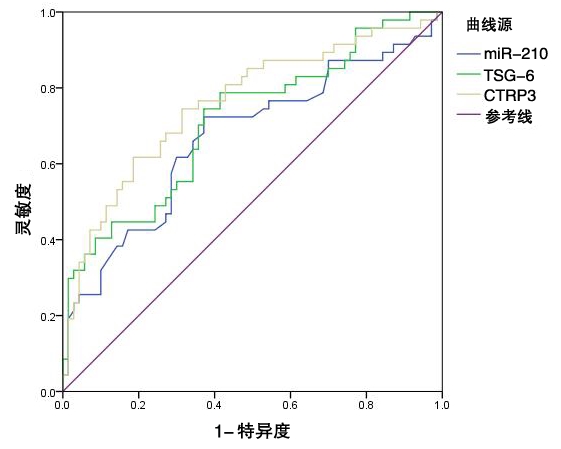
ROC curve analysis of serum miR-210, TSG-6 and CTRP3 predicting heart failure in patients with DCM"
| 指标 | 截断值 | AUC | 95%CI | 灵敏度/% | 特异度/% | 约登指数 |
|---|---|---|---|---|---|---|
| miR-210 | 1.200 | 0.669 | 0.565 ~ 0.772 | 72.34 | 62.86 | 0.352 |
| TSG-6 | 191.69 | 0.712 | 0.615 ~ 0.808 | 74.47 | 62.86 | 0.373 |
| CTRP3 | 143.42 | 0.759 | 0.668 ~ 0.851 | 74.47 | 68.57 | 0.430 |
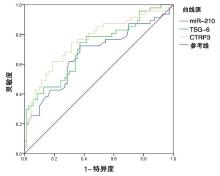
Fig.1
ROC curve of serum miR-210, TSG-6, and CTRP3 predicting heart failure in patients with DCM"
| [1] |
HEYMANS S, LAKDAWALA N K, TSCHÖPE C, et al. Dilated cardiomyopathy: Causes, mechanisms, and current and future treatment approaches[J]. Lancet, 2023, 402(10406): 998-1011. doi:10.1016/s0140-6736(23)01241-2
doi: 10.1016/s0140-6736(23)01241-2 |
| [2] |
ORPHANOU N, PAPATHEODOROU E, ANASTASAKIS A. Dilated cardiomyopathy in the era of precision medicine: Latest concepts and developments[J]. Heart Fail Rev, 2022, 27(4): 1173-1191. doi:10.1007/s10741-021-10139-0
doi: 10.1007/s10741-021-10139-0 |
| [3] | XU X R, HAN M M, YANG Y Z, et al. Fifteen-year mortality and prognostic factors in patients with dilated cardiomyopathy: Persistent standardized application of drug therapy and strengthened management may bring about encouraging change in an aging society[J]. J Geriatr Cardiol, 2022, 19(5): 335-342. |
| [4] | ZACCAGNINI G, BACI D, TASTSOGLOU S, et al. miR-210 overexpression increases pressure overload-induced cardiac fibrosis[J]. Noncoding RNA Res, 2025, 31(12): 20-33. |
| [5] |
WANG M, ZHANG M, FU L, et al. Liver-targeted delivery of TSG-6 by calcium phosphate nanoparticles for the management of liver fibrosis[J]. Theranostics, 2020, 10(1): 36-49. doi:10.7150/thno.37301
doi: 10.7150/thno.37301 |
| [6] |
曾玉玲, 占德进, 刘婷, 等. 肿瘤坏死因子相关蛋白3、成纤维细胞生长因子21与冠心病合并糖尿病经皮冠状动脉介入术后支架内再狭窄的相关性[J].实用医学杂志, 2020, 36(11): 1494-1498. doi:10.3969/j.issn.1006-5725.2020.11.017
doi: 10.3969/j.issn.1006-5725.2020.11.017 |
| [7] | YILDIRIM A, SUMBUL H E, KOCA H, et al. Complement C1q/Tumor Necrosis Factor-Related Protein-3 (CTRP3) is Significantly Decreased in Patients with Heart Failure and Closely Related with Ventricular Tachycardia[J]. Acta Cardiol Sin, 2021, 37(3): 278-285. |
| [8] |
AMR A, FREY N, MEDER B. Guideline update: Phenotype-based management of cardiomyopathy[J]. Dtsch Med Wochenschr, 2025, 150(6): 286-292. doi:10.1055/a-2271-4980
doi: 10.1055/a-2271-4980 |
| [9] |
MARQUES M D, WEINBERG R, KAPOOR S, et al. Myocardial fibrosis by T1 mapping magnetic resonance imaging predicts incident cardiovascular events and all-cause mortality: The Multi-Ethnic Study of Atherosclerosis[J]. Eur Heart J Cardiovasc Imaging, 2022, 23(10): 1407-1416. doi:10.1093/ehjci/jeac010
doi: 10.1093/ehjci/jeac010 |
| [10] | 田朝伟, 陈晓辉. 急性心力衰竭的诊治进展: 2016ESC急慢性心力衰竭诊断和治疗指南[J]. 中华急诊医学杂志, 2016, 25(7): 854-857. |
| [11] |
PERERA A N D, NOORBAKHSH K A, MARIN J R, et al. Focused cardiac ultrasound diagnosis of dilated cardiomyopathy[J]. Pediatr Emerg Care, 2024, 40(2): 164-165. doi:10.1097/pec.0000000000003123
doi: 10.1097/pec.0000000000003123 |
| [12] |
HAILU F T, KARIMPOUR A, TONI L S, et al. Integrated analysis of miRNA-mRNA interaction in pediatric dilated cardiomyopathy[J]. Pediatr Res, 2022, 92(1): 98-108. doi:10.1038/s41390-021-01548-w
doi: 10.1038/s41390-021-01548-w |
| [13] | SHEN N N, WANG J L, FU Y P. The microRNA Expression Profiling in Heart Failure: A Systematic Review and Meta-Analysis[J]. Front Cardiovasc Med, 2022, 15(9): 6358-6370. |
| [14] | 孙豪杰, 王杨淦. 特发性扩张型心肌病心衰相关基因和miRNA的筛选与分析[J]. 重庆医科大学学报, 2022, 47(1): 85-91. |
| [15] |
RUTKOVSKIY A, LYNGBAKKEN M N, DAHL M B, et al. Circulating MicroRNA-210 concentrations in patients with acute heart failure: Data from the akershus cardiac examination 2 study[J]. Clin Chem, 2021, 67(6): 889-898. doi:10.1093/clinchem/hvab030
doi: 10.1093/clinchem/hvab030 |
| [16] | LUO Z, GONG X, LIU Y, et al. Mitochondrial dysfunction due to miR-210/Drd5/ROS axis is a potential mechanism of heart failure[J]. Int J Cardiol, 2024, 15(403): 131897. |
| [17] |
WU Y, WANG T, QIAO L, et al. Upregulated microRNA-210-3p improves sevoflurane-induced protective effect on ventricular remodeling in rats with myocardial infarction by inhibiting ADCY9[J]. Funct Integr Genomics, 2022, 22(3): 279-289. doi:10.1007/s10142-021-00816-6
doi: 10.1007/s10142-021-00816-6 |
| [18] |
PU Y, LI C, QI X, et al. Extracellular Vesicles from NMN Preconditioned Mesenchymal Stem Cells Ameliorated Myocardial Infarction via miR-210-3p Promoted Angiogenesis[J]. Stem Cell Rev Rep, 2023, 19(4): 1051-1066. doi:10.1007/s12015-022-10499-6
doi: 10.1007/s12015-022-10499-6 |
| [19] | CHEN Y, CHANG G, CHEN X, et al. IL-6-miR-210 suppresses regulatory T cell function and promotes atrial fibrosis by targeting foxp3[J]. Mol Cells, 2020, 43(5): 438-447. |
| [20] | 许丽君, 张银妆, 匡圆圆, 等. 血浆TSG-6水平与扩张型心肌病心力衰竭患者心功能、心肌纤维化及预后的相关性[J].中南大学学报(医学版), 2021, 46(7): 689-696. |
| [21] |
MA L, HUA L, YU W, et al. TSG-6 inhibits hypertrophic scar fibroblast proliferation by regulating IRE1α/TRAF2/NF-κB signalling[J]. Int Wound J, 2023, 20(4): 1008-1019. doi:10.1111/iwj.13950
doi: 10.1111/iwj.13950 |
| [22] |
LI X Y, WENG X J, LI X J, et al. TSG-6 Inhibits the Growth of Keloid Fibroblasts Via Mediating the TGF-β1/Smad Signaling Pathway[J]. J Invest Surg, 2021, 34(9): 947-956. doi:10.1080/08941939.2020.1716894
doi: 10.1080/08941939.2020.1716894 |
| [23] |
SHI L, TAN Y, ZHENG W, et al. CTRP3 alleviates mitochondrial dysfunction and oxidative stress injury in pathological cardiac hypertrophy by activating UPRmt via the SIRT1/ATF5 axis[J]. Cell Death Discov, 2024, 10(1): 53-60. doi:10.1038/s41420-024-01813-x
doi: 10.1038/s41420-024-01813-x |
| [24] |
SONG Y, ZHANG Y, WAN Z, et al. CTRP3 alleviates cardiac ischemia/reperfusion injury via LAMP1/JIP2/JNK signaling pathway[J]. Aging, 2022, 14(3): 1321-1335. doi:10.18632/aging.203876
doi: 10.18632/aging.203876 |
| [25] | LIU Y, WU P, XU X, et al. C1q/TNF-related protein 3 alleviates heart failure via attenuation of oxidative stress in myocardial infarction rats[J]. Peptides, 2023, 5(163): 170980. |
| [26] |
LIU N, GONG Z, LI Y, et al. CTRP3 inhibits myocardial fibrosis through the P2X7R-NLRP3 inflammasome pathway in SHR rats[J]. J Hypertens, 2024, 42(2): 315-328. doi:10.1097/hjh.0000000000003591
doi: 10.1097/hjh.0000000000003591 |
| Viewed | ||||||
|
Full text |
|
|||||
|
Abstract |
|
|||||
