

The Journal of Practical Medicine ›› 2025, Vol. 41 ›› Issue (21): 3358-3364.doi: 10.3969/j.issn.1006-5725.2025.21.009
• Clinical Research • Previous Articles
Ruiyi JIA1,Bo ZHANG1,Guoyun YU1,Jiawei QIANG1,Xinyu WANG2,Guifen. PANG1( )
)
Received:2025-08-25
Online:2025-11-10
Published:2025-11-13
Contact:
Guifen. PANG
E-mail:cyfypang@163.com
CLC Number:
Ruiyi JIA,Bo ZHANG,Guoyun YU,Jiawei QIANG,Xinyu WANG,Guifen. PANG. The impact of chronic obstructive pulmonary disease combined with hypertension on cardiovascular events[J]. The Journal of Practical Medicine, 2025, 41(21): 3358-3364.
Tab.1
Comparison of general information of the three groups of patients"
| 项目 | HTN组(n = 64) | COPD组(n = 64) | 合并组(n = 64) | χ2/t值 | P值 |
|---|---|---|---|---|---|
| 性别/[例(%)] | 2.632 | 0.268 | |||
| 男 | 40(62.50) | 39(60.94) | 47(73.44) | ||
| 女 | 24(37.50) | 25(39.06) | 17(26.56) | ||
| 年龄/岁 | 67.30 ± 8.20 | 66.80 ± 8.40 | 67.20 ± 8.60 | 0.054 | 0.947 |
| BMI/(kg/m2) | 21.80 ± 3.17 | 22.38 ± 2.82 | 21.98 ± 2.56 | 0.675 | 0.510 |
| 吸烟史/[例(%)] | 1.309 | 0.520 | |||
| 是 | 17(26.56) | 23(35.94) | 20(31.25) | ||
| 否 | 47(73.44) | 41(64.06) | 44(68.75) |
Tab.2
Incidence and distribution of cardiovascular events among different populations"
| 项目 | HTN组(n = 64) | COPD组(n = 64) | 合并组(n = 64) | χ2值 | P值 |
|---|---|---|---|---|---|
| 心梗 | 3(4.69) | 6(9.38) | 10(15.63) | 4.322 | 0.115 |
| 卒中 | 2(3.13) | 5(7.81) | 11(17.19)? | 7.862 | 0.020 |
| 心衰 | 3(4.69) | 6(9.38) | 7(10.94) | 1.733 | 0.412 |
| 心血管死亡 | 1(1.56) | 2(3.13) | 3(4.69) | 1.023 | 0.597 |
| 总发生率 | 9(14.06) | 19(29.69)? | 31(48.44)? | 17.813 | 0.000 |

Fig.1
Kaplan-Meier curves of the three groupswithout cardiovascular events"

Tab.3
Comparison of pulmonary function and blood pressure-related indicators among the three groups of patients"
| 指标 | HTN组(n = 64) | COPD组(n = 64) | 合并组(n = 64) | F值 | P值 |
|---|---|---|---|---|---|
| FVC/L | 3.36 ± 0.68 | 2.86 ± 0.73? | 2.60 ± 0.66?# | 20.152 | 0.000 |
| FEV1/L | 2.72 ± 0.56 | 1.87 ± 0.59? | 1.65 ± 0.56?# | 62.443 | 0.000 |
| PEF/(L/s) | 6.84 ± 1.31 | 4.95 ± 1.15? | 4.22 ± 1.01?# | 86.200 | 0.000 |
| FEV1% pred/% | 94.58 ± 8.21 | 59.01 ± 11.74? | 53.78 ± 11.10?# | 288.181 | 0.000 |
| SBP/mmHg | 145.81 ± 15.22 | 118.50 ± 12.42? | 158.74 ± 18.63?# | 120.605 | 0.000 |
| DBP/mmHg | 88.62 ± 8.53 | 76.41 ± 7.21? | 96.30 ± 9.82?# | 74.626 | 0.000 |
Tab.4
Comparison of general data between patients with and without cardiovascular events"
| 项目 | 发生组(n = 59) | 未发生组(n = 133) | χ2/t值 | P值 |
|---|---|---|---|---|
| 性别/[例(%)] | 0.564 | 0.452 | ||
| 男 | 41(69.49) | 85(63.91) | ||
| 女 | 18(30.51) | 48(36.09) | ||
| 年龄/岁 | 67.02 ± 9.66 | 67.14 ± 7.82 | 0.096 | 0.924 |
| BMI/(kg/m2) | 22.33 ± 2.78 | 21.93 ± 2.89 | 0.908 | 0.365 |
| 疾病类型/[例(%)] | 17.813 | 0.000 | ||
| HTN | 9(15.25) | 55(41.35) | 12.528 | 0.000 |
| COPD | 19(32.2) | 45(33.83) | 0.049 | 0.825 |
| HTN合并COPD | 31(52.54) | 33(24.81) | 14.142 | 0.000 |
| 吸烟史/[例(%)] | 0.677 | 0.411 | ||
| 是 | 16(27.12) | 44(33.08) | ||
| 否 | 43(72.88) | 89(66.92) | ||
| 饮酒史/[例(%)] | 0.074 | 0.785 | ||
| 是 | 13(22.03) | 27(20.3) | ||
| 否 | 46(77.97) | 106(79.7) | ||
| TC/(mmol/L) | 4.57 ± 0.88 | 4.59 ± 0.95 | 0.182 | 0.856 |
| TG/(mmol/L) | 1.68 ± 0.57 | 1.6 ± 0.61 | 0.904 | 0.367 |
| LDL-C/(mmol/L) | 3.18 ± 0.79 | 3.14 ± 0.72 | 0.319 | 0.750 |
| HDL-C/(mmol/L) | 1.28 ± 0.29 | 1.32 ± 0.29 | 0.930 | 0.353 |
| 空腹血糖/(mmol/L) | 5.53 ± 0.75 | 5.76 ± 0.89 | 1.743 | 0.083 |
| WBC/(× 109/L) | 7.06 ± 1.89 | 6.96 ± 2.04 | 0.363 | 0.739 |
| NE/% | 65.26 ± 7.88 | 67.05 ± 8.21 | 1.409 | 0.161 |
| LY/% | 25.09 ± 6.16 | 23.3 ± 6.36 | 1.815 | 0.071 |
| PLT/(× 109/L) | 287.54 ± 76.18 | 275.4 ± 72.84 | 1.051 | 0.295 |
| FVC/L | 2.69 ± 0.78 | 3.05 ± 0.72 | 3.107 | 0.002 |
| FEV1/L | 1.96 ± 0.73 | 2.13 ± 0.73 | 1.537 | 0.126 |
| PEF/(L/s) | 4.9 ± 1.38 | 5.53 ± 1.66 | 2.561 | 0.011 |
| FEV1% pred/% | 60.29 ± 17.09 | 73.04 ± 21.36 | 4.045 | 0.000 |
| SBP/mmHg | 152.93 ± 16.72 | 128.53 ± 14.20 | 10.389 | 0.000 |
| DBP/mmHg | 94.22 ± 9.61 | 80.80 ± 8.53 | 9.668 | 0.000 |
Tab.5
Cox regression analysis of factors affectingcardiovascular events"
| 变量 | β | SE | HR | 95%CI | Wald χ2 | P值 |
|---|---|---|---|---|---|---|
| 疾病类型 | 16.248 | < 0.001 | ||||
| COPD vs. HTN | 0.756 | 0.412 | 2.130 | 0.951 ~ 4.768 | 3.371 | 0.066 |
| 合并vs. HTN | 1.524 | 0.398 | 4.593 | 2.107 ~ 10.014 | 14.681 | < 0.001 |
| FEV1% pred | -0.025 | 0.009 | 0.975 | 0.958 ~ 0.993 | 7.842 | 0.005 |
| SBP | 0.142 | 0.042 | 1.153 | 1.060 ~ 1.253 | 11.458 | 0.001 |
| DBP | 0.098 | 0.068 | 1.103 | 0.965 ~ 1.261 | 2.078 | 0.149 |
| FVC | -0.185 | 0.198 | 0.831 | 0.563 ~ 1.226 | 0.872 | 0.350 |
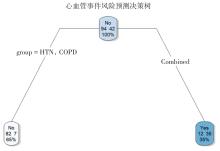
Fig.2
Cardiovascular event risk prediction decision tree"

| [1] |
JI J, ZHAO Q, YUAN J, et al. Causal Associations Between Chronic Obstructive Pulmonary Disease and Common Comorbidities: Evidence from Comprehensive Genetic Methods[J]. Int J Chron Obstruct Pulmon Dis, 2025, 20: 601-610. doi:10.2147/copd.s498513
doi: 10.2147/copd.s498513 |
| [2] |
NATHAN S D, ARGULA R, TRIVIERI M G, et al. Inhaled treprostinil in pulmonary hypertension associated with COPD: PERFECT study results[J]. Eur Respir J, 2024, 63(6): 2400172. doi:10.1183/13993003.00172-2024
doi: 10.1183/13993003.00172-2024 |
| [3] |
BOREK I, BIRNHUBER A, VOELKEL N F, et al. The vascular perspective on acute and chronic lung disease[J]. J Clin Invest, 2023, 133(16): e170502. doi:10.1172/jci170502
doi: 10.1172/jci170502 |
| [4] |
KARSANJI U, EVANS R A, QUINT J K, et al. Mortality associated with metabolic syndrome in people with COPD managed in primary care[J]. ERJ Open Research, 2022, 8(4): 00211-2022. doi:10.1183/23120541.00211-2022
doi: 10.1183/23120541.00211-2022 |
| [5] | 董涛, 何航帜, 胡晓娟, 等. 慢阻肺急性加重患者不同共病模式下生命质量MCID风险分析[J]. 现代预防医学, 2025, 50(2): 312-318. |
| [6] |
TAO S, YU L, LI J, et al. Association between the triglyceride-glucose index and 1-year major adverse cardiovascular events in patients with coronary heart disease and hypertension[J]. Cardiovasc Diabetol, 2023, 22(1): 305. doi:10.1186/s12933-023-02018-9
doi: 10.1186/s12933-023-02018-9 |
| [7] |
SAHOO K C, SUBHANKAR S, MOHANTA P C, et al. Prevalence of metabolic syndrome in chronic obstructive pulmonary disease and its correlation with severity of disease[J]. J Family Med Prim Care, 2022, 11(5): 2094-2098. doi:10.4103/jfmpc.jfmpc_1640_21
doi: 10.4103/jfmpc.jfmpc_1640_21 |
| [8] |
LACHIN J M. Introduction to sample size determination and power analysis for clinical trials[J]. Control Clin Trials, 1981, 2(2): 93-113. doi:10.1016/0197-2456(81)90001-5
doi: 10.1016/0197-2456(81)90001-5 |
| [9] | 中国高血压防治指南修订委员会. 中国高血压防治指南(2010年修订版)[M]. 北京: 人民卫生出版社, 2010: 8-11. |
| [10] | 中华医学会呼吸病学分会慢性阻塞性肺疾病学组. 慢性阻塞性肺疾病诊治指南(2013年修订版)[J]. 中国医学前沿杂志: 电子版, 2014,6(2): 14-35. |
| [11] | KAHNERT K, JÖRRES R A, BEHR J, et al. The Diagnosis and Treatment of COPD and Its Comorbidities[J]. Dtsch Arztebl Int, 2023, 120(25): 434-444. |
| [12] |
FABBRI L M, CELLI B R, AGUSTÍ A, et al. COPD and multimorbidity: recognising and addressing a syndemic occurrence[J]. Lancet Respir Med, 2023, 11(11): 1020-1034. doi:10.1016/s2213-2600(23)00261-8
doi: 10.1016/s2213-2600(23)00261-8 |
| [13] |
GHOSH A J, HOBBS B D. Comorbidity-Based Clusters Contain Chaos in COPD[J]. Chest, 2020, 158(1): 11-12. doi:10.1016/j.chest.2020.03.016
doi: 10.1016/j.chest.2020.03.016 |
| [14] | MAHATO B, NIGOSKAR S, LAKSHMI L J, et al. Glycemic Profile and Lipid Profile in Chronic Obstructive Pulmonary Disease (COPD) Patients With and Without Metabolic Syndrome[J]. Cureus, 2024, 16(4): e58921. |
| [15] |
LABAKI W W, ROSENBERG S R. Chronic Obstructive Pulmonary Disease[J]. Ann Intern Med, 2020, 173(3): 17-32. doi:10.7326/istranslatedfrom_aitc202008040_japanese
doi: 10.7326/istranslatedfrom_aitc202008040_japanese |
| [16] |
DANIELS K, LANES S, TAVE A, et al. Risk of Death and Cardiovascular Events Following an Exacerbation of COPD: The EXACOS-CV US Study[J]. Int J Chron Obstruct Pulmon Dis, 2024, 19: 225-241. doi:10.2147/copd.s438893
doi: 10.2147/copd.s438893 |
| [17] |
GRAUL E L, NORDON C, RHODES K, et al. Temporal Risk of Nonfatal Cardiovascular Events After Chronic Obstructive Pulmonary Disease Exacerbation: A Population-based Study[J]. Am J Respir Crit Care Med, 2024, 209(8): 960-972. doi:10.1164/rccm.202307-1122oc
doi: 10.1164/rccm.202307-1122oc |
| [18] |
ZHANG K, HAN Y, GAO Y X, et al. Association Between Systolic Blood Pressure and in-Hospital Mortality Among Congestive Heart Failure Patients with Chronic Obstructive Pulmonary Disease in the Intensive Care Unit: A Retrospective Cohort Study[J]. Int J Chron Obstruct Pulmon Dis, 2024, 19: 2023-2034. doi:10.2147/copd.s448332
doi: 10.2147/copd.s448332 |
| [19] | ASKIN M, KOC E M, SOZMEN K, et al. Evaluation of Dipper and Non-dipper Blood Pressure Patterns and Quality of Life Among Patients with Chronic Obstructive Pulmonary Disease[J]. Arq Bras Cardiol, 2021, 116(2): 295-302. |
| [20] |
SINGH D, HAN M K, HAWKINS N M, et al. Implications of Cardiopulmonary Risk for the Management of COPD: A Narrative Review[J]. Adv Ther, 2024, 41(6): 2151-2167. doi:10.1007/s12325-024-02855-4
doi: 10.1007/s12325-024-02855-4 |
| [21] |
SWART K M A, BAAK B N, LEMMENS L, et al. Risk of cardiovascular events after an exacerbation of chronic obstructive pulmonary disease: results from the EXACOS-CV cohort study using the PHARMO Data Network in the Netherlands[J]. Respir Res, 2023, 24(1): 293. doi:10.1186/s12931-023-02601-4
doi: 10.1186/s12931-023-02601-4 |
| [22] | 陈典, 隆寰宇, 张丛溪, 等. 2025年GOLD慢性阻塞性肺疾病诊断, 治疗, 管理及预防全球策略更新要点解读[J]. 中国全科医学, 2025, 28(16): 1937-1949. |
| [23] |
DOS SANTOS P B, SIMÕES R P, GOULART C D L, et al. Eccentric Left Ventricular Hypertrophy and Left and Right Cardiac Function in Chronic Heart Failure with or without Coexisting COPD: Impact on Exercise Performance[J]. Int J Chron Obstruct Pulmon Dis, 2021, 16: 203-214. doi:10.2147/copd.s285812
doi: 10.2147/copd.s285812 |
| [24] |
MACLEOD M, PAPI A, CONTOLI M, et al. Chronic obstructive pulmonary disease exacerbation fundamentals: Diagnosis, treatment, prevention and disease impact[J]. Respirology, 2021, 26(6): 532-551. doi:10.1111/resp.14041
doi: 10.1111/resp.14041 |
| [25] | 马雯,白力,邹琳,等. SPH3127调节炎症和FXYD1对高血压血管内皮损伤的保护机制[J]. 实用医学杂志, 2023, 39(4):430-435. |
| [26] |
WANG M, LIN E P, HUANG L C, et al. Mortality of Cardiovascular Events in Patients With COPD and Preceding Hospitalization for Acute Exacerbation[J]. Chest, 2020, 158(3): 973-985. doi:10.1016/j.chest.2020.02.046
doi: 10.1016/j.chest.2020.02.046 |
| [27] |
CALABRIA S, RONCONI G, DONDI L, et al. Cardiovascular events after exacerbations of chronic obstructive pulmonary disease: Results from the EXAcerbations of COPD and their OutcomeS in CardioVascular diseases study in Italy[J]. Eur J Intern Med, 2024, 127: 97-104. doi:10.1016/j.ejim.2024.04.021
doi: 10.1016/j.ejim.2024.04.021 |
| [1] | Li AN,Xiaomiao XIONG,Minsheng LI,Wei JIANG,Yanxin LIU,Zhijian ZHANG. The impact of high⁃flow nasal cannula versus non⁃invasive mechanical ventilation in elderly patients experiencing acute exacerbation of chronic obstructive pulmonary disease with mild to moderate hypercapnia [J]. The Journal of Practical Medicine, 2025, 41(9): 1332-1338. |
| [2] | Lulin CHEN,Tingjie YANG,Meng SUN,Xin LI,Yiming GUO,Yuqing YANG,Yudong CAO,Wenzhe LI,Jiangshu YUAN,Honghui YANG. Association between coronary inflammation and malnutrition on prognosis in patients with coronary artery disease [J]. The Journal of Practical Medicine, 2025, 41(7): 1010-1017. |
| [3] | Wenfang HE,Xun ZHOU,Meizhu DING,Yiping CHEN,Qianli LIU,Xinyuan. TAN. Application of the "ASK⁃T" aspiration prevention management model in reducing the risk of aspiration in elderly patients with chronic obstructive pulmonary disease (COPD) complicated by dysphagia [J]. The Journal of Practical Medicine, 2025, 41(3): 434-441. |
| [4] | Yanmin ZHENG,Qingqing WANG,Shenghao LI,Ye LI,Lu. ZHANG. Analysis of factors influencing hyperdynamic circulation indicators in patients with liver cirrhosis and ascites [J]. The Journal of Practical Medicine, 2025, 41(20): 3228-3234. |
| [5] | Minhua LAI,Yanshan LIN,Fangliang ZOU,Yang ZHANG,Jing LONG,Huaan XIA,Lihong LIN,Yunzhi DENG,Ruiyun CHEN,Jianhua YANG,Yao XU,Tianwen. PENG. Research on the current status of penile erection hardness and its influencing factors in patients with non-obstructive azoospermia [J]. The Journal of Practical Medicine, 2025, 41(20): 3276-3282. |
| [6] | Xiaoyi CHEN,Chao WANG,Yan. NIE. A predictive model for bowel preparation quality and mild adverse events in colonoscopy [J]. The Journal of Practical Medicine, 2025, 41(19): 3016-3025. |
| [7] | Shuting ZHENG,Xixi LIU,Shiyang CHEN,Peiqian LAI,Chunhong GUO,Shaohua. CHEN. Latent profiles analysis and influencing factors of Health⁃Promoting Lifestyle in patients with conservative treatment of Lumbar Disc Herniation [J]. The Journal of Practical Medicine, 2025, 41(19): 3052-3059. |
| [8] | Yilin HUANG,Shuang LI,Zhengyong HE,Zeyu. ZHANG. Research progress on fecal microbiota transplantation for the treatment of hypertension [J]. The Journal of Practical Medicine, 2025, 41(19): 3129-3134. |
| [9] | Fengwei QIN,Jiang LIU,Wen CHEN,Yonghui FENG,Sineng ZHANG. Analysis of influencing factors for early residual low back pain after percutaneous vertebro plasty [J]. The Journal of Practical Medicine, 2025, 41(18): 2884-2889. |
| [10] | Biao LENG,Dequan HONG,Ming TAN,Ming TIAN,Shanliang XIE,Yaoran. TU. Value of serum TFPI-1 combined with NF-κB in prognostic analysis of severe traumatic brain injury [J]. The Journal of Practical Medicine, 2025, 41(16): 2455-2460. |
| [11] | Yi LU,Shilong DAI,Mingjun WANG,Jing ZHOU,Junying HAO,Chen ZHENG,Xinbo XU,Shan DING,Qingsong ZHANG. The relationship between the triglyceride⁃glucose index and its modified index and colorectal cancer: A prospective cohort study [J]. The Journal of Practical Medicine, 2025, 41(15): 2362-2371. |
| [12] | Xinyu CHEN,Xiaolei LUO,Yimeng HUANG,Li MA. Predictive value of non⁃invasive assessment for adverse events in acute coronary syndrome patients with chronic kidney disease [J]. The Journal of Practical Medicine, 2025, 41(13): 1971-1978. |
| [13] | Yuexin SHI,Li LI,Jun YAN,Caijun WU,Zhi YAO,Yuanzhen JIAN,Ziqing LI,Fang LI,Lulu YANG. Expression characteristics and diagnostic value of PD⁃1 and PD⁃L1 in patients with acute exacerbation of chronic obstructive pulmonary disease [J]. The Journal of Practical Medicine, 2025, 41(11): 1655-1662. |
| [14] | Yan YANG,Li YAO,Wenxia WAN,Zhenzhen ZHOU,Nan LING. Evaluation of the effect of three nebulizing inhalation methods on patients with acute exacerbation of chronic obstructive pulmonary disease treated by non⁃invasive ventilation [J]. The Journal of Practical Medicine, 2025, 41(11): 1694-1704. |
| [15] | Hongmei FU,Chao. YU. Analysis of the influencing factors for achieving textbook outcomes of liver surgery after laparoscopic liver resection in patients with laparoscopic liver resection for liver lesions [J]. The Journal of Practical Medicine, 2025, 41(10): 1466-1472. |
| Viewed | ||||||
|
Full text |
|
|||||
|
Abstract |
|
|||||
