

The Journal of Practical Medicine ›› 2026, Vol. 42 ›› Issue (15): 2722-2729.doi: 10.3969/j.issn.1006-5725.2026.15.007
• Oncology: Diagnosis, Treatment and Prevention • Previous Articles
Jiacheng JIANG1,2,Jie MA3,Wei ZHU1( )
)
Received:2026-05-28
Revised:2026-06-24
Accepted:2026-06-26
Online:2026-08-10
Published:2026-08-13
Contact:
Wei ZHU
E-mail:zhuwei@ujs.edu.cn
CLC Number:
Jiacheng JIANG,Jie MA,Wei ZHU. Immunosuppressive effects and targeted therapeutic strategies of platelet-derived PD-L1 in hematogenous tumor metastasis[J]. The Journal of Practical Medicine, 2026, 42(15): 2722-2729.
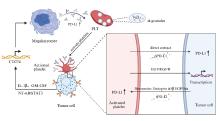
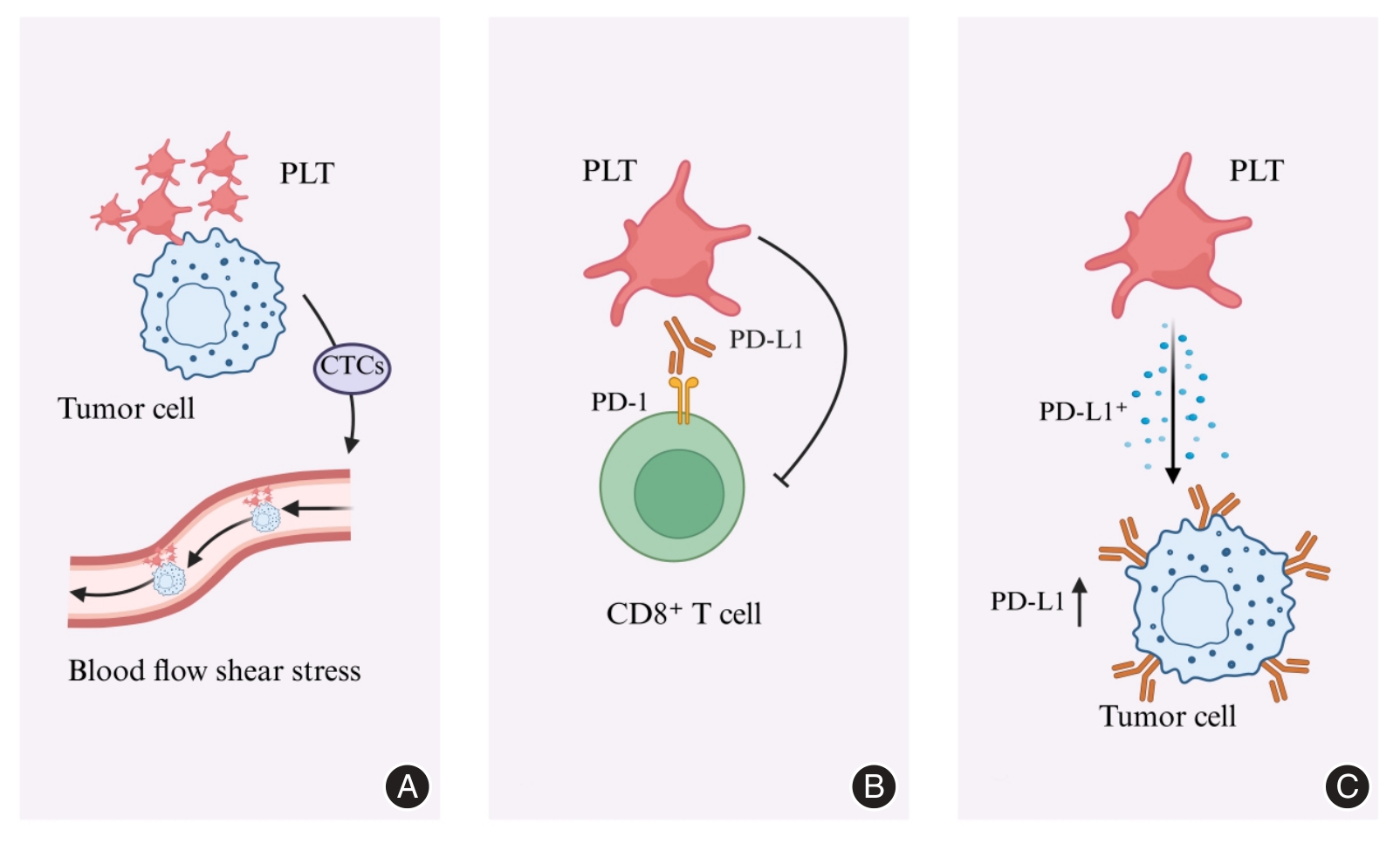
Fig.1
Bidirectional PD-L1 regulation and transfer between platelets and tumor cells"
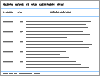
Tab.1
Species differences in the PD-1/PD-L1 pathway between mice and humans and implications for preclinical studies"
| 特征 | 小鼠 | 人 | 对临床前研究的启示 | 参考文献 |
|---|---|---|---|---|
| PD-1氨基酸同源性 | 与人类PD-1的氨基酸序列一致性为59.6% | - | 抗体交叉反应性有限 | [ |
| 对治疗性抗体的反应 | 部分抗体(如atezolizumab)可结合;其他(如durvalumab)不结合 | 全部可结合 | 需验证抗体在鼠源的交叉反应性 | [ |
| 小分子/肽类抑制剂 | 多数不结合mPD-L1 | 可结合 | 避免在小鼠模型中筛出假阴性 | [ |
| PD-1与PD-L1亲和力 | 较低(相对亲和力设为1) | 高(约为小鼠的3.2倍) | 人源化小鼠模型更准确评估药物 | [ |
| PD-1对Shp2招募效率 | 较低 | 更高(通过PEQ基序) | 小鼠模型可能低估PD-1通路抑制强度 | [ |
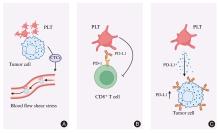
Fig.2
Triple inhibition model"
Tab.2
Comparison of major therapeutic strategies targeting the platelet PD-L1 axis"
| 治疗策略 | 核心机制 | 优势 | 局限性/挑战 | 参考文献 |
|---|---|---|---|---|
| 减少pPD-L1的生成与膜转位 | 抑制血小板活化/聚集,减少pPD-L1上调及tPD-L1诱导 | 老药新用,安全性相对明确;临床转化快 | 出血风险;最佳联合方案未定;需前瞻性临床试验验证 | [12-13,33] |
| 直接削弱pPD-L1的免疫抑制功能 | 化学偶联anti-PD-L1并吸附光热剂;术后局部释放 | 肿瘤归巢;可联合光热治疗 | 制备复杂;储存期短;个体差异 | [ |
| 清除pPD-L1的细胞载体 | cRGD纳米颗粒靶向肿瘤相关血小板,诱导凋亡 | 精准干预,避免全身血小板耗竭 | 需验证TAPs特异性标志物;长期安全性 | [ |
| 仿生替代pPD-L1介导的靶向功能 | 血小板膜包裹纳米内核,继承靶向和免疫逃逸功能 | 无活细胞储存问题;易于规模化 | 膜提取及涂层工艺需标准化;体内稳定性待优化 | [ |
| [1] |
LI S, LU Z, WU S, et al. The dynamic role of platelets in cancer progression and their therapeutic implications[J]. Nat Rev Cancer, 2024, 24(1):72-87. doi: 10.1038/s41568-023-00639-6 .
doi: 10.1038/s41568-023-00639-6 |
| [2] |
何嘉豪, 江倩, 刘春丽.血栓弹力图与传统凝血功能检测的相关性与一致性分析[J]. 实用医学杂志, 2022, 38(5): 606-610. doi: 10.3969/j.issn.1006-5725.2022.05.016 .
doi: 10.3969/j.issn.1006-5725.2022.05.016 |
| [3] |
张旺发,李明欣,陈荣鹏,等. Ⅳ期结直肠癌化疗前血小板参数与化疗敏感性及预后的关系[J].实用医学杂志,2021,37(20):2608-2613. doi: 10.3969/j.issn.1006-5725.2021.20.008 .
doi: 10.3969/j.issn.1006-5725.2021.20.008 |
| [4] |
CHAMBERS A F, NAUMOV G N, VARGHESE H J, et al. Critical steps in hematogenous metastasis: an overview[J]. Surg Oncol Clin N Am, 2001,10(2):243-255. doi: 10.1016/s1055-3207(18)30063-2 .
doi: 10.1016/s1055-3207(18)30063-2 |
| [5] |
LEE D Y, IM E, YOON D, LEE Y S, et al. Pivotal role of PD-1/PD-L1 immune checkpoints in immune escape and cancer progression: Their interplay with platelets and FOXP3+Tregs related molecules, clinical implications and combinational potential with phytochemicals[J]. Semin Cancer Biol, 2022, 86(3):1033-1057. doi: 10.1016/j.semcancer.2020.12.001 .
doi: 10.1016/j.semcancer.2020.12.001 |
| [6] |
XIAO J, WANG H, LIU X, et al. From escort to target, the multidimensional roles and prospects of platelets in tumor immune checkpoint inhibitor therapy[J]. Front Immunol, 2026,17(3):1764513. doi: 10.3389/fimmu.2026.1764513 .
doi: 10.3389/fimmu.2026.1764513 |
| [7] |
ROLFES V, IDEL C, PRIES R, et al. PD-L1 is expressed on human platelets and is affected by immune checkpoint therapy[J]. Oncotarget, 2018, 9(44):27460-27470. doi: 10.18632/oncotarget.25446 .
doi: 10.18632/oncotarget.25446 |
| [8] |
GAN J, ZHANG X, GUO J. The role of platelets in tumor immune evasion and metastasis: mechanisms and therapeutic implications[J]. Cancer Cell Int, 2025,25(1):258. doi: 10.1186/s12935-025-03877-w .
doi: 10.1186/s12935-025-03877-w |
| [9] |
TRIVANOVIĆ D, MOJSILOVIĆ S, BOGOSAVLJEVIĆ N, et al. Revealing profile of cancer-educated platelets and their factors to foster immunotherapy development[J]. Transl Oncol, 2024, 40(2):101871. doi: 10.1016/j.tranon.2023.101871 .
doi: 10.1016/j.tranon.2023.101871 |
| [10] |
LU Q, YE H, ZHAO J, et al. Surface-Anchored Ticagrelor Gelatin Nanoparticles-Platelets System for Enhanced Anti-PD-L1 Therapy Response and Boosted Chemotherapeutic Efficacy of Nanomedicines[J]. Exploration (Beijing), 2025,5(3):20240084. doi: 10.1002/EXP.20240084 .
doi: 10.1002/EXP.20240084 |
| [11] |
ZASLAVSKY A B, ADAMS M P, CAO X, et al. Platelet PD-L1 suppresses anti-cancer immune cell activity in PD-L1 negative tumors[J]. Sci Rep, 2020, 10(1):19296. doi: 10.1038/s41598-020-76351-4 .
doi: 10.1038/s41598-020-76351-4 |
| [12] |
GUO Q, MALLOY M W, ROWETH H G, et al. Platelets upregulate tumor cell programmed death ligand 1 in an epidermal growth factor receptor-dependent manner in vitro[J]. Blood Adv, 2022, 6(20):5668-5675. doi: 10.1182/bloodadvances .
doi: 10.1182/bloodadvances |
| [13] |
LI J, LIU J, YANG S, et al. PD-L1 positive platelets mediate resistance to immune checkpoint inhibitors in patients with colorectal cancer[J]. Cell Commun Signal, 2025, 23(1):29. doi: 10.1186/s12964-025-02034-0 .
doi: 10.1186/s12964-025-02034-0 |
| [14] |
XU C, XIA Y, ZHANG B W, et al. Macrophages facilitate tumor cell PD-L1 expression via an IL-1β-centered loop to attenuate immune checkpoint blockade[J]. Med Comm, 2023, 4(2):e242. doi: 10.1002/mco2.242 .
doi: 10.1002/mco2.242 |
| [15] |
YI M, NIU M, XU L, et al. Regulation of PD-L1 expression in the tumor microenvironment[J]. Hematol Oncol, 2021, 14(1):10. doi: 10.1186/s13045-020-01027-5 .
doi: 10.1186/s13045-020-01027-5 |
| [16] |
RONG Q X, WANG F, GUO Z X, et al. GM-CSF mediates immune evasion via upregulation of PD-L1 expression in extranodal natural killer/T cell lymphoma[J]. Mol Cancer, 2021, 20(1):80. doi: 10.1186/s12943-021-01374-y .
doi: 10.1186/s12943-021-01374-y |
| [17] |
LI Z, LIU J, YAN M, et al. Tumor-educated platelets: from molecular mechanisms to liquid biopsy and therapeutic applications[J]. Int J Pharm, 2026, 694:126708. doi: 10.1016/j.ijpharm. 2026.126708 .
doi: 10.1016/j.ijpharm. 2026.126708 |
| [18] |
MASUBUCHI T, CHEN L, MARCEL N, et al. Functional differences between rodent and human PD-1 linked to evolutionary divergence[J]. Sci Immunol, 2025, 10(103):6295. doi: 10.1126/sciimmunol.ads6295 .
doi: 10.1126/sciimmunol.ads6295 |
| [19] |
MAGIERA-MULARZ K, KOCIK J, MUSIELAK B, et al. Human and mouse PD-L1: similar molecular structure, but different druggability profiles[J]. iScience, 2020, 24(1):101960. doi: 10.1016/j.isci.2020.101960 .
doi: 10.1016/j.isci.2020.101960 |
| [20] |
STAICU I. Human versus mouse PD-1[J]. Nat Immunol, 2025, 26(2):149. doi: 10.1038/s41590-025-02086-x .
doi: 10.1038/s41590-025-02086-x |
| [21] |
TANG M, ZHANG Z, WANG P, et al. Advancements in precision nanomedicine design targeting the anoikis-platelet interface of circulating tumor cells[J]. Acta Pharm Sin B, 2024, 14(8):3457-3475. doi: 10.1016/j.apsb.2024.04.034 .
doi: 10.1016/j.apsb.2024.04.034 |
| [22] |
SUN Y, LI T, DING L, et al. Platelet-mediated circulating tumor cell evasion from natural killer cell killing through immune checkpoint CD155-TIGIT[J]. Hepatology, 2025, 81(3):791-807. doi: 10.1097/HEP.0000000000000934 .
doi: 10.1097/HEP.0000000000000934 |
| [23] |
MAURER S, KROPP KN, KLEIN G, et al. Platelet-mediated shedding of NKG2D ligands impairs NK cell immune-surveillance of tumor cells[J]. Oncoimmunology, 2017, 7(2):e1364827. doi: 10.1080/2162402X.2017.1364827 .
doi: 10.1080/2162402X.2017.1364827 |
| [24] |
CHO M S, LEE H, GONZALEZ-DELGADO R, et al. Platelets Increase the Expression of PD-L1 in Ovarian Cancer[J]. Cancers (Basel), 2022, 14(10):2498. doi: 10.3390/cancers14102498 .
doi: 10.3390/cancers14102498 |
| [25] |
SMITH-OLIVER M R, GAUTAM D, PETRARCA G C, et al. Tumor-Associated Platelets Suppress T-Cell Function and Promote Immune Evasion in TNBC via the P-selectin/ P-selectin glycoprotein ligand-1 Pathway[J]. Cancer Res Commun, 2026,6(7):1640-1655. doi: 10.1158/2767-9764.CRC-26-0187 .
doi: 10.1158/2767-9764.CRC-26-0187 |
| [26] |
LIU Y, ZHANG Y, DING Y, et al. Platelet-mediated tumor metastasis mechanism and the role of cell adhesion molecules[J]. Crit Rev Oncol Hematol, 2021, 167:103502. doi: 10.1016/j.critrevonc.2021.103502 .
doi: 10.1016/j.critrevonc.2021.103502 |
| [27] |
VASILAKI D, BAKOPOULOU A, TSOUKNIDAS A, et al. Biophysical interactions between components of the tumor microenvironment promote metastasis[J]. Biophys Rev, 2021, 13(3):339-357. doi: 10.1007/s12551-021-00811-y .
doi: 10.1007/s12551-021-00811-y |
| [28] |
RASKOV H, ORHAN A, AGERBÆK M Ø, et al. The impact of platelets on the metastatic potential of tumour cells[J]. Heliyon, 2024, 10(14):e34361. doi: 10.1016/j.heliyon.2024.e34361 .
doi: 10.1016/j.heliyon.2024.e34361 |
| [29] |
HINTERLEITNER C, STRÄHLE J, MALENKE E, et al. Platelet PD-L1 reflects collective intratumoral PD-L1 expression and predicts immunotherapy response in non-small cell lung cancer[J]. Nat Commun, 2021, 12(1):7005. doi: 10.1038/s41467-021-27303-7 .
doi: 10.1038/s41467-021-27303-7 |
| [30] |
COLARUSSO C, FALANGA A, TERLIZZI M, et al. High levels of PD-L1 on platelets of NSCLC patients contributes to the pharmacological activity of Atezolizumab[J]. Biomed Pharmacother, 2023, 168:115709. doi: 10.1016/j.biopha.2023.115709 .
doi: 10.1016/j.biopha.2023.115709 |
| [31] |
LEE S W, JEONG S, KIM Y J, et al. Enhanced thrombopoiesis supplies PD-L1 to circulating immune cells via the generation of PD-L1-expressing platelets in patients with lung cancer[J]. Immunother Cancer, 2025, 13(2):e010193. doi: 10.1136/jitc-2024-010193 .
doi: 10.1136/jitc-2024-010193 |
| [32] |
DARGA E P, DOLCE E M, FANG F, et al. PD-L1 expression on circulating tumor cells and platelets in patients with metastatic breast cancer[J]. PLoS One, 2021, 16(11):e0260124. doi: 10.1371/journal.pone.0260124 .
doi: 10.1371/journal.pone.0260124 |
| [33] |
KÖTT J, MATTHES N, BAUER A T, et al. Synergistic effects of anticoagulants and platelet aggregation inhibitors with immune checkpoint inhibitors in cancer therapy: a comprehensive review of preclinical and clinical evidence[J]. Immunother Cancer, 2026 Feb 4;14(2):e013879. doi: 10.1136/jitc-2025-013879 .
doi: 10.1136/jitc-2025-013879 |
| [34] |
GAO Y, CHEN X, WANG B, et al. Engineering Platelets with PDL1 Antibodies and Iron Oxide Nanoparticles for Postsurgical Cancer Immunotherapy[J]. ACS Appl Bio Mater, 2023, 6(1):257-266. doi: 10.1021/acsabm.2c00869 .
doi: 10.1021/acsabm.2c00869 |
| [35] |
DA X, MO J, LI Q, et al. Targeted co-delivery of PD-L1 monoclonal antibody and sorafenib to circulating tumor cells via platelet-functionalized nanocarriers[J]. Biochem Biophys Res Commun, 2023, 671:335-342. doi: 10.1016/j.bbrc.2023.05.124 .
doi: 10.1016/j.bbrc.2023.05.124 |
| [36] |
WU S, WU Z, LU Z, et al. Selective apoptosis of tumor-associated platelets boosts the anti-metastatic potency of PD-1 blockade therapy[J]. Cell Rep Med, 2025, 6(3):101984. doi: 10.1016/j.xcrm.2025.101984 .
doi: 10.1016/j.xcrm.2025.101984 |
| [37] |
ZHANG Y, WANG Z J, WANG J, et al. Immunomodulating platelet-mimicking nanoparticles for AIE-based enhanced photodynamic immunotherapy against lung cancer[J]. Materials Today Bio, 2025, 32:101683. doi: 10.1016/j.mtbio.2025.101683 .
doi: 10.1016/j.mtbio.2025.101683 |
| [38] |
LV Y, MA G. Platelet-Based Nanotechnology Improves Cancer Immunotherapy[J]. Eur J Immunol, 2025, 55(7):e70017. doi: 10.1002/eji.70017 .
doi: 10.1002/eji.70017 |
| [39] |
GRANICA M, LASKOWSKI G, LINK-LENCZOWSKI P, et al. Modulation of N-glycosylation in the PD-1: PD-L1 axis as a strategy to enhance cancer immunotherapies[J]. Biochim Biophys Acta Rev Cancer, 2025, 1880(2):189274. doi: 10.1016/j.bbcan.2025.189274 .
doi: 10.1016/j.bbcan.2025.189274 |
| [40] |
WANG X, HUANG Y, LUO T, et al. Rewiring immune evasion in liver metastases: WNT11 as a central node - a mini review[J]. Front Oncol, 2025, 15(3):1666889. doi: 10.3389/fonc.2025. 1666889 .
doi: 10.3389/fonc.2025. 1666889 |
| [41] |
NASSER N J, SINDHU K K, NASSER L, et al. Immune Checkpoint Inhibition in Patients with Brain Metastases from Non-Small-Cell Lung Cancer: Emerging Mechanisms and Personalized Clinical Strategies[J]. Int J Mol Sci, 2025, 26(17):8624. doi: 10.3390/ijms26178624 .
doi: 10.3390/ijms26178624 |
| [42] |
CHEN Y, WOLTER T, GU Z, et al. Engineering platelets as cancer therapeutics[J]. Nat Rev Clin Oncol, 2026, 23(5):323-340. doi: 10.1038/s41571-026-01122-5 .
doi: 10.1038/s41571-026-01122-5 |
| [43] |
WANG Y, OGUNNAIKE E, YANG H, et al. Platelet-engineered CAR-T cells as adjuvant therapy after cancer surgery[J]. Proc Natl Acad Sci U S A, 2025, 122(51):e2522020122. doi: 10.1073/pnas.2522020122 .
doi: 10.1073/pnas.2522020122 |
| Viewed | ||||||
|
Full text |
|
|||||
|
Abstract |
|
|||||
