

The Journal of Practical Medicine ›› 2026, Vol. 42 ›› Issue (10): 1811-1821.doi: 10.3969/j.issn.1006-5725.2026.10.016
• Modernization of Traditional Chinese Medicine • Previous Articles
Peijia CHEN1,2,Peiyun FENG1,2,Ying JIANG1,2,Rong WU1,2,Houwei WEI1,2,Zhenglin WEI1,2,Wenghao HUANG1,2,Liming LU3,Yanqing LU1,2( )
)
Received:2025-12-24
Online:2026-05-25
Published:2026-05-27
Contact:
Yanqing LU
E-mail:Stellaqing@126.com
CLC Number:
Peijia CHEN,Peiyun FENG,Ying JIANG,Rong WU,Houwei WEI,Zhenglin WEI,Wenghao HUANG,Liming LU,Yanqing LU. Study on the brain network effects of stroke patients treated with Tongdu Tiaoshen acupuncture method based on the fMRI[J]. The Journal of Practical Medicine, 2026, 42(10): 1811-1821.

Tab.1
Selection and localization of acupoints in the experimental group"
| 穴位 | 位置 | 深度/寸 |
|---|---|---|
| 百会 | 在头部,当前发际正中直上5寸,或两耳尖连线的中点处 | 0.5 ~ 0.8 |
| 大椎 | 在项部,后正中线上,第7颈椎棘下凹陷中 | 0.5 ~ 1.2 |
| 曲池 | 在肘横纹外侧端,屈肘,当尺泽与肱骨外上髁连线中点 | 0.5 ~ 1.2 |
| 内关 | 在前臂掌侧,腕横纹上2寸,掌长肌腱与桡侧腕屈肌腱之间 | 0.5 ~ 0.8 |
| 足三里 | 位于小腿外侧,犊鼻下3寸,犊鼻与解溪连线上 | 0.8 ~ 1.2 |
| 三阴交 | 内踝尖上直上3寸,胫骨后缘靠近骨边凹陷处 | 0.5 ~ 1.2 |
Tab.2
Selection and localization of acupoints in the observation group"
| 假穴位 | 位置 | 深度/寸 |
|---|---|---|
| 假穴1 | 在头部,前发际直上5寸,旁开2寸,当百会穴旁开2寸 | 0 |
| 假穴2 | 在项部,横平第7颈椎椎棘下,当大椎穴旁开1寸 | 0 |
| 假穴3 | 在肘横纹外侧端,当曲池穴下1寸 | 0 |
| 假穴4 | 在前臂掌侧,腕横纹上2寸,当内关穴桡骨侧旁开0.5寸 | 0 |
| 假穴5 | 在小腿胫骨前嵴外侧,外膝眼下3寸,当足三里向外旁开1寸 | 0 |
| 假穴6 | 内踝尖上直上3寸,胫骨上,当三阴交穴向前0.5寸 | 0 |
Tab.3
Research process timeline"
| 项目 | 筛查期 | 治疗前 | 治疗期 | 随访期 | ||||||
|---|---|---|---|---|---|---|---|---|---|---|
| 日期/d | -3 ~ -1 | -1 ~ 0 | 7 | 14 | 21 | 28 | 35 | 42 | 90 | 180 |
| fMRI | √ | √ | ||||||||
| mRS | √ | √ | √ | √ | ||||||
| NHISS | √ | √ | √ | √ | √ | √ | √ | √ | √ | |
| MBI | √ | √ | √ | √ | √ | |||||
| MMSE | √ | √ | √ | |||||||
| FMA | √ | √ | √ | √ | ||||||
Tab.4
Comparison of clinical data between the two groups before and after matching"
| 指标 | 匹配前 | 匹配后 | ||||||
|---|---|---|---|---|---|---|---|---|
| 对照组(n = 68) | 观察组(n = 68) | t/χ2 值 | P值 | 对照组(n = 68) | 观察组(n = 68) | t/χ2 值 | P值 | |
| 年龄/岁 | 56.62 ± 6.23 | 51.24 ± 7.51 | 2.240 | 0.031 | 53.58 ± 5.67 | 53.86 ± 5.56 | 0.256 | 0.775 |
| BMI/(kg/m2) | 23.52 ± 2.02 | 25.38 ± 4.56 | 3.25 | 0.024 | 24.44 ± 2.82 | 24.75 ± 2.66 | 0.581 | 0.856 |
| 性别/[例(%)] | 5.066 | 0.002 | 4.025 | 0.568 | ||||
| 男 | 45(66.18) | 40(58.52) | 35(51.47) | 36(52.94) | ||||
| 女 | 23(51.11) | 28(43.08) | 33(48.53) | 32(47.06) | ||||
| 糖尿病/[例(%)] | 36(53.94) | 48(70.59) | 5.588 | 0.026 | 40(58.82) | 44(64.70) | 0.256 | 0.588 |
| 高血压/[例(%)] | 30(44.12) | 42(61.76) | 6.25 | 0.025 | 38(55.88) | 34(50.00) | 2.075 | 0.586 |
| 高血脂/[例(%)] | 42(61.76) | 26(38.24) | 3.058 | 0.079 | 32(47.06) | 36(52.94) | 0.579 | 0.964 |
| 吸烟史 | 40(58.82) | 32(47.06) | 0.578 | 0.352 | 38(55.88) | 34(50.00) | 2.341 | 0.698 |
| 饮酒史 | 18(27.69) | 20(39.22) | 2.554 | 0.552 | 16(33.33) | 19(39.58) | 0.325 | 0.461 |
| 发病至入院时间/h | 4.13 ± 1.85 | 4.65 ± 1.72 | 1.549 | 0.124 | 4.31 ± 1.95 | 4.39 ± 2.13 | ||
| NIHSS评分/分 | 0.023 | 0.988 | 0.487 | 0.654 | ||||
| < 10 | 32(47.06) | 25(36.76) | 30(44.12) | 28(41.18) | ||||
| ≥ 10 | 36(52.94) | 43(63.24) | 38(55.88) | 40(55.82) | ||||
| mRs指数 | 0.045 | 0.856 | 0.745 | 0.866 | ||||
| 0 ~ 2 | 21(30.88) | 23(33.82) | 23(33.82) | 22(32.35) | ||||
| 2 ~ 4 | 30(44.12) | 25(36.76) | 28(41.18) | 18(26.47) | ||||
| 4 ~ 6 | 17(25.00) | 20(29.41) | 17(0.25) | 28(41.18) | ||||
| SBP/mmHg | 159.82 ± 22.05 | 156.88 ± 22.35 | 0.563 | 0.744 | 161.25 ± 22.65 | 162.45 ± 15.23 | 0.231 | 0.899 |
| DBP/mmHg | 83.86 ± 15.12 | 83.62 ± 10.02 | 0.025 | 0.874 | 82.75 ± 13.24 | 82.66 ± 12.64 | 0.369 | 0.841 |
| 空腹血糖/(mmol/L) | 9.33 ± 3.05 | 9.41 ±3 .03 | 0.231 | 0.875 | 9.43 ± 3.22 | 9.46 ± 3.33 | 0.632 | 0.852 |
| 餐后血糖(mmol/L) | 12.58 ± 6.30 | 13.20 ± 5.52 | 0.234 | 0.847 | 12.77 ± 3.85 | 12.54 ± 5.22 | 0.361 | 0.785 |
| HbA1c/% | 7.56 ± 1.78 | 7.61 ± 3.43 | 0.301 | 0.852 | 7.23 ± 2.53 | 7.45 ± 3.02 | 0.314 | 0.804 |
| TG/(mmol/L) | 1.25 ± 0.85 | 1.58 ± 1.05 | 0.335 | 0.874 | 1.25 ± 1.83 | 1.86 ± 1.65 | 0.358 | 0.741 |
| TC/(mmol/L) | 4.52 ± 0.58 | 4.57 ± 0.52 | 0.296 | 0.852 | 4.38 ± 0.56 | 4.52 ± 0.88 | 0.25 | 0.412 |
| LDL-C/(mmol/L) | 2.58 ± 0.74 | 3.42 ± 0.26 | 2.140 | 0.258 | 2.65 ± 0.58 | 2.74 ± 0.26 | 0.663 | 0.566 |
Tab.5
Comparison of motor function scale scores between the two groups"
| 量表 | 观察组 (n = 68) | 对照组 (n = 68) | P值 | |
|---|---|---|---|---|
| MMSE | 治疗前 | 12.99 ± 3.25 | 15.14 ± 3.22 | 0.042 |
| 治疗42 d | 25.52 ± 4.58 | 18.23 ± 2.25 | <0.001 | |
| FMA | 治疗前 | 38.56 ± 6.36 | 37.56 ± 7.76 | 0.589 |
| 治疗42 d | 61.25 ± 8.56 | 41.23 ± 8.56 | <0.001 | |
| mRs | 治疗前 | 4.01 ± 2.25 | 4.15 ± 0.52 | 0.960 |
| 治疗42 d | 1.02 ± 0.25 | 3.84 ± 2.12 | <0.001 | |
| MBI | 治疗前 | 44.98 ± 12.25 | 45.52 ± 12.23 | 0.086 |
| 治疗42 d | 75.23 ± 9.52 | 52.23 ± 7.44 | <0.001 | |
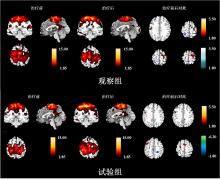
Fig.1
Comparison of different brain networks between the two groups"
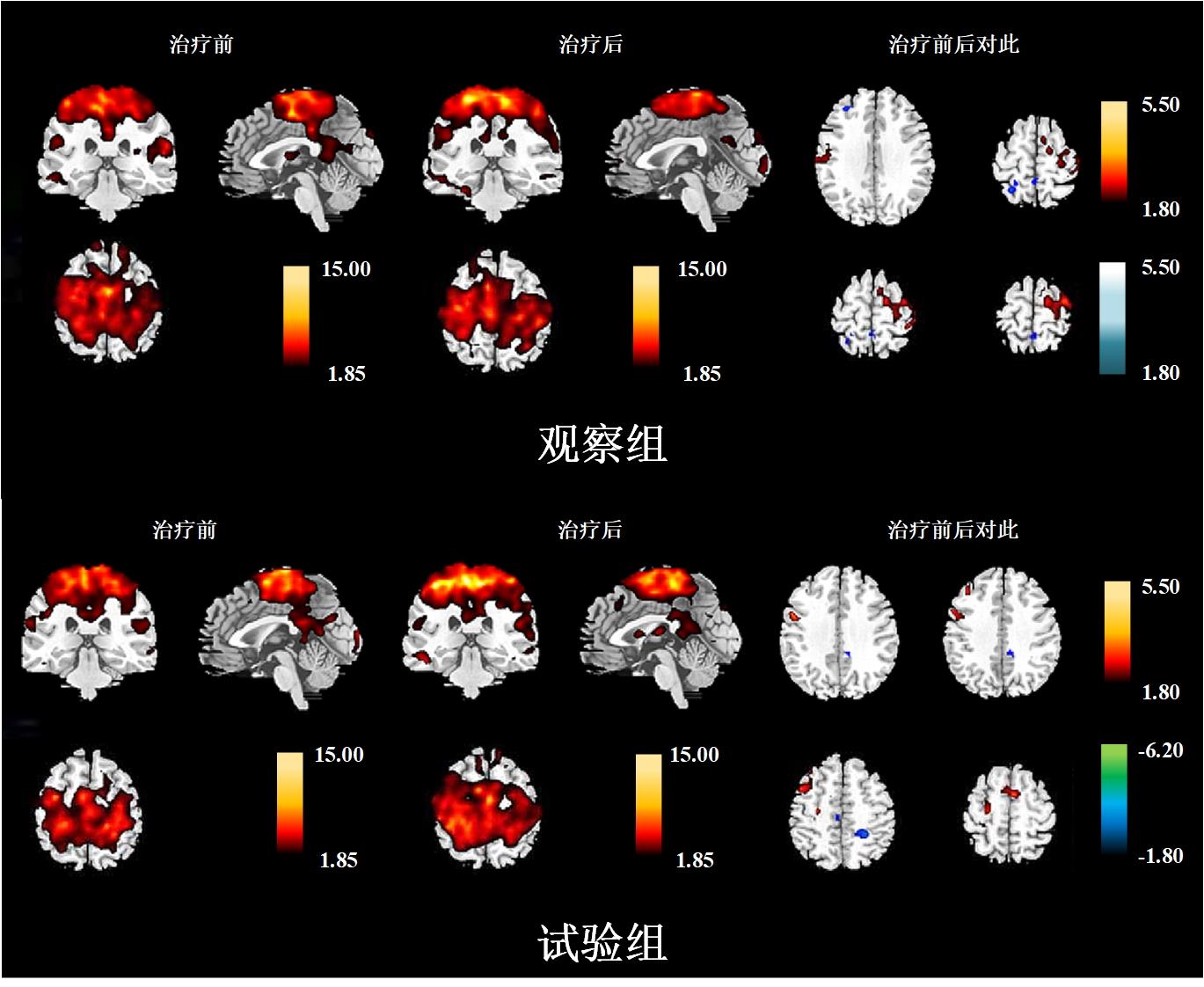
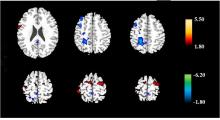
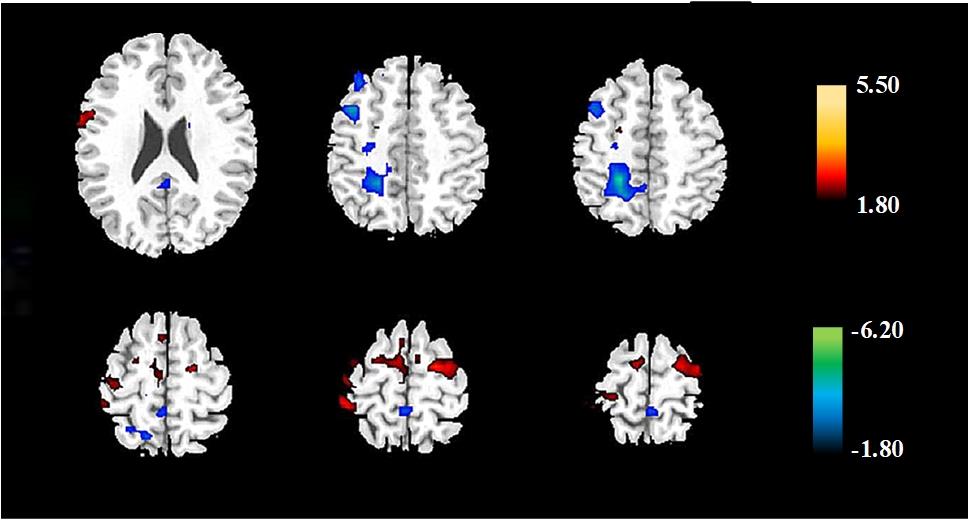
Fig.2
Comparison of changes in brain network differences between the observation group and the experimental group before and after treatment"
Tab.6
Results of brain network differences between the experimental group and the observation group"
| 脑区 | MNI/mm | 大小/mm3 | ||
|---|---|---|---|---|
| x | y | z | ||
| 中央前回(观察组>对照组) | ||||
| 右侧中央前回 | -34 | -8 | 71 | 561 |
| 辅助运动区(观察组>对照组) | ||||
| 右侧辅助运动区 | -7 | -2 | 59 | 458 |
| 额中回(观察组<对照组) | ||||
| 右侧额中回 | -21 | -11 | 65 | 1105 |
| 中央后回脑网络(观察组>对照组) | ||||
| 右侧中央后回脑网络 | 11 | -4 | 68 | 348 |
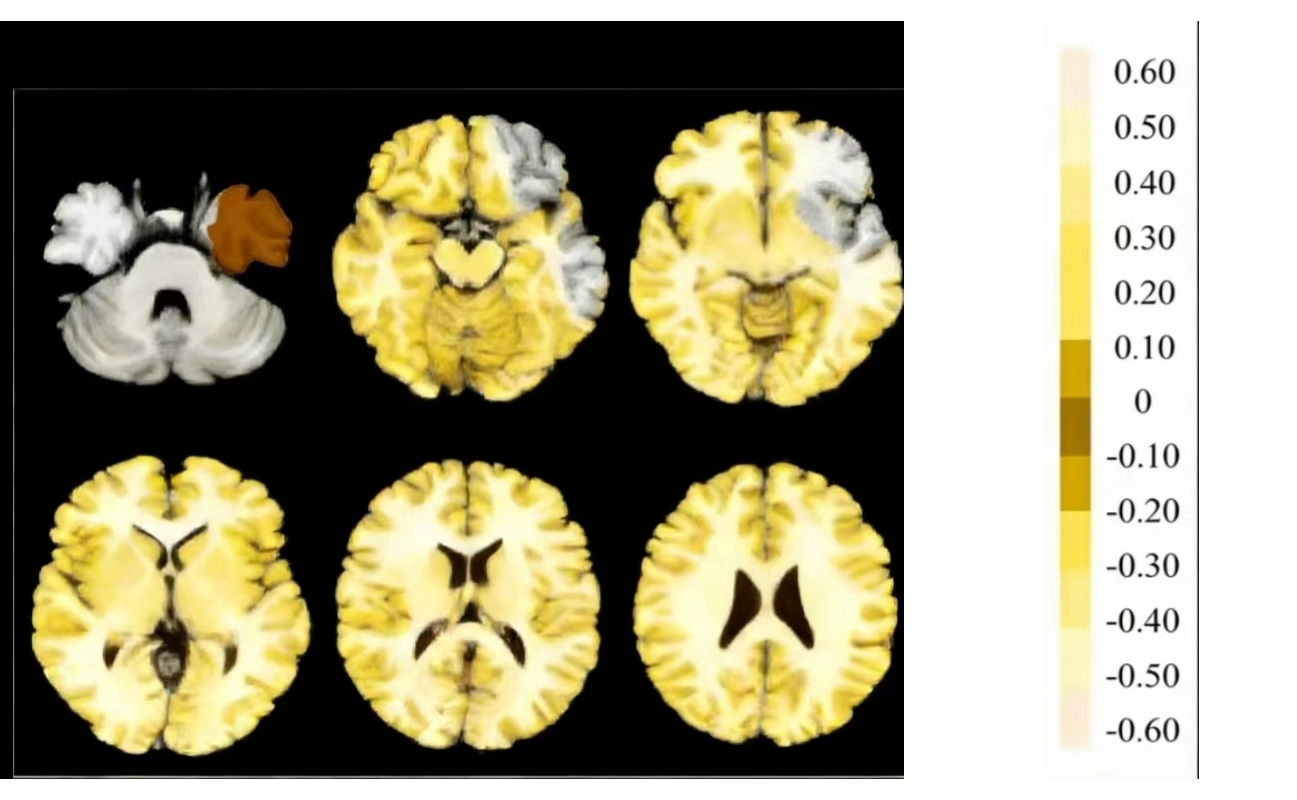
Fig.3
Functional connectivity analysis between ROI and whole-brain voxels in the two groups"
Tab.7
Correlation analysis between differential brain regions and clinical indicators in the two groups"
| 部位 | 统计值 | 对照组 | 观察组 | ||||
|---|---|---|---|---|---|---|---|
| MMSE | NIHSS | MBI指数 | MMSE | NIHSS | MBI指数 | ||
| 中央前回 | r值 | -0.135 | -0.358 | 0.314 | 0.153 | -0.223 | -0.247 |
| P(AlphaSim矫正) | 0.072 | 0.063 | 0.015 | 0.032 | 0.031 | -0.027 | |
| 辅助运动区 | r值 | -0.633 | -0.420 | 0.569 | 0.367 | -0.165 | -0.230 |
| P(AlphaSim矫正) | 0.058 | 0.085 | 0.091 | 0.040 | 0.023 | -0.019 | |
| 额中回 | r值 | 0.465 | 0.530 | -0.125 | -0.285 | 0.148 | 0.240 |
| P(AlphaSim矫正) | 0.067 | 0.056 | 0.081 | 0.027 | -0.030 | 0.030 | |
| 中央后回 | r值 | 0.527 | 0.263 | -0.154 | -0.264 | 0.240 | 0.404 |
| P(AlphaSim矫正) | 0.055 | 0.080 | 0.079 | 0.028 | -0.029 | 0.017 | |
| 侧颞下回 | r值 | 0.416 | 0.325 | -0.015 | -0.248 | 0.145 | 0.165 |
| P(AlphaSim矫正) | 0.064 | 0.081 | 0.027 | 0.001 | -0.035 | 0.046 | |
| 左侧顶下回 | r值 | 0.234 | 0.154 | -0.134 | -0.154 | 0.158 | -0.154 |
| P(AlphaSim矫正) | 0.075 | 0.084 | 0.067 | 0.002 | -0.046 | -0.002 | |
Tab.8
Covariance analysis between differential brain regions and clinical indicators in the two Groups"
| 脑区 | 临床量表 | 多元线性回归结果 | 回归模型评价 | ||||
|---|---|---|---|---|---|---|---|
| 标准化β值 | t值 | P值 | 校正后R2 值 | F值 | P值 | ||
| 中央前回 | MMSE | -0.265 | 2.38 | <0.001 | 0.254 | 2.64 | <0.001 |
| FMA | -0.359 | 2.72 | 0.005 | 0.309 | 3.34 | <0.001 | |
| NIHSS | -0.658 | 2.29 | 0.008 | 0.223 | 2.91 | 0.055 | |
| MBI指数 | 0.151 | 2.18 | 0.012 | 0.314 | 2.40 | 0.018 | |
| 辅助运动区 | MMSE | -0.236 | 2.64 | <0.001 | 0.215 | 2.45 | 0.026 |
| FMA | -0.315 | 2.69 | 0.035 | 0.248 | 2.83 | 0.017 | |
| NIHSS | -0.284 | 2.67 | 0.005 | 0.253 | 3.43 | 0.069 | |
| MBI指数 | 0.261 | 2.61 | 0.006 | 0.203 | 3.61 | <0.001 | |
| 额中回 | MMSE | -0.652 | 3.03 | 0.014 | 0.213 | 3.23 | 0.056 |
| FMA | 0.842 | 2.65 | 0.015 | 0.31 | 3.32 | <0.001 | |
| NIHSS | -0.615 | 2.93 | 0.006 | 0.34 | 2.80 | 0.021 | |
| MBI指数 | -0.363 | 2.40 | 0.006 | 0.244 | 3.61 | 0.017 | |
| 中央后回 | MMSE | 0.651 | 2.64 | 0.017 | 0.275 | 2.11 | 0.036 |
| FMA | 0.154 | 2.68 | <0.001 | 0.262 | 2.96 | 0.005 | |
| NIHSS | 0.265 | 2.49 | 0.002 | 0.239 | 2.81 | 0.043 | |
| MBI指数 | 0.512 | 3.12 | 0.009 | 0.340 | 2.06 | <0.001 | |
| 侧颞下回 | MMSE | 0.265 | 2.86 | 0.004 | 0.206 | 2.58 | 0.015 |
| FMA | 0.351 | 2.24 | 0.018 | 0.212 | 2.46 | 0.034 | |
| NIHSS | 0.228 | 2.64 | <0.001 | 0.341 | 2.72 | 0.026 | |
| MBI指数 | 0.324 | 3.03 | 0.006 | 0.275 | 2.06 | 0.034 | |
| 左侧顶下回 | MMSE | 0.315 | 2.23 | 0.011 | 0.365 | 2.18 | 0.007 |
| FMA | 0.258 | 2.63 | 0.007 | 0.35 | 3.43 | 0.006 | |
| NIHSS | 0.326 | 2.21 | 0.041 | 0.228 | 3.30 | 0.002 | |
| MBI指数 | 0.374 | 2.69 | 0.032 | 0.339 | 3.12 | <0.001 | |
| [1] |
刘绍辉,吴曦,魏思源,等. 不同严重程度的急性缺血性脑卒中患者急性胃肠损伤事件分级与短期预后的关系[J]. 实用医学杂志,2024,40(23):3323-3330. doi:10.3969/j.issn.1006-5725.2024.23.007 .
doi: 10.3969/j.issn.1006-5725.2024.23.007 |
| [2] |
王涛, 吴子建, 李佩芳, 等. 基于Trx1/TXNIP通路探讨通督调神针法改善缺血再灌注大鼠海马凋亡机制研究[J]. 辽宁中医杂志, 2024, 51(1):188-191,227. doi:10.13192/j.issn.1000-1719.2024.01.048 .
doi: 10.13192/j.issn.1000-1719.2024.01.048 |
| [3] |
周一舫, 尤海珍, 余平波, 等. “通督调神”针法联合可乐定透皮贴剂治疗儿童抽动障碍随机对照临床研究[J]. 中国中西医结合杂志, 2023, 43(1):39-44. doi:10.7661/j.cjim.20220705.055 .
doi: 10.7661/j.cjim.20220705.055 |
| [4] |
罗翠蜜,陈子蓉,黄东莹,等.钠离子通道阻滞剂药物治疗颞叶癫痫相关的脑功能复杂网络的变化[J].实用医学杂志,2025,41(2):250-257. doi:10.7661/j.cjim.20220705.055 .
doi: 10.7661/j.cjim.20220705.055 |
| [5] |
童婷婷,王颖,李奎武 等.“通督调神”电针预处理对脑缺血再灌注损伤大鼠脑皮质PPARγ介导的细胞焦亡的影响[J].中国针灸,2023,43(7):783-792. doi: 10.13703/j.0255-2930.20221010-k0004 .
doi: 10.13703/j.0255-2930.20221010-k0004 |
| [6] |
江六顺,汪瑛,陈少飞,等.通督调神针法联合补阳还五汤治疗卒中偏瘫的临床疗效观察[J].中华中医药学刊,2023,41(5):206-208. doi:10.13193/j.issn.1673-7717.2023.05.042 .
doi: 10.13193/j.issn.1673-7717.2023.05.042 |
| [7] |
《中国脑卒中防治报告2021》概要[J]. 中国脑血管病杂志, 2023, 20(11):783-793. doi:10.3969/j.issn.1672-5921.2023.11.009 .
doi: 10.3969/j.issn.1672-5921.2023.11.009 |
| [8] |
LINEBACK C M, STAMM B, SOROND F, et al. Carotid disease, cognition, and aging: Time to redefine asymptomatic disease [J] Geroscience,2023,45(2):719-725. doi: 10.1007/s11357-022-00688-z .
doi: 10.1007/s11357-022-00688-z |
| [9] |
张利达,韩为,高志波,等.“通督调神”法针刺联合颈动脉内膜剥脱术治疗颈动脉狭窄:随机对照研究[J].中国针灸,2022,42(2):121-125. doi:10.13703/j.0255-2930.20210202-k0007 .
doi: 10.13703/j.0255-2930.20210202-k0007 |
| [10] |
张君宇,茅伟,代飞,等.通督调神法针刺联合Bobath康复训练治疗卒中后上肢痉挛:随机对照试验[J].中国针灸,2024,44(1):43-47. doi:10.13703/j.0255-2930.20230711-k0002 .
doi: 10.13703/j.0255-2930.20230711-k0002 |
| [11] |
李静,周冰原,程乐,等.芒针透刺联合通督调神法针刺治疗卒中后疲劳:随机对照试验[J].中国针灸,2024,44(10):1114-1118,1124. doi:10.13703/j.0255-2930.20231114-k0008 .
doi: 10.13703/j.0255-2930.20231114-k0008 |
| [12] |
李成龙,茅伟,张利达,等.“通督调神”法针刺治疗主观性耳鸣:随机对照试验[J].中国针灸,2024,44(6):648-652. doi:10.13703/j.0255-2930.20230808-k0001 .
doi: 10.13703/j.0255-2930.20230808-k0001 |
| [13] |
张琼帅,张钰,汲广成,等.头穴丛刺联合运动疗法治疗中风后肢体痉挛疗效观察[J].中国针灸,2022,42(4):377-380. doi:10.13703/j.0255-2930.20210506-k0001 .
doi: 10.13703/j.0255-2930.20210506-k0001 |
| [14] |
GARCIA J C, ALTOE L S, AMARAL R F M DO,et al. Double-Blinded Randomized Study of the Correlation between Simple Radiography and Magnetic Resonance Imaging in the Evaluation of the Critical Shoulder Angle: Reproducibility and Learning Curve[J]. Rev Bras Ortop (Sao Paulo),2021,56(1):78-82. doi: 10.1055/s-0040-1701288 .
doi: 10.1055/s-0040-1701288 |
| [15] |
BAR-OR A, THANEI G A, HARP C, et al.Blood neurofilament light levels predict non-relapsing progression following anti-CD20 therapy in relapsing and primary progressive multiple sclerosis: Findings from the ocrelizumab randomised, double-blind phase 3 clinical trials[J]. EBioMedicine,2023,93:104662. doi: 10.1016/j.ebiom.2023.104662 .
doi: 10.1016/j.ebiom.2023.104662 |
| [16] |
KAMOGAWA N, MIWA K, TOYODA K, et al. Evaluation of Unknown Onset Stroke Thrombolysis Trials (EOS) Investigators. Thrombolysis for Wake-Up Stroke Versus Non-Wake-Up Unwitnessed Stroke: EOS Individual Patient Data Meta-Analysis[J]. Stroke,2024,55(4):895-904. doi: 10.1161/STROKEAHA.123.043358 .
doi: 10.1161/STROKEAHA.123.043358 |
| [17] |
SHIMODAIRA H, TENSHO K, KOYAMA S, et al. Effect of a new remnant-preserving technique with anatomical double-bundle anterior cruciate ligament reconstruction on MRI-based graft maturity: A comparison cohort study[J]. Knee Surg Sports Traumatol Arthrosc,2023,31(6):2394-2405. doi: 10.1007/s00167-022-07180-3 .
doi: 10.1007/s00167-022-07180-3 |
| [18] |
NEWMAN A B, PATEL S, KIZER J R, et al.Evaluation of Associations of Growth Differentiation Factor-11, Growth Differentiation Factor-8, and Their Binding Proteins Follistatin and Follistatin-Like Protein-3 With Dementia and Cognition[J]. J Gerontol A Biol Sci Med Sci,2023,78(11):2039-2047. doi: 10.1093/gerona/glad019 .
doi: 10.1093/gerona/glad019 |
| [19] |
REGENHARDT R W, NOLAN N M, ROSENTHAL J A,et al.Understanding Delays in MRI-based Selection of Large Vessel Occlusion Stroke Patients for Endovascular Thrombectomy[J]. Clin Neuroradiol,2022,32(4):979-986. doi: 10.1007/s00062-022-01165-y .
doi: 10.1007/s00062-022-01165-y |
| [20] |
BIJVANK J A NIJ, HOF S N, PROUSKAS S E, et al.A novel eye-movement impairment in multiple sclerosis indicating widespread cortical damage[J]. Brain,2023,146(6):2476-2488. doi: 10.1093/brain/awac474 .
doi: 10.1093/brain/awac474 |
| [21] |
SHARMA M, SMITH E E, PEARCE L A,et al.NAVIGATE ESUS MRI Substudy Investigators. Rivaroxaban versus aspirin for prevention of covert brain infarcts in patients with embolic stroke of undetermined source: NAVIGATE ESUS MRI substudy[J]. Int J Stroke,2022,17(7):799-805. doi: 10.1177/17474930211058012 .
doi: 10.1177/17474930211058012 |
| [22] |
刘霞, 浦芳, 刘辉, 等. 通督调神针法联合艾司唑仑片对缺血性脑卒中后失眠患者脑血流、多导睡眠图指标以及神经递质的影响[J]. 现代生物医学进展, 2024, 24(16): 3134-3137.doi:10.13241/j.cnki.pmb.2024.16.026 .
doi: 10.13241/j.cnki.pmb.2024.16.026 |
| [23] |
王慧凯, 王晓颖, 李文路, 等. “通督调神”针刺对脑卒中后抑郁大鼠海马神经元保护作用及单胺类神经递质的影响[J]. 针刺研究, 2025, 40(5): 489-494.doi:10.13703/j.0255-2930.2019.07.017 .
doi: 10.13703/j.0255-2930.2019.07.017 |
| [24] |
张立志, 许能贵. 通督调神针刺法治疗缺血性中风的研究进展[J]. 上海针灸杂志, 2018, 37(9):1096-1099. doi:10.13460/j.issn.1005-0957.2018.09.1096 .
doi: 10.13460/j.issn.1005-0957.2018.09.1096 |
| [25] |
陈健, 刘静, 黄燕, 等. 通督调神针法对缺血性脑卒中患者血清BDNF、VEGF及神经功能的影响[J]. 实用医学杂志, 2024, 40(12): 1562-1566. doi:10.3969/j.issn.1006-5725.2024.12.018 .
doi: 10.3969/j.issn.1006-5725.2024.12.018 |
| [26] |
李佩芳, 刘辉, 孙培养, 等. 通督调神针刺法对缺血性卒中后轻度认知功能障碍患者血管内皮功能及炎症因子水平的影响[J]. 实用医学杂志, 2025, 41(5): 589-593. doi:10.3969/j.issn.1006-5725.2025.05.012 .
doi: 10.3969/j.issn.1006-5725.2025.05.012 |
| [27] |
孙雪琴,黄雷,刘尚. 通督调神针法治疗急性脑梗死疗效及对患者kruppel样转录因子2、内皮型一氧化氮合酶3的影响[J]. 陕西中医,2025,46(6):835-838,843. doi:10.3969/j.issn.1000-7369.2025.06.024 .
doi: 10.3969/j.issn.1000-7369.2025.06.024 |
| [28] |
CHENG N, CHENG X, TAN F L,et al.Electroacupuncture attenuates cerebral ischemia/reperfusion injury by regulating oxidative stress, neuronal death and neuroinflammation via stimulation of PPAR-γ[J]. Acupunct Med,2024,42(3):133-145. doi: 10.1177/09645284231211600 .
doi: 10.1177/09645284231211600 |
| [29] |
SHA R, ZHANG B, HAN X,et al.Electroacupuncture Alleviates Ischemic Brain Injury by Inhibiting the miR-223/NLRP3 Pathway[J]. Med Sci Monit,2019,25:4723-4733. doi: 10.12659/MSM.917213 .
doi: 10.12659/MSM.917213 |
| [1] | Xiang GAO,Beibei MA,Wanru BAO. The relationship between demoralization syndrome and death anxiety in stroke patients undergoing neuroendovascular procedures based on latent profile analysis [J]. The Journal of Practical Medicine, 2025, 41(22): 3609-3617. |
| [2] | Shaohui LIU,Xi WU,Siyuan WEI,Zhixin WU,Shaojuan HUANG,Yi SU,Yuanyi LI,Wending FAN,Qingyu. WU. The relationship between AGI event grading and short⁃term prognosis in patients with acute ischemic stroke of different severity levels [J]. The Journal of Practical Medicine, 2024, 40(23): 3323-3330. |
| [3] | Yan LI,Xianlong XIE,Mengli ZHU,Qing. SU. Clinical value of serum VILIP⁃1 and Hepc25 in predicting prognosis of patients with acute ischemic stroke after intravenous thrombolysis [J]. The Journal of Practical Medicine, 2024, 40(17): 2425-2429. |
| [4] | Yawei GU,Xu CHU,Lujing ZHAO,Bo HONG,Zhikuan LUO,Zhanzeng LIN,Jingzhen GAO,Yinhua DONG,Lijun WANG,Nian. CHEN. Thrombolysis with low⁃dose and standard⁃dose intravenous recombinant tissue plasminogen activator in elderly patients with acute ischemic stroke: a stratified analysis [J]. The Journal of Practical Medicine, 2024, 40(11): 1568-1573. |
| [5] |
SHI Heng, HOU Miaomiao, SUN Bo, LIU Xiaolei, LI Xinyi..
Application and research progress of Tirofiban in the treatment of acute ischemic stroke [J]. The Journal of Practical Medicine, 2022, 38(11): 1309-1313. |
| [6] |
SI Zheng, CHEN Dongxiao, WANG Jingye..
Value of Dickkopf⁃1 combined with ADP⁃induced platelet⁃fibrin clot strength in risk assessment of recur⁃ rence in patients with acute ischemic stroke [J]. The Journal of Practical Medicine, 2022, 38(11): 1319-1322. |
| [7] |
WANG Jiajing, KUANG Jie, TU Jianglong, PENG Chen, CHEN Jib⁃ iao, YIN Shujuan, ZHANG Xiaolin, YI Yingping. .
Relationship between precision medication of clopidogrel combined with aspirin and short⁃term prognosis in patients with acute ischemic stroke [J]. The Journal of Practical Medicine, 2021, 37(13): 1737-1741. |
| [8] |
CHEN Yingdao, LI Haining, ZHANG Qiping, LI Yuying, LIANG Bingsong, RAO Yuan, CHEN Xiaoling. .
Influence of collateral circulation on curative effect and prognosis of patients with acute cerebral infarction after mechanical thrombectomy [J]. The Journal of Practical Medicine, 2021, 37(12): 1563-1568. |
| Viewed | ||||||
|
Full text |
|
|||||
|
Abstract |
|
|||||
