

The Journal of Practical Medicine ›› 2025, Vol. 41 ›› Issue (22): 3572-3578.doi: 10.3969/j.issn.1006-5725.2025.22.015
• Clinical Research • Previous Articles
Jixin CHAI,Yong CHEN( ),Xue ZHANG,Yazhou AO,Bo. LI
Received:2025-09-05
Online:2025-11-25
Published:2025-11-26
Contact:
Yong CHEN
E-mail:chenyong0838@sina.com
CLC Number:
Jixin CHAI,Yong CHEN,Xue ZHANG,Yazhou AO,Bo. LI. Clinical application of combined clinical pathological features and genetic testing in predicting occult lymph node metastasis in patients with papillary thyroid microcarcinoma[J]. The Journal of Practical Medicine, 2025, 41(22): 3572-3578.
??Tab.1 Primer sequences for BRAFV600E and TERT promoter gene detection?"
| 目的基因 | 引物名称 | 引物序列(5′→3′) | 片段长度/bp | 退火温度/℃ |
|---|---|---|---|---|
| BRAF | BRAF-V600E-F | TCATAATGCTTGCTCTGATAGGA | 150 | 60 |
| BRAF-V600E-R | GGCCAAAAATTTAATCAGTGGA | 60 | ||
| TERT | TERT-C228T-F | GCCCTGACGTCTGGCTTC | 178 | 60 |
| TERT-C250T-R | GGCGGCCGGAAAGGGAT | 60 |
Tab.2
Comparison of baseline characteristics between the two groups"
| 项目 | OLNM阳性组(n = 53) | OLNM阴性组(n = 51) | χ2/t值 | P值 |
|---|---|---|---|---|
| 年龄/岁 | 44.32 ± 8.76 | 46.18 ± 9.24 | 1.054 | 0.295 |
| 性别/[例(%)] | 0.143 | 0.704 | ||
| 男 | 12(22.64) | 10(19.61) | ||
| 女 | 41(77.36) | 41(80.39) | ||
| 体质量指数/(kg/m2) | 23.87 ± 3.15 | 24.02 ± 2.97 | 0.249 | 0.803 |
| 合并结节性甲状腺肿/[例(%)] | 19(35.85) | 17(33.33) | 0.072 | 0.787 |
| 吸烟史/[例(%)]? | ?9(16.98) | 6(11.76) | 0.573 | 0.449 |
| 术前FT3/(pmol/L)? | 4.82 ± 0.67 | 4.91 ± 0.59 | 0.725 | 0.469 |
| 术前FT4/(pmol/L)? | 15.34 ± 2.16 | 15.87 ± 1.95 | 1.311 | 0.192 |
| 术前TSH/(μIU/mL) | 2.83 ± 1.24 | 2.05 ± 0.91 | 3.645 | < 0.001 |
Tab.3
Comparison of clinicopathological features, BRAFV600E mutation, and TERT promoter"
| 项目 | OLNM阳性组(n = 53) | OLNM阴性组(n = 51) | χ2 值 | P值 |
|---|---|---|---|---|
| 肿瘤最大径 | 4.776 | 0.028 | ||
| 0.5 ~ 1.0 cm | 39(73.58) | 27(52.94) | ||
| < 0.5 cm | 14(26.42) | 24(47.06) | ||
| 病灶数 | 5.877 | 0.015 | ||
| 单发 | 25(47.17) | 36(70.59) | ||
| 多发 | 28(52.83) | 15(29.41) | ||
| 微钙化 | 8.657 | 0.003 | ||
| 是 | 34(64.15) | 18(35.29) | ||
| 否 | 19(35.85) | 33(64.71) | ||
| 被膜侵犯 | 13.099 | < 0.001 | ||
| 是 | 31(58.49) | 12(23.53) | ||
| 否 | 22(41.51) | 39(76.47) | ||
| 侵及腺外 | 6.784 | 0.009 | ||
| 是 | 19(35.85) | 7(13.73) | ||
| 否 | 34(64.15) | 44(86.27) | ||
| T分期 | 5.829 | 0.015 | ||
| T1a | 35(66.04) | 44(86.27) | ||
| T3 | 18(33.96) | 7(13.73) | ||
| BRAFV600E突变 | 5.278 | 0.021 | ||
| 是 | 47(88.68) | 36(70.59) | ||
| 否 | 6(11.32) | 15(29.41) | ||
| TERT启动子突变 | 10.630 | 0.001 | ||
| 是 | 18(33.96) | 4(7.84) | ||
| 否 | 35(66.04) | 47(92.16) |
Tab.4
Multivariate logistic regression analysis of factors associated with OLNM in PTMC patients?"
| 项目 | 赋值 | β | S.E | Wald χ2 | P值 | OR | OR(95%CI) |
|---|---|---|---|---|---|---|---|
| 术前TSH | 连续变量 | 0.427 | 0.152 | 7.892 | 0.005 | 1.533 | 1.137 ~ 2.066 |
| 肿瘤最大径 | 1 = 0.5 ~ 1.0 cm,0 =?< 0.5 cm | 1.012 | 0.412 | 6.036 | 0.014 | 2.752 | 1.227 ~ 6.172 |
| 病灶数 | 1=多发,0 =单发 | 0.836 | 0.398 | 4.412 | 0.036 | 2.307 | 1.056 ~ 5.041 |
| 微钙化 | 1 =是,0 =否 | 0.725 | 0.385 | 3.552 | 0.059 | 2.064 | 0.972 ~ 4.384 |
| 被膜侵犯 | 1 =是,0 =否 | 1.352 | 0.431 | 9.837 | 0.002 | 3.867 | 1.662 ~ 9.001 |
| 侵及腺外 | 1 =是,0 =否 | 1.098 | 0.462 | 5.649 | 0.017 | 3.001 | 1.213 ~ 7.421 |
| T分期 | 1 = T3,0 =T1a | 1.504 | 0.512 | 8.631 | 0.003 | 4.502 | 1.651 ~ 6.269 |
| BRAFV600E突变 | 1 =是,0 =否 | 0.875 | 0.542 | 2.610 | < 0.001 | 2.399 | 1.830 ~ 6.938 |
| TERT启动子突变 | 1 =是,0 =否 | 1.792 | 0.602 | 8.861 | 0.003 | 6.015 | 1.842 ~ 8.545 |
Tab.5
Predictive value of combined clinicopathological features and genetic testing for OLNM in PTMC patients?"
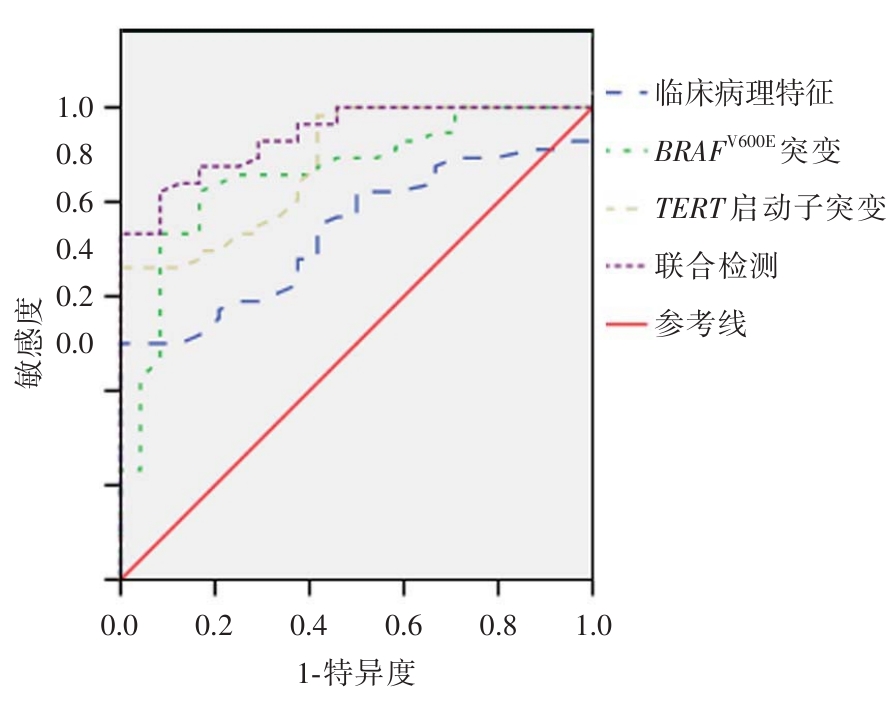
| 变量 | AUC | 95%CI | 灵敏度/% | 特异度/% | P值 |
|---|---|---|---|---|---|
| 临床病理特征模型 | 0.736 | 0.629 ~ 0.843 | 72.53 | 65.84 | < 0.001 |
| BRAFV600E突变 | 0.860 | 0.771 ~ 0.949 | 85.64 | 75.46 | < 0.001 |
| TERT启动子突变 | 0.882 | 0.808 ~ 0.956 | 90.25 | 80.64 | < 0.001 |
| 联合检测 | 0.940 | 0.892 ~ 0.987 | 95.10 | 90.21 | < 0.001 |
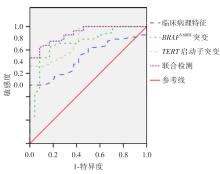
Fig.1
Receiver operating characteristic (ROC) curve analysis of the combined model of clinicopathological features and genetic testing for predicting OLNM in PTMC patients?"
| [1] |
MIYAUCHI A, ITO Y, FUJISHIMA M, et al. Long-term outcomes of active surveillance and immediate surgery for adult patients with low-risk papillary thyroid microcarcinoma: 30-year experience[J]. Thyroid, 2023, 33(7): 817-825. doi:10.1089/thy.2023.0076
doi: 10.1089/thy.2023.0076 |
| [2] |
CHEN Z, ZHANG W, HE W, et al. Ultrasound-guided thermal ablation for papillary thyroid microcarcinoma: A systematic review[J]. Clin Endocrinol (Oxf), 2023, 98(3): 296-305. doi:10.1111/cen.14857
doi: 10.1111/cen.14857 |
| [3] |
WANG J, FU W, LUO J, et al. Development of a clinical-molecular prediction model for central lymph node metastasis in cN0 stage papillary thyroid microcarcinoma: A retrospective study[J]. BMC Cancer, 2025, 25(1): 693. doi:10.1186/s12885-025-14112-0
doi: 10.1186/s12885-025-14112-0 |
| [4] | 刘津, 王小平, 瞿琳娣, 等. 热消融技术治疗甲状腺微小乳头状癌的研究进展[J]. 西安交通大学学报(医学版), 2024, 45(6): 1041-1046. |
| [5] | 许魁, 周军. 超声微泡在甲状腺癌诊疗中的研究进展[J]. 实用医学杂志, 2025, 41(3): 454-458. |
| [6] |
ZHANG J, YI W, WU R, et al. Predictive nomogram for occult metastasis in central lymph nodes of papillary thyroid microcarcinoma based on clinical and ultrasound features[J]. Gland Surg, 2025, 14(7): 1295-1305. doi:10.21037/gs-2025-159
doi: 10.21037/gs-2025-159 |
| [7] |
HUANG X, HUANG X, WANG K, et al. Predictors of occult lymph node metastasis in clinical T1 lung adenocarcinoma: A retrospective dual-center study[J]. BMC Pulm Med, 2025, 25(1): 99. doi:10.1186/s12890-025-03559-3
doi: 10.1186/s12890-025-03559-3 |
| [8] |
REN J, YUAN Y, TAO X, et al. Histogram analysis of diffusion-weighted imaging and dynamic contrast-enhanced MRI for predicting occult lymph node metastasis in early-stage oral tongue squamous cell carcinoma[J]. Eur Radiol, 2022, 32(4): 2739-2747. doi:10.1007/s00330-021-08310-0
doi: 10.1007/s00330-021-08310-0 |
| [9] | 张洁, 冯艳红, 何秀丽, 等. 常规超声特征及BRAFV600E基因突变与甲状腺乳头状癌中央区淋巴结转移的相关性[J]. 临床耳鼻咽喉头颈外科杂志, 2022, 36(3): 184-188. |
| [10] |
SAKO A, MATSUSE M, SAENKO V, et al. TERT promoter mutations increase tumor aggressiveness by altering TERT mRNA splicing in papillary thyroid carcinoma[J]. J Clin Endocrinol Metab, 2024, 109(10): e1827-e1838. doi:10.1210/clinem/dgae220
doi: 10.1210/clinem/dgae220 |
| [11] | 赵雯, 董珍林, 单海燕, 等. 双能CT碘图预测甲状腺乳头状癌颈部中央区隐匿性淋巴结转移的价值[J]. 中国医学影像学杂志, 2023, 31(10): 1007-1010, 1023. |
| [12] |
KUMAR R, MANCHANDA S, HOTA A, et al. Ultrasound characteristics of metastatic occult cervical lymph nodes in early tongue cancer[J]. Indian J Otolaryngol Head Neck Surg, 2023, 75(4): 2786-2791. doi:10.1007/s12070-023-03881-4
doi: 10.1007/s12070-023-03881-4 |
| [13] |
XUE B, WANG X, et al. Predictive value of PET metabolic parameters for occult lymph node metastases in PET/CT defined node-negative patients with advanced epithelial ovarian cancer[J]. Sci Rep, 2023, 13(1): 9439. doi:10.1038/s41598-023-36640-0
doi: 10.1038/s41598-023-36640-0 |
| [14] |
HU R, REN Q, LI T, et al. Evidence-based integration of clinicopathological factors with the risk of papillary thyroid carcinoma lateral cervical lymph node metastasis: Systematic review and meta-analysis and subgroup study[J]. Gland Surg, 2025, 14(5): 912-928. doi:10.21037/gs-2025-60
doi: 10.21037/gs-2025-60 |
| [15] |
ZENG S, HU H, LI Z, et al. Local TSH/TSHR signaling promotes CD8+ T cell exhaustion and immune evasion in colorectal carcinoma[J]. Cancer Commun (Lond), 2024, 44(11): 1287-1310. doi:10.1002/cac2.12605
doi: 10.1002/cac2.12605 |
| [16] |
WU Z, XI Z, XIAO Y, et al. TSH-TSHR axis promotes tumor immune evasion[J]. J Immunother Cancer, 2022, 10(1): e004049. doi:10.1136/jitc-2021-004049
doi: 10.1136/jitc-2021-004049 |
| [17] | 董萌, 洪晨忱, 聂昕玥, 等. cN0期甲状腺乳头状癌右喉返神经深层淋巴结转移的影响因素及预测模型构建[J]. 中国普通外科杂志, 2023, 32(5): 673-681. |
| [18] |
CHANG J, SARASWATHIBHATLA A, SONG Z, et al. Cell volume expansion and local contractility drive collective invasion of the basement membrane in breast cancer[J]. Nat Mater, 2024, 23(5): 711-722. doi:10.1038/s41563-023-01716-9
doi: 10.1038/s41563-023-01716-9 |
| [19] | 徐泽林, 郑振浩, 邓雅倩, 等. 弹性相对指数联合S-Detect对甲状腺乳头状癌颈部淋巴结转移的预测价值[J]. 实用医学杂志, 2025, 41(16): 2581-2589. |
| [20] | 贺星云, 刘晨, 杜俊泽, 等. 基于增强静脉期CT放射组学的甲状腺乳头状癌中央区淋巴结转移预测模型构建与验证[J]. 陆军军医大学学报, 2025, 47(12): 1367-1375. |
| [21] | 张继方, 陈芳, 唐佳雯, 等. 肿瘤出芽及肿瘤浸润淋巴细胞对食管鳞状细胞癌淋巴结转移的预测价值研究[J]. 中国全科医学, 2023, 26(32): 4038-4042. |
| [22] |
张浩轩, 陆进, 蒋成义, 等. 基于人工智能技术的鼻咽癌风险预测模型的构建与评价[J]. 南方医科大学学报, 2023, 43(2): 271-279. doi:10.12122/j.issn.1673-4254.2023.02.16
doi: 10.12122/j.issn.1673-4254.2023.02.16 |
| [23] |
GADAL S, BOYER J A, ROY S F, et al. Tumorigenesis driven by BRAFV600E requires secondary mutations that overcome its feedback inhibition of RAC1 and migration[J]. Cancer Res, 2025, 85(9): 1611-1627. doi:10.1158/0008-5472.can-24-2220
doi: 10.1158/0008-5472.can-24-2220 |
| [24] |
LI S, XUE J, JIANG K, et al. TERT promoter methylation is associated with high expression of TERT and poor prognosis in papillary thyroid cancer[J]. Front Oncol, 2024, 14: 1325345. doi:10.3389/fonc.2024.1325345
doi: 10.3389/fonc.2024.1325345 |
| [25] |
PARVATHAREDDY S K, SIRAJ A K, IQBAL K, et al. TERT promoter mutations are an independent predictor of distant metastasis in Middle Eastern papillary thyroid microcarcinoma[J]. Front Endocrinol (Lausanne), 2022, 13: 808298. doi:10.3389/fendo.2022.808298
doi: 10.3389/fendo.2022.808298 |
| [26] |
TRAVAGLINO A, RAFFONE A, SANTORO A, et al. Clinicopathological features associated with microsatellite instability/mismatch repair deficiency in uterine carcinosarcoma: A quantitative systematic review[J]. Pathobiology, 2022, 89(4): 198-204. doi:10.1159/000521876
doi: 10.1159/000521876 |
| [27] |
TANG L, ZHU Y, DU Y, et al. Clinicopathologic features and genomic profiling of female axillary lymph node metastases from adenocarcinoma or poorly differentiated carcinoma of unknown primary[J]. J Cancer Res Clin Oncol, 2024, 150(5): 256. doi:10.1007/s00432-024-05783-6
doi: 10.1007/s00432-024-05783-6 |
| [28] |
MA D, ZHANG Y, SHAO X, et al. PET/CT for predicting occult lymph node metastasis in gastric cancer[J]. Curr Oncol, 2022, 29(9): 6523-6539. doi:10.3390/curroncol29090513
doi: 10.3390/curroncol29090513 |
| [29] |
SEOL H Y, KIM Y S, KIM S J, et al. Predictive value of 18F-fluorodeoxyglucose positron emission tomography or positron emission tomography/computed tomography for assessment of occult lymph node metastasis in non-small cell lung cancer[J]. Oncology, 2021, 99(2): 96-104. doi:10.1159/000509988
doi: 10.1159/000509988 |
| Viewed | ||||||
|
Full text |
|
|||||
|
Abstract |
|
|||||
