

The Journal of Practical Medicine ›› 2026, Vol. 42 ›› Issue (18): 3408-3416.doi: 10.3969/j.issn.1006-5725.2026.18.020
• Treatise:Mechanism and Practice • Previous Articles
Huiling Huang1, Lianhuan Yang2( ), Cailian Xu2, Rongbin Chen2, Haibing Qin2, Yong Li2, Lin Liao2
Received:2026-05-26
Revised:2026-08-17
Accepted:2026-08-20
Online:2026-09-25
Published:2026-10-19
Contact:
Lianhuan Yang
About author:Huang Huiling carried out data analysis and wrote the article. Yang Lianhuan carried out project design. Xu Cailian and Chen Rongbin performed the experiments. Qin Haibing participated in the collection of data. Li Yong and Liao Lin revised the article. All authors read and approved the final manuscript as submitted.
CLC Number:
Huiling Huang, Lianhuan Yang, Cailian Xu, Rongbin Chen, Haibing Qin, Yong Li, Lin Liao. Effects of wrist-ankle needle combined with multimodal analgesia on pain after posterior lumbar interbody fusion: A prospective randomized controlled trial[J]. The Journal of Practical Medicine, 2026, 42(18): 3408-3416.
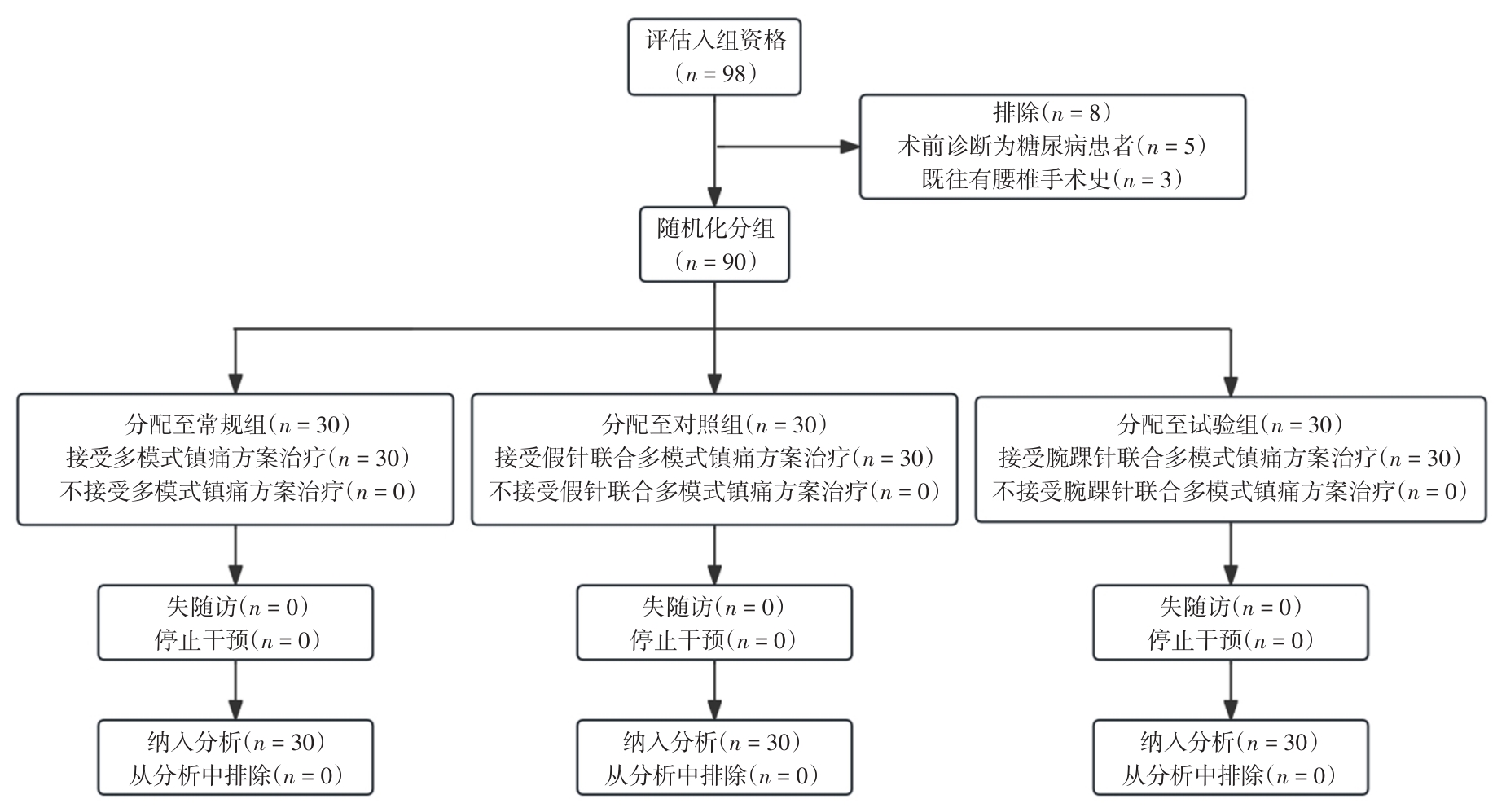
Fig.1
Flow chart of this study"
Tab.1
Comparison of baseline data among three groups"
| 项目 | 常规组(n = 30) | 对照组(n = 30) | 试验组(n = 30) | χ2 /F值 | P值 |
|---|---|---|---|---|---|
| 性别/[例(%)] | 1.158 | 0.646 | |||
| 男 | 15(50.00) | 12(40.00) | 16(53.33) | ||
| 女 | 15(50.00) | 18(60.00) | 14(46.67) | ||
| 年龄/岁 | 63.93 ± 11.35 | 63.37 ± 11.10 | 62.77 ± 10.51 | 0.085 | 0.919 |
| BMI/(kg/m2) | 24.95 ± 3.51 | 24.62 ± 3.50 | 24.17 ± 2.82 | 0.425 | 0.655 |
| 手术节段/[例(%)] | 7.323 | 0.459 | |||
| T12/L1 | 1(3.33) | 0(0.00) | 0(0.00) | ||
| L2/L3 | 0(0.00) | 1(3.33) | 0(0.00) | ||
| L3/L4 | 2(6.67) | 2(6.67) | 4(13.33) | ||
| L4/L5 | 25(83.33) | 24(80.00) | 20(66.67) | ||
| L5/S1 | 2(6.67) | 3(10.00) | 6(20.00) | ||
| 手术时长/min | 157.70 ± 42.98 | 141.53 ± 36.45 | 134.13 ± 42.73 | 2.614 | 0.079 |
| 术中出血量/mL | 195.00 ± 115.48 | 173.33 ± 138.80 | 179.33 ± 121.43 | 0.238 | 0.789 |
| 切口长度/cm | 6.60 ± 1.30 | 6.50 ± 2.00 | 6.60 ± 1.87 | 0.029 | 0.972 |
Tab.2
Repeated measures ANOVA for pain index among three groups"
| 项目 | 时间效应 | 组间效应 | 交互效应 | |||||
|---|---|---|---|---|---|---|---|---|
| F值 | P值 | F值 | P值 | F值 | P值 | |||
| 切口疼痛VAS评分 | 182.205 | < 0.001 | 6.349 | 0.003 | 1.444 | 0.179 | ||
| 下肢反跳痛VAS评分 | 45.840 | < 0.001 | 3.696 | 0.030 | 1.337 | 0.232 | ||
Tab.3
Comparison of VAS scores of incision among three groups"
| 组别 | 例数 | 切口VAS评分 | |||||
|---|---|---|---|---|---|---|---|
| 术后12 h | 术后24 h | 术后48 h | 术后72 h | 术后7 d | 术后1个月随访时 | ||
| 常规组 | 30 | 4.63 ± 0.72 | 4.43 ± 1.10 | 4.33 ± 0.99 | 4.10 ± 1.09 | 3.20 ± 0.61 | 2.30 ± 0.75 |
| 对照组 | 30 | 4.27 ± 1.01 | 4.30 ± 0.79 | 4.27 ± 0.64 | 4.00 ± 0.64 | 3.07 ± 0.78 | 2.07 ± 0.69 |
| 试验组 | 30 | 4.37 ± 0.81 | 4.17 ± 0.46 | 3.73 ± 0.74*# | 3.41 ± 0.73*# | 2.60 ± 0.62*# | 1.87 ± 0.68 |
| F值 | 1.470 | 0.896 | 5.005 | 6.044 | 6.498 | 2.814 | |
| P值 | 0.236 | 0.415 | 0.009 | 0.003 | 0.002 | 0.065 | |
Tab.4
Simple effect analysis of VAS scores of incisionamong three groups"
| 时间 | 均值差 | 标准误 | P值 | 差值95%CI | |
|---|---|---|---|---|---|
| 下限 | 上限 | ||||
| T0(G1-G0) | -0.367 | 0.221 | 0.303 | -0.906 | 0.173 |
| T0(G2-G0) | -0.267 | 0.221 | 0.693 | -0.806 | 0.273 |
| T0(G2-G1) | 0.100 | 0.221 | 1.000 | -0.440 | 0.640 |
| T1(G1-G0) | -0.133 | 0.214 | 1.000 | -0.656 | 0.389 |
| T1(G2-G0) | -0.267 | 0.214 | 0.649 | -0.789 | 0.256 |
| T1(G2-G1) | -0.133 | 0.214 | 1.000 | -0.656 | 0.389 |
| T2(G1-G0) | -0.067 | 0.208 | 1.000 | -0.574 | 0.441 |
| T2(G2-G0) | -0.600 | 0.208 | 0.015* | -1.107 | -0.093 |
| T2(G2-G1) | -0.533 | 0.208 | 0.036* | -1.041 | -0.026 |
| T3(G1-G0) | -0.133 | 0.216 | 1.000 | -0.662 | 0.395 |
| T3(G2-G0) | -0.700 | 0.218 | 0.006* | -1.232 | -0.168 |
| T3(G2-G1) | -0.600 | 0.218 | 0.021* | -1.132 | -0.068 |
| T4(G1-G0) | -0.133 | 0.175 | 1.000 | -0.560 | 0.293 |
| T4(G2-G0) | -0.600 | 0.175 | 0.003* | -1.027 | -0.173 |
| T4(G2-G1) | -0.467 | 0.175 | 0.027* | -0.893 | -0.040 |
| T5(G1-G0) | -0.233 | 0.183 | 0.616 | -0.680 | 0.213 |
| T5(G2-G0) | -0.433 | 0.183 | 0.060 | -0.880 | 0.013 |
| T5(G2-G1) | -0.200 | 0.183 | 0.831 | -0.646 | 0.246 |
Tab.5
Comparison of VAS scores of lower limb rebounding pain among three groups"
| 组别 | 例数 | 下肢反跳痛/例 | 下肢反跳痛VAS评分 | ||||||
|---|---|---|---|---|---|---|---|---|---|
| 是 | 否 | 术后24 h | 拔引流管当天 | 拔引流管48 h | 术后7 d | 术后1个月随访时 | |||
| 常规组 | 30 | 15 | 15 | 4.73 ± 1.53 | 6.13 ± 1.68 | 5.47 ± 1.68 | 4.27 ± 1.49 | 1.73 ± 0.59 | |
| 对照组 | 30 | 12 | 18 | 4.08 ± 2.02 | 6.08 ± 1.16 | 5.58 ± 1.38 | 4.42 ± 0.90 | 1.92 ± 0.67 | |
| 试验组 | 30 | 5 | 25 | 3.80 ± 0.45 | 4.60 ± 1.34 | 3.20 ± 0.84*# | 3.00 ± 1.00 | 1.40 ± 0.55 | |
| F/χ2 值 | 7.662 | 2.149 | 2.481 | 11.522 | 3.656 | 1.302 | |||
| P值 | 0.021 | 0.144 | 0.127 | 0.001 | 0.058 | 0.308 | |||
Tab.6
Simple effect analysis of VAS scores of lower limb rebounding pain among three groups"
| 时间 | 均值差 | 标准误 | P值 | 差值95%CI | |
|---|---|---|---|---|---|
| 下限 | 上限 | ||||
| T0(G1-G0) | -0.650 | 0.638 | 0.950 | -2.271 | 0.971 |
| T0(G2-G0) | -0.933 | 0.850 | 0.884 | -3.094 | 1.228 |
| T0(G2-G1) | -0.283 | 0.877 | 1.000 | -2.511 | 1.944 |
| T1(G1-G0) | -0.050 | 0.566 | 1.000 | -1.487 | 1.387 |
| T1(G2-G0) | -1.533 | 0.754 | 0.154 | -3.450 | 0.383 |
| T1(G2-G1) | -1.483 | 0.777 | 0.199 | -3.459 | 0.492 |
| T2(G1-G0) | 0.050 | 0.452 | 1.000 | -1.098 | 1.198 |
| T2(G2-G0) | -2.267 | 0.764 | 0.018* | -4.208 | -0.326 |
| T2(G2-G1) | -2.383 | 0.787 | 0.015* | -4.384 | -0.383 |
| T3(G1-G0) | 0.150 | 0.476 | 1.000 | -1.060 | 1.260 |
| T3(G2-G0) | -1.267 | 0.635 | 0.167 | -2.880 | 0.347 |
| T3(G2-G1) | -1.417 | 0.655 | 0.116 | -3.080 | 0.246 |
| T4(G1-G0) | 0.183 | 0.239 | 0.986 | -0.424 | 0.791 |
| T4(G2-G0) | -0.333 | 0.319 | 0.913 | -1.143 | 0.477 |
| T4(G2-G1) | -0.517 | 0.329 | 0.380 | -1.352 | 0.318 |
Tab.7
Comparison of laboratory indexes among three groups"
| 指标 | 常规组(n = 30) | 对照组(n = 30) | 试验组(n = 30) | F值 | P值 |
|---|---|---|---|---|---|
| 白细胞计数/(×109·L-1) | |||||
| 术后24 h | 13.47 ± 4.16 | 12.70 ± 3.73 | 14.76 ± 4.11 | 2.019 | 0.139 |
| 术后72 h | 10.09 ± 2.86 | 10.17 ± 2.78 | 11.82 ± 3.62 | 2.937 | 0.058 |
| 术后7 d | 10.14 ± 3.42 | 9.35 ± 3.16 | 9.85 ± 2.62 | 0.508 | 0.603 |
| 中性粒细胞百分比/% | |||||
| 术后24 h | 77.93 ± 21.27 | 79.07 ± 15.00 | 83.83 ± 9.63 | 1.144 | 0.323 |
| 术后72 h | 74.30 ± 8.20 | 74.63 ± 8.43 | 75.90 ± 7.82 | 0.321 | 0.726 |
| 术后7 d | 71.82 ± 9.75 | 69.09 ± 8.51 | 66.03 ± 7.63* | 3.339 | 0.040 |
| C-反应蛋白/(mg/L) | |||||
| 术后24 h | 26.31 ± 18.44 | 28.69 ± 22.36 | 26.50 ± 18.15 | 0.134 | 0.874 |
| 术后72 h | 50.46 ± 37.55 | 60.41 ± 44.18 | 55.37 ± 39.66 | 0.451 | 0.638 |
| 术后7 d | 39.43 ± 42.21 | 35.23 ± 36.27 | 36.30 ± 30.24 | 0.109 | 0.897 |
Tab.8
Comparison of analgesic drugs intervention times and JOA scores among three groups"
| 项目 | 常规组(n = 30) | 对照组(n = 30) | 试验组(n = 30) | χ2/F值 | P值 |
|---|---|---|---|---|---|
| 术后止痛药物干预次数/[例(%)] | 11.535 | 0.073 | |||
| 0次 | 13(43.33) | 16(53.33) | 19(63.33) | ||
| 1次 | 6(20.00) | 4(13.33) | 6(20.00) | ||
| 2次 | 5(16.67) | 4(13.33) | 5(16.67) | ||
| ≥ 3次 | 6(20.00) | 6(20.00) | 0(0.00) | ||
| JOA评分/分 | |||||
| v术前 | 12.17 ± 1.39 | 12.87 ± 2.08 | 12.53 ± 1.52 | 1.284 | 0.282 |
| 术后7 d | 14.63 ± 1.30 | 14.80 ± 1.29 | 15.70 ± 1.24*# | 6.170 | 0.004 |
| 术后1个月随访时 | 19.87 ± 1.85 | 19.67 ± 1.90 | 20.23 ± 1.33 | 0.844 | 0.434 |
Tab.9
Comparison of maternal satisfaction and hospitalization outcomes among three groups"
| 项目 | 常规组(n = 30) | 对照组(n = 30) | 试验组(n = 30) | F值 | P值 |
|---|---|---|---|---|---|
| 患者满意度评分/分 | 84.83 ± 5.66 | 86.20 ± 7.01 | 90.30 ± 5.55*# | 6.505 | 0.002 |
| 住院时间/d | 16.00 ± 5.48 | 14.70 ± 5.32 | 14.60 ± 4.32 | 0.713 | 0.493 |
| [1] |
|
| [2] |
|
| [3] |
|
| [4] |
|
| [5] |
|
| [6] |
|
| [7] |
|
| [8] |
李成龙, 万仑, 黄丽莎, 等. 鞘内吗啡联合布比卡因脂质体收肌管阻滞对全膝关节置换术患者术后镇痛及阿片类药物节约效应的影响[J]. 实用医学杂志, 2025, 41(19): 3083-3088. doi:10.3969/j.issn.1006-5725.2025.19.019 .
|
| [9] |
|
| [10] |
魏真, 高心宇, 胡娟. 腕踝针治疗慢性疼痛临床应用进展[J]. 福建中医药, 2023, 54(12): 69-72. doi:10.13260/j.cnki.jfjtcm. 2023.12020 .
|
| [11] |
中国康复医学会骨质疏松预防与康复专业委员会, 中国老年保健协会骨科微创分会. 退行性腰椎管狭窄症诊疗专家共识[J]. 中华骨与关节外科杂志, 2023, 16(2): 97-103. doi:10.3969/j.issn.2095-9958.2023.02.01 .
|
| [12] |
凌昌全, 周庆辉, 顾伟. 腕踝针[M]. 上海: 上海科学技术出版社, 2017: 51-57.
|
| [13] |
朱源, 毛安, 徐红, 等. 腕踝针结合体针治疗急性腰扭伤临床研究[J]. 针灸临床杂志, 2021, 37(2): 24-28. doi:10.19917/j.cnki.1005-0779.021029 .
|
| [14] |
|
| [15] |
|
| [16] |
|
| [17] |
|
| [18] |
|
| [19] |
|
| [20] |
|
| [21] |
|
| [22] |
江娇, 江嘉轶, 吴冰心, 等. 腰方肌神经阻滞联合羟考酮对腹腔镜经腹直肠癌根治术患者围术期应激反应及血清P物质、前列腺素E2的影响[J]. 实用医学杂志, 2026, 42(14): 2570-2576. doi:10.3969/j.issn.1006-5725.2026.14.010 .
|
| [23] |
窦群立, 杨萍, 董博, 等. 腕踝针结合针刺夹脊穴对腰椎间盘突出症患者痛阈、血浆5-HT的影响[J]. 现代中医药, 2020, 40(6): 46-49. doi:10.13424/j.cnki.mtcm.2020.06.011 .
|
| [24] |
鲁美静, 张恺辰, 赵金霞, 等. 腕踝针联合静脉自控镇痛对髋关节置换术后疼痛程度、炎性疼痛介质及应激激素表达的影响研究[J]. 中华中医药学刊, 2021, 39(10): 104-107. doi:10.13193/j.issn.1673-7717.2021.10.024 .
|
| [25] |
|
| [26] |
杨阳, 吕瑶. 艾灸联合腕踝针治疗腰椎间盘突出症急性期的临床研究[J]. 针灸临床杂志, 2024, 40(10): 55-61. doi:10.19917/j.cnki.1005-0779.024195 .
|
| Viewed | ||||||
|
Full text |
|
|||||
|
Abstract |
|
|||||
