

The Journal of Practical Medicine ›› 2026, Vol. 42 ›› Issue (3): 517-524.doi: 10.3969/j.issn.1006-5725.2026.03.021
• Treatise: Clinical Practice • Previous Articles
Tianxiao DU1,2,Caifen LI2,Yu ZHANG2,Luming DAI2,Qiuxiang JIANG2,Hanqing QU2,Yang LU2,Zheng GONG2( )
)
Received:2025-08-07
Online:2026-02-10
Published:2026-02-09
Contact:
Zheng GONG
E-mail:GZqyydoctor@163.com
CLC Number:
Tianxiao DU,Caifen LI,Yu ZHANG,Luming DAI,Qiuxiang JIANG,Hanqing QU,Yang LU,Zheng GONG. Effect of superficial cervical plexus block with ropivacaine or combined with adjuvants on patients undergoing radical thyroid cancer surgery[J]. The Journal of Practical Medicine, 2026, 42(3): 517-524.
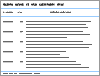
Tab.1
Comparison of the general information in the four groups of patients"
| 项目 | C组(n = 34) | R组(n = 31) | R1组(n = 34) | R2组(n = 33) | H/F/χ2值 | P值 |
|---|---|---|---|---|---|---|
| 性别/[例(%)] | 6.840 | 0.077 | ||||
| 男 | 4(11.76) | 5(16.13) | 7(20.59) | 12(36.36) | ||
| 女 | 30(88.24) | 26(83.87) | 27(79.41) | 21(63.64) | ||
| 年龄/岁 | 44.38 ± 12.01 | 43.16 ± 10.06 | 44.65 ± 13.09 | 43.58 ± 11.36 | 0.113 | 0.952 |
| ASA分级/[例(%)] | 0.490 | 0.920 | ||||
| Ⅰ级 | 27(79.41) | 23(74.19) | 25(73.53) | 24(72.73) | ||
| Ⅱ级 | 7(20.59) | 8(25.81) | 9(26.47) | 9(27.27) | ||
| BMI/(kg/m2) | 22.80 ± 2.95 | 22.89 ± 3.22 | 23.53 ± 3.68 | 23.84 ± 3.31 | 0.752 | 0.523 |
| 手术时间[M(P25,P75)]/min | 103(69,148) | 95(80,130) | 100(79,116) | 110(85,153) | 1.645 | 0.649 |
| 麻醉时间[M(P25,P75)]/min | 130.00 (100.00,180.00) | 125.00 (100.00,150.00) | 130.00 (110.00,161.25) | 135.00 (110.00,185.00) | 1.151 | 0.680 |
| 出血量[M(P25,P75)]/mL | 10(9,12) | 10(5,10) | 10(10,15) | 10(10,10) | 1.296 | 0.730 |
Tab.2
Comparison of intraoperative heart rate and blood pressure changes in the four groups of patients"
| 项目 | C组(n = 34) | R组(n = 31) | R1组(n = 34) | R2组(n = 33) |
|---|---|---|---|---|
| ΔHR/(次/min) | ||||
| ΔHR1 | -11.68 ± 5.00 | -6.52 ± 3.70a | -7.94 ± 3.80a | -7.52 ± 3.46a |
| ΔHR2 | -12.59 ± 6.47 | -5.94 ± 3.55a | -7.68 ± 3.46a | -7.58 ± 3.23a |
| ΔHR3 | 10.12 ± 4.57 | 7.74 ± 4.45a | 4.85 ± 2.57ab | 6.03 ± 3.03a |
| ΔMAP/mmHg | ||||
| ΔMAP1 | -12.38 ± 6.30 | -7.32 ± 4.85a | -6.35 ± 4.14a | -6.94 ± 3.98a |
| ΔMAP2 | 8.38 ± 4.98 | 5.29 ± 3.56a | 5.41 ± 3.68a | 4.61 ± 3.53a |
| ΔMAP3 | 7.47 ± 3.76 | 5.61 ± 3.99a | 4.24 ± 2.28a | 5.67 ± 3.39a |
Tab.3
Comparison of the dosage of sedative and analgesic drugs during anesthesia in the four groups of patients"
| 项目 | C组(n = 34) | R组(n = 31) | R1组(n = 34) | R2组(n = 33) |
|---|---|---|---|---|
| 丙泊酚/(10 mg/mL) | 48.00(34.00,58.00) | 41.00(35.00,45.00) | 39.00(33.00,50.00) | 40.00(33.50,50.00) |
| 瑞芬太尼/μg | 1 440.00(1 175.00,2 000.00) | 1 100.00(820.00,1 700.00)a | 1 100.00(820.00,1 300.00)a | 1 140.00(900.00,1 700.00)a |
| 舒芬太尼/μg | 30.00(25.00,30.00) | 20.00(20.00,20.00)a | 20.00(20.00,25.00)a | 20.00(20.00,25.00)a |
| 七氟烷/mL | 14.40(10.80,25.20) | 7.20(3.60,10.80)a | 7.20(3.60,10.80)a | 7.20(5.40,14.40)a |
Tab.4
Comparison of VAS scores at rest in four groups of patients"
| 时间 | C组(n = 34) | R组(n = 31) | R1组(n = 34) | R2组(n = 33) |
|---|---|---|---|---|
| 术后苏醒时 | 1(1,2) | 0(0,0)a | 0(0,0)a | 0(0,0)a |
| 术后6 h | 2(1,3) | 0(0,0)a | 0(0,0)a | 0(0,0)a |
| 术后12 h | 2(1,3) | 1(1,2)a | 0(0,1)ab | 0(0,1)ab |
| 术后24 h | 1(0,2) | 1(0,1) | 1(0,1)a | 1(0,1)a |
| 术后48 h | 1(0,1) | 1(0,1) | 1(0,1) | 1(0,1) |
Tab.5
Comparison of VAS scores during activity in four groups of patients"
| 时间 | C组(n = 34) | R组(n = 31) | R1组(n = 34) | R2组(n = 33) |
|---|---|---|---|---|
| 术后苏醒时 | 2(1,2) | 0(0,0)a | 0(0,0)a | 0(0,0)a |
| 术后6 h | 3(2,4) | 1(1,2)a | 0(0,1)ab | 0(0,1)ab |
| 术后12 h | 2(2,3) | 1(1,3)a | 1(0,1)ab | 1(0,1)ab |
| 术后24 h | 2(2,3) | 2(1,3) | 1(1,1)ab | 1(0,2)ab |
| 术后48 h | 1(1,2) | 1(1,2) | 1(1,2) | 1(1,1) |
Tab.6
Comparison of remedial analgesia within 24 hours and satisfaction in the four groups of patients"
| 组别 | 术后24 h内补救镇痛/[例(%)] | Likert量表满意度评分[M(P25,P75)]/分 |
|---|---|---|
| C组(n = 34) | 23(67.65) | 4(3,4) |
| R组(n = 31) | 10(32.26)a | 4(4,5)a |
| R1组(n = 34) | 2(5.88)ab | 5(5,5)ab |
| R2组(n = 33) | 2(6.06)ab | 5(5,5)ab |
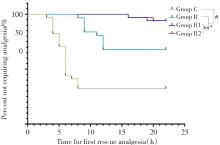
Fig.1
Comparison of first rescue analgesia time in the four groups of patients"
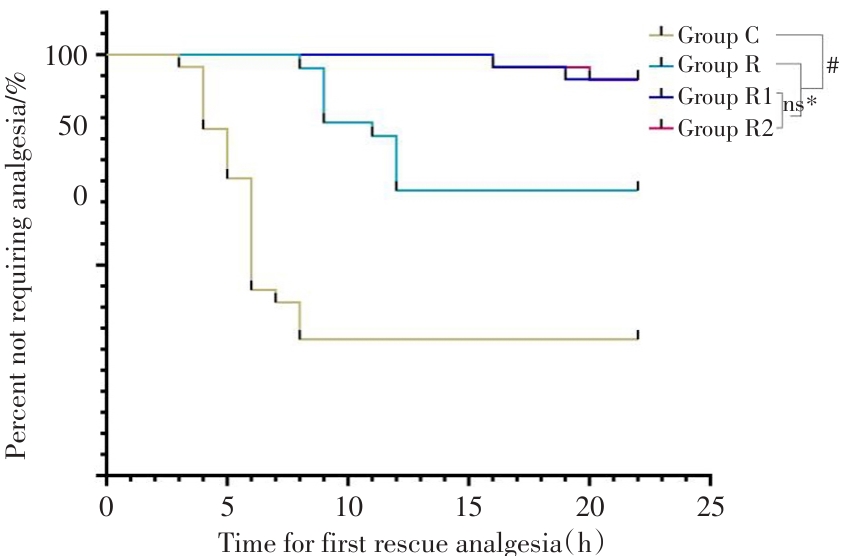
Tab.7
Comparison of recovery time, extubation time, time out of the resuscitation room, Ramsay sedation score after extubation and length of hospital stay in the four groups of patients"
| 组别 | C组(n = 34) | R组(n = 31) | R1组(n = 34) | R2组(n = 33) |
|---|---|---|---|---|
| 苏醒时间/min | 24.03 ± 9.65 | 14.81 ± 4.94a | 16.76 ± 7.29a | 14.15 ± 6.49a |
| 拔管时间/min | 31.59 ± 8.19 | 23.42 ± 8.02a | 22.18 ± 7.00a | 22.76 ± 6.99a |
| 出复苏室时间/min | 71.41 ± 18.03 | 59.29 ± 10.78a | 50.35 ± 8.10ab | 50.00 ± 13.81ab |
| 拔管后Ramsay镇静评分[M(P25,P75)]/分 | 2.00(1.00,2.00) | 2.00(2.00,2.00)a | 2.00(2.00,3.00)abc | 2.00(2.00,2.00)a |
| 住院时长/d | 7.56 ± 1.65 | 7.52 ± 2.32 | 7.18 ± 1.48 | 7.15 ± 2.28 |
Tab.8
Comparison of QoR-15 score in the four groups of patients"
| 时间 | C组(n = 34) | R组(n = 31) | R1组(n = 34) | R2组(n = 33) |
|---|---|---|---|---|
| 术前 | 149.00(145.00,150.00) | 149.00(137.00,150.00) | 149.00(147.00,149.25) | 145.00(141.50,148.00) |
| 术后第1天 | 111.00(105.00,114.00) | 119.00(107.00,131.00)a | 124.50(119.75,131.00)ab | 129.00(121.00,134.00)ab |
| 术后第2天 | 130.50(125.00,137.50) | 144.00(139.00,148.00)a | 142.00(142.00,145.00)a | 142.70(139.50,147.50)a |
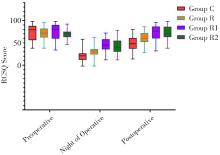
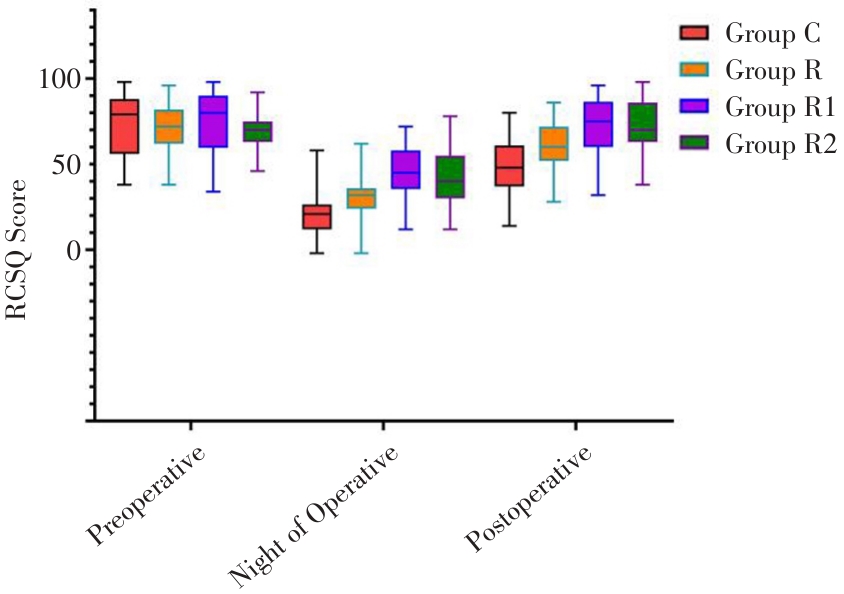
Fig.2
Comparison of RCSQ score in the four groups of patients"
Tab.9
Comparison of postoperative adverse reactions"
| 项目 | C组 (n = 34) | R组 (n = 31) | R1组(n = 34) | R2组(n = 33) |
|---|---|---|---|---|
| 声音嘶哑 | 2(5.88) | 1(3.23) | 0(0) | 0(0) |
| 饮水呛咳 | 1(2.94) | 1(3.23) | 1(2.94) | 0(0) |
| 呼吸困难 | 0(0) | 0(0) | 0(0) | 0(0) |
| 恶心呕吐 | 16(47.06) | 5(16.13)a | 4(14.76)a | 1(3.03)a |
| 高血压 | 1(2.94) | 0(0) | 0(0) | 0(0) |
| 低血压 | 6(17.65) | 1(3.23) | 1(2.94) | 0(0.0) |
| 头晕 | 19(55.88) | 7(22.58)a | 5(14.71)a | 3(9.09)a |
| [1] |
许魁, 周军. 超声微泡在甲状腺癌诊疗中的研究进展[J]. 实用医学杂志, 2025, 41(3): 454-458. doi: 10.3969/j.issn.1006-5725.2025.03.023 .
doi: 10.3969/j.issn.1006-5725.2025.03.023 |
| [2] |
XING J, WU R, LIANG L, et al. Comparison of the Analgesic Effects of Intravenous Infusion of Dexmedetomidine Versus Bilateral Superficial Cervical Plexus Block After Thyroidectomy: A Randomized Controlled Trial[J]. Clin J Pain, 2021, 37(8): 623-628. doi: 10.1097/AJP.0000000000000954 .
doi: 10.1097/AJP.0000000000000954 |
| [3] |
刘琰, 窦青芳, 陈丽丽, 等. 全凭静脉麻醉复合超声引导颈浅丛神经阻滞在甲状腺癌根治术中的应用[J].中国现代普通外科进展, 2022, 25(9): 741-743, 750. doi: 10.3969/j.issn.1009-9905.2022.09.017 .
doi: 10.3969/j.issn.1009-9905.2022.09.017 |
| [4] |
MORITA S, OIZUMI N, SUENAGA N, et al. Dexamethasone added to levobupivacaine prolongs the duration of interscalene brachial plexus block and decreases rebound pain after arthroscopic rotator cuff repair[J]. J Shoulder Elbow Surg, 2020, 29(9): 1751-1757. doi: 10.1016/j.jse.2020.04.019 .
doi: 10.1016/j.jse.2020.04.019 |
| [5] |
HUANG J, LIU J C. Ultrasound-guided erector spinae plane block for postoperative analgesia: A meta-analysis of randomized controlled trials[J]. BMC Anesthesiol, 2020, 20(1): 83. doi: 10.1186/s12871-020-00999-8 .
doi: 10.1186/s12871-020-00999-8 |
| [6] |
MARHOFER D, KETTNER S C, MARHOFER P, et al. Dexmedetomidine as an adjuvant to ropivacaine prolongs peripheral nerve block: A volunteer study[J]. Br J Anaesth, 2013, 110(3): 438-442. doi: 10.1093/bja/aes400 .
doi: 10.1093/bja/aes400 |
| [7] |
孙跃峰, 邓志杰, 叶陆恒, 等. 右美托咪定混合罗哌卡因用于肋缘下腹横肌平面阻滞对接受上腹部手术患者术后睡眠质量的影响[J]. 实用医学杂志, 2025, 41(7): 1030-1035. doi: 10.3969/j.issn.1006-5725.2025.07.015 .
doi: 10.3969/j.issn.1006-5725.2025.07.015 |
| [8] |
RINGEL M D, SOSA J A, BALOCH Z, et al. 2025 American Thyroid Association Management Guidelines for Adult Patients with Differentiated Thyroid Cancer[J]. Thyroid, 2025, 35(8): 841-985. doi: 10.1177/10507256251363120 .
doi: 10.1177/10507256251363120 |
| [9] |
朱倩, 邵刘佳子, 郝小芳, 等. 1倍ED95和2倍ED95罗库溴铵配合全凭静脉麻醉对甲状腺手术喉返神经功能监测的比较分析[J]. 临床和实验医学杂志, 2019, 18(20): 2233-2237. doi: 10.3969/j.issn.1671-4695.2019.20.032 .
doi: 10.3969/j.issn.1671-4695.2019.20.032 |
| [10] |
KANG X, LI C, LU L, et al. Effect of superficial cervical plexus nerve block with Ropivacaine or a combination of different adjuvants on perioperative analgesia and quality of postoperative recovery in patients undergoing radical thyroid cancer surgery under general anesthesia: A prospective randomized controlled trial[J]. World J Surg Oncol, 2025, 23(1): 74. doi: 10.1186/s12957-025-03721-5 .
doi: 10.1186/s12957-025-03721-5 |
| [11] |
GOULART T F, DE ARAUJO-FILHO V J F, CERNEA C R, et al. Superficial cervical plexus blockade improves pain control after thyroidectomy: A randomized controlled trial[J]. Clinics (Sao Paulo), 2019, 74: e605. doi: 10.6061/clinics/2019/e605 .
doi: 10.6061/clinics/2019/e605 |
| [12] |
WOO J H, LEE H J, OH H W, et al. Perineural dexamethasone reduces rebound pain after ropivacaine single injection interscalene block for arthroscopic shoulder surgery: A randomized controlled trial[J]. Reg Anesth Pain Med, 2021, 46(11): 965-970. doi: 10.1136/rapm-2021-102795 .
doi: 10.1136/rapm-2021-102795 |
| [13] |
MAYHEW D, SAHGAL N, KHIRWADKAR R, et al. Analgesic efficacy of bilateral superficial cervical plexus block for thyroid surgery: Meta-analysis and systematic review[J]. Br J Anaesth, 2018, 120(2): 241-251. doi: 10.1016/j.bja.2017.11.083 .
doi: 10.1016/j.bja.2017.11.083 |
| [14] |
DESAI R, COLLETT D, WATSON C J E, et al. Estimated risk of cancer transmission from organ donor to graft recipient in a national transplantation registry[J]. Br J Surg, 2014, 101(7): 768-774. doi: 10.1002/bjs.9460 .
doi: 10.1002/bjs.9460 |
| [15] |
周委, 张桂云. 地塞米松联合罗哌卡因用于胸腔镜肺叶切除术患者胸椎旁神经阻滞麻醉中的效果[J]. 中外医疗, 2025, 44(7): 56-60. doi: 10.16662/j.cnki.1674-0742.2025.07.056 .
doi: 10.16662/j.cnki.1674-0742.2025.07.056 |
| [16] |
LIU W, GUO J, ZHENG J, et al. Low-dose dexmedetomidine as a perineural adjuvant for postoperative analgesia: A randomized controlled trial[J]. BMC Anesthesiol, 2022, 22(1): 249. doi: 10.1186/s12871-022-01791-6 .
doi: 10.1186/s12871-022-01791-6 |
| [17] |
WANG Y, XU W, XIA W, et al. Comparison of the Sedative and Analgesic Effects of Dexmedetomidine-Remifentanil and Dexmedetomidine–Sufentanil for Liposuction: A Prospective Single-Blind Randomized Controlled Study[J]. Aesthetic Plast Surg, 2022, 46(1): 524-534. doi: 10.1007/s00266-021-02566-z .
doi: 10.1007/s00266-021-02566-z |
| [18] |
RASHMI H, KOMALA H. Effect of dexmedetomidine as an adjuvant to 0.75% ropivacaine in interscalene brachial plexus block using nerve stimulator: A prospective, randomized double-blind study[J]. Anesth Essays Res, 2017, 11(1): 134. doi: 10.4103/0259-1162.181431 .
doi: 10.4103/0259-1162.181431 |
| [19] |
BAO N, SHI K, WU Y, et al. Dexmedetomidine prolongs the duration of local anesthetics when used as an adjuvant through both perineural and systemic mechanisms: A prospective randomized double-blinded trial[J]. BMC Anesthesiol, 2022, 22(1): 176. doi: 10.1186/s12871-022-01716-3 .
doi: 10.1186/s12871-022-01716-3 |
| [20] |
黄柳青, 陆柳玉, 覃晓彤, 等. 右美托咪定联合罗哌卡因四点神经阻滞应用于腹腔镜肝肿瘤手术患者的效果研究[J]. 中国临床新医学, 2024, 17(4): 371-377. doi: 10.3969/j.issn.1674-3806.2024.04.04 .
doi: 10.3969/j.issn.1674-3806.2024.04.04 |
| [21] |
GUPTA A, GUPTA A, YADAV N. Effect of dexamethasone as an adjuvant to ropivacaine on duration and quality of analgesia in ultrasound-guided transversus abdominis plane block in patients undergoing lower segment cesarean section - A prospective, randomised, single-blinded study[J]. Indian J Anaesth, 2019, 63(6): 469. doi: 10.4103/ija.IJA_773_18 .
doi: 10.4103/ija.IJA_773_18 |
| [22] |
赵薇, 邓硕曾. 地塞米松辅助周围神经阻滞的镇痛作用与机制[J]. 中华疼痛学杂志, 2023, 19(1): 33-35. doi: 10.3760/cma.j.cn101658-20220930-00180 .
doi: 10.3760/cma.j.cn101658-20220930-00180 |
| [23] |
ZHANG G, WANG B, LI H. Esketamine combined with ultrasound-guided superficial cervical plexus block to complete pediatric subglottic stenosis tracheotomy-a case report and literature review[J]. BMC Anesthesiol, 2025, 25(1): 101. doi: 10.1186/s12871-025-02973-8 .
doi: 10.1186/s12871-025-02973-8 |
| [24] |
ANDERSEN J H, JAEGER P, GREVSTAD U, et al. Systemic dexmedetomidine is not as efficient as perineural dexmedetomidine in prolonging an ulnar nerve block[J]. Reg Anesth Pain Med, 2019, 44(3): 333-340. doi: 10.1136/rapm-2018-100089 .
doi: 10.1136/rapm-2018-100089 |
| [25] |
HAO J, WU Z, LUO Z, et al. Addition of dexmedetomidine to ropivacaine for local infiltration anaesthesia improves analgesic efficacy after tonsillectomy and adenoidectomy: A randomized controlled trial[J]. Int J Pediatr Otorhinolaryngol, 2020, 137: 110168. doi: 10.1016/j.ijporl.2020.110168 .
doi: 10.1016/j.ijporl.2020.110168 |
| Viewed | ||||||
|
Full text |
|
|||||
|
Abstract |
|
|||||
