实用医学杂志 ›› 2026, Vol. 42 ›› Issue (3): 395-405.doi: 10.3969/j.issn.1006-5725.2026.03.006

• 慢性病防治专栏 • 上一篇    

深度学习构建舌象分类系统在银屑病中医证型识别中的应用

蔡淑娴1,朱东宁2,徐皓玮1,黄嘉淇1,李逍宇1,李卓豪2,刘秀峰2,闫玉红3()   

  1. 1.广州中医药大学第二临床医学院 (广东 广州 510405 )
    2.广州中医药大学医学信息工程学院 (广东 广州 510006 )
    3.广东省中医院皮肤科 (广东 广州 510120 )
  • 收稿日期:2025-10-15 出版日期:2026-02-10 发布日期:2026-02-09
  • 通讯作者: 闫玉红 E-mail:15920395608@139.com
  • 基金资助:
    省部共建中医湿证国家重点实验室重点项目(SZ2021ZZ37);广州市科学技术局市校企联合资助项目(2024A03J0727);广东省中医院慢病管理专项课题(YN2024MB007);广州中医药大学“筑峰造尖”行动计划(GZY2025GB0417);第七批全国老中医药专家学术经验继承工作项目(国中医药人教函〔2022〕76号)

Application of a deep learning-based tongue image classification system in TCM syndrome identification of psoriasis

Sokhan CHOI1,Dongning ZHU2,Haowei XU1,Jiaqi HUANG1,Xiaoyu LI1,Zhuohao LI2,Xiufeng LIU2,Yuhong YAN3()   

  1. 1.The Second Clinical Medical College,Guangzhou University of Chinese Medicine,Guangzhou 510405,Guangdong,China
    2.School of Medical Information Engineering,Guangzhou University of Chinese Medicine,Guangzhou 510006,Guangdong,China
    3.Department of Dermatology,Guangdong Provincial Hospital of Traditional Chinese Medicine,Guangzhou 510120,Guangdong,China
  • Received:2025-10-15 Online:2026-02-10 Published:2026-02-09
  • Contact: Yuhong YAN E-mail:15920395608@139.com

摘要:

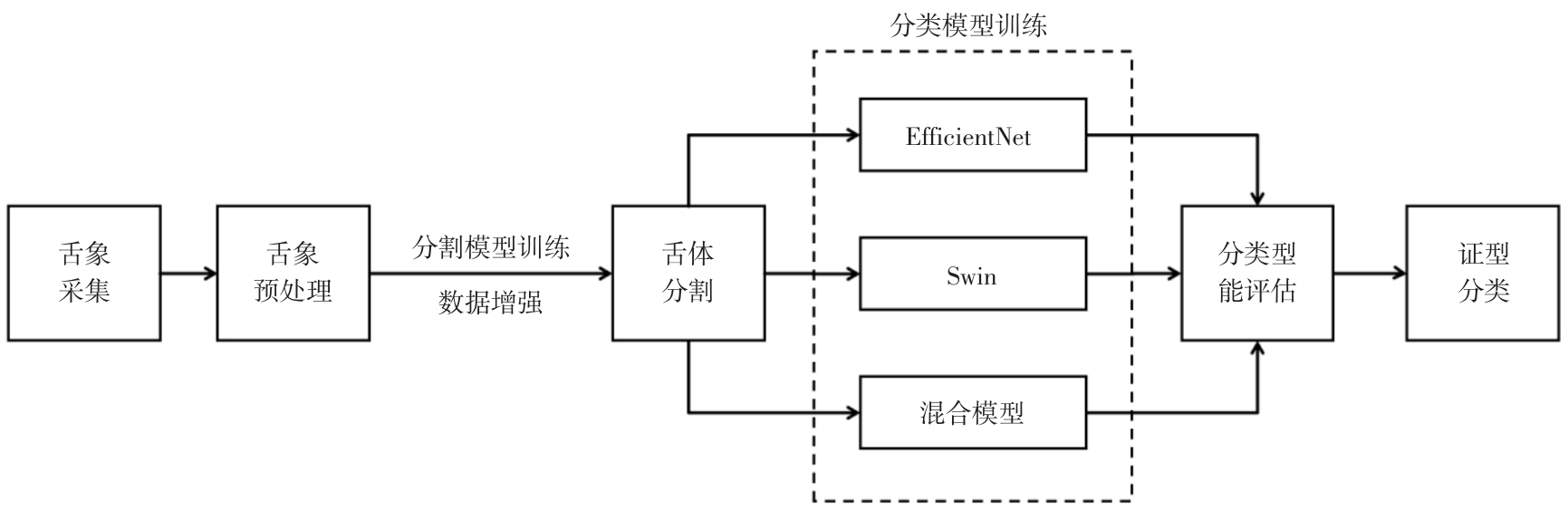
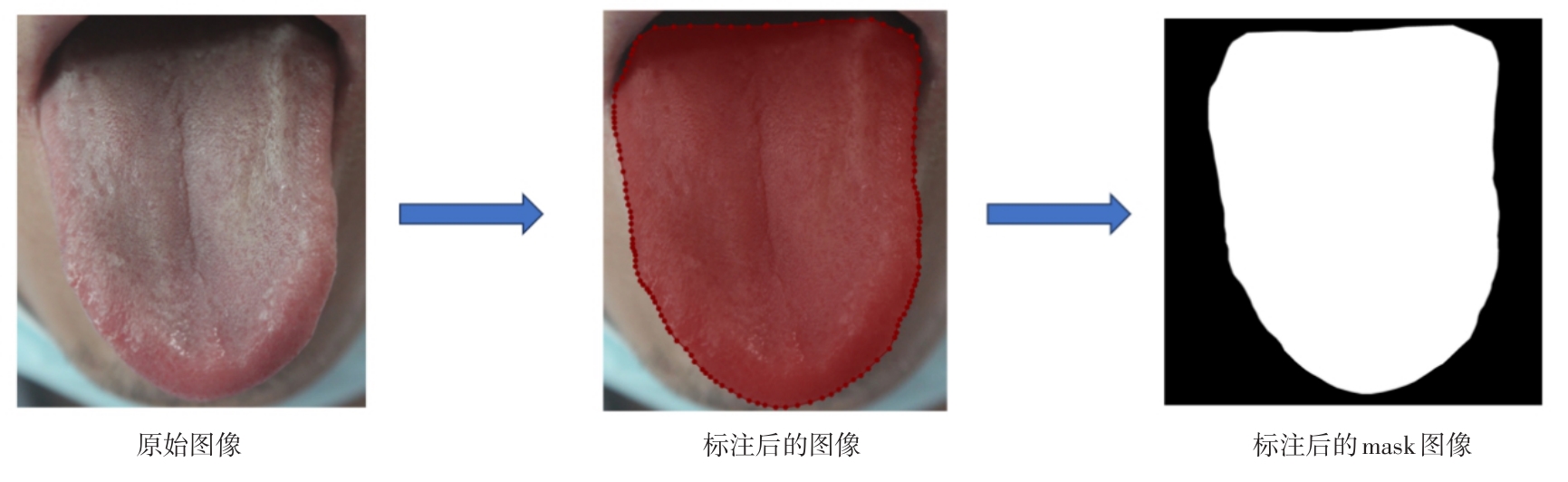
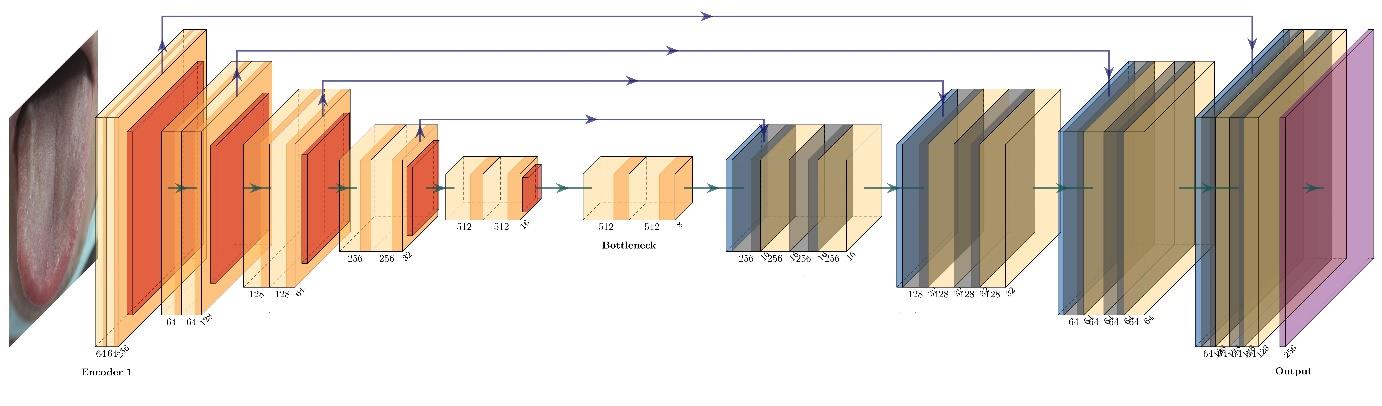
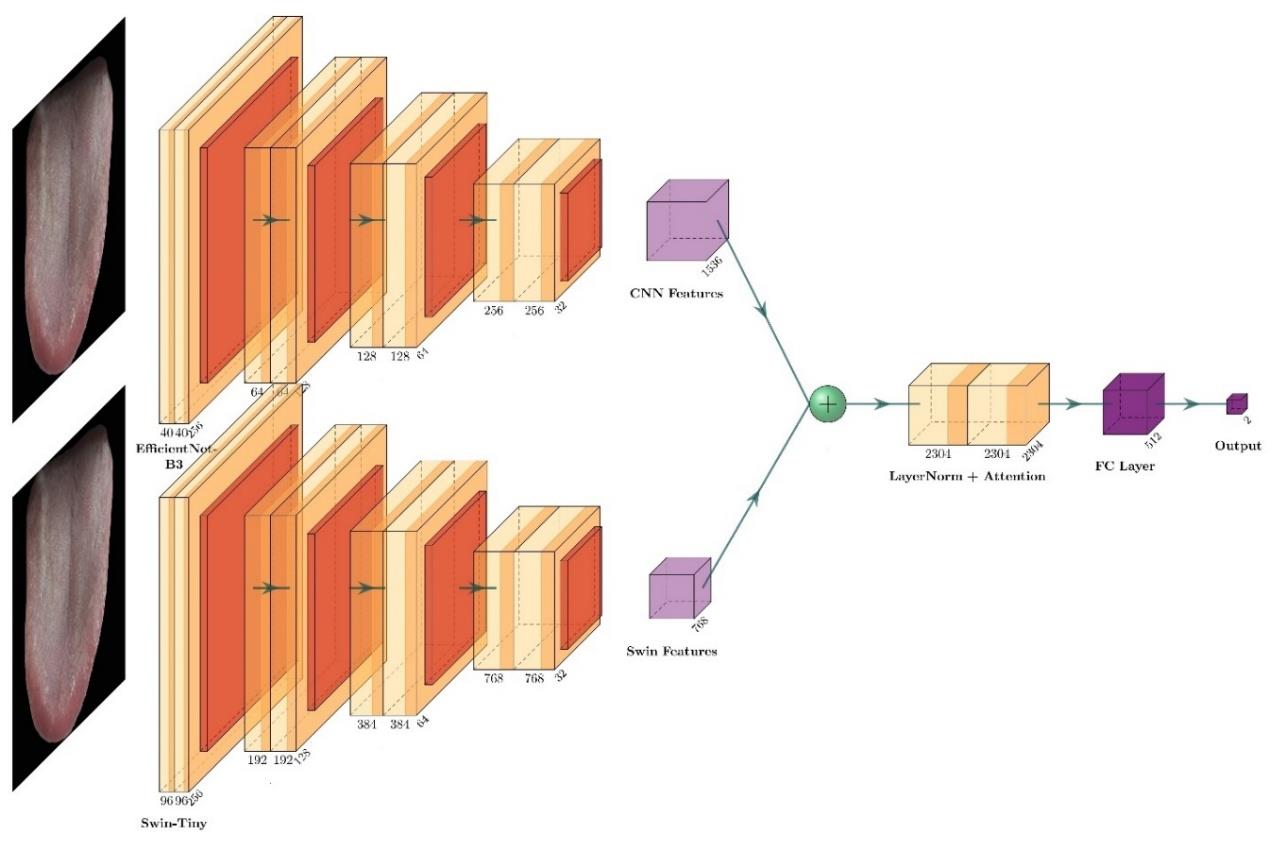
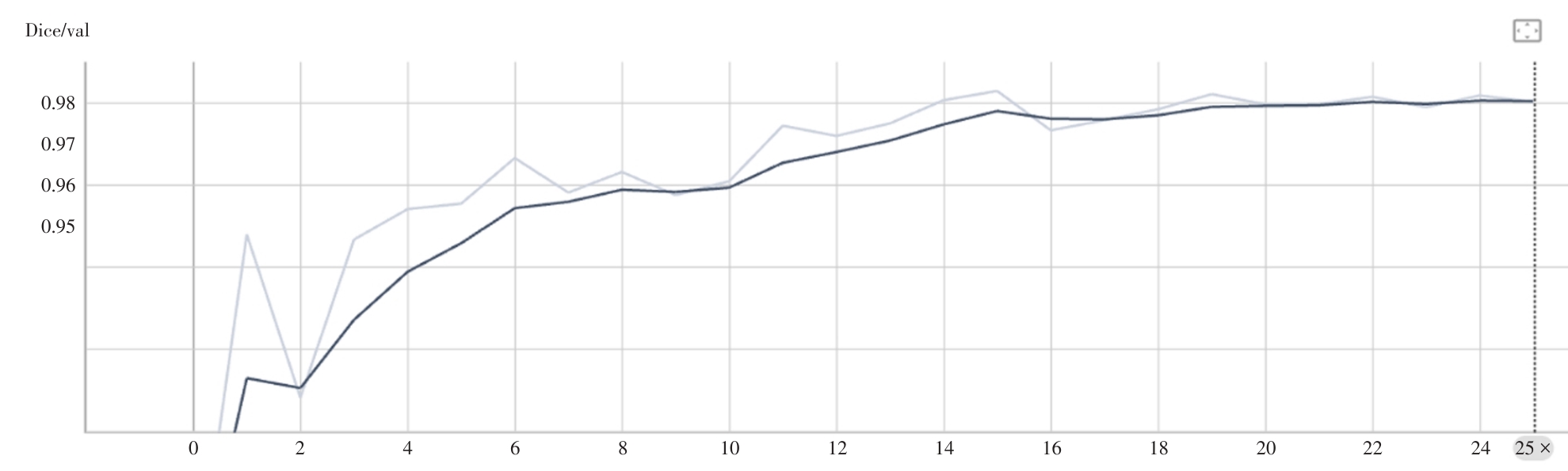
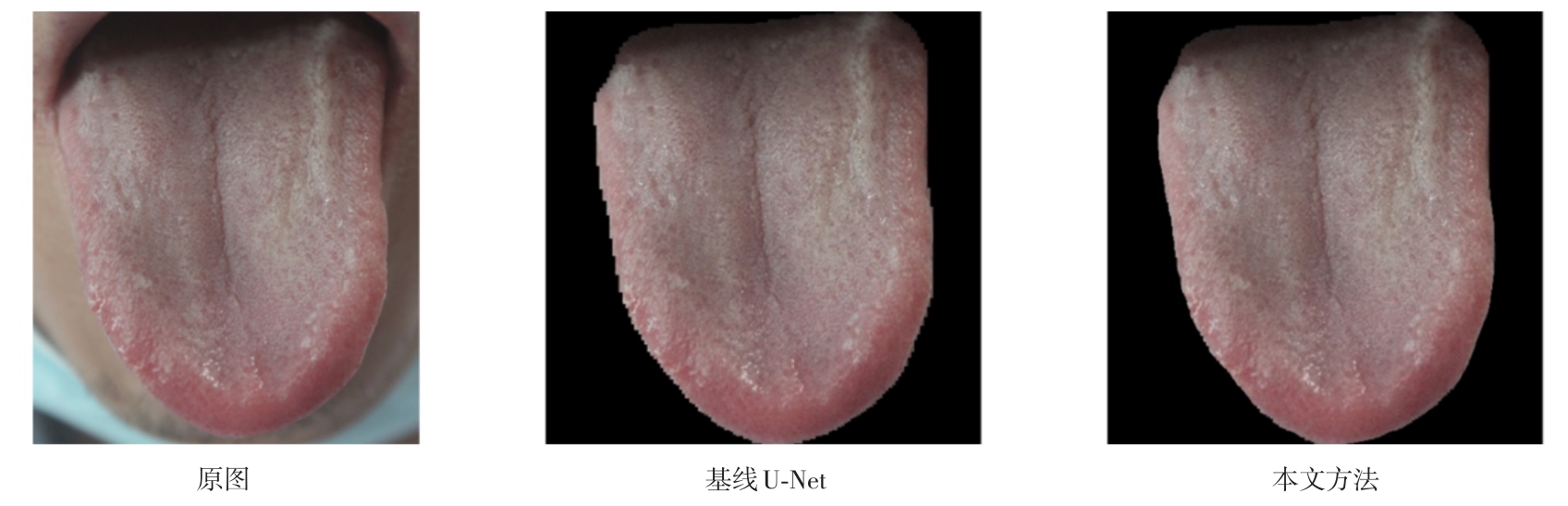
目的 构建基于深度学习的银屑病舌象分类系统,提升脾虚湿阻证与血瘀证的客观辨识能力。 方法 收集981张脾虚湿阻证与血瘀证银屑病患者的舌象图像,采用改进U-Net(编码器为ResNet-34,优化上采样与跳跃连接)实现舌体自动分割,并引入Macenko颜色标准化及Albumentations增强以降低设备与光照差异影响。构建两阶段分类框架:第一阶段精准提取舌体区域;第二阶段融合EfficientNet-B3与Swin-Tiny构建Hybrid Model,并引入跨模态多头注意力机制,融合局部纹理与全局结构特征以完成证型分类。 结果 改进U-Net在舌体分割中性能最优,Dice系数达0.98,IoU为0.89,显著优于原始U-Net(Dice 0.85)。在证型分类中,Hybrid Model表现最佳,五折平均准确率为0.981 6,平均AUC为0.999 3,F1分数显著优于单一模型;Macenko增强使F1-score提升8.3%,单图推理时间为38 ms,满足临床实时需求。 结论 所构建模型能有效区分银屑病脾虚湿阻证与血瘀证,为中医辨证提供客观依据,具备良好的临床应用前景。

关键词: 银屑病, 脾虚湿阻证, 血瘀证, 中医舌诊, 深度学习

Abstract:

Objective To develop a deep learning-based tongue image classification system for psoriasis to improve the objective differentiation between the patterns of Spleen Deficiency with Dampness Retention (SDDR) and Blood Stasis (BS). Methods A total of 981 tongue images from psoriasis patients diagnosed with SDDR or BS were collected. An improved U-Net model, featuring a ResNet-34 encoder, bilinear interpolation upsampling, and optimized skip connections, was employed for automatic tongue region segmentation. Macenko color normalization and the Albumentations library were applied for data augmentation to mitigate variances from imaging devices and lighting conditions. A two-stage framework was constructed: the first stage precisely extracted the tongue body region, while the second stage utilized a Hybrid Model integrating EfficientNet-B3 and Swin-Tiny architectures for pattern classification. A cross-modal multi-head attention mechanism was introduced to fuse local textural and global structural features. Results The improved U-Net achieved superior performance in tongue segmentation, with a Dice coefficient of 0.98 and an IoU of 0.89, significantly outperforming the original U-Net (Dice 0.85). For pattern classification, the Hybrid Model demonstrated the best overall performance, achieving a 5-fold cross-validation mean accuracy of 0.9816 and a mean AUC of 0.9993. The F1-score was significantly higher than those of individual models. Macenko normalization contributed to an 8.3% increase in F1-score. The inference time per image was 38 ms on an A10 GPU, meeting the requirement for clinical real-time application. Conclusion The constructed two-stage tongue image classification model effectively and accurately distinguishes between SDDR and BS patterns in psoriasis, significantly enhancing the objectivity of tongue diagnosis. It provides a reliable tool for pattern differentiation in Traditional Chinese Medicine and shows promising potential for clinical application.

Key words: psoriasis, spleen deficiency with dampness obstruction syndrome, blood stasis syndrome, traditional chinese medicine tongue diagnosis, deep learning

中图分类号: