

实用医学杂志 ›› 2025, Vol. 41 ›› Issue (24): 3808-3815.doi: 10.3969/j.issn.1006-5725.2025.24.003
• 脑与心身医学专栏 • 上一篇
张华1,梁秀雅2,郑梓儀2,尹通1,李声1,黄键澎1( )
)
收稿日期:2025-07-31
出版日期:2025-12-25
发布日期:2025-12-25
通讯作者:
黄键澎
E-mail:jianpengtcm@gzucm.edu.cn
基金资助:
Hua ZHANG1,Xiuya LIANG2,Ziyi ZHENG2,Tong YIN1,Sheng LI1,Jianpeng. HUANG1()
Received:2025-07-31
Online:2025-12-25
Published:2025-12-25
Contact:
Jianpeng. HUANG
E-mail:jianpengtcm@gzucm.edu.cn
摘要:
广泛性焦虑障碍(GAD)是一种高发病率的精神疾病,对患者和社会均造成严重负担。现有治疗手段多样,但疗效不一且存在局限性。近年来,非侵入性脑刺激技术(NIBS)的快速发展为GAD的个体化精准治疗提供了新思路,展现出广阔的临床应用前景。该文系统综述了重复经颅磁刺激(rTMS)、经颅直流电刺激(tDCS)、经皮耳迷走神经刺激(taVNS)及经颅微电流刺激(CES)等技术在GAD治疗中的临床应用进展及其调节相关脑区、神经递质、炎症反应以及神经内分泌等多种相互关联的潜在机制,以期为未来临床研究和实践提供理论依据。
中图分类号:
张华,梁秀雅,郑梓儀,尹通,李声,黄键澎. 非侵入性脑刺激技术在广泛性焦虑障碍治疗中的应用研究进展[J]. 实用医学杂志, 2025, 41(24): 3808-3815.
Hua ZHANG,Xiuya LIANG,Ziyi ZHENG,Tong YIN,Sheng LI,Jianpeng. HUANG. Research progress on the application of non-invasive brain stimulation techniques in the treatment of generalized anxiety disorder[J]. The Journal of Practical Medicine, 2025, 41(24): 3808-3815.
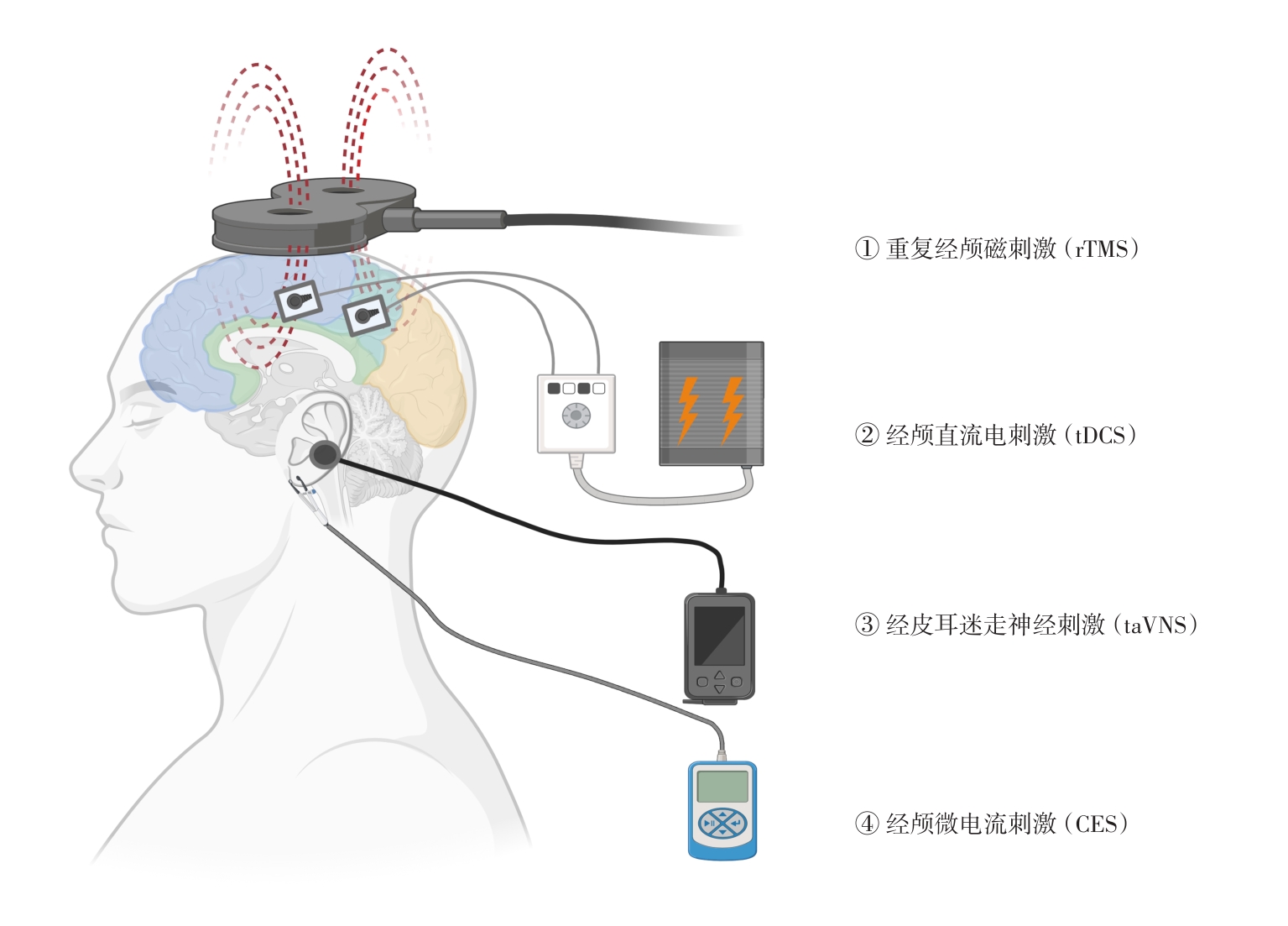
图1
NIBS示意图"
| [1] | BATTLE D E. Diagnostic and Statistical Manual of Mental Disorders (DSM) [J]. Codas, 2013, 25(2): 191-192. |
| [2] |
FAGAN H A, BALDWIN D S. Pharmacological Treatment pf Generalised Anxiety Disorder: Current Practice and Future Direction [J]. Expert Rev Neurother, 2023, 23(5): 535-548. doi:10.1080/14737175.2023.2211767
doi: 10.1080/14737175.2023.2211767 |
| [3] |
ERRAZURIZ A, AVELLO⁃VEGA D, PASSI⁃SOLAR A,et al. Prevalence of anxiety disorders in Latin America: A systematic review and meta⁃analysis [J]. Lancet Rag Health Am, 2025, 45: 101057. doi:10.1016/j.lana.2025.101057
doi: 10.1016/j.lana.2025.101057 |
| [4] |
CARL E, WITCRAFT S M, KAUFFMAN B Y, et al. Psychological and pharmacological treatments for generalized anxiety disorder (GAD): A meta-analysis of randomized controlled trials [J]. Cogn Behav Ther, 2020, 49(1): 1-21. doi:10.1080/16506073.2018.1560358
doi: 10.1080/16506073.2018.1560358 |
| [5] |
WANG H, MOU S, PEI X, et al. The power spectrum and functional connectivity characteristics of resting-state EEG in patients with generalized anxiety disorder [J]. Sci Rep, 2025, 15(1): 5991. doi:10.1038/s41598-025-90362-z
doi: 10.1038/s41598-025-90362-z |
| [6] |
CUI Q, SHENG W, CHEN Y, et al. Dynamic changes of amplitude of low-frequency fluctuations in patients with generalized anxiety disorder [J]. Hum Brain Mapp, 2020, 41(6): 1667-1676. doi:10.1002/hbm.24902
doi: 10.1002/hbm.24902 |
| [7] |
HELLER W, NITSCHKE J B, ETIENNE M A, et al. Patterns of regional brain activity differentiate types of anxiety [J]. J Abnorm Psychol, 1997, 106(3): 376-385. doi:10.1037//0021-843x.106.3.376
doi: 10.1037//0021-843x.106.3.376 |
| [8] |
WHITE L K, MAKHOUL W, TEFERI M, et al. The role of dlPFC laterality in the expression and regulation of anxiety [J]. Neuropharmacology, 2023, 224: 109355. doi:10.1016/j.neuropharm.2022.109355
doi: 10.1016/j.neuropharm.2022.109355 |
| [9] |
MACHADO S, PAES F, VELASQUES B, et al. Is rTMS an effective therapeutic strategy that can be used to treat anxiety disorders? [J]. Neuropharmacology, 2012, 62(1): 125-134. doi:10.1016/j.neuropharm.2011.07.024
doi: 10.1016/j.neuropharm.2011.07.024 |
| [10] |
ZHANG Y, LI L, BIAN Y, et al. Theta-burst stimulation of TMS treatment for anxiety and depression: A FNIRS study [J]. J Affect Disord, 2023, 325: 713-720. doi:10.1016/j.jad.2023.01.062
doi: 10.1016/j.jad.2023.01.062 |
| [11] |
NARMASHIRI A, AKBARI F. The Effects of Transcranial Direct Current Stimulation (tDCS) on the Cognitive Functions: A Systematic Review and Meta-analysis [J]. Neuropsychol Rev, 2025, 35(1): 126-152. doi:10.1007/s11065-023-09627-x
doi: 10.1007/s11065-023-09627-x |
| [12] |
WU Y, TANG L, SHI X, et al. Effects of tDCS on Depression and Comorbid Generalized Anxiety Disorder: A Brain Function Imaging Case Report [J]. Front Neurol, 2022, 13: 879339. doi:10.3389/fneur.2022.879339
doi: 10.3389/fneur.2022.879339 |
| [13] |
LU R, ZHANG C, LIU Y, et al. The effect of bilateral low-frequency rTMS over dorsolateral prefrontal cortex on serum brain-derived neurotropic factor and serotonin in patients with generalized anxiety disorder [J]. Neurosci Lett, 2018, 684: 67-71. doi:10.1016/j.neulet.2018.07.008
doi: 10.1016/j.neulet.2018.07.008 |
| [14] |
FILHO P R, VERCELINO R, CIOATO S G, et al. Transcranial direct current stimulation (tDCS) reverts behavioral alterations and brainstem BDNF level increase induced by neuropathic pain model: Long-lasting effect [J]. Prog Neuropsychopharmacol Biol Psychiatry, 2016, 64: 44-51. doi:10.1016/j.pnpbp.2015.06.016
doi: 10.1016/j.pnpbp.2015.06.016 |
| [15] |
CLARKE D, BEROS J, BATES K A, et al. Low intensity repetitive magnetic stimulation reduces expression of genes related to inflammation and calcium signalling in cultured mouse cortical astrocytes [J]. Brain Stimul, 2021, 14(1): 183-191. doi:10.1016/j.brs.2020.12.007
doi: 10.1016/j.brs.2020.12.007 |
| [16] |
TIAN L, SUN S S, CUI L B, et al. Repetitive Transcranial Magnetic Stimulation Elicits Antidepressant- and Anxiolytic-like Effect via Nuclear Factor-E2-related factor 2-mediated Anti-inflammation Mechanism in Rats [J]. Neuroscience, 2020, 429: 119-133. doi:10.1016/j.neuroscience.2019.12.025
doi: 10.1016/j.neuroscience.2019.12.025 |
| [17] |
YANG L, WANG S, HU Y, et al. Effects of Repetitive Transcranial Magnetic Stimulation on Astrocytes Proliferation and nNOS Expression in Neuropathic Pain Rats [J]. Curr Med Sci, 2018, 38(3): 482-490. doi:10.1007/s11596-018-1904-3
doi: 10.1007/s11596-018-1904-3 |
| [18] |
HONG Y, LIU Q, PENG M, et al. High-frequency repetitive transcranial magnetic stimulation improves functional recovery by inhibiting neurotoxic polarization of astrocytes in ischemic rats [J]. J Neuroinflammation, 2020, 17(1): 150. doi:10.1186/s12974-020-01747-y
doi: 10.1186/s12974-020-01747-y |
| [19] |
SMITS J A, ROSENFIELD D, OTTO M W, et al. D-cycloserine enhancement of exposure therapy for social anxiety disorder depends on the success of exposure sessions [J]. J Psychiatr Res, 2013, 47(10): 1455-1461. doi:10.1016/j.jpsychires.2013.06.020
doi: 10.1016/j.jpsychires.2013.06.020 |
| [20] |
SUN L, MA S, YU Y, et al. Transcutaneous auricular vagus nerve stimulation ameliorates adolescent depressive- and anxiety-like behaviors via hippocampus glycolysis and inflammation response [J]. CNS Neurosci Ther, 2024, 30(2): e14614. doi:10.1111/cns.14614
doi: 10.1111/cns.14614 |
| [21] | 刘晶晶, 相福芹, 黄奇, 等. 经颅直流电刺激治疗广泛性焦虑障碍的疗效观察 [J]. 浙江临床医学, 2022, 24(5): 690-692. |
| [22] |
WANG H N, BAI Y H, CHEN Y C, et al. Repetitive transcranial magnetic stimulation ameliorates anxiety-like behavior and impaired sensorimotor gating in a rat model of post-traumatic stress disorder [J]. PLoS One, 2015, 10(2): e0117189. doi:10.1371/journal.pone.0117189
doi: 10.1371/journal.pone.0117189 |
| [23] |
KECK M E, WELT T, POST A, et al. Neuroendocrine and behavioral effects of repetitive transcranial magnetic stimulation in a psychopathological animal model are suggestive of antidepressant-like effects [J]. Neuropsychopharmacology, 2001, 24(4): 337-349. doi:10.1016/s0893-133x(00)00191-3
doi: 10.1016/s0893-133x(00)00191-3 |
| [24] |
MEHRSAFAR A H, ROSA M A S, ZADEH A M, et al. A feasibility study of application and potential effects of a single session transcranial direct current stimulation (tDCS) on competitive anxiety, mood state, salivary levels of cortisol and alpha amylase in elite athletes under a real-world competition [J]. Physiol Behav, 2020, 227: 113173. doi:10.1016/j.physbeh.2020.113173
doi: 10.1016/j.physbeh.2020.113173 |
| [25] |
QI L, WANG S, LI X, et al. Non-invasive brain stimulation in the treatment of generalized anxiety disorder: A systematic review and meta-analysis [J]. J Psychiatr Res, 2024, 178: 378-387. doi:10.1016/j.jpsychires.2024.07.046
doi: 10.1016/j.jpsychires.2024.07.046 |
| [26] |
CUI H, JIANG L, WEI Y, et al. Efficacy and safety of repetitive transcranial magnetic stimulation for generalised anxiety disorder: A meta-analysis [J]. Gen Psychiatr, 2019, 32(5): e100051. doi:10.1136/gpsych-2019-100051
doi: 10.1136/gpsych-2019-100051 |
| [27] |
SAGLIANO L, ATRIPALDI D, DE VITA D, et al. Non-invasive brain stimulation in generalized anxiety disorder: A systematic review [J]. Prog Neuropsychopharmacol Biol Psychiatry, 2019, 93: 31-38. doi:10.1016/j.pnpbp.2019.03.002
doi: 10.1016/j.pnpbp.2019.03.002 |
| [28] |
DIEFENBACH G J, BRAGDON L B, ZERTUCHE L, et al. Repetitive transcranial magnetic stimulation for generalised anxiety disorder: A pilot randomised, double-blind, sham-controlled trial [J]. Br J Psychiatry, 2016, 209(3): 222-228. doi:10.1192/bjp.bp.115.168203
doi: 10.1192/bjp.bp.115.168203 |
| [29] |
DILKOV D, HAWKEN E R, KALUDIEV E, et al. Repetitive transcranial magnetic stimulation of the right dorsal lateral prefrontal cortex in the treatment of generalized anxiety disorder: A randomized, double-blind sham controlled clinical trial [J]. Prog Neuropsychopharmacol Biol Psychiatry, 2017, 78: 61-65. doi:10.1016/j.pnpbp.2017.05.018
doi: 10.1016/j.pnpbp.2017.05.018 |
| [30] | 陈丽雅, 王红梅. 重复经颅磁刺激治疗焦虑症伴有失眠的临床疗效分析 [J]. 中国现代药物应用, 2020, 14(15): 112-114. |
| [31] | 李越, 王玉平, 詹淑琴, 等. 重复经颅磁刺激治疗广泛性焦虑的对照研究 [J]. 脑与神经疾病杂志, 2012, 20(2): 84-88. |
| [32] |
HUANG Z, LI Y, BIANCHI M T, et al. Repetitive transcranial magnetic stimulation of the right parietal cortex for comorbid generalized anxiety disorder and insomnia: A randomized, double-blind, sham-controlled pilot study [J]. Brain Stimul, 2018, 11(5): 1103-1109. doi:10.1016/j.brs.2018.05.016
doi: 10.1016/j.brs.2018.05.016 |
| [33] | 杨硕. 不同模式重复经颅磁刺激对广泛性焦虑障碍的疗效及安全性评价 [D]. 唐山:华北理工大学, 2023. |
| [34] | 宋明桥, 孙亚南, 钟晓明, 等. 低频重复经颅磁刺激治疗96例焦虑患者的疗效分析 [J]. 医学与哲学(B), 2016, 37(1): 47-49. |
| [35] |
RAMASUBBU R, BROWN E C, SELBY B, et al. Accelerated sequential bilateral theta-burst stimulation in major depression: An open trial [J]. Eur Arch Psychiatry Clin Neurosci, 2024, 274(3): 697-707. doi:10.1007/s00406-023-01648-0
doi: 10.1007/s00406-023-01648-0 |
| [36] |
LI X, ZHANG C, TAN J, et al. Clinical effects of continuous theta burst stimulation for generalized anxiety disorder and a mechanism involving alpha oscillations: A randomized controlled trial [J]. J Psychiatry Neurosci, 2022, 47(2): E123-E133. doi:10.1503/jpn.210134
doi: 10.1503/jpn.210134 |
| [37] |
NITSCHE M A, PAULUS W. Excitability changes induced in the human motor cortex by weak transcranial direct current stimulation [J]. J Physiol, 2000, 527 Pt 3: 633-639. doi:10.1111/j.1469-7793.2000.t01-1-00633.x
doi: 10.1111/j.1469-7793.2000.t01-1-00633.x |
| [38] |
SHIOZAWA P, LEIVA A P G, CASTRO C D C, et al. Transcranial direct current stimulation for generalized anxiety disorder: A case study [J]. Biol Psychiatry, 2014, 75(11): e17-e18. doi:10.1016/j.biopsych.2013.07.014
doi: 10.1016/j.biopsych.2013.07.014 |
| [39] |
NASIRI F, MASHHADI A, BIGDELI I, et al. Augmenting the unified protocol for transdiagnostic treatment of emotional disorders with transcranial direct current stimulation in individuals with generalized anxiety disorder and comorbid depression: A randomized controlled trial [J]. J Affect Disord, 2020, 262: 405-413. doi:10.1016/j.jad.2019.11.064
doi: 10.1016/j.jad.2019.11.064 |
| [40] | 邓明其, 冯尚武, 陈颂玲. 经颅直流电刺激治疗轻中度焦虑和抑郁障碍共病患者的随机对照研究 [J]. 中国康复, 2015, 30(4): 268-270. |
| [41] |
DE LIMA A L, BRAGA F M A, COSTA R M M DA, et al. Transcranial direct current stimulation for the treatment of generalized anxiety disorder: A randomized clinical trial [J]. J Affect Disord, 2019, 259: 31-37. doi:10.1016/j.jad.2019.08.020
doi: 10.1016/j.jad.2019.08.020 |
| [42] |
NEJATI V, MAJDI R, SALEHINEJAD M A, et al. The role of dorsolateral and ventromedial prefrontal cortex in the processing of emotional dimensions [J]. Sci Rep, 2021, 11(1): 1971. doi:10.1038/s41598-021-81454-7
doi: 10.1038/s41598-021-81454-7 |
| [43] |
FERREIRA L M A, BRITES R, FRAIAO G, et al. Transcutaneous auricular vagus nerve stimulation modulates masseter muscle activity, pain perception, and anxiety levels in university students: A double-blind, randomized, controlled clinical trial [J]. Front Integr Neurosci, 2024, 18: 1422312. doi:10.3389/fnint.2024.1422312
doi: 10.3389/fnint.2024.1422312 |
| [44] |
SRINIVASAN V, ABATHSAGAYAM K, SUGANTHIRABABU P, et al. Effect of vagus nerve stimulation (taVNS) on anxiety and sleep disturbances among elderly health care workers in the post COVID-19 pandemic [J]. Work, 2024, 78(4): 1149-1156. doi:10.3233/wor-231362
doi: 10.3233/wor-231362 |
| [45] |
BIKSON M, ESMAEILPOUR Z, ADAIR D, et al. Transcranial electrical stimulation nomenclature [J]. Brain Stimul, 2019, 12(6): 1349-1366. doi:10.1016/j.brs.2019.07.010
doi: 10.1016/j.brs.2019.07.010 |
| [46] |
BYSTRITSKY A, KERWIN L, FEUSNER J. A pilot study of cranial electrotherapy stimulation for generalized anxiety disorder [J]. J Clin Psychiatry, 2008, 69(3): 412-417. doi:10.4088/jcp.v69n0311
doi: 10.4088/jcp.v69n0311 |
| [47] |
CHU C S, CHANG C H, PAN C C, et al. Effect of cranial electrotherapy stimulation as an add-on therapy on late-life generalized anxiety disorder: An open-label study [J]. J Formos Med Assoc, 2024, 123(7): 781-787. doi:10.1016/j.jfma.2023.12.002
doi: 10.1016/j.jfma.2023.12.002 |
| [1] | 马源鑫,梅笑,王云峥,王伟. TRPV1介导腹泻型肠易激综合征内脏高敏感的机制及针刺干预研究进展[J]. 实用医学杂志, 2025, 41(7): 1084-1090. |
| [2] | 陈星驰,朱小玉. 异基因造血干细胞移植后的免疫相关研究进展[J]. 实用医学杂志, 2025, 41(5): 641-647. |
| [3] | 孙硕,张文洁,赵益,孙有智. 昼夜节律基因调控消化系统肿瘤及中药干预作用的研究进展[J]. 实用医学杂志, 2025, 41(5): 648-656. |
| [4] | 孙洪艺,骆思宏,张成宇,孟子杭,陈卓,李晓宁. 基于伏隔核神经环路探讨抑郁症的发病机制及针灸治疗的研究进展[J]. 实用医学杂志, 2025, 41(22): 3618-3624. |
| [5] | 刘春辉,吴瑞鹏,王志强,陕文生,李少君. 精浆外泌体miR-26a-5p靶向PTEN调控特发性畸形精子症的分子机制及诊断价值[J]. 实用医学杂志, 2025, 41(20): 3256-3266. |
| [6] | 刘晓宁,梁雅雪,王华. 常见结核后肺疾病的诊疗进展[J]. 实用医学杂志, 2025, 41(19): 2985-2990. |
| [7] | 李琪,高静,张铭,张栩,冯雅琛,潘蕊,王春晓,任琼迪. 中药调控小胶质细胞改善卒中后抑郁的研究进展[J]. 实用医学杂志, 2025, 41(18): 2945-2952. |
| [8] | 何悦,程珂新,李艳秋,侯雨君,周思远. 肠道屏障在肠易激综合征发病机制中的研究进展[J]. 实用医学杂志, 2025, 41(16): 2597-2603. |
| [9] | 蒋强,丁宇,丁至立,韩嘉恒. 基于ROS/NLRP3/Caspase-1焦亡通路探讨针刀对LDH模型兔神经根炎性反应的作用机制[J]. 实用医学杂志, 2025, 41(14): 2167-2173. |
| [10] | 赖静文,赵雨川,巫株华,陈珣珣,彭柯浩,陈喻晖,魏然,赖晓宇,王静宇. 结核细胞外囊泡生物标志物研究新进展与挑战[J]. 实用医学杂志, 2025, 41(14): 2278-2284. |
| [11] | 王伟,路士华,张宏昊,邓华亮. 丹皮酚治疗肠道疾病作用机制研究进展[J]. 实用医学杂志, 2025, 41(10): 1597-1602. |
| [12] | 王佳慧,郑可,李雪梅. 脂质组学在肾脏疾病中的应用与进展[J]. 实用医学杂志, 2025, 41(1): 1-6. |
| [13] | 关巧妍,包宋羽,崔源源,李思铭. “长新冠”患者疲劳的机制研究进展[J]. 实用医学杂志, 2024, 40(9): 1186-1190. |
| [14] | 袁宸,赵霞,吴嘉宝,严花. S1P在哮喘中的研究现状及应用前景[J]. 实用医学杂志, 2024, 40(7): 936-940. |
| [15] | 刘永辉,谭庆晶,陈清,韦理萍,杨俊威,杨侃,高玉广. miR-421靶向调控Menin/Caspase-3影响抑郁症的机制[J]. 实用医学杂志, 2024, 40(4): 453-459. |
| 阅读次数 | ||||||
|
全文 |
|
|||||
|
摘要 |
|
|||||
