实用医学杂志 ›› 2025, Vol. 41 ›› Issue (23): 3697-3703.doi: 10.3969/j.issn.1006-5725.2025.23.010

• 临床研究 • 上一篇    

血浆致动脉粥样硬化指数对急性心肌梗死患者长期预后的影响

王凯阳1,2,永佳蕙1,2,陶静1,2,沈鑫1,2()   

  1. 1.新疆维吾尔自治区人民医院心内科 (新疆 乌鲁木齐 830000 )
    2.新疆心脏血管稳态与再生医学研究重点实验室 (新疆 乌鲁木齐 830000 )
  • 收稿日期:2025-07-10 出版日期:2025-12-10 发布日期:2025-12-18
  • 通讯作者: 沈鑫 E-mail:xjrmyyxnk@sina.com
  • 基金资助:
    新疆维吾尔自治区自然科学基金-青年基金项目(2024D01C288)

Correlation between atherogenic index of plasma and prognosis of patients with acute myocardial infarction

Kaiyang WANG1,2,Jiahui YONG1,2,Jing TAO1,2,Xin. SHEN1,2()   

  1. *.Department of Cardiology,Xinjiang Uygur Autonomous Region People's Hospital,Urumqi 830000,Xinjiang,China
    *.Xinjiang Key Laboratory of Cardiovascular Homeostasis and Regeneration Research,Urumqi 830000,Xinjiang,China
  • Received:2025-07-10 Online:2025-12-10 Published:2025-12-18
  • Contact: Xin. SHEN E-mail:xjrmyyxnk@sina.com

摘要:

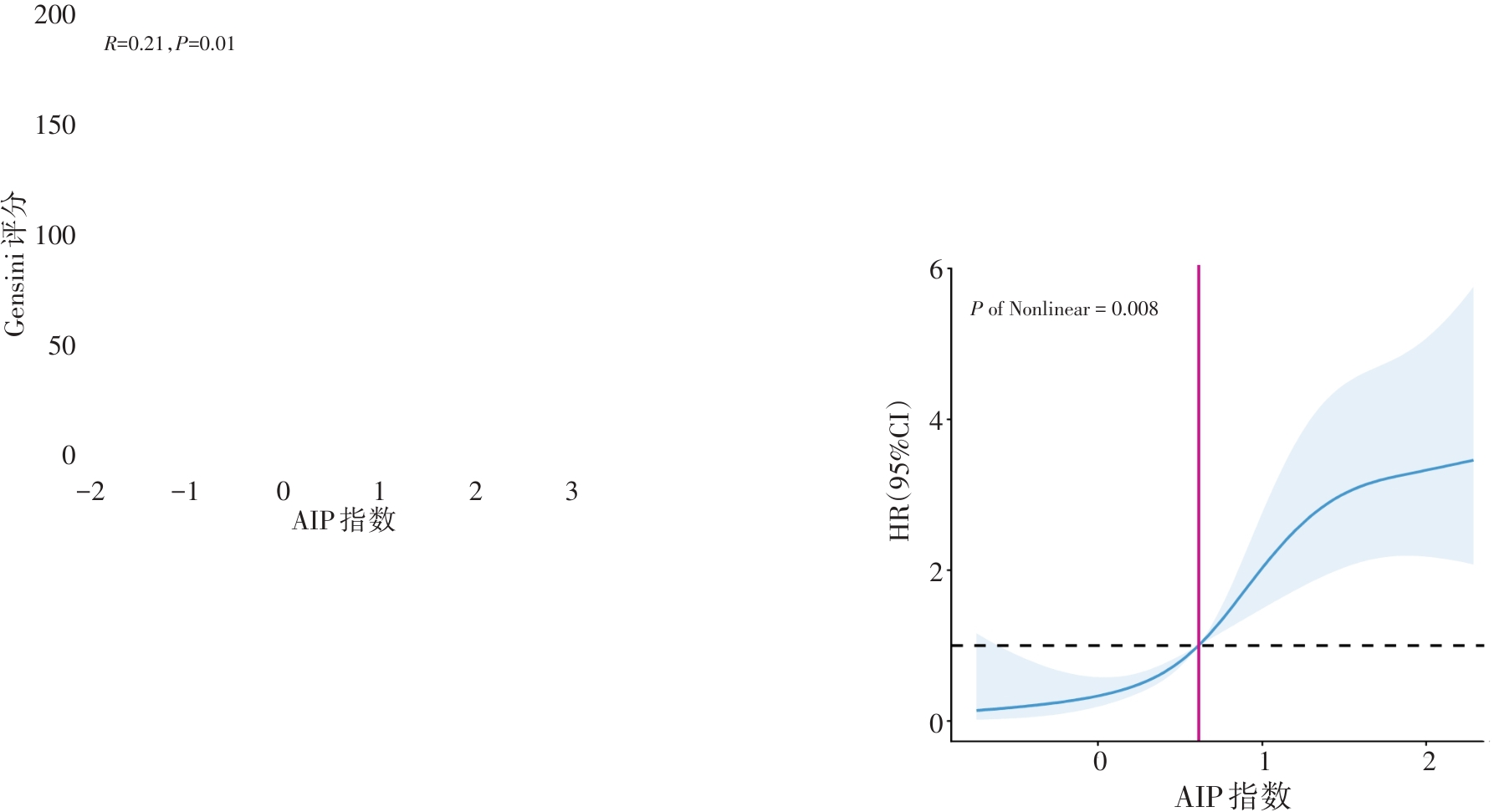
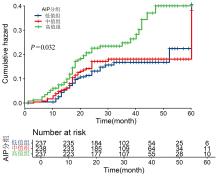
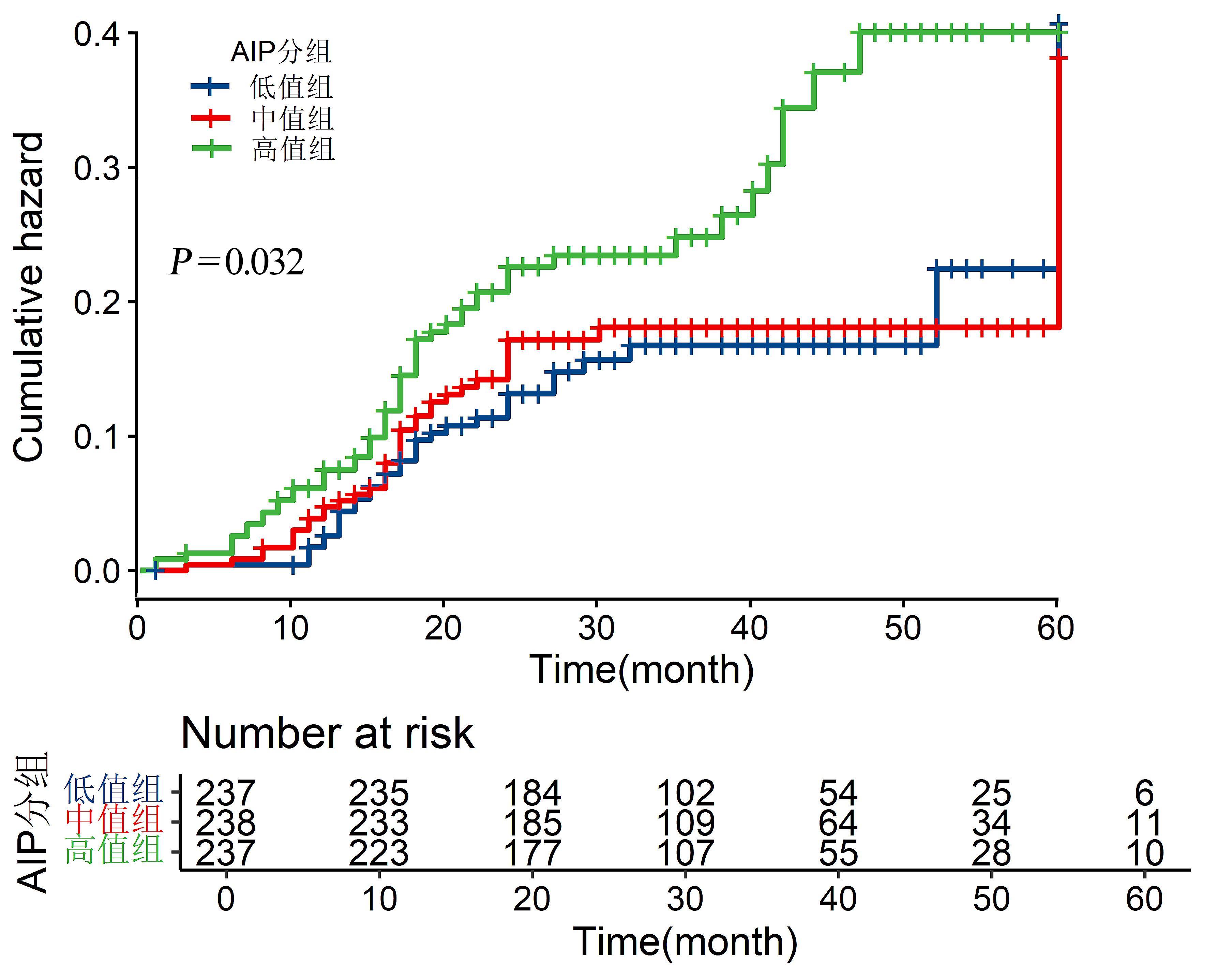
目的 探讨基线血浆致动脉粥样硬化指数(AIP)对急性心肌梗死(AMI)患者长期预后的影响。 方法 连续纳入2018年1月至2019年12月期间新疆维吾尔自治区人民医院收治的712例AMI患者作为研究对象,依据AIP三分位数将研究对象分为低值组(AIP < 0.280,n = 237),中值组(AIP 0.280 ~ 0.852,n = 238)和高值组(AIP > 0.852, n = 237)。终点事件定义为主要心血管不良事件(MACEs)的发生。采用多因素Cox回归分析MACEs发生的独立影响因素;采用限制性立方样条图分析AIP与MACEs发生风险之间的非线性关系;采用Kaplan-Meier曲线分析组间生存差异;亚组分析评估AIP对MACEs预测价值的一致性。 结果 随着AIP三分位数分组递增,患者血脂异常和MACEs发生比例升高,白细胞计数、空腹血糖、甘油三酯、总胆固醇、低密度脂蛋白、AIP升高,高密度脂蛋白降低 (P ? 0.05)。多因素Cox回归分析结果显示:AIP是MACEs 发生的独立危险因素(HR = 2.024,95%CI:1.211 ~ 3.381,P = 0.007)。限制性立方样条图分析结果显示:AIP与MACEs发生风险之间呈“L”形非线性效应关系(P-Nonlinear = 0.008),当AIP > 0.613时,AMI患者MACEs风险随AIP升高而升高。Kaplan-Meier生存曲线分析结果显示:随着AIP升高AMI患者MACEs累积发生率显著增加(Log-rank test,P = 0.032),与低值组相比,高值组患者MACEs发生风险增加131%(HR = 2.311,95%CI:1.261 ~ 4.234,P = 0.007)。亚组分析结果显示,各亚组内交互作用P值均不显著,AIP对MACEs预测能力适用于所有亚组人群。 结论 基线AIP升高是AMI患者远期不良预后的独立危险因素。

关键词: 血浆致动脉粥样硬化指数, 急性心肌梗死, 危险因素, 预后

Abstract:

Objective To investigate the effect of baseline atherogenic index of plasma (AIP) on the long-term prognosis of patients with acute myocardial infarction (AMI). Methods A total of 712 AMI patients admitted to the hospital from January 2018 to December 2019 were continuously included as subjects and divided into a low-value group (AIP < 0.280, n = 237), a median-value group (AIP 0.280 ~ 0.852, n = 238) and a high-value group (AIP > 0.852, n = 237) according to the baseline AIP tertiles. The primary endpoint was defined as the occurrence of major cardiovascular adverse events (MACEs). Multivariate Cox regression was used to analyze the independent influencing factors of MACEs. The nonlinear relationship between AIP and the risk of MACEs was analyzed with restricted cubic spline plots. Kaplan-Meier curve was used to analyze survival differences between groups. Subgroup analysis assesses the consistency of AIP's predictive value to MACEs. Results With the increase of AIP tertile groups, the proportion of dyslipidemia and MACEs increased, white blood cell count, fasting blood glucose, triglyceride, total cholesterol, low density lipoprotein and AIP increased, and high-density lipoprotein decreased, with statistical significance (P < 0.05). Multivariate Cox regression analysis showed that AIP was an independent risk factor for MACEs (HR = 2.024, 95%CI: 1.211 ~ 3.381, P = 0.007). The results of restricted cubic spline analysis show that there is an L-shaped nonlinear effect relationship between AIP and the risk of MACEs (P-nonlinear = 0.008). When AIP > 0.613, the risk of MACEs in AMI patients increases with the increase of AIP. Kaplan-Meier survival curve analysis results show: With the increase of AIP, the cumulative incidence of MACEs in AMI patients increased significantly (Log-rank test, P = 0.032). Compared with the low-value group, the risk of MACEs in the high-value group increased by 131% (HR = 2.311, 95%CI: 1.261 ~ 4.234, P = 0.007). The results of subgroup analysis showed that the P value of interaction within each subgroup was not significant, and the ability of AIP to predict MACEs was applicable to all subgroups. Conclusion Increased AIP at baseline is an independent predictor of poor long-term prognosis in patients with AMI.

Key words: atherogenic index of plasma, acute myocardial infarction, risk factors, prognosis

中图分类号: