

实用医学杂志 ›› 2026, Vol. 42 ›› Issue (7): 1225-1234.doi: 10.3969/j.issn.1006-5725.2026.07.015
• 慢性病防治专栏 • 上一篇
袁泽峰,陈强,罗明,王勃,孔斌( )
)
收稿日期:2025-12-10
修回日期:2026-01-11
接受日期:2026-01-19
出版日期:2026-04-10
发布日期:2026-04-13
通讯作者:
孔斌
E-mail:kongtian75@hebmu.edu.cn
基金资助:
Zefeng YUAN,Qiang CHEN,Ming LUO,Bo WANG,Bin KONG()
Received:2025-12-10
Revised:2026-01-11
Accepted:2026-01-19
Online:2026-04-10
Published:2026-04-13
Contact:
Bin KONG
E-mail:kongtian75@hebmu.edu.cn
摘要:
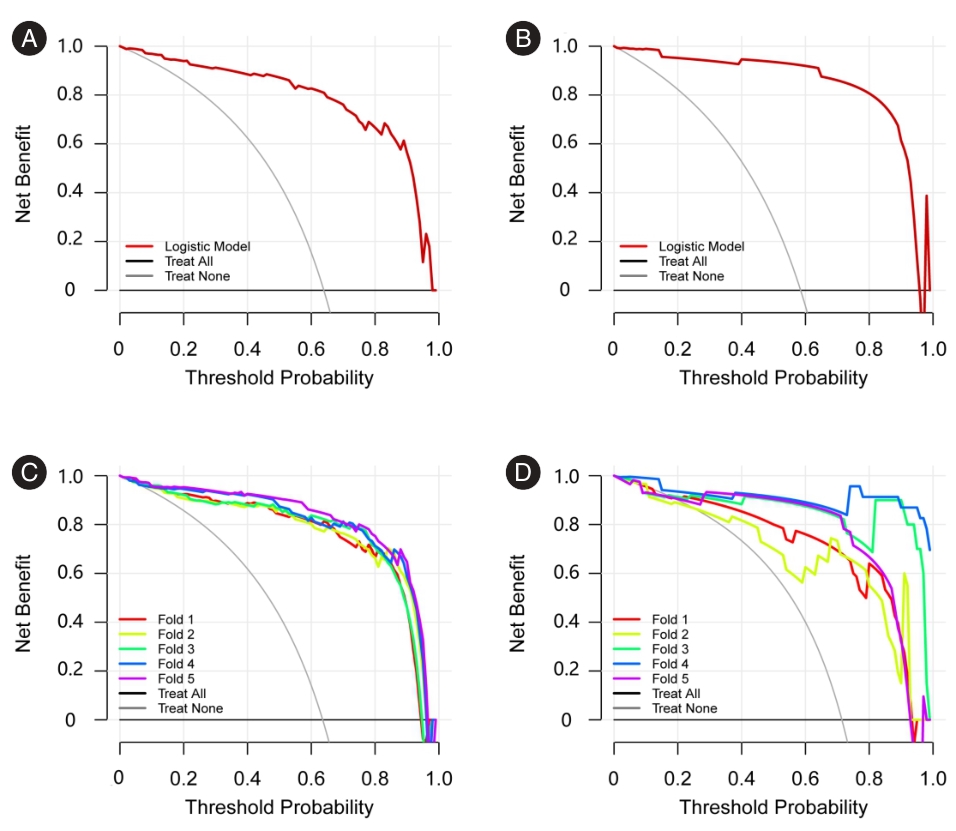
目的 构建基于临床数据的列线图预测模型,探讨影响生物反馈(BFT)治疗盆底痉挛综合征(SPFS)的疗效因素,为早期识别疗效不佳的患者指导个体化治疗提供依据。 方法 选取2020年6月至2025年6月在河北医科大学第三医院胃肠外科接受1个疗程(10次)生物反馈的175例患者治疗前后的临床资料。将数据集划分为70%训练集(n = 122)和30%验证集(n = 53),定义治疗后ODS评分下降> 50%且肛门肌电图排便模式正常化为疗效满意,根据疗效划分有效组(TE)和无效组(TIE)。通过单因素logistic回归、Lasso回归与多因素logistic回归逐步筛选特征变量,构建列线图并采用受试者工作特征曲线(ROC)、Calibrate校正曲线、Hosmer-Lemeshow检验和决策曲线分析(DCA)评估模型区分度、校准度、拟合度与临床价值。 结果 最终多因素logistic回归显示肛门静息压、手助排便、使用泻药、使用灌肠、排便不尽感、患者满意度为疗效的独立危险因素。训练集和验证集的AUC分别为0.959(95%CI:0.921 ~ 0.996)和0.971(95%CI:0.918 ~ 1.000),校正曲线显示出良好的校准度,Hosmer-Lemeshow检验表明,训练集和验证集的实际概率与预测概率差异无统计学意义(P > 0.05)。DCA曲线和5折交叉验证均表明模型在0.1 ~ 0.8范围存在临床净收益。 结论 本研究整合了SPFS患者临床症状、检查等指标,对接受BFT治疗的疗效具有良好的预测效能,有助于筛查高风险患者为临床决策提供依据。
中图分类号:
袁泽峰,陈强,罗明,王勃,孔斌. 生物反馈治疗盆底痉挛综合征患者疗效的列线图预测模型构建[J]. 实用医学杂志, 2026, 42(7): 1225-1234.
Zefeng YUAN,Qiang CHEN,Ming LUO,Bo WANG,Bin KONG. Construction of a nomogram prediction model for the efficacy of biofeedback therapy in patients with spastic pelvic floor syndrome[J]. The Journal of Practical Medicine, 2026, 42(7): 1225-1234.
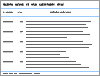
表1
BFT治疗前后疗效的改善情况 (xˉ±s)"
| 项目 | 治疗前(n = 175) | 治疗后(n = 175) | t值 | P值 |
|---|---|---|---|---|
| 肛管静息压/mmHg | 84.61 ± 19.87 | 65.81 ± 10.98 | 15.897 | 0.003 |
| 肛管长度/cm | 4.76 ± 0.80 | 3.79 ± 0.47 | 19.088 | < 0.001 |
| 缩榨压增量/mmHg | 100.67 ± 35.42 | 68.72 ± 17.78 | 17.283 | < 0.001 |
| 直肠推压/mmHg | 62.26 ± 23.22 | 73.47 ± 16.27 | -9.810 | < 0.001 |
| 肛管松弛率/% | -0.33 ± 10.62 | 16.75 ± 5.52 | -26.355 | < 0.001 |
| 初始感觉阈值/mmHg | 72.98 ± 19.83 | 57.71 ± 13.95 | 14.665 | < 0.001 |
| 初始便意阈值/mmHg | 108.90 ± 29.00 | 94.12 ± 20.57 | 12.905 | < 0.001 |
| 最大耐受阈值/mmHg | 164.77 ± 32.75 | 158.85 ± 23.87 | 4.453 | < 0.001 |
| ODS评分/分 | 23.15 ± 2.33 | 10.81 ± 2.27 | 62.346 | < 0.001 |
| 排便时间/分 | 2.87 ± 0.71 | 1.55 ± 0.60 | 25.74 | < 0.001 |
| 便意次数/分 | 2.58 ± 0.83 | 1.34 ± 0.63 | 23.344 | < 0.001 |
| 手助排便/分 | 3.35 ± 0.63 | 1.63 ± 0.77 | 29.989 | < 0.001 |
| 使用泻药/分 | 3.41 ± 0.62 | 1.30 ± 0.75 | 35.253 | < 0.001 |
| 使用灌肠/分 | 2.22 ± 0.89 | 1.05 ± 0.64 | 18.050 | < 0.001 |
| 排便不尽感/分 | 3.45 ± 0.67 | 1.42 ± 0.73 | 30.689 | < 0.001 |
| 排便费力/分 | 3.60 ± 0.49 | 1.65 ± 0.63 | 38.368 | < 0.001 |
| 粪便性状/分 | 1.66 ± 0.93 | 0.87 ± 0.62 | 12.299 | < 0.001 |
| PAC-QOL总分/分 | 60.86 ± 4.66 | 22.10 ± 3.94 | 102.196 | < 0.001 |
| 躯体不适 | 10.21 ± 2.02 | 3.65 ± 1.30 | 53.540 | < 0.001 |
| 心理不适 | 13.71 ± 2.48 | 4.65 ± 1.41 | 57.427 | < 0.001 |
| 担心与焦虑 | 24.03 ± 2.93 | 9.57 ± 2.76 | 59.428 | < 0.001 |
| 满意度 | 12.91 ± 1.68 | 4.23 ± 1.40 | 59.738 | < 0.001 |
表2
SPFS患者的基线特征 (xˉ±s)"
| 项目 | TIE(n = 66) | TE(n = 109) | χ2/t/Z值 | P值 |
|---|---|---|---|---|
| 性别/[例(%)] | 0.644 | 0.422 | ||
| 男 | 27(45.1) | 38(34.9) | ||
| 女 | 39(54.9) | 71(65.1) | ||
| 年龄/岁 | 57.12 ± 14.06 | 56.15 ± 14.15 | 0.443 | 0.659 |
| 病程/年 | 12.38 ± 10.04 | 11.34 ± 7.30 | 0.732 | 0.466 |
| BMI/(kg/m2) | 22.12 ± 2.39 | 22.57 ± 2.15 | -1.295 | 0.197 |
| 高血压/[例(%)] | 30(45.5) | 50(45.9) | 0.003 | 0.957 |
| 糖尿病/[例(%)] | 21(31.8) | 38(34.9) | 0.170 | 0.680 |
| 腹部手术史/[例(%)] | 16(24.2) | 31(26.3) | 0.092 | 0.762 |
| 肛门手术史/[例(%)] | 17(25.8) | 27(25.0) | 0.012 | 0.911 |
| 肛管静息压/mmHg | 69.17 ± 12.63 | 63.78 ± 9.33 | 3.004 | < 0.001 |
| 肛管长度/cm | 3.92 ± 0.48 | 3.71 ± 0.45 | 2.933 | 0.004 |
| 缩榨压增量/mmHg | 69.18 ± 16.41 | 68.44 ± 18.63 | 0.267 | 0.790 |
| 直肠推压/mmHg | 71.32 ± 14.11 | 74.78 ± 17.38 | -1.439 | 0.152 |
| 肛管松弛率/% | 15.56 ± 5.77 | 17.47 ± 5.26 | -2.242 | 0.026 |
| 初始感觉阈值/mmHg | 61.26 ± 13.13 | 55.57 ± 14.05 | 2.660 | 0.009 |
| 初始便意阈值/mmHg | 96.33 ± 20.50 | 92.78 ± 20.59 | 1.108 | 0.269 |
| 最大耐受阈值/mmHg | 160.36 ± 21.59 | 157.94 ± 25.21 | 0.651 | 0.516 |
| ODS总评分 | 12.91 ± 1.39 | 9.54 ± 1.68 | 14.340 | < 0.001 |
| 排便时间 | 1.71 ± 0.55 | 1.46 ± 0.62 | 2.826 | 0.005 |
| 便意次数 | 1.41 ± 0.58 | 1.29 ± 0.66 | 1.176 | 0.241 |
| 手助排便 | 2.12 ± 0.60 | 1.33 ± 0.71 | 7.923 | < 0.001 |
| 使用泻药 | 1.80 ± 0.66 | 1.00 ± 0.62 | 8.069 | < 0.001 |
| 使用灌肠 | 1.35 ± 0.62 | 0.86 ± 0.59 | 5.210 | < 0.001 |
| 排便不尽感 | 1.89 ± 0.64 | 1.13 ± 0.63 | 7.802 | < 0.001 |
| 排便费力 | 1.73 ± 0.60 | 1.61 ± 0.65 | 1.235 | 0.218 |
| 粪便性状 | 0.89 ± 0.61 | 0.86 ± 0.63 | 0.325 | 0.746 |
| PAC-QOL总评分 | 23.38 ± 3.53 | 21.32 ± 3.99 | 3.452 | 0.001 |
| 躯体不适 | 3.86 ± 1.31 | 3.52 ± 1.27 | 1.696 | 0.092 |
| 心理不适 | 4.71 ± 1.38 | 4.61 ± 1.43 | 0.442 | 0.659 |
| 担心与焦虑 | 9.77 ± 2.55 | 9.44 ± 2.89 | 0.770 | 0.442 |
| 满意度 | 5.03 ± 1.52 | 3.74 ± 1.07 | 6.042 | < 0.001 |
表3
BFT疗效的单因素Logistic回归分析"
| 变量 | β | SE | Waldχ2 | OR | 95%CI | P值 |
|---|---|---|---|---|---|---|
| 肛门静息压 | -0.05 | 0.02 | 5.95 | 0.95 | 0.92 ~ 0.99 | 0.015 |
| 肛管长度 | -1.38 | 0.45 | 9.55 | 0.25 | 0.10 ~ 0.58 | 0.002 |
| 肛管松弛率 | 0.09 | 0.04 | 6.59 | 1.10 | 1.02 ~ 1.18 | 0.010 |
| ODS总评分 | -1.39 | 0.27 | 27.53 | 0.25 | 0.14 ~ 0.39 | < 0.001 |
| 排便时间 | -0.77 | 0.33 | 5.36 | 0.46 | 0.23 ~ 0.87 | 0.021 |
| 手助排便 | -1.59 | 0.37 | 18.56 | 0.20 | 0.09 ~ 0.40 | < 0.001 |
| 使用泻药 | -1.92 | 0.38 | 25.67 | 0.15 | 0.07 ~ 0.29 | < 0.001 |
| 使用灌肠 | -1.17 | 0.35 | 10.95 | 0.31 | 0.15 ~ 0.60 | 0.001 |
| 排便不尽感 | -1.89 | 0.38 | 24.96 | 0.15 | 0.07 ~ 0.30 | < 0.001 |
| 满意度 | -0.7 | 0.17 | 17.07 | 0.50 | 0.35 ~ 0.68 | < 0.001 |
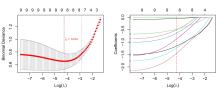
图1
Lasso回归变量筛选注:A,Lasso回归交叉验证图;B,Lasso回归系数路径图"
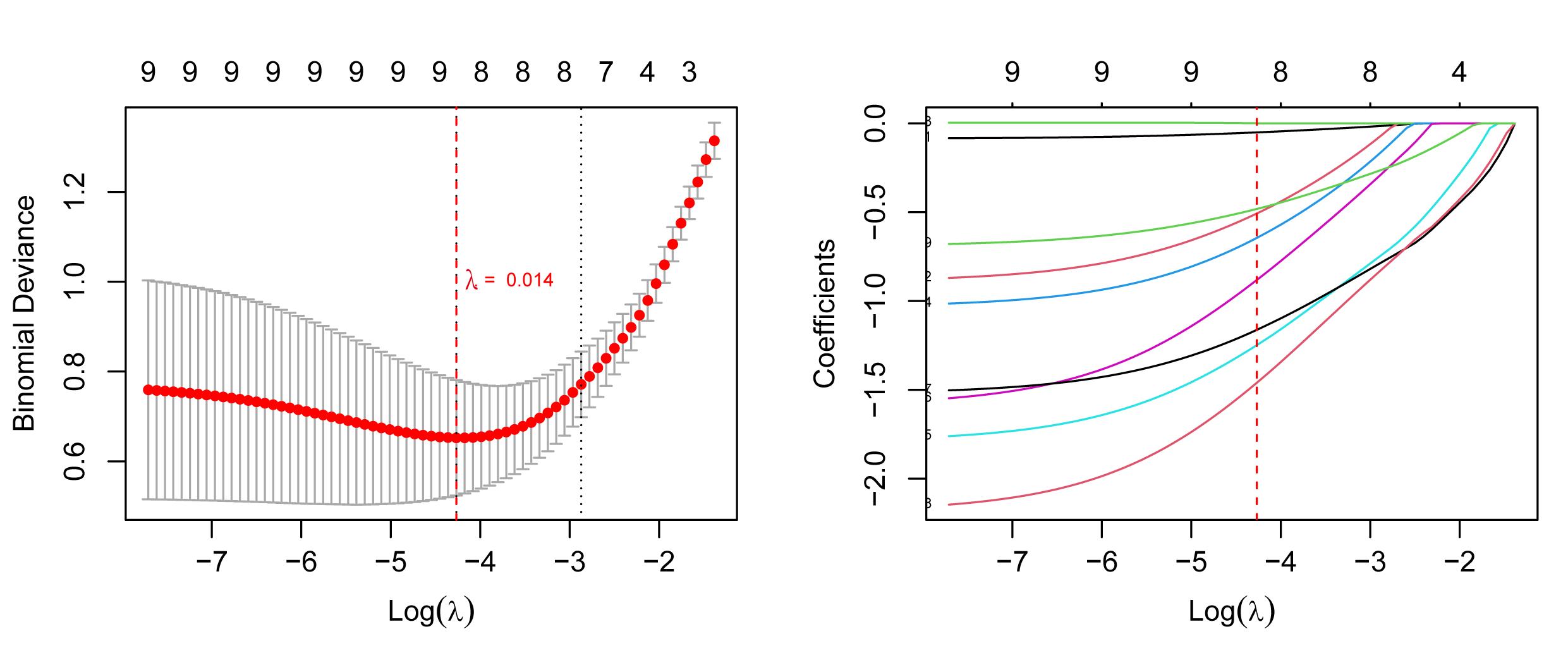
表4
BFT疗效的多因素Logistic回归分析"
| 变量 | β | SE | Wald χ2 | OR | 95% CI | P值 |
|---|---|---|---|---|---|---|
| 肛门静息压 | -0.09 | 0.04 | 5.18 | 0.92 | 0.85 ~ 0.98 | 0.024 |
| 肛管长度 | -0.89 | 0.70 | 1.63 | 0.41 | 0.10 ~ 1.55 | 0.201 |
| 肛管松弛率 | 0.01 | 0.07 | 0.01 | 1.00 | 0.88 ~ 1.15 | 0.955 |
| 排便时间 | -1.03 | 0.63 | 2.72 | 0.36 | 0.09 ~ 1.15 | 0.099 |
| 手助排便 | -1.79 | 0.65 | 7.57 | 0.17 | 0.04 ~ 0.52 | 0.006 |
| 排便不尽感 | -2.19 | 0.72 | 9.23 | 0.11 | 0.02 ~ 0.39 | 0.002 |
| 使用泻药 | -1.52 | 0.61 | 6.23 | 0.22 | -0.06 ~ 0.67 | 0.013 |
| 使用灌肠 | -1.59 | 2.35 | 4.12 | 0.20 | 0.04 ~ 0.80 | 0.042 |
| 满意度 | -0.69 | 0.63 | 4.74 | 0.50 | 0.25 ~ 0.88 | 0.029 |
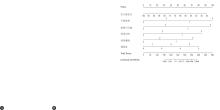
图2
BFT疗效的预测模型列线图"
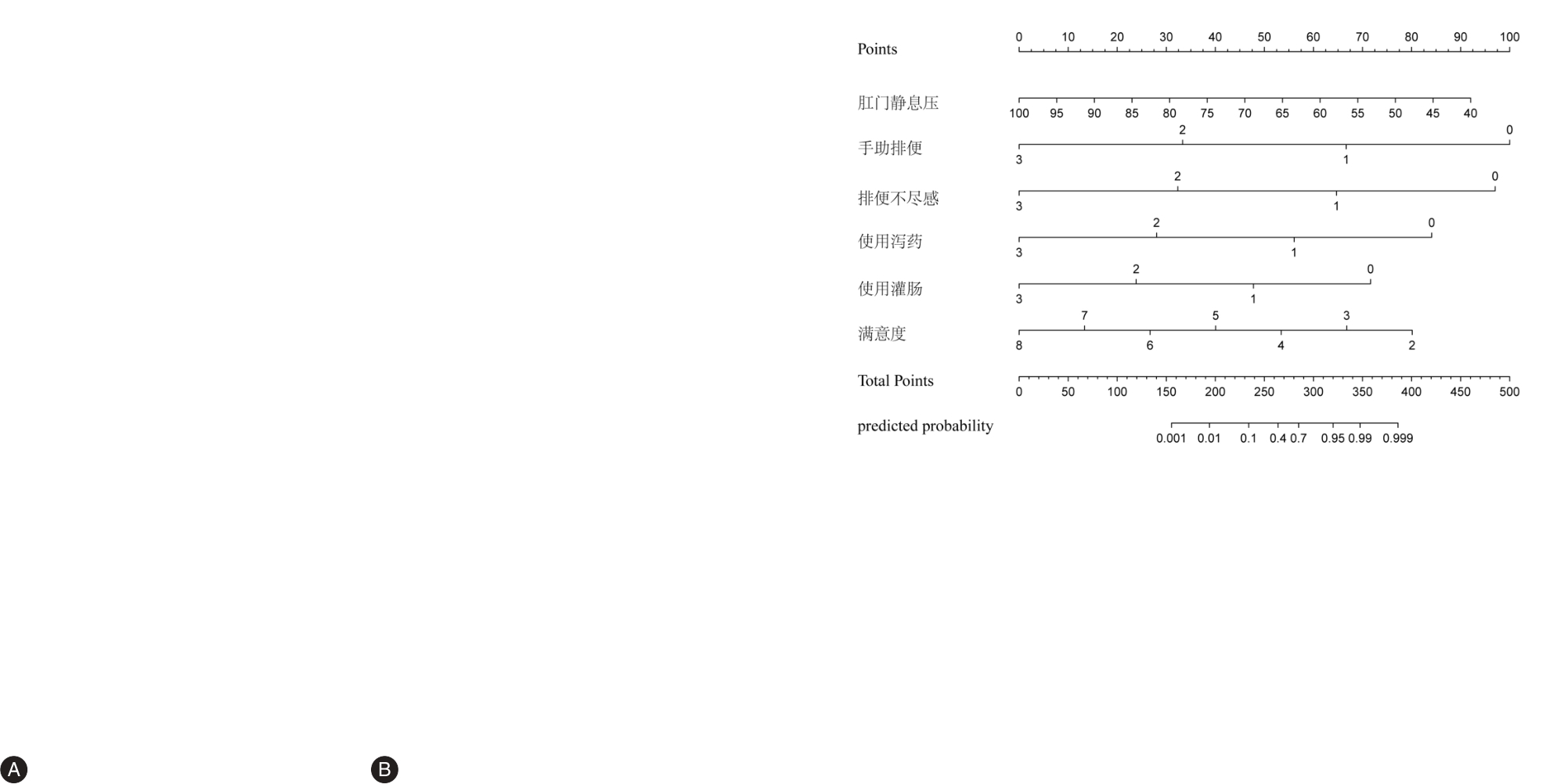
图3
BFT疗效预测模型的性能验证注:A,训练集ROC曲线;B,验证集ROC曲线;C,训练集calibrate校正曲线;D,验证集calibrate校正曲线"
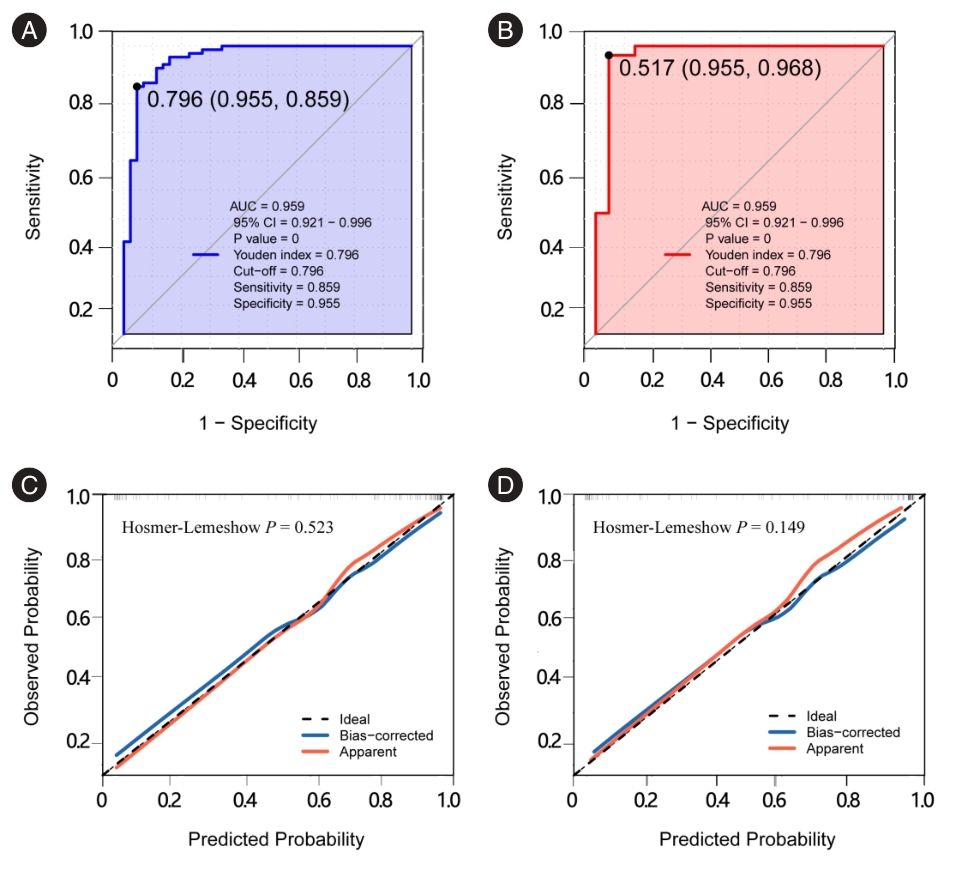
图4
BFT疗效预测模型的临床实用性评估注:A,训练集DCA曲线;B,验证集DCA曲线;C,训练集5折交叉验证;D,验证集5折交叉验证"
| [1] |
SRINIVASAN S G, MUTHYALA A, SHARMA M, et al. Abdomino-anal Dyscoordination in Defecatory Disorders[J]. Clin Gastroenterol Hepatol, 2022, 20: 2091-2101. e2095. doi: 10.1016/j.cgh.2021.11.040 .
doi: 10.1016/j.cgh.2021.11.040 |
| [2] |
SUN F F, CHEN Y Q, JIANG Z L, et al. Botulinum toxin type A injection combined with biofeedback in the treatment of spastic pelvic floor syndrome[J]. World J Clin Cases, 2024, 12: 4905-4912. doi: 10.12998/wjcc.v12.i22.4905 .
doi: 10.12998/wjcc.v12.i22.4905 |
| [3] |
HEINRICH H. Deconstructing Obstructive Defecation Syndrome with Adaptive Biofeedback[J]. Dig Dis Sci, 2022, 67: 1095-1096. doi: 10.1007/s10620-021-07097-w .
doi: 10.1007/s10620-021-07097-w |
| [4] |
WEGH C A M, BAALEMAN D F, TABBERS M M, et al. Nonpharmacologic Treatment for Children with Functional Constipation: A Systematic Review and Meta-analysis[J]. J Pediatr, 2022, 240: 136-149.e5. doi: 10.1016/j.jpeds.2021.09.010 .
doi: 10.1016/j.jpeds.2021.09.010 |
| [5] |
中国慢性便秘专家共识意见( 2019,广州)[J]. 中华消化杂志, 2019, (9): 577-598. doi: 10.3760/cma.j.issn.0254-1432.2019.09.001 .
doi: 10.3760/cma.j.issn.0254-1432.2019.09.001 |
| [6] |
ALAVI K, THORSEN A J, FANG S H, et al. The American Society of Colon and Rectal Surgeons Clinical Practice Guidelines for the Evaluation and Management of Chronic Constipation [J]. Dis Colon Rectum, 2024, 67: 1244-1257. doi:10.1097/dcr.0000000000003430 .
doi: 10.1097/dcr.0000000000003430 |
| [7] |
HOJO M, SHIBUYA T, NAGAHARA A. Management of Chronic Constipation: A Comprehensive Review[J]. Intern Med, 2025, 64(1): 7-15. doi: 10.2169/internalmedicine.2867-23 .
doi: 10.2169/internalmedicine.2867-23 |
| [8] |
PATCHARATRAKUL T, VALESTIN J, SCHMELTZ A, et al. Factors Associated With Response to Biofeedback Therapy for Dyssynergic Defecation[J]. Clin Gastroenterol Hepatol, 2018, 16: 715-721. doi: 10.1016/j.cgh.2017.10.027 .
doi: 10.1016/j.cgh.2017.10.027 |
| [9] |
AZIZ I, WHITEHEAD W E, PALSSON O S, et al. An approach to the diagnosis and management of Rome IV functional disorders of chronic constipation[J]. Expert Rev Gastroenterol Hepatol, 2020, 14: 39-46. doi: 10.1080/17474124.2020.1708718 .
doi: 10.1080/17474124.2020.1708718 |
| [10] |
KILGORE A, KHLEVNER J. Functional Constipation: Pathophysiology, evaluation, and management[J]. Aliment Pharmacol Ther, 2024, 60 : S20-S29. doi: 10.1111/apt.17852 .
doi: 10.1111/apt.17852 |
| [11] |
任晓阳, 殷燕, 闫小妮, 等. 不同检测方法对基于罗马Ⅳ标准的排便障碍型便秘的诊断价值 [J]. 西安交通大学学报(医学版), 2022, 43(6): 867-871. doi: 10.7652/jdyxb202206012 .
doi: 10.7652/jdyxb202206012 |
| [12] |
BUNNI J, LAUGHARNE M J. Pathophysiological basis, clinical assessment, investigation and management of patients with obstruction defecation syndrome[J]. Langenbecks Arch Surg, 2023, 408: 75. doi: 10.1007/s00423-023-02755-1 .
doi: 10.1007/s00423-023-02755-1 |
| [13] |
SADEGHI A, AKBARPOUR E, MAJIDIRAD F, et al. Dyssynergic Defecation: A Comprehensive Review on Diagnosis and Management[J]. Turk J Gastroenterol, 2023, 34: 182-195. doi: 10.5152/tjg.2023.22148 .
doi: 10.5152/tjg.2023.22148 |
| [14] |
TALEBI A, ALIMADADI E, AKBARI A, et al. Improvement of Patient Satisfaction and Anorectal Manometry Parameters After Biofeedback Therapy in Patients with Different Types of Dyssynergic Defecation[J]. Appl Psychophysiol Biofeedback, 2020, 45: 267-274. doi: 10.1007/s10484-020-09476-x .
doi: 10.1007/s10484-020-09476-x |
| [15] |
柴秀红, 杜丽萍, 张华. 生物反馈治疗加护理干预对出口梗阻型便秘的疗效观察[J]. 中国肛肠病杂志, 2019, 39(1): 63-65. doi: 10.3969/j.issn.1000-1174.2019.01.030 .
doi: 10.3969/j.issn.1000-1174.2019.01.030 |
| [16] |
CADEDDU F, SALIS F, DE LUCA E, et al. Efficacy of biofeedback plus transanal stimulation in the management of pelvic floor dyssynergia: A randomized trial[J]. Tech Coloproctol, 2015, 19: 333-338. doi:10.1007/s10151-015-1292-7 .
doi: 10.1007/s10151-015-1292-7 |
| [17] |
金绍兰, 贺潇月. 盆底磁刺激联合生物反馈治疗盆底失弛缓型便秘30例疗效观察[J]. 中国肛肠病杂志, 2021, 41(09): 51-53. doi: 10.3969/j.issn.1000-1174.2021.09.024 .
doi: 10.3969/j.issn.1000-1174.2021.09.024 |
| [18] |
RAO S S, SEATON K, MILLER M, et al. Randomized controlled trial of biofeedback, sham feedback, and standard therapy for dyssynergic defecation[J]. Clin Gastroenterol Hepatol, 2007, 5: 331-338. doi: 10.1016/j.cgh.2006.12.023 .
doi: 10.1016/j.cgh.2006.12.023 |
| [19] |
罗育连, 罗宏标, 唐清珠, 等. 电针联合生物反馈治疗盆底失弛缓型便秘患者疗效及对肛管直肠动力学的影响[J]. 现代中西医结合杂志, 2021, 30(28): 3113-3117+3150. doi: 10.3969/j.issn.1008-8849.2021.28.007 .
doi: 10.3969/j.issn.1008-8849.2021.28.007 |
| [20] |
BENNY S, MATHEWS N V, THOMAS A, et al. Abbreviated anorectal biofeedback therapy is beneficial in symptomatic improvement of functional defecatory disorder[J]. Indian J Gastroenterol, 2025, 44(4): 562. doi: 10.1007/s12664-025-01752-0 .
doi: 10.1007/s12664-025-01752-0 |
| [21] |
HONGYU Z, NANA L, MINGWEI H, et al. Effect of Biofeedback Combined with Psychotherapy on Functional Constipation Complicated with Anxiety and Depression[J]. Appl Psychophysiol Biofeedback, 2025, 50(1): 65-69. doi: 10.1007/s10484-024-09670-1 .
doi: 10.1007/s10484-024-09670-1 |
| [22] |
袁泽峰, 田高源, 黄志伟, 等. 生物反馈联合磁电刺激对盆底痉挛综合征患者排粪梗阻的改善作用[J]. 实用医学杂志, 2025, 41(15): 2372-2380. doi: 10.3969/j.issn.1006-5725.2025.15.012 .
doi: 10.3969/j.issn.1006-5725.2025.15.012 |
| [23] |
MARRA A A, SIMONELLI I, PARELLO A, et al. Analysis of factors that indicated surgery in 400 patients submitted to a complete diagnostic workup for obstructed defecation syndrome and rectal prolapse using a supervised machine learning algorithm[J]. Tech Coloproctol, 2024, 28(1): 73. doi: 10.1007/s10151-024-02951-1 .
doi: 10.1007/s10151-024-02951-1 |
| [24] |
BHARUCHA A E, LACY B E. Mechanisms, Evaluation, and Management of Chronic Constipation[J]. Gastroenterology, 2020, 158(5): 1232-1249. e1233. doi: 10.1053/j.gastro.2019.12.034 .
doi: 10.1053/j.gastro.2019.12.034 |
| [25] |
BHARUCHA A E, KNOWLES C H, MALCOLM A. An Evidence-Based Practical Review on Common Benign Anorectal Disorders: Hemorrhoids, Anal Fissure, Dyssynergic Defecation, and Fecal Incontinence[J]. Gastroenterology, 2026, 170(1): 50-69. doi: 10.1053/j.gastro.2025.07.031 .
doi: 10.1053/j.gastro.2025.07.031 |
| [26] |
MURAD-REGADAS S M, REGADAS F S, BEZERRA C C, et al. Use of Biofeedback Combined With Diet for Treatment of Obstructed Defecation Associated With Paradoxical Puborectalis Contraction (Anismus): Predictive Factors and Short-term Outcome[J]. Dis Colon Rectum, 2016, 59(2): 115-121. doi: 10.1097/dcr.0000000000000519 .
doi: 10.1097/dcr.0000000000000519 |
| [27] |
ISLAM M T, SHEIKH S H, REZA E, et al. Evaluation of Short Term Outcome of Stapled Transanal Rectal Resection (STARR) for ODS (Obstructed Defecation Syndrome) by Comparing Pre and Post-operative ODS Score[J]. Mymensingh Med J, 2022, 31(2): 355-359. PMID: .
pmid: 35383750 |
| [28] |
MAKSOUD W M ABD EL, ABBAS K S, BAWAHAB M A, et al. Prevalence of Obstructed Defecation among Patients Who Underwent Hemorrhoidectomy and Correlation between Preoperative Constipation Score and Postoperative Patients' Satisfaction: A Prospective Study in Two Centers[J]. Healthcare (Basel), 2023, 11(5): 759. doi: 10.3390/healthcare11050759 .
doi: 10.3390/healthcare11050759 |
| [29] |
BARBERIO B, JUDGE C, SAVARINO E V, et al. Global prevalence of functional constipation according to the Rome criteria: A systematic review and meta-analysis[J]. Lancet Gastroenterol Hepatol, 2021, 6(8): 638-648. doi: 10.1016/s2468-1253(21)00111-4 .
doi: 10.1016/s2468-1253(21)00111-4 |
| [30] |
ÖZIN Y, ÖZTÜRK Ö, TENLIK I, et al. Efficacy of combination of biofeedback therapy and pelvic floor muscle training in dyssynergic defecation[J]. Acta Gastroenterol Belg, 2021, 84: 577-583. doi: 10.51821/84.4.008 .
doi: 10.51821/84.4.008 |
| [31] |
LAMBIASE C, Bellini M, Whitehead W E, et al. Biofeedback efficacy for outlet dysfunction constipation: Clinical outcomes and predictors of response by a limited approach[J].Neurogastroenterol Motil, 2025, 37(1):e14948. doi: 10.1111/nmo.14948 .
doi: 10.1111/nmo.14948 |
| [32] |
PANNEMANS J, MASUY I, TACK J. Functional Constipation: Individualising Assessment and Treatment[J]. Drugs, 2020, 80(10): 947-963. doi: 10.1007/s40265-020-01305-z .
doi: 10.1007/s40265-020-01305-z |
| [33] |
SERRA J, POHL D, AZPIROZ F, et al. European society of neurogastroenterology and motility guidelines on functional constipation in adults[J]. Neurogastroenterol Motil, 2020, 32(2): e13762. doi: 10.1111/nmo.13762 .
doi: 10.1111/nmo.13762 |
| [34] |
CHEN Z, PENG Y, SHI Q, et al. Prevalence and Risk Factors of Functional Constipation According to the Rome Criteria in China: A Systematic Review and Meta-Analysis[J]. Front Med (Lausanne), 2022, 9: 815156. doi: 10.3389/fmed.2022.815156 .
doi: 10.3389/fmed.2022.815156 |
| [35] |
CAMILLERI M. Gastrointestinal motility disorders in neurologic disease[J]. J Clin Invest, 2021, 131(4): e143771. doi: 10.1172/jci143771 .
doi: 10.1172/jci143771 |
| [36] |
VRIESMAN M H, KOPPEN I J N, CAMILLERI M, et al. Management of functional constipation in children and adults[J]. Nat Rev Gastroenterol Hepatol, 2020, 17(1): 21-39. doi: 10.1038/s41575-019-0222-y .
doi: 10.1038/s41575-019-0222-y |
| [37] |
RAO S S, PATCHARATRAKUL T. Diagnosis and Treatment of Dyssynergic Defecation[J]. J Neurogastroenterol Motil, 2016, 22: 423-435. doi: 10.5056/jnm16060 .
doi: 10.5056/jnm16060 |
| [38] |
VELDMAN F, HAWINKELS K, KESZTHELYI D. Efficacy of vagus nerve stimulation in gastrointestinal disorders: A systematic review[J]. Gastroenterol Rep (Oxf), 2025, 13: goaf009. doi: 10.1093/gastro/goaf009 .
doi: 10.1093/gastro/goaf009 |
| [39] |
VERMA A, MISRA A, GHOSHAL U C. Effect of biofeedback therapy on anorectal physiological parameters among patients with fecal evacuation disorder[J]. Indian J Gastroenterol, 2017, 36(2): 99-104. doi: 10.1007/s12664-017-0731-y .
doi: 10.1007/s12664-017-0731-y |
| [40] |
GADEL HAK N, EL-HEMALY M, HAMDY E, et al. Pelvic floor dyssynergia: Efficacy of biofeedback training[J]. Arab J Gastroenterol, 2011, 12(1): 15-19. doi: 10.1016/j.ajg.2011.01.001 .
doi: 10.1016/j.ajg.2011.01.001 |
| [41] |
GULCIN N, ANADOLULU A I, CAGLAR M, et al. Evaluation of conventional anorectal manometry and biofeedback therapy in adolescents with functional constipation[J]. North Clin Istanb, 2024, 11(5): 466-470. doi: 10.14744/nci.2023.85126 .
doi: 10.14744/nci.2023.85126 |
| [42] |
袁泽峰, 程敏静, 陈强, 等. 生物反馈疗法在盆底失弛缓型便秘中的研究进展[J]. 实用医学杂志, 2024, 40(24): 3568-3574. doi: 10.3969/j.issn.1006-5725.2024.24.021 .
doi: 10.3969/j.issn.1006-5725.2024.24.021 |
| [43] |
SHIN J K, CHEON J H, KIM E S, et al. Predictive capability of anorectal physiologic tests for unfavorable outcomes following biofeedback therapy in dyssynergic defecation[J]. J Korean Med Sci, 2010, 25(7): 1060-1065. doi: 10.3346/jkms.2010.25.7.1060 .
doi: 10.3346/jkms.2010.25.7.1060 |
| [1] | 吴胜利,谢爱霞,雒肖艳,赵岩,王福刚,伊力哈木·吐尼亚孜null. 促甲状腺激素受体抗体滴度动态变化联合甲状腺超声弹性成像对Graves病复发风险的预警价值[J]. 实用医学杂志, 2026, 42(6): 991-998. |
| [2] | 程守全,刘乃丰,李若水. 冠状动脉钙化患者主动脉瓣钙化危险因素分析及预测模型构建[J]. 实用医学杂志, 2026, 42(4): 668-676. |
| [3] | 王梦苑,孟凡亮. 碳青霉烯类耐药肺炎克雷伯菌感染的危险因素分析及列线图预测模型的构建[J]. 实用医学杂志, 2026, 42(3): 477-485. |
| [4] | 邓波,彭曹霞,熊启连,辇伟奇,刘影. Ⅲ—Ⅳ期肺癌免疫检查点抑制剂治疗30天内非计划再入院风险预测模型[J]. 实用医学杂志, 2026, 42(1): 1-11. |
| [5] | 高盼盼,张倩,刘婷慧,孙洁. 健侧高频重复经颅磁刺激联合生物反馈下的空吞咽训练在脑卒中后吞咽障碍患者中的应用[J]. 实用医学杂志, 2025, 41(8): 1105-1110. |
| [6] | 董魁,吴洁,燕静,刘海涛,王军,乔冠恩. 大肠腺瘤性息肉危险因素及预测模型的构建与验证[J]. 实用医学杂志, 2025, 41(6): 838-845. |
| [7] | 刘冬丽,全梓林,钟灵秀,陈琦琦,蔡文巧,庄森培,魏莹,潘惠仪,林雅文. 儿童先天性心脏病术后抗生素相关性腹泻预测模型的构建与验证[J]. 实用医学杂志, 2025, 41(5): 683-690. |
| [8] | 张宏威,王楠,石国西,翟俊英,钮红丽,王颖. 血清FGF-21、AMH及NRP-1联合预测体外受精-胚胎移植术后孕6周胎停育的模型构建与验证[J]. 实用医学杂志, 2025, 41(22): 3480-3489. |
| [9] | 杨秀冬,刘星,刘鑫,姜岩,王维,何宗斌,黄沙,文美红,刘亚珍. 腹腔镜下根治性前列腺切除术后淋巴漏风险预测模型的构建与验证[J]. 实用医学杂志, 2025, 41(21): 3378-3384. |
| [10] | 王照,左解鹏,车航,任凌云,徐哲,王磊. 血浆PPARγ作为女性间质性膀胱炎/膀胱疼痛综合征潜在诊断标志物的评估及其预测价值[J]. 实用医学杂志, 2025, 41(2): 258-263. |
| [11] | 王翠翠,乔万通,姚俊英,李倩,高维鸽,范旻. 营养控制状态评分联合预后营养指数评估老年结直肠癌患者合并贫血风险的临床应用价值[J]. 实用医学杂志, 2025, 41(17): 2696-2704. |
| [12] | 王兆阳,张楠. 基于CT影像组学与中医舌象特征构建肝细胞癌根治术后早期复发的Nomogram预测模型[J]. 实用医学杂志, 2025, 41(16): 2590-2596. |
| [13] | 张红,章容,杨鹏程,罗丽艳,张文龙,成玉蓉,刘文琳,董文斌. 大理高海拔地区早产儿呼吸窘迫综合征发生风险的列线图预测模型构建[J]. 实用医学杂志, 2025, 41(15): 2342-2348. |
| [14] | 袁泽峰,田高源,黄志伟,曹玉婷,孔斌. 生物反馈联合磁电刺激对盆底痉挛综合征患者排粪梗阻的改善作用[J]. 实用医学杂志, 2025, 41(15): 2372-2380. |
| [15] | 丘海,归奕飞,刘媛. 术前腋窝超声正常的临床T1—2 N0乳腺癌患者发生前哨淋巴结转移的预测模型[J]. 实用医学杂志, 2025, 41(14): 2143-2151. |
| 阅读次数 | ||||||
|
全文 |
|
|||||
|
摘要 |
|
|||||
