

The Journal of Practical Medicine ›› 2026, Vol. 42 ›› Issue (15): 2684-2691.doi: 10.3969/j.issn.1006-5725.2026.15.002
• Cardiovascular and Cerebrovascular Diseases Column • Previous Articles
Liangxian LIU1,Li LI1,Lihong HAN1,Zhijuan HE1,Zuhong WANG1,Peidong HUANG2,Xuejiao PAN1( )
)
Received:2026-05-07
Revised:2026-06-16
Accepted:2026-06-17
Online:2026-08-10
Published:2026-08-13
Contact:
Xuejiao PAN
E-mail:57284743@qq.com
CLC Number:
Liangxian LIU,Li LI,Lihong HAN,Zhijuan HE,Zuhong WANG,Peidong HUANG,Xuejiao PAN. Effects of acupuncture of time acupoint space based on Linggui Bafa on serum 5-hydroxytryptamine and sleep quality in patients with sleep disorders following ischemic stroke[J]. The Journal of Practical Medicine, 2026, 42(15): 2684-2691.
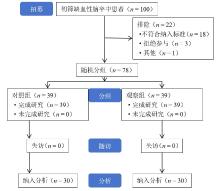
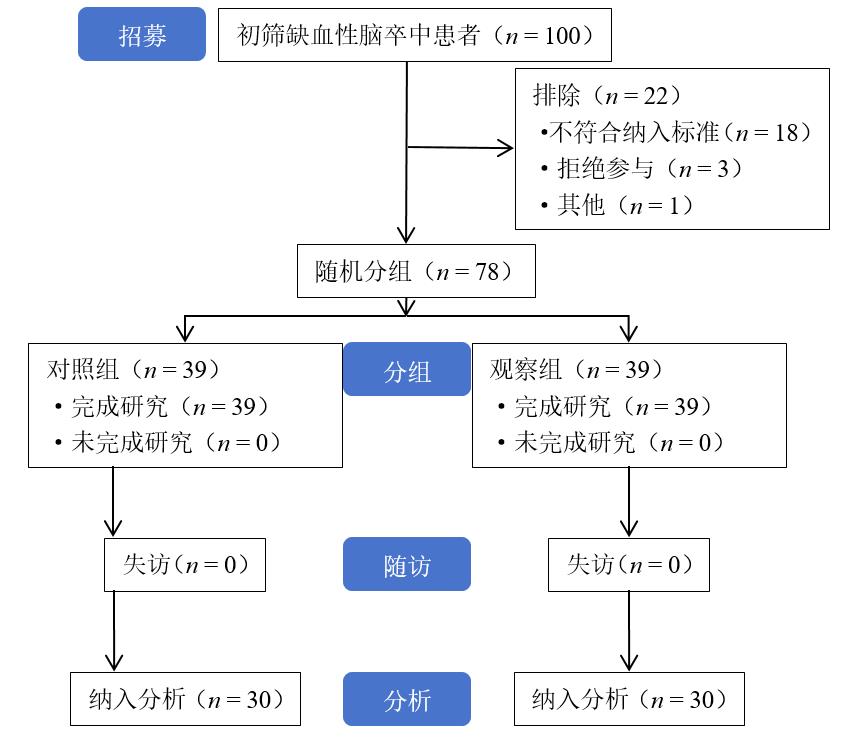
Fig.1
CONSORT flow diagram"
Tab.1
Comparison of general data between the two groups"
| 项目 | 对照组 (n = 39) | 观察组 (n = 39) | t/χ2值 | P值 |
|---|---|---|---|---|
| 性别 | 0.21 | 0.65 | ||
| 男 | 22(56.41) | 20(51.28) | ||
| 女 | 17(43.59) | 19(48.72) | ||
| 年龄(x ± s)/岁 | 61.34 ± 8.72 | 62.05 ± 8.49 | 0.36 | 0.72 |
| 脑卒中病程(x ± s)/d | 38.65 ± 12.47 | 39.12 ± 13.06 | 0.16 | 0.87 |
| 文化程度 | 0.40 | 0.82 | ||
| 小学及以下 | 10(25.64) | 12(30.77) | ||
| 初中及高中 | 19(48.72) | 19(48.72) | ||
| 大专及以上 | 10(25.64) | 8(20.51) | ||
| 缺血性脑卒中分型 | 0.53 | 0.91 | ||
| 大动脉粥样硬化型 | 10(25.64) | 12(30.77) | ||
| 小血管闭塞型 | 18(46.15) | 15(38.46) | ||
| 心源性栓塞型 | 6(15.38) | 7(17.95) | ||
| 其他 | 5(12.82) | 5(15.38) | ||
| 高血压病史 | 0.06 | 0.81 | ||
| 有 | 25(64.10) | 26(66.67) | ||
| 无 | 14(35.90) | 13(33.33) | ||
| 糖尿病史 | 0.25 | 0.62 | ||
| 有 | 12(30.77) | 10(25.65) | ||
| 无 | 27(69.23) | 29(74.36) | ||
| 心脏病史 | 0.08 | 0.77 | ||
| 有 | 8(20.51) | 7(17.95) | ||
| 无 | 31(79.49) | 32(82.05) | ||
| 失眠病程( | 4.72 ± 1.31 | 4.69 ± 1.27 | 0.10 | 0.92 |
| 肢体瘫痪程度 | 0.24 | 0.89 | ||
| 轻度 | 14(35.90) | 16(41.03) | ||
| 中度 | 18(46.15) | 17(43.59) | ||
| 重度 | 7(17.95) | 6(15.38) |
Tab.2
Repeated measures ANOVA of scale scores between the two groups"
| 项目 | 对照组(n = 39) | 观察组(n = 39) | F时间, P时间 | F组间, P组间 | F交互, P交互 |
|---|---|---|---|---|---|
| FSS评分 | 66.81, < 0.01 | 40.12, < 0.01 | 13.28, < 0.01 | ||
| 治疗前 | 48.35 ± 6.20 | 48.62 ± 6.16 | |||
| 治疗1周后 | 45.03 ± 6.02 | 40.35 ± 5.84ac | |||
| 治疗3周后 | 42.16 ± 5.95a | 32.48 ± 5.49abc | |||
| PSQI总分 | 71.51, < 0.01 | 41.65, < 0.01 | 18.46, < 0.01 | ||
| 治疗前 | 12.47 ± 2.34 | 12.62 ± 2.31 | |||
| 治疗1周后 | 11.52 ± 2.27 | 9.45 ± 2.08ac | |||
| 治疗3周后 | 10.48 ± 2.21a | 6.53 ± 1.84abc | |||
| HADS总分 | 52.17, < 0.01 | 40.03, < 0.01 | 8.16, < 0.01 | ||
| 治疗前 | 18.24 ± 4.21 | 18.31 ± 4.13 | |||
| 治疗1周后 | 16.38 ± 3.97 | 13.15 ± 3.50ac | |||
| 治疗3周后 | 14.26 ± 3.73a | 9.24 ± 2.98abc | |||
| NIHSS评分 | 28.66, < 0.01 | 11.00, < 0.01 | 4.24, 0.02 | ||
| 治疗前 | 8.46 ± 3.06 | 8.53 ± 3.02 | |||
| 治疗1周后 | 7.52 ± 2.88 | 6.04 ± 2.49ac | |||
| 治疗3周后 | 6.48 ± 2.68a | 4.12 ± 2.11abc |
Tab.3
Repeated measures ANOVA of serological indicators between the two groups"
| 组别 | 5-HT | MT | ||||
|---|---|---|---|---|---|---|
| 治疗前 | 治疗1周后 | 治疗3周后 | 治疗前 | 治疗1周后 | 治疗3周后 | |
| 对照组(n = 39) | 85.34 ± 15.46 | 90.18 ± 15.62 | 95.26 ± 15.88a | 25.18 ± 8.35 | 28.35 ± 8.67 | 32.14 ± 9.24a |
| 观察组(n = 39) | 84.92 ± 15.38 | 105.34 ± 18.48ac | 128.45 ± 20.63abc | 24.86 ± 8.29 | 38.42 ± 10.41ac | 52.36 ± 12.61abc |
| F时间, P时间 | 47.13, < 0.01 | 65.42, < 0.01 | ||||
| F组间, P组间 | 53.77, < 0.01 | 54.98, < 0.01 | ||||
| F交互, P交互 | 18.65, < 0.01 | 23.24, < 0.01 | ||||
Tab.4
Comparison of clinical efficacy between the two groups"
| 组别 | 显效 | 有效 | 无效 | 总有效率 |
|---|---|---|---|---|
| 对照组(n = 39) | 12(30.77) | 17(43.59) | 10(25.64) | 29(74.36) |
| 观察组(n = 39) | 21(53.85) | 15(38.46) | 3(7.69) | 36(92.31) |
| χ2值 | 4.523 | |||
| P值 | 0.033 |
| [1] |
李航, 冯梓柚, 张宇, 等. 中国脑卒中及亚型疾病负担趋势分析与预测研究[J]. 现代预防医学, 2025, 52(12): 2113-2119, 2145. doi:10.20043/j.cnki.MPM.202410110 .
doi: 10.20043/j.cnki.MPM.202410110 |
| [2] |
方崇涛, 苗丹, 刘广志. 《2024年中国脑卒中防治报告》解读——疾病负担、主要危险因素及诊疗进展[J]. 实用心脑肺血管病杂志, 2026, 34(4): 1-8. doi:10.12114/j.issn.1008-5971. 2026.00.102 .
doi: 10.12114/j.issn.1008-5971. 2026.00.102 |
| [3] |
林发. 2020年中国脑卒中负担评估[J]. 中华医学杂志, 2023, 103(17): 1279. doi:10.3760/cma.j.issn.0376-2491.2023.17.101 .
doi: 10.3760/cma.j.issn.0376-2491.2023.17.101 |
| [4] |
SUN S, ZHENG Y, XU L, et al. The impact of periodic leg movements during sleep on neurological recovery in patients with acute mild cerebral infarction[J]. Front Neurol, 2025, 16: 1610871. doi:10.3389/fneur.2025.1610871 .
doi: 10.3389/fneur.2025.1610871 |
| [5] |
王丹, 钟建国. 基于“多感官刺激”理论的中医综合康复方案对老年缺血性脑卒中后失眠患者睡眠功能的影响[J]. 实用医学杂志, 2021, 37(12): 1619-1625. doi:10.3969/j.issn.1006-5725.2021.12.021 .
doi: 10.3969/j.issn.1006-5725.2021.12.021 |
| [6] | 王晓, 鲁玉宝, 王学习, 等. 灵龟八法治疗中风病的研究进展[J]. 中华中医药杂志, 2023, 38(4): 1718-1722. |
| [7] |
林润, 罗菁, 许明珠, 等. 不同针灸方法治疗缺血性卒中下肢功能障碍疗效的系统评价[J]. 中国康复医学杂志, 2023, 38(1): 87-94. doi:10.3969/j.issn.1001-1242.2023.01.016 .
doi: 10.3969/j.issn.1001-1242.2023.01.016 |
| [8] |
赵琦, 王程婷, 曹灿灿. “调神潜阳” 针刺法对伴有高血压的卒中相关睡眠障碍患者血压及睡眠质量的影响[J]. 中国针灸, 2022, 42(2): 126-130. doi:10.13703/j.0255-2930.20210223-k0002 .
doi: 10.13703/j.0255-2930.20210223-k0002 |
| [9] |
中华医学会神经病学分会, 中华医学会神经病学分会脑血管病学组. 中国急性缺血性脑卒中诊治指南2018[J]. 中华神经科杂志, 2018, 51(9): 666-682. doi:10.3760/cma.j.issn.1006-7876.2018.09.004 .
doi: 10.3760/cma.j.issn.1006-7876.2018.09.004 |
| [10] |
中国睡眠研究会. 中国失眠症诊断和治疗指南[J]. 中华医学杂志,2017,97(24):1844-1856. doi: 10.3760/cma.j.issn.0376-2491.2017.24.002 .
doi: 10.3760/cma.j.issn.0376-2491.2017.24.002 |
| [11] |
路桃影, 李艳, 夏萍, 等. 匹兹堡睡眠质量指数的信度及效度分析[J]. 重庆医学, 2014, 43(3): 260-263. doi:10.3969/j.issn.1671-8348.2014.03.002 .
doi: 10.3969/j.issn.1671-8348.2014.03.002 |
| [12] |
吴春薇, 王得新. 疲劳严重度量表中译本应用于脑梗死患者的临床与评价[J]. 中华物理医学与康复杂志, 2007, 29(9): 608-611. doi:10.3760/j.issn:0254-1424.2007.09.009 .
doi: 10.3760/j.issn:0254-1424.2007.09.009 |
| [13] |
孙振晓, 刘化学, 焦林瑛, 等. 医院焦虑抑郁量表的信度及效度研究[J/OL]. 中华临床医师杂志(电子版), 2017, 11(2): 198-201. doi:10.3877/cma.j.issn.1674-0785.2017.02.005 .
doi: 10.3877/cma.j.issn.1674-0785.2017.02.005 |
| [14] |
陶子荣. 我国脑卒中患者临床神经功能缺损评分标准信度、效度及敏感度的评价[J]. 第二军医大学学报, 2009, 30(3): 283-285. doi:10.3724/SP.J.1008.2009.00283 .
doi: 10.3724/SP.J.1008.2009.00283 |
| [15] |
CHEN P, WANG W, BAN W, et al. Deciphering post-stroke sleep disorders: Unveiling neurological mechanisms in the realm of brain science[J]. Brain Sci, 2024, 14(4): 307. doi:10.3390/brainsci14040307 .
doi: 10.3390/brainsci14040307 |
| [16] |
SONG Z, CHEN Y, LI J, et al. Comparative effectiveness of different treatments for post-stroke insomnia: A network meta-analysis[J]. Heliyon, 2023, 9(11): e21801. doi:10.1016/j.heliyon.2023.e21801 .
doi: 10.1016/j.heliyon.2023.e21801 |
| [17] |
刘亮先, 王祖红, 方永江, 等. 时空针灸治疗失眠的疗效观察及对血清褪黑素和5-羟色胺水平的影响[J]. 上海针灸杂志, 2025, 44(4): 402-406. doi: 10.13460/j.issn.1005-0957.2025.04. 0402 .
doi: 10.13460/j.issn.1005-0957.2025.04. 0402 |
| [18] |
QI S, QIAN J, LI Y, et al. Effect of acupuncture at Back-Shu points on gut microbiota in insomnia model rats based on metagenomic sequencing technology[J]. Front Microbiol, 2025, 16: 1541958. doi:10.3389/fmicb.2025.1541958 .
doi: 10.3389/fmicb.2025.1541958 |
| [19] |
向凡, 王辉, 王芳芳. 穴位艾灸结合中医康复护理对缺血性脑卒中患者上肢功能、神经功能和生活质量的影响[J]. 保健医学研究与实践, 2023, 20(10): 113-116. doi:10.11986/j.issn. 1673-873X.2023.10.022 .
doi: 10.11986/j.issn. 1673-873X.2023.10.022 |
| [20] |
LIAO C, TAO S, XIONG Y, et al. The effects and potential mechanisms of moxibustion for rheumatoid arthritis-related pain: A randomized, controlled trial[J]. J Pain Res, 2023, 16: 1739-1749. doi:10.2147/jpr.s408814 .
doi: 10.2147/jpr.s408814 |
| [21] |
SHI M, YANG J, LIU Y, et al. Huanglian Wendan decoction improves insomnia in rats by regulating BDNF/TrkB signaling pathway through gut microbiota-mediated SCFAs and affecting microglia polarization[J]. Mol Neurobiol, 2025, 62(1): 1047-1066. doi:10.1007/s12035-024-04330-1 .
doi: 10.1007/s12035-024-04330-1 |
| [22] |
CAO L, SHEN M, YU H, et al. Clinical effect of the warm acupuncture of Mongolian medicine on insomnia in the elderly and its brain-gut peptide mechanism: a randomized controlled trial[J]. Zhongguo Zhen Jiu, 2024,44(7):787-791. doi:10.13703/j.0255-2930.20230816-k0001 .
doi: 10.13703/j.0255-2930.20230816-k0001 |
| [23] |
黄卫权, 蒋妍, 支胜利. 米氮平联合经颅直流电刺激治疗难治性抑郁症的疗效及对5-HT、BDNF水平的影响[J]. 中国现代医学杂志, 2025, 35(8): 92-96. doi: 10.3969/j.issn.1005-8982. 2025.08.016 .
doi: 10.3969/j.issn.1005-8982. 2025.08.016 |
| [24] |
SHI W, WU L, QIN Q, et al. Research progress on the role of microbiome-immune-neurotransmitter network in post-stroke sleep disorders[J]. Front Aging Neurosci, 2025, 17: 1694709. doi:10.3389/fnagi.2025.1694709 .
doi: 10.3389/fnagi.2025.1694709 |
| [25] |
杨涵棋, 何玲娜. 基于“原络配穴”针刺联合艾灸治疗脑梗死相关失眠的疗效及对血清下丘脑泌素-1、5羟色胺和脑电慢波的影响[J]. 实用医学杂志, 2025, 41(8): 1253-1258. doi: 10.3969/j.issn.1006-5725.2025.08.024 .
doi: 10.3969/j.issn.1006-5725.2025.08.024 |
| [26] |
向毅明, 柳州, 赵玲玲, 等. 脑卒中患者睡眠质量、睡眠中点与抑郁的关系[J]. 卒中与神经疾病, 2024, 31(5): 490-493, 501. doi: 10.3969/j.issn.1007-0478.2024.05.012 .
doi: 10.3969/j.issn.1007-0478.2024.05.012 |
| [27] |
周晨. 中医艾灸联合中药塌渍对失眠病人睡眠质量及负性情绪的影响[J]. 护理研究, 2025, 39(21): 3676-3681. doi:10.12102/j.issn.1009-6493.2025.21.019 .
doi: 10.12102/j.issn.1009-6493.2025.21.019 |
| [28] |
HUANG X, LI R, ZHANG S, et al. Effects of integrative therapy with Du Meridian moxibustion, ear acupuncture, and alprazolam on cardiac function and neurotransmitter levels in patients with coronary heart disease and insomnia: An observational study[J].Medicine (Baltimore), 2024,103(34):e39318. doi:10.1097/MD.0000000000039318 .
doi: 10.1097/MD.0000000000039318 |
| Viewed | ||||||
|
Full text |
|
|||||
|
Abstract |
|
|||||
