

The Journal of Practical Medicine ›› 2026, Vol. 42 ›› Issue (5): 884-891.doi: 10.3969/j.issn.1006-5725.2026.05.021
• Treatise: Clinical Practice • Previous Articles
Ao YU,Yong ZHOU,Bo DAI,Gefei ZHAO( )
)
Received:2025-11-03
Online:2026-03-10
Published:2026-03-09
Contact:
Gefei ZHAO
E-mail:zgf6160@sina.com
CLC Number:
Ao YU,Yong ZHOU,Bo DAI,Gefei ZHAO. Application of indocyanine green fluorescent staining method in thoracoscopic anatomical lung segmentectomy[J]. The Journal of Practical Medicine, 2026, 42(5): 884-891.

Tab.1
Basic clinical information of patients"
| 临床资料 | 观察组(n = 112) | 对照组(n = 98) | t/χ2值 | P值 |
|---|---|---|---|---|
| 年龄(x ± s)/岁 | 58.12 ± 10.97 | 58.84 ± 9.57 | -0.522 | 0.602 |
| 性别 | 0.336 | 0.562 | ||
| 男 | 49(43.8) | 39(39.8) | ||
| 女 | 63(56.2) | 59(60.2) | ||
| 吸烟史 | 0.911 | 0.340 | ||
| 有 | 43(38.4) | 44(44.9) | ||
| 无 | 69(61.6) | 54(55.1) | ||
| COPD | 3.642 | 0.056 | ||
| 有 | 14(12.5) | 22(22.4) | ||
| 无 | 98(87.5) | 76(77.6) | ||
| 靶段 | 10.686 | 0.382 | ||
| RS1 | 11(9.8) | 13(13.3) | ||
| RS2 | 9(8.0) | 15(15.3) | ||
| RS3 | 11(9.8) | 6(6.1) | ||
| RS6 | 6(5.4) | 5(5.1) | ||
| RS7+8 | 13(11.6) | 10(10.2) | ||
| RS9+10 | 9(8.0) | 9(9.2) | ||
| LS1+2 | 7(6.2) | 5(5.1) | ||
| LS1+2+3 | 12(10.7) | 8(8.2) | ||
| LS4+5 | 11(9.8) | 8(8.2) | ||
| LS6 | 7(6.2) | 13(13.3) | ||
| LS7+8 | 16(14.3) | 6(6.1) | ||
| 肺结节大小(x ± s)/cm | 1.54 ± 0.50 | 1.52 ± 0.50 | -0.221 | 0.825 |
| 肺结节CTR值(x ± s) | 0.50 ± 0.29 | 0.46 ± 0.29 | -1.104 | 0.270 |
| 肺结节性质 | 0.221 | 0.974 | ||
| 良性 | 9(8.0) | 9(9.2) | ||
| 原位腺癌 | 31(27.7) | 28(28.6) | ||
| 微浸润腺癌 | 49(43.8) | 43(43.9) | ||
| 浸润性腺癌 | 23(20.5) | 18(18.4) |
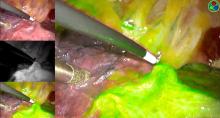
Fig.1
Intersegmental plane displayed under fluorescent laparoscope"
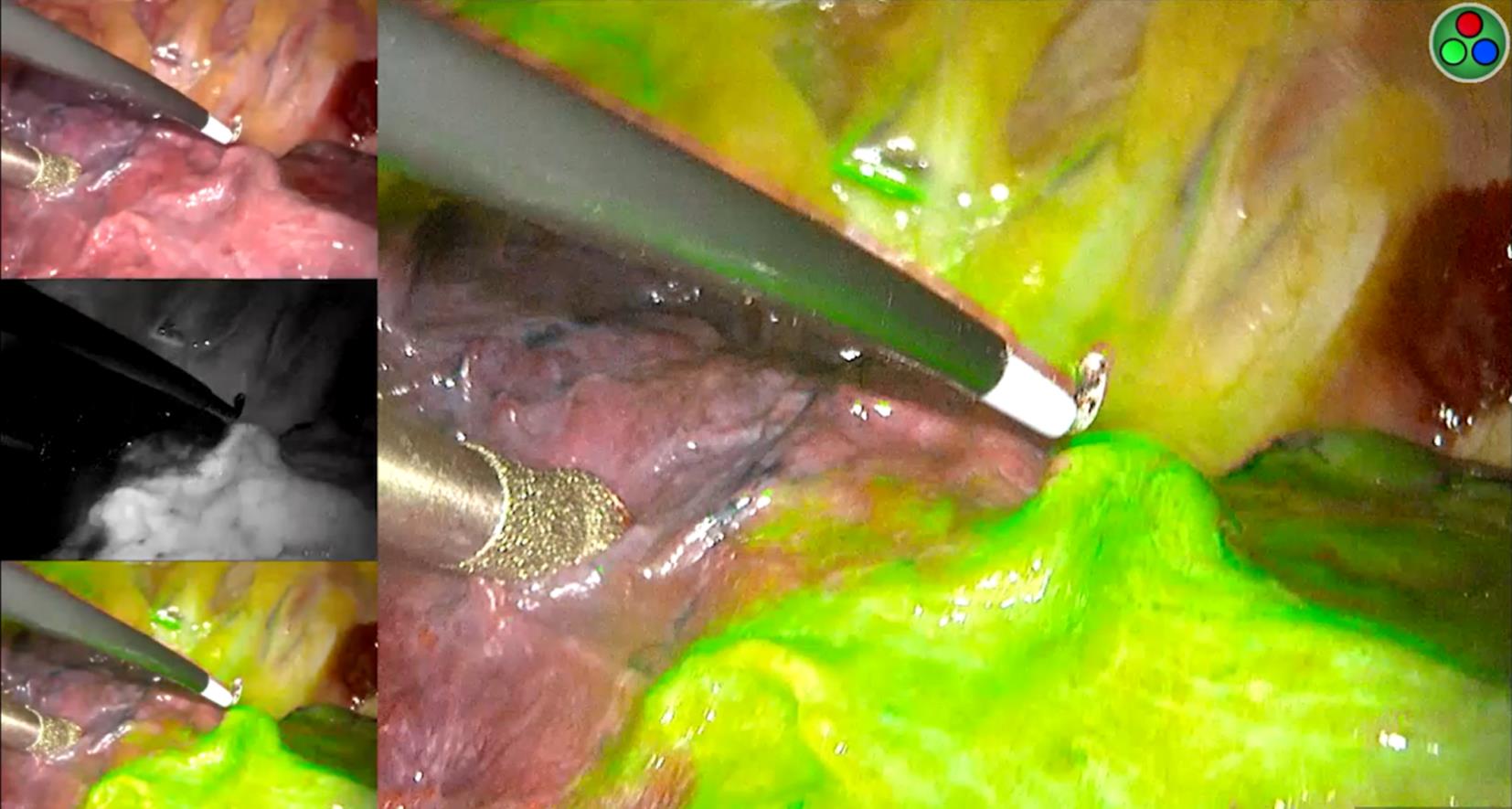
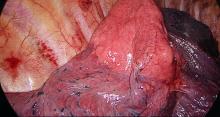
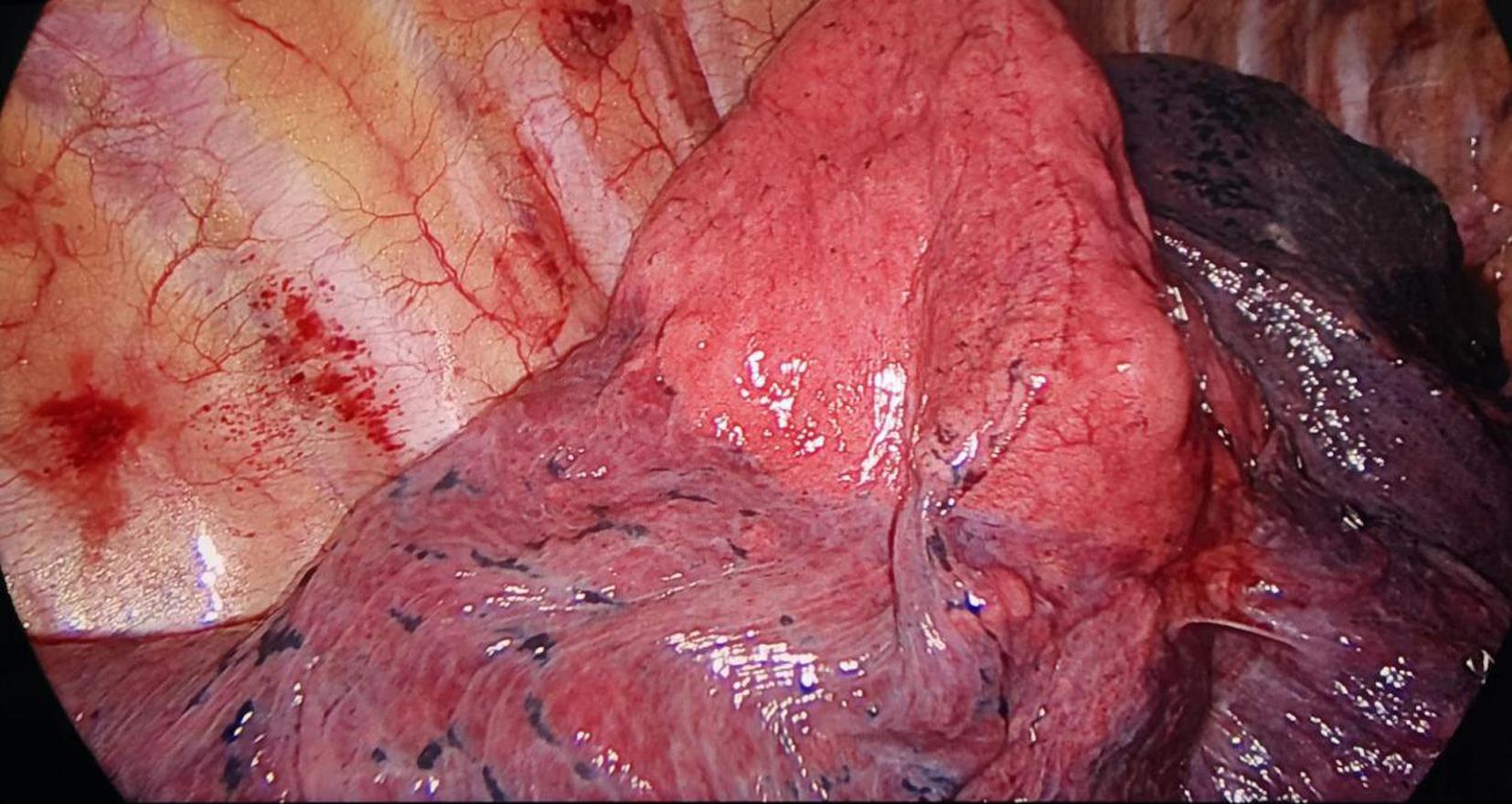
Fig.2
Intersegmental plane displayed by the inflation-deflation method"
Tab.2
Comparison of surgical conditions between the two groups"
| 观察指标 | 观察组(n = 112) | 对照组(n = 98) | t/χ2值 | P值 |
|---|---|---|---|---|
| 手术时间/min | 87.4 ± 14.1 | 100.7 ± 14.3 | -5.718 | < 0.001 |
| 术中出血量/mL | 74.2 ± 13.8 | 74.9 ± 15.4 | -0.420 | 0.674 |
| 段间平面出现时间/s | 11.0 ± 2.0 | 962.7 ± 101.3 | -12.515 | < 0.001 |
| 段间平面持续时间/s | 103.4 ± 37.4 | - | - | - |
| 淋巴结清扫组数/组 | 2.0 ± 0.8 | 2.0 ± 0.8 | -0.043 | 0.965 |
| 结节与切缘距离/cm | 3.0 ± 1.5 | 3.0 ± 1.4 | -0.430 | 0.667 |
| 肺结节R0切除/[例(%)] | 112(100.0) | 98(100.0) | - | - |
| 术后住院时间/d | 3.5 ± 1.2 | 3.5 ± 1.2 | -0.357 | 0.721 |
| 胸腔黏连/[例(%)] | 1.406 | 0.236 | ||
| 有 | 13(11.6) | 17(17.3) | ||
| 无 | 99(88.4) | 81(82.7) |
Tab.3
Comparison of complications between the two groups"
| 观察指标 | 观察组(n = 112) | 对照组(n = 98) | χ2值 | P值 |
|---|---|---|---|---|
| 咯血 | 10(8.9) | 8(8.2) | 0.039 | 0.843 |
| 肺不张 | 5(4.5) | 6(6.1) | 0.290 | 0.591 |
| 肺部感染 | 4(3.6) | 9(9.2) | 2.835 | 0.092 |
| 心律失常 | 3(2.7) | 7(7.1) | 2.297 | 0.130 |
| 持续性肺漏气 | 12(10.7) | 16(16.3) | 1.425 | 0.233 |
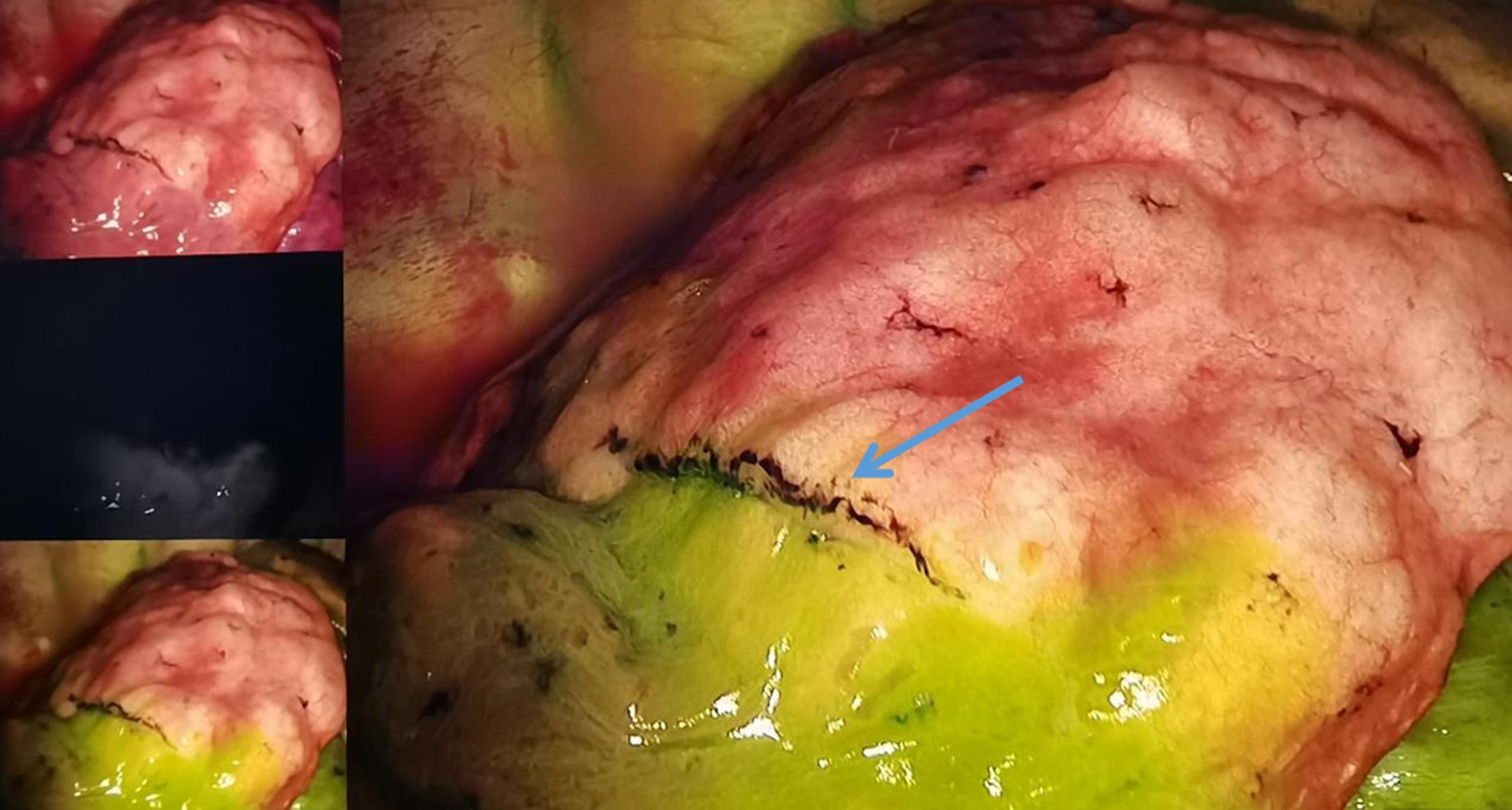
Fig.3
Comparison between the intersegmental planes displayed by the inflation-deflation method andthe fluorescent staining method, and the natural pulmonary segment boundaries"
| [1] |
HAN B, ZHENG R, ZENG H, et al. Cancer incidence and mortality in China, 2022[J]. J Natl Cancer Cent, 2024,4(1):47-53. doi: 10.1016/j.jncc.2024.01.006 .
doi: 10.1016/j.jncc.2024.01.006 |
| [2] |
PATEL A J, LAMPRIDIS S, BILLE A. Evolving Resection Strategies for Non-Small Cell Lung Cancers: Translating Trial Evidence to Real-World Practice[J]. Cancers (Basel), 2025,17(21):3437. doi: 10.3390/cancers17213437 .
doi: 10.3390/cancers17213437 |
| [3] |
SAJI H, OKADA M, TSUBOI M, et al. Segmentectomy versus lobectomy in small-sized peripheral non-small-cell lung cancer (JCOG0802/WJOG4607L): A multicentre, open-label, phase 3, randomised, controlled, non-inferiority trial[J]. Lancet, 2022,399(10335):1607-1617. doi: 10.1016/S0140-6736(21)02333-3 .
doi: 10.1016/S0140-6736(21)02333-3 |
| [4] |
ALTORKI N, WANG X, DAMMAN B, et al. Lobectomy, segmentectomy, or wedge resection for peripheral clinical T1aN0 non-small cell lung cancer: A post hoc analysis of CALGB 140503 (Alliance)[J]. J Thorac Cardiovasc Surg, 2024,167(1):338-347. doi: 10.1016/j.jtcvs.2023.07.008 .
doi: 10.1016/j.jtcvs.2023.07.008 |
| [5] |
NEX G, SCHIAVONE M, DE P A, et al. How to identify intersegmental planes in performing sublobar anatomical resections[J]. J Thorac Dis, 2020,12(6):3369-3375. doi: 10.21037/jtd.2020.01.09 .
doi: 10.21037/jtd.2020.01.09 |
| [6] |
ANDOLFI M, POTENZA R, SEGUIN-GIVELET A, et al. Identification of the intersegmental plane during thoracoscopic segmentectomy: State of the art[J]. Interact Cardiovasc Thorac Surg, 2020,30(3):329-336. doi: 10.1093/icvts/ivz278 .
doi: 10.1093/icvts/ivz278 |
| [7] |
XING M, TONG L, DUAN H, et al. Partial pressure of oxygen control versus modified inflation-deflation method in identifying intersegmental plane during anatomical sublobectomy: A prospective, randomized, controlled trial[J]. J Thorac Dis, 2025,17(2):1042-1053. doi: 10.21037/jtd-2025-45 .
doi: 10.21037/jtd-2025-45 |
| [8] |
CAI L, WANG C, LUO T, et al. Delineation of intersegmental plane: Application of blood flow blocking method in pulmonary segmentectomy[J]. J Cardiothorac Surg, 2024,19(1):684. doi: 10.1186/s13019-024-03133-8 .
doi: 10.1186/s13019-024-03133-8 |
| [9] |
ONODERA K, SUZUKI J, MIYOSHI T, et al. Comparison of various lung intersegmental plane identification methods[J]. Gen Thorac Cardiovasc Surg, 2023,71(2):90-97. doi: 10.1007/s11748-022-01885-5 .
doi: 10.1007/s11748-022-01885-5 |
| [10] |
ZHANG X, LI C, JIN R, et al. Intraoperative Identification of the Intersegmental Plane: From the Beginning to the Future[J]. Front Surg, 2022,9:948878. doi: 10.3389/fsurg.2022.948878 .
doi: 10.3389/fsurg.2022.948878 |
| [11] |
CASSINOTTI E, BONI L, BALDARI L. Application of indocyanine green (ICG)-guided surgery in clinical practice: Lesson to learn from other organs-an overview on clinical applications and future perspectives[J]. Updates Surg, 2023,75(2):357-365. doi: 10.1007/s13304-022-01361-y .
doi: 10.1007/s13304-022-01361-y |
| [12] |
HORISBERGER K, ROSSLER F, OBERKOFLER C E, et al. The value of intraoperative dynamic liver function test ICG in predicting postoperative complications in patients undergoing staged hepatectomy: A pilot study[J]. Langenbecks Arch Surg, 2023,408(1):264. doi: 10.1007/s00423-023-02983-5 .
doi: 10.1007/s00423-023-02983-5 |
| [13] |
ZHANG P, LUO H, ZHU W, et al. Real-time navigation for laparoscopic hepatectomy using image fusion of preoperative 3D surgical plan and intraoperative indocyanine green fluorescence imaging[J]. Surg Endosc, 2020,34(8):3449-3459. doi: 10.1007/s00464-019-07121-1 .
doi: 10.1007/s00464-019-07121-1 |
| [14] |
冯其柱,徐喆,孙杰,等. 经外周静脉和胆囊注射吲哚菁绿在腹腔镜困难胆囊切除术中应用效果对比[J]. 实用医学杂志,2024,40(11):1537-1541. doi: 10.3969/j.issn.1006-5725. 2024. 11.012 .
doi: 10.3969/j.issn.1006-5725. 2024. 11.012 |
| [15] |
POTHARAZU A V, GANGEMI A. Indocyanine green (ICG) fluorescence in robotic hepatobiliary surgery: A systematic review[J]. Int J Med Robot, 2023,19(1):e2485. doi: 10.1002/rcs. 2485 .
doi: 10.1002/rcs. 2485 |
| [16] |
HUANG C, HSIEH C, SIOW T, et al. Indocyanine green staining via hyperselective portal vein angiographic approach for laparoscopic S8 anatomical subsegmentectomy[J]. Asian J Surg, 2023,46(7):2802-2803. doi: 10.1016/j.asjsur.2023.01.053 .
doi: 10.1016/j.asjsur.2023.01.053 |
| [17] |
焦伟,赵凯,汪正,等. 吲哚菁绿近红外荧光成像技术在乳腺癌保乳手术中的应用[J]. 实用医学杂志,2023,39(11):1444-1450. doi: 10.3969/j.issn.1006-5725.2023.11.021 .
doi: 10.3969/j.issn.1006-5725.2023.11.021 |
| [18] |
DAI B, YU A, ZHAO G, et al. Advantages and rational application of indocyanine green fluorescence in pulmonary nodule surgery: A narrative review[J]. J Thorac Dis, 2024,16(10):7192-7203. doi: 10.21037/jtd-24-1502 .
doi: 10.21037/jtd-24-1502 |
| [19] |
晋建,梁栋,王云飞,等. 肺段切除术中段间平面识别的研究进展[J]. 中国微创外科杂志,2025,1(3):180-184. doi: 10.3969/j.issn.1009-6604.2025.03.010 .
doi: 10.3969/j.issn.1009-6604.2025.03.010 |
| [20] |
陈大庆,詹必成,周新涛,等. 两种确定肺段间平面的胸腔镜精准肺段切除术的临床对照研究[J]. 局解手术学杂志,2024,33(3):264-267. doi: 10.11659/jjssx.04E023090 .
doi: 10.11659/jjssx.04E023090 |
| [21] |
OKADA M, MIMURA T, IKEGAKI J, et al. A novel video-assisted anatomic segmentectomy technique: Selective segmental inflation via bronchofiberoptic jet followed by cautery cutting[J]. J Thorac Cardiovasc Surg, 2007,133(3):753-758. doi: 10.1016/j.jtcvs.2006.11.005 .
doi: 10.1016/j.jtcvs.2006.11.005 |
| [22] |
马常天. 吲哚菁绿荧光染色法判定段间平面在单孔全胸腔镜精准肺段切除术中的应用研究[J]. 实用癌症杂志,2025,40(6):960-963. doi: 10.3969/j.issn.1001-5930.2025.06.022 .
doi: 10.3969/j.issn.1001-5930.2025.06.022 |
| [23] |
WU W, XU X, WEN W, et al. Three-dimensional computed tomography bronchography and angiography in the preoperative evaluation of thoracoscopic segmentectomy and subsegmentectomy[J]. J Thorac Dis, 2016,8():S710-S715. doi: 10.21037/jtd.2016.09.43 .
doi: 10.21037/jtd.2016.09.43 |
| [24] |
TARUMI S, MISAKI N, KASAI Y, et al. Clinical trial of video-assisted thoracoscopic segmentectomy using infrared thoracoscopy with indocyanine green[J]. Eur J Cardiothorac Surg, 2014,46(1):112-115. doi: 10.1093/ejcts/ezt565 .
doi: 10.1093/ejcts/ezt565 |
| [25] |
陈瑞骥,马永富,李宬润,等. 吲哚菁绿荧光染色右肺S2段切除术[J]. 中华腔镜外科杂志(电子版),2017,10(4):242-243. doi: 10.3877/cma.j.issn.1674-6899.2017.04.014 .
doi: 10.3877/cma.j.issn.1674-6899.2017.04.014 |
| [26] |
FAN W, YANG H, MA J, et al. Indocyanine green fluorescence-navigated thoracoscopy versus traditional inflation-deflation approach in precise uniportal segmentectomy: A short-term outcome comparative study[J]. J Thorac Dis, 2022,14(3):741-748. doi: 10.21037/jtd-22-292 .
doi: 10.21037/jtd-22-292 |
| [27] |
张成龙,王瑞尧,肖阔,等. 吲哚菁绿荧光法与改良膨胀萎陷法应用于胸腔镜肺段切除术的系统评价与Meta分析[J]. 中国胸心血管外科临床杂志,2024,31(10):1486-1495. doi: 10.7507/1007-4848.202307001 .
doi: 10.7507/1007-4848.202307001 |
| [28] |
MATSUURA Y, MUN M, ICHINOSE J, et al. Recent fluorescence-based optical imaging for video-assisted thoracoscopic surgery segmentectomy[J]. Ann Transl Med, 2019,7(2):32. doi: 10.21037/atm.2019.01.23 .
doi: 10.21037/atm.2019.01.23 |
| [29] |
汪志海,林苗苗,杨坤,等. 4K荧光单孔胸腔镜解剖性肺段切除术在肺小结节中的应用[J]. 局解手术学杂志,2025,34(4):337-341. doi: 10.11659/jjssx.10E024045 .
doi: 10.11659/jjssx.10E024045 |
| [30] |
徐瑞鑫,王浩力,张文伟,等. 三维电视胸腔镜肺段切除术采用吲哚菁绿荧光反染法治疗Ⅰ期肺癌病人的疗效及安全性观察[J]. 临床外科杂志,2025,33(8):822-826. doi: 10.3969/j.issn.1005-6483.20241967 .
doi: 10.3969/j.issn.1005-6483.20241967 |
| [31] |
骆涛波,陈奇勋,蔡磊,等. 关于新肺段命名系统的探讨:基于肺段三维重建实例分析[J]. 肿瘤学杂志,2022,28(10):797-801. doi: 10.11735/j.issn.1671-170X.2022.10.B001 .
doi: 10.11735/j.issn.1671-170X.2022.10.B001 |
| [32] |
孙卓琛,黄云超,赵光强,等. 解剖性肺段切除术治疗早期非小细胞肺癌的研究进展[J]. 中国胸心血管外科临床杂志,2022,29(10):1384-1389. doi: 10.7507/1007-4848.202203040 .
doi: 10.7507/1007-4848.202203040 |
| [33] |
FU H, FENG Z, LI M, et al. The arterial-ligation-alone method for identifying the intersegmental plane during thoracoscopic anatomic segmentectomy[J]. J Thorac Dis, 2020,12(5):2343-2351. doi: 10.21037/jtd.2020.03.83 .
doi: 10.21037/jtd.2020.03.83 |
| [34] |
张煜,唐兴,马海涛,等. 荧光染色技术在胸腔镜肺段切除术中的价值[J]. 山东大学学报(医学版),2020,58(12):38-42. doi: 10.6040/j.issn.1671-7554.0.2020.0453 .
doi: 10.6040/j.issn.1671-7554.0.2020.0453 |
| [35] |
刘佳良,马海涛,龚宇辉,等. 静脉注射吲哚菁绿荧光显影中相邻肺段肺循环独立性的研究[J]. 吉林医学,2024,45(10):2353-2355. doi: 10.3969/j.issn.1004-0412.2024.10.008 .
doi: 10.3969/j.issn.1004-0412.2024.10.008 |
| Viewed | ||||||
|
Full text |
|
|||||
|
Abstract |
|
|||||
