

The Journal of Practical Medicine ›› 2026, Vol. 42 ›› Issue (2): 185-193.doi: 10.3969/j.issn.1006-5725.2026.02.003
• Oncology: Diagnosis, Treatment and Prevention • Previous Articles
Huiping ZHU,Jian JIANG( ),Chunfeng WU,Chen NI,Yang SUN,Yu SONG
Received:2025-10-24
Online:2026-01-25
Published:2026-01-22
Contact:
Jian JIANG
E-mail:jsdxjiangjian@126.com
CLC Number:
Huiping ZHU,Jian JIANG,Chunfeng WU,Chen NI,Yang SUN,Yu SONG. The efficacy of sintilimab combined with concurrent chemoradiotherapy in the treatment of oligometastatic non-small cell lung cancer and its influence on the levels of serum VEGF, NF-κB and PD-L1 in patients[J]. The Journal of Practical Medicine, 2026, 42(2): 185-193.
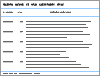
Tab.1
General comparison of two groups of NSCLC patients with oligometastatic metastasis"
| 项目 | 观察组(n = 72) | 对照组(n = 70) | χ2 /t值 | P值 |
|---|---|---|---|---|
| 性别 | 0.287 | 0.592 | ||
| 男 | 40(55.56) | 42(60.00) | ||
| 女 | 32(44.44) | 28(40.00) | ||
| 年龄(x ± s)/岁 | 59.00 ± 6.50 | 58.43 ± 6.38 | 0.527 | 0.599 |
| 体质量指数(x ± s)/(kg/m2) | 22.10 ± 1.42 | 22.16 ± 1.50 | 0.204 | 0.839 |
| 吸烟史 | 0.099 | 0.753 | ||
| 有 | 30(41.67) | 31(44.29) | ||
| 无 | 42(58.33) | 39(55.71) | ||
| 临床分期 | 0.273 | 0.601 | ||
| Ⅳa | 34(47.22) | 30(42.86) | ||
| Ⅳb | 38(52.78) | 40(57.14) | ||
| 病理类型 | 0.036 | 0.849 | ||
| 腺癌 | 40(55.56) | 40(57.14) | ||
| 鳞状细胞癌 | 32(44.44) | 30(42.86) | ||
| 东部肿瘤协作组评分 | 0.273 | 0.601 | ||
| 0 | 38(52.78) | 40(57.14) | ||
| 1 ~ 2 | 34(47.22) | 30(42.86) | ||
| 累及器官数目 | 0.483 | 0.487 | ||
| 1 | 38(52.78) | 41(58.57) | ||
| 2 ~ 3 | 34(47.22) | 29(41.43) | ||
| 转移灶数目 | 0.431 | 0.511 | ||
| 1 ~ 2 | 51(70.83) | 53(75.71) | ||
| 3 ~ 5 | 21(29.17) | 17(24.29) | ||
| 寡转移常见部位 | ||||
| 骨 | 28(38.89) | 26(37.14) | 0.046 | 0.830 |
| 对侧肺 | 16(22.22) | 14(20.00) | 0.105 | 0.746 |
| 肾上腺 | 18(25.00) | 15(21.43) | 0.254 | 0.614 |
| 脑 | 15(20.83) | 15(21.43) | 0.008 | 0.931 |
| 肝 | 7(9.72) | 9(12.86) | 0.349 | 0.555 |
Tab.2
Comparison of short-term efficacy between two groups of NSCLC patients with oligometastatic metastasis"
| 组别 | 完全缓解 | 部分缓解 | 疾病稳定 | 疾病进展 | ORR | DCR |
|---|---|---|---|---|---|---|
| 观察组(n = 72) | 6(8.33) | 37(51.39) | 17(23.61) | 12(16.67) | 43(59.72) | 60(83.33) |
| 对照组(n = 70) | 1(1.43) | 27(38.57) | 20(28.57) | 22(31.43) | 28(40.00) | 48(68.57) |
| χ2 值 | 5.522 | 4.247 | ||||
| P值 | 0.019 | 0.039 |
Tab.3
Comparison of serum tumor markers between two groups of NSCLC patients with oligometastatic metastasis"
| 组别 | CEA/(ng/mL) | CA125/(U/mL) | CYFRA21-1/(μg/L) | |||
|---|---|---|---|---|---|---|
| 治疗前 | 治疗后 | 治疗前 | 治疗后 | 治疗前 | 治疗后 | |
| 观察组(n = 72) | 18.16 ± 4.25 | 5.72 ± 1.58* | 120.00 ± 21.36 | 25.14 ± 4.57* | 8.67 ± 1.00 | 3.00 ± 0.45* |
| 对照组(n = 70) | 17.89 ± 4.30 | 8.03 ± 2.00* | 118.94 ± 20.43 | 40.63 ± 6.10* | 8.60 ± 0.94 | 4.58 ± 0.56* |
| t值 | 0.376 | 7.649 | 0.302 | 17.157 | 0.430 | 18.559 |
| P值 | 0.707 | < 0.001 | 0.763 | < 0.001 | 0.668 | < 0.001 |
Tab.4
Comparison of cellular immune function indicators between two groups of NSCLC patients with oligometastatic metastasis"
| 组别 | CD4+/% | CD8+/% | CD4+/CD8+ | |||
|---|---|---|---|---|---|---|
| 治疗前 | 治疗后 | 治疗前 | 治疗后 | 治疗前 | 治疗后 | |
| 观察组(n = 72) | 30.10 ± 4.12 | 36.53 ± 3.70* | 24.12 ± 3.80 | 23.13 ± 2.49 | 1.25 ± 0.42 | 1.58 ± 0.47* |
| 对照组(n = 70) | 30.28 ± 4.05 | 29.84 ± 3.36 | 23.90 ± 3.86 | 24.00 ± 3.22 | 1.27 ± 0.45 | 1.24 ± 0.43 |
| t值 | 0.262 | 11.270 | 0.342 | 1.804 | 0.274 | 4.494 |
| P值 | 0.793 | < 0.001 | 0.733 | 0.073 | 0.785 | < 0.001 |
Tab.5
Comparison of serum VEGF, NF-κB and PD-L1 levels between two groups of NSCLC patients with oligometastatic metastasis"
| 组别 | VEGF | NF-κB | PD-L1 | |||
|---|---|---|---|---|---|---|
| 治疗前 | 治疗后 | 治疗前 | 治疗后 | 治疗前 | 治疗后 | |
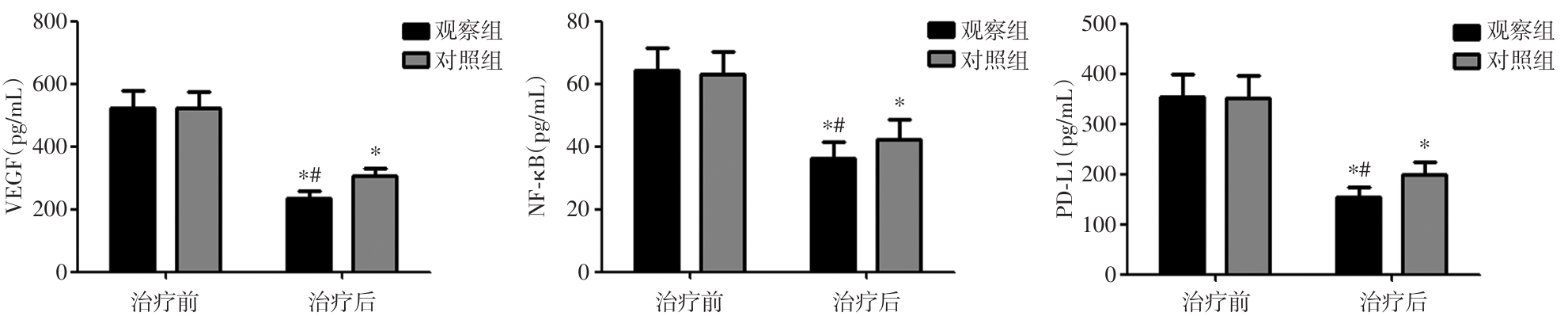
| 观察组(n = 72) | 523.16 ± 54.37 | 236.25 ± 21.74* | 64.13 ± 7.28 | 36.27 ± 5.15* | 354.27 ± 44.53 | 153.12 ± 20.38* |
| 对照组(n = 70) | 520.95 ± 55.12 | 308.36 ± 22.15* | 62.95 ± 7.36 | 42.30 ± 6.42* | 352.34 ± 45.16 | 200.06 ± 23.34* |
| t值 | 0.241 | 19.578 | 0.960 | 6.182 | 0.256 | 12.776 |
| P值 | 0.810 | < 0.001 | 0.339 | < 0.001 | 0.798 | < 0.001 |
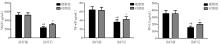
Fig. 1
Comparison of serum VEGF, NF-κB and PD-L1 levels between two groups of NSCLC patients with oligometastatic metastasis"
Tab.6
Comparison of EORTC QLQ-C30 scores between two groups of NSCLC patients with oligometastatic metastasis"
| 组别 | 总健康状况 | 功能维度 | 症状领域 | |||
|---|---|---|---|---|---|---|
| 治疗前 | 治疗后 | 治疗前 | 治疗后 | 治疗前 | 治疗后 | |
| 观察组(n = 72) | 58.50 ± 10.32 | 72.45 ± 12.16* | 71.15 ± 11.06 | 82.30 ± 12.00* | 43.42 ± 8.65 | 31.02 ± 6.75* |
| 对照组(n = 70) | 59.04 ± 10.23 | 65.28 ± 11.37* | 72.02 ± 11.14 | 76.03 ± 11.85* | 44.03 ± 9.12 | 34.68 ± 6.13* |
| t值 | 0.313 | 3.637 | 0.467 | 3.132 | 0.409 | 3.380 |
| P值 | 0.755 | < 0.001 | 0.641 | 0.002 | 0.683 | 0.001 |
Tab.7
Comparison of toxic and side effects between two groups of NSCLC patients with oligometastatic metastasis"
| 指标 | 观察组(n = 72) | 对照组(n = 70) | χ2 值 | P值 |
|---|---|---|---|---|
| 合计 | 14(19.44) | 16(22.86) | 0.248 | 0.618 |
| 胃肠道反应 | ||||
| Ⅰ~Ⅱ级 | 42(58.33) | 43(61.43) | 0.142 | 0.707 |
| Ⅲ~Ⅳ级 | 12(16.67) | 7(10.00) | 1.361 | 0.243 |
| 合计 | 54(75.00) | 50(71.43) | 0.231 | 0.631 |
| 骨髓抑制 | ||||
| Ⅰ~Ⅱ级 | 29(40.28) | 26(37.14) | 0.147 | 0.701 |
| Ⅲ~Ⅳ级 | 8(11.11) | 5(7.14) | 0.672 | 0.412 |
| 合计 | 37(51.39) | 31(44.28) | 0.718 | 0.397 |
| 肝功能损伤 | ||||
| Ⅰ~Ⅱ级 | 8(11.11) | 6(8.57) | 0.258 | 0.612 |
| Ⅲ~Ⅳ级 | 2(2.78) | 2(2.86) | 0.229 | 0.632 |
| 合计 | 10(13.89) | 8(11.43) | 0.194 | 0.660 |
| 免疫相关不良反应 | ||||
| Ⅰ~Ⅱ级 | 9(12.50) | 0(0.00) | 7.355 | 0.007 |
| Ⅲ ~ Ⅳ级 | 2(2.78) | 0(0.00) | - | 0.497 |
| 合计 | 11(15.28) | 0(0.00) | 11.593 | 0.001 |
| 放射性肺炎 | ||||
| Ⅰ ~ Ⅱ级 | 11(15.28) | 12(17.14) | 0.091 | 0.763 |
| Ⅲ ~ Ⅳ级 | 3(4.17) | 4(5.71) | 0.002 | 0.970 |
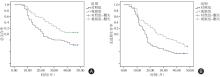
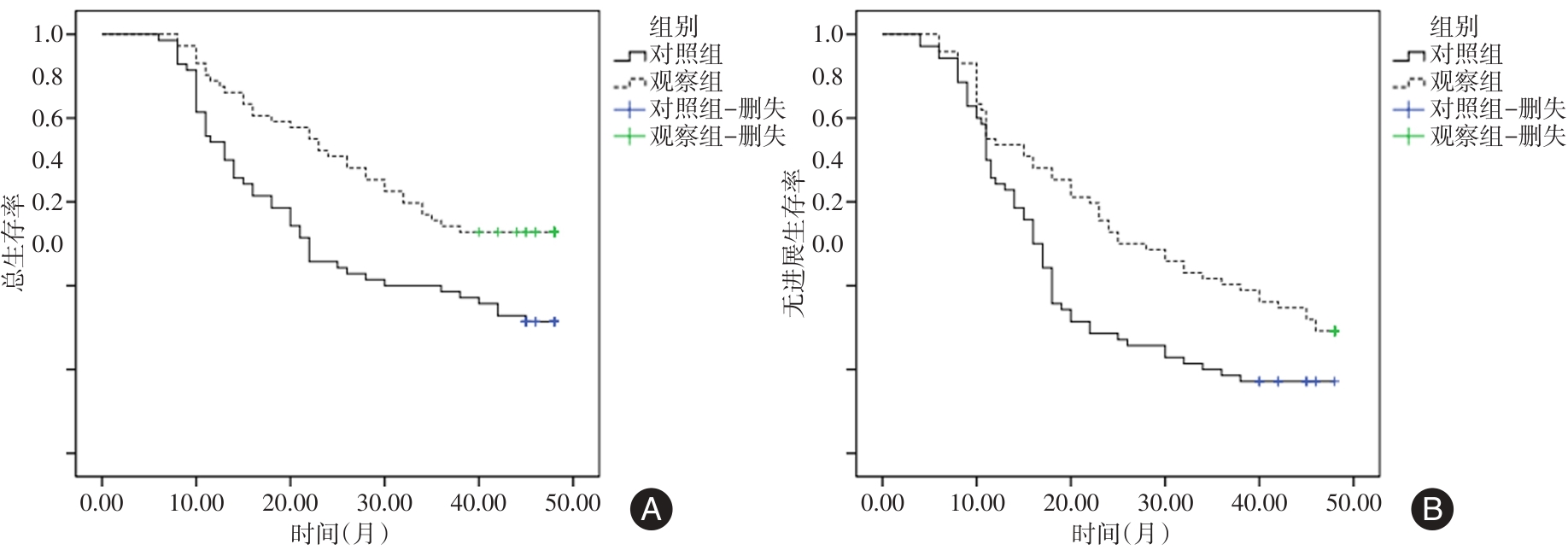
Fig.2
Comparison of survival curves of two groups of NSCLC patients with oligometastatic metastasis"
| [1] |
ZHANG Y, VACCARELLA S, MORGAN E, et al. Global variations in lung cancer incidence by histological subtype in 2020: A population-based study[J]. Lancet Oncol, 2023, 24(11): 1206-1218. doi:10.1016/S1470-2045(23)00444-8 .
doi: 10.1016/S1470-2045(23)00444-8 |
| [2] |
张耀文, 温晶媛, 汪晨宇, 等. 放疗在免疫联合化疗一线治疗非小细胞肺癌寡转移患者中的应用价值[J]. 中华放射医学与防护杂志, 2025, 45(2): 91-100. doi:10.3760/cma.j.cn112271-20240902-00332 .
doi: 10.3760/cma.j.cn112271-20240902-00332 |
| [3] |
RICCIUTI B, FUSCO F, COOPER A, et al. Neoadjuvant PD-1 and PD-L1 blockade with chemotherapy for borderline resectable and unresectable stage III non-small cell lung cancer[J]. JAMA Oncol, 2025, 11(7): 735-741. doi:10.1001/jamaoncol. 2025. 1115 .
doi: 10.1001/jamaoncol. 2025. 1115 |
| [4] |
JEON H, WANG S, SONG J, et al. Update 2025: Management of non-small-cell lung cancer[J]. Lung, 2025, 203(1): 53. doi:10.1007/s00408-025-00801-x .
doi: 10.1007/s00408-025-00801-x |
| [5] |
ZHANG X, SHAO M, YAO J, et al. NeoSCORE II: Three vs four cycles of neoadjuvant sintilimab + chemotherapy for squamous non-small-cell lung cancer[J]. Future Oncol, 2024, 20(3): 121-129. doi:10.2217/fon-2024-0026 .
doi: 10.2217/fon-2024-0026 |
| [6] |
MOLIFE C, BRNABIC A, STEFANIAK V J, et al. Sintilimab plus chemotherapy for first-line treatment of advanced or metastatic nonsquamous non-small-cell lung cancer: Network meta-analysis[J]. Immunotherapy, 2023, 15(4): 293-309. doi:10.2217/ imt-2022-0252 .
doi: 10.2217/ imt-2022-0252 |
| [7] |
KOKKOTOU E, GRAPSA D, PAPADOPOULOU A, et al. Soluble PD-L1 and serum vascular endothelial growth factor-B may independently predict prognosis in patients with advanced non-small cell lung cancer treated with pembrolizumab[J]. Cancers, 2025, 17(3): 421. doi:10.3390/cancers17030421 .
doi: 10.3390/cancers17030421 |
| [8] |
中华医学会, 中华医学会肿瘤学分会, 中华医学会杂志社. 中华医学会肺癌临床诊疗指南(2018版)[J]. 中华肿瘤杂志, 2018, 40(12): 935-964. doi:10.3760/cma.j.issn.0253-3766. 2018.12.012 .
doi: 10.3760/cma.j.issn.0253-3766. 2018.12.012 |
| [10] |
EISENHAUER E A, THERASSE P, BOGAERTS J, et al. New response evaluation criteria in solid tumours: Revised RECIST guideline (version 1.1)[J]. Eur J Cancer, 2009, 45(2): 228-247. doi:10.1016/j.ejca.2008.10.026 .
doi: 10.1016/j.ejca.2008.10.026 |
| [11] |
BERNARDO D C, LI R J, JIMENO C. Validity and reliability of the European organization for research and treatment of cancer quality of life questionnaire core 30 - Tagalog among adult filipinos with differentiated thyroid cancer[J]. J ASEAN Fed Endocr Soc, 2018, 33(2): 174-180. doi:10.15605/jafes.033.02.10 .
doi: 10.15605/jafes.033.02.10 |
| [12] |
KLUETZ P G, CHINGOS D T, BASCH E M, et al. Patient-reported outcomes in cancer clinical trials: Measuring symptomatic adverse events with the national cancer institute′s patient-reported outcomes version of the common terminology criteria for adverse events (PRO-CTCAE)[J]. Am Soc Clin Oncol Educ Book, 2016, 35: 67-73. doi:10.1200/EDBK_159514 .
doi: 10.1200/EDBK_159514 |
| [13] |
IYENGAR P, ALL S, BERRY M F, et al. Treatment of oligometastatic non-small cell lung cancer: An ASTRO/ESTRO clinical practice guideline[J]. Pract Radiat Oncol, 2023, 13(5): 393-412. doi:10.1016/j.prro.2023.04.004 .
doi: 10.1016/j.prro.2023.04.004 |
| [14] |
TSAI C J, YANG J T, SHAVERDIAN N, et al. Standard-of-care systemic therapy with or without stereotactic body radiotherapy in patients with oligoprogressive breast cancer or non-small-cell lung cancer (Consolidative Use of Radiotherapy to Block [CURB] oligoprogression): An open-label, randomised, controlled, phase 2 study[J]. Lancet, 2024, 403(10422): 171-182. doi:10.1016/S0140-6736(23)01857-3 .
doi: 10.1016/S0140-6736(23)01857-3 |
| [15] |
段景灏, 姜威, 王文卿, 等. 化学免疫治疗联合放疗治疗NSCLC野生型脑寡转移研究[J]. 中华放射肿瘤学杂志, 2025, 34(6): 545-552. doi:10.3760/cma.j.cn113030-20250318-00101 .
doi: 10.3760/cma.j.cn113030-20250318-00101 |
| [16] |
王豪, 陆筱祎, 王文杰. 老年局部晚期食管癌同步放化疗序贯信迪利单抗免疫治疗的疗效[J]. 实用医学杂志, 2025, 41(3): 365-370. doi:10.3969/j.issn.1006-5725.2025.03.009 .
doi: 10.3969/j.issn.1006-5725.2025.03.009 |
| [17] |
何梓健, 万宁, 梁蔚婷, 等. 真实世界中帕博利珠单抗治疗晚期非小细胞肺癌的有效性与安全性Meta分析[J]. 暨南大学学报(自然科学与医学版), 2022, 43(4): 393-405. doi:10. 11778/j.jdxb.20220083 .
doi: 10. 11778/j.jdxb.20220083 |
| [18] |
CHEN Y, WANG Y, YANG Z, et al. Local consolidative therapy for synchronous oligometastatic non-small cell lung cancer treated with first-line pembrolizumab: A retrospective observational study[J]. Thorac Cancer,2022, 13(5): 732-741. doi: 10.1111/1759-7714.14312 .
doi: 10.1111/1759-7714.14312 |
| [19] |
GRAY J E, VILLEGAS A, DANIEL D, et al. Three-year overall survival with durvalumab after chemoradiotherapy in stage III NSCLC-update from PACIFIC[J]. J Thorac Oncol, 2020, 15(2): 288-293. doi:10.1016/j.jtho.2019.10.002 .
doi: 10.1016/j.jtho.2019.10.002 |
| [20] |
CANKI E, SCHUURBIERS M M, LINDERS T C, et al. Pre-analytical stability of the CEA, CYFRA 21.1, NSE, CA125 and HE4 tumor markers[J]. Tumour Biol, 2024, 46(s1): S15-S25. doi:10.3233/TUB-220013 .
doi: 10.3233/TUB-220013 |
| [21] |
王海英, 吴凯, 田胤纯. 血清基质金属蛋白酶-9、细胞角蛋白19片段及血管内皮细胞生长因子水平与非小细胞肺癌患者顺铂治疗效果的关系[J]. 实用医学杂志, 2024, 40(24): 3452-3457. doi:10.3969/j.issn.1006-5725.2024.24.004 .
doi: 10.3969/j.issn.1006-5725.2024.24.004 |
| [22] |
HIRAKAWA T, YAMAGUCHI K, FUNAISHI K, et al. Predictive value of circulatory total VEGF-A and VEGF-A isoforms for the efficacy of anti-PD-1/PD-L1 antibodies in patients with non-small-cell lung cancer[J]. Cancers, 2025, 17(4): 572. doi:10.3390/cancers17040572 .
doi: 10.3390/cancers17040572 |
| [23] |
HUA C, GUO Z, DAI M, et al. Lumbrokinase extracted from earthworms synergizes with bevacizumab and chemotherapeutics in treating non-small cell lung cancer by targeted inactivation of BPTF/VEGF and NF-κB/COX-2 signaling[J]. Biomolecules, 2024, 14(7): 741. doi:10.3390/biom14070741 .
doi: 10.3390/biom14070741 |
| [24] |
ANTONANGELI F, NATALINI A, GARASSINO M C, et al. Regulation of PD-L1 expression by NF-κB in cancer[J]. Front Immunol, 2020, 11: 584626. doi:10.3389/fimmu.2020.584626 .
doi: 10.3389/fimmu.2020.584626 |
| [25] |
冯晓洁, 雷霏, 刘宏伟, 等. 血清MMP-2、NF-κB水平对进展期胃癌患者新辅助化疗效果的影响及评估价值[J]. 广西医学, 2023, 45(10): 1143-1147. doi:10.11675/j.issn.0253-4304. 2023.10.02 .
doi: 10.11675/j.issn.0253-4304. 2023.10.02 |
| [26] |
张静, 毛英. 血清转化生长因子β1、白细胞介素-6、Toll样受体-4、核转录因子κB联合评估非小细胞肺癌放射性肺炎病情严重程度的价值[J]. 实用临床医药杂志, 2024, 28(14): 12-17. doi:10.7619/jcmp.20234065 .
doi: 10.7619/jcmp.20234065 |
| [27] |
杨敏伟, 曾冬香, 杨全良, 等. 信迪利单抗在晚期非小细胞肺癌化疗患者中的应用及对其血清细胞因子、免疫功能的影响[J]. 中国临床药理学杂志, 2022, 38(24): 2931-2935. doi:10.13699/j.cnki.1001-6821.2022.24.001 .
doi: 10.13699/j.cnki.1001-6821.2022.24.001 |
| [1] | Mei CHEN,Zongzhi LI,Xuewei QIN,Limin WANG,LI ZHENG. Protective effect of LncRNA MEG3 on diabetic retinopathy in rats by regulating COX⁃2/PGE2/VEGF signaling pathway [J]. The Journal of Practical Medicine, 2025, 41(9): 1319-1326. |
| [2] | Yingding ZHAO,Bangsheng LI,Tiantian XUE,Qihan ZI,Xin YANG,Xi WANG. Efficacy and complications of microwave ablation and sublobectomy for treating ⅠA⁃stage NSCLC: A comparative analysis based on propensity score matching [J]. The Journal of Practical Medicine, 2025, 41(7): 976-984. |
| [3] | Lifei HE,Lin ZHU,Feng XUE,Zuyue BI,Zhaoxin. LI. Effects of LINC01772 on cell cycle, apoptosis and radiosensitivity of A549 [J]. The Journal of Practical Medicine, 2025, 41(5): 657-663. |
| [4] | Yang HUANG,Ge QU,Peizong WANG,Weian ZENG,Fang. YAN. Association between intraoperative dexamethasone and long-term survival in non-small cell lung cancer patients undergoing curative resection [J]. The Journal of Practical Medicine, 2025, 41(5): 724-730. |
| [5] | Hao WANG,Xiaoyi LU,Wenjie. WANG. Clinical efficacy of concurrent chemoradiotherapy followed by sequential sintilimab immunotherapy in elderly patients with locally advanced esophageal cancer [J]. The Journal of Practical Medicine, 2025, 41(3): 365-370. |
| [6] | Xiaokun GAO,Ziming XIE,Guangyu TAO,Yanbing SUN,Hua REN,Jiahui YU,Lin ZHU,Hong YU,Qiming. NI. The application value of multi⁃parameter quantitative analysis of spectral and perfusion CT in differentiating pathological types of lung cancer [J]. The Journal of Practical Medicine, 2025, 41(19): 3096-3105. |
| [7] | Jingguo LI,Yan LIU,Chao WANG,Chenghui LI. Impact of sintilimab combined with TP chemotherapy regimen on immune function and prognostic survival in patients with advanced esophageal cancer [J]. The Journal of Practical Medicine, 2025, 41(18): 2906-2912. |
| [8] | Rui ZHONG,Jianing WANG,Lei ZHANG,Lingyun GUO,Jianye YANG,Fei ZHENG,Yuwen YAN,Danli YU,Liguo. TAN. Experimental study on treatment of severe limb ischemia with Ad⁃hVEGF⁃hHGF gene [J]. The Journal of Practical Medicine, 2024, 40(5): 639-645. |
| [9] | Jing HU,Xu WANG,Xiaoqin GONG,Rui LING,Tao YOU,Chunhua DAI,Ye TIAN,Fei. CHEN. Analysis of dosimetric parameters of acute radiation enteritis in cervical cancer patients treated with concurrent chemoradiotherapy [J]. The Journal of Practical Medicine, 2024, 40(5): 672-676. |
| [10] | Haiying WANG,Kai WU,Yinchun. TIAN. Association of serum MMP⁃9, CYRFA21⁃1, and VEGF levels on cisplatin treatment efficacy in patients with non⁃small cell lung cancer [J]. The Journal of Practical Medicine, 2024, 40(24): 3452-3457. |
| [11] | Xinpan LI,Yi FANG,Jun QIU. Predictive value of CD3+/CD4+T lymphocyte level and neutrophil to lymphocyte ratio in radiation pneumonia [J]. The Journal of Practical Medicine, 2024, 40(20): 2923-2928. |
| [12] | Canwei CHEN,Zhuangwen LIAO,Ziwen FAN,Shuai HUANG,Yan HUANG,Binwei CHEN. LAMP3 inhibited the proliferation, metastatic and PC⁃3⁃induced vasculogenesis of HUVEC by regulating VEGF/AKT signaling [J]. The Journal of Practical Medicine, 2024, 40(2): 182-187. |
| [13] | Xueyan HU,Fanliang MENG,Juanjuan. DONG. Prognostic analysis of patients with bone metastases from primary non-small cell lung cancer with different pathologic staging [J]. The Journal of Practical Medicine, 2024, 40(16): 2316-2325. |
| [14] | Shengfang YUAN,Bu WANG,Baoli XIANG,Jianqing ZHAO,Jingjing SHEN,Zhihua. ZHANG. Prediction of immune therapy efficacy and prognosis for advanced non-small cell lung cancer using peripheral blood circulation tumor DNA [J]. The Journal of Practical Medicine, 2024, 40(15): 2110-2115. |
| [15] | Yuting LI,Qilu YAN,Qibin. SONG. Molecular basis of variability in EGFR⁃targeted therapy response in non⁃small cell lung cancer [J]. The Journal of Practical Medicine, 2024, 40(15): 2166-2171. |
| Viewed | ||||||
|
Full text |
|
|||||
|
Abstract |
|
|||||
