

The Journal of Practical Medicine ›› 2025, Vol. 41 ›› Issue (22): 3558-3565.doi: 10.3969/j.issn.1006-5725.2025.22.013
• Clinical Research • Previous Articles
Jianqiang WEI1,Jing YIN2( ),Mingyan HONG1,Jianzhong CUI1,Kaijie WANG1,Hongyu WANG1,Xinwang CAI1,Wenqian ZHANG1,Huan LIU1
Received:2025-08-19
Online:2025-11-25
Published:2025-11-26
Contact:
Jing YIN
E-mail:yinj1121@163.com
CLC Number:
Jianqiang WEI,Jing YIN,Mingyan HONG,Jianzhong CUI,Kaijie WANG,Hongyu WANG,Xinwang CAI,Wenqian ZHANG,Huan LIU. Study on the correlation between the expression of inflammatory cytokines in cerebrospinal fluid and the severity and prognosis of spontaneous intracerebral hemorrhage[J]. The Journal of Practical Medicine, 2025, 41(22): 3558-3565.
Tab.1
Comparison of general information of different"
| 指标 | 观察组 (n = 168) | 对照组 (n = 30) | χ2/t值 | P值 |
|---|---|---|---|---|
| 性别 | 0.635 | 0.426 | ||
| 男 | 108(64.29) | 17(56.67) | ||
| 女 | 60(35.71) | 13(43.33) | ||
| 年龄( | 64.95 ± 10.49 | 64.20 ± 10.21 | 0.363 | 0.717 |
| BMI( | 24.13 ± 3.45 | 23.90 ± 2.77 | 0.351 | 0.726 |
| 吸烟史 | 0.759 | 0.384 | ||
| 是 | 76(45.24) | 11(36.67) | ||
| 否 | 92(54.76) | 19(63.33) | ||
| 饮酒史 | 0.233 | 0.630 | ||
| 是 | 58(34.52) | 9(30.00) | ||
| 否 | 110(65.48) | 21(70.00) |
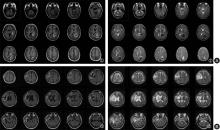
Fig.1
MRI image of patients with sICH"
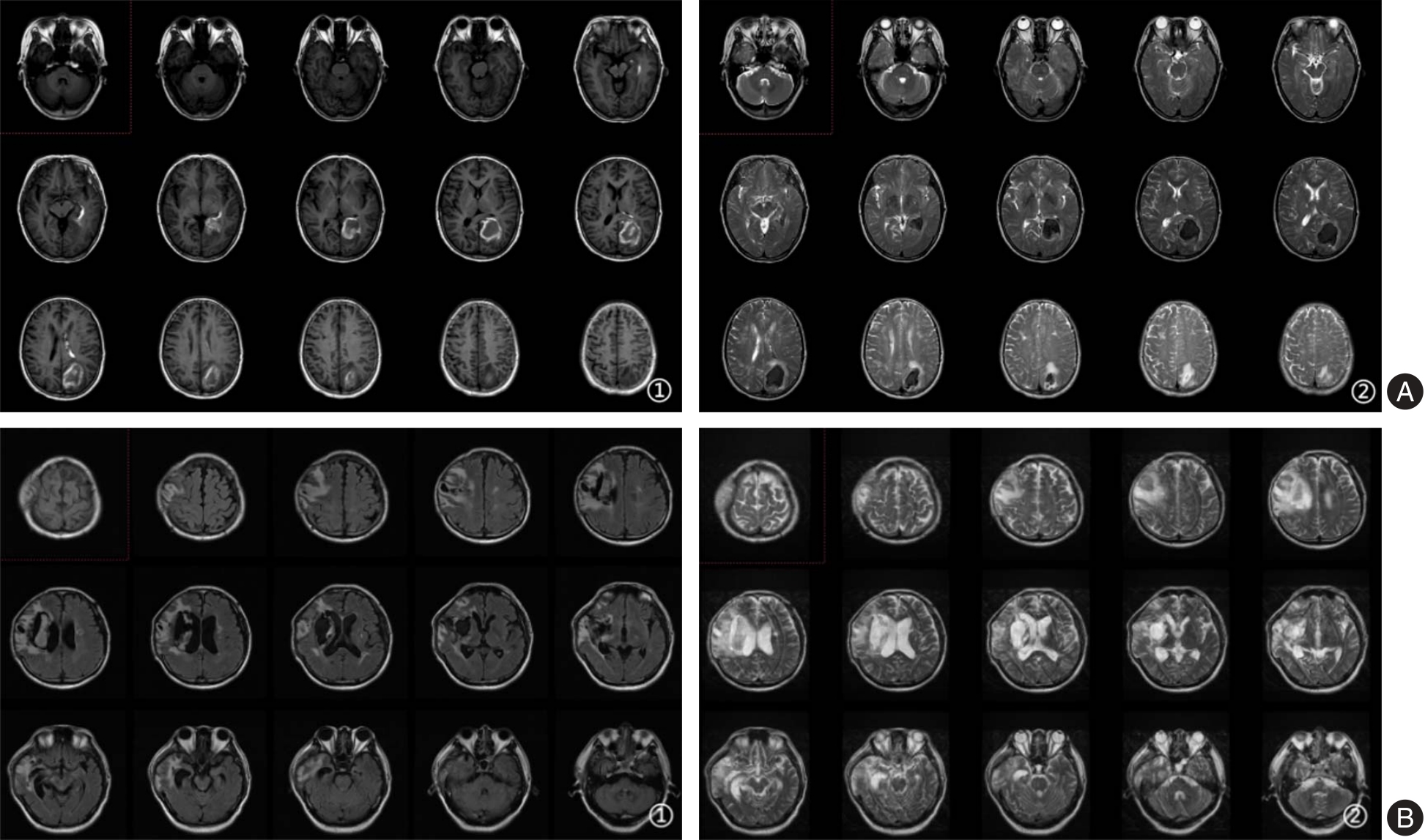
Tab.2
Comparison of CSF inflammatory factor levels between sICH patients and non-sICH patients"
| 指标 | 观察组(n = 168) | 对照组(n = 30) | t值 | P值 |
|---|---|---|---|---|
| IL-6/(pg/mL) | 90.58 ± 36.45 | 18.75 ± 8.33 | 10.722 | < 0.001 |
| IL-10/(pg/mL) | 25.68 ± 12.84 | 8.24 ± 3.65 | 7.369 | < 0.001 |
| MMP-9/(ng/mL) | 184.39 ± 62.75 | 52.27 ± 18.98 | 11.418 | < 0.001 |
| IL-17A/(pg/mL) | 42.08 ± 20.88 | 12.15 ± 5.76 | 7.785 | < 0.001 |
| LDH/(U/L) | 279.73 ± 101.66 | 156.12 ± 42.18 | 6.549 | < 0.001 |
Tab.3
Comparison of CSF inflammatory factors in different severity levels of SICH"
| 指标 | 轻度组(n = 78) | 中度组(n = 62) | 重度组(n = 28) | F值 | P值 |
|---|---|---|---|---|---|
| NIHSS评分/分 | 8.08 ± 3.47 | 22.65 ± 3.82# | 36.89 ± 3.73#* | 715.026 | < 0.001 |
| IL-6/(pg/mL) | 65.37 ± 18.22 | 98.70 ± 25.31# | 142.82 ± 31.74#* | 116.831 | < 0.001 |
| IL-10/(pg/mL) | 18.39 ± 7.20 | 28.51 ± 10.79# | 39.72 ± 15.26#* | 48.250 | < 0.001 |
| MMP-9/(ng/mL) | 143.21 ± 32.59 | 194.67 ± 41.73# | 276.38 ± 58.95#* | 110.013 | < 0.001 |
| IL-17A/(pg/mL) | 28.90 ± 11.30 | 46.70 ± 16.28# | 68.58 ± 21.30#* | 74.462 | < 0.001 |
| LDH/(U/L) | 213.48 ± 52.71 | 295.82 ± 68.37# | 428.67 ± 95.70#* | 108.275 | < 0.001 |
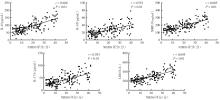
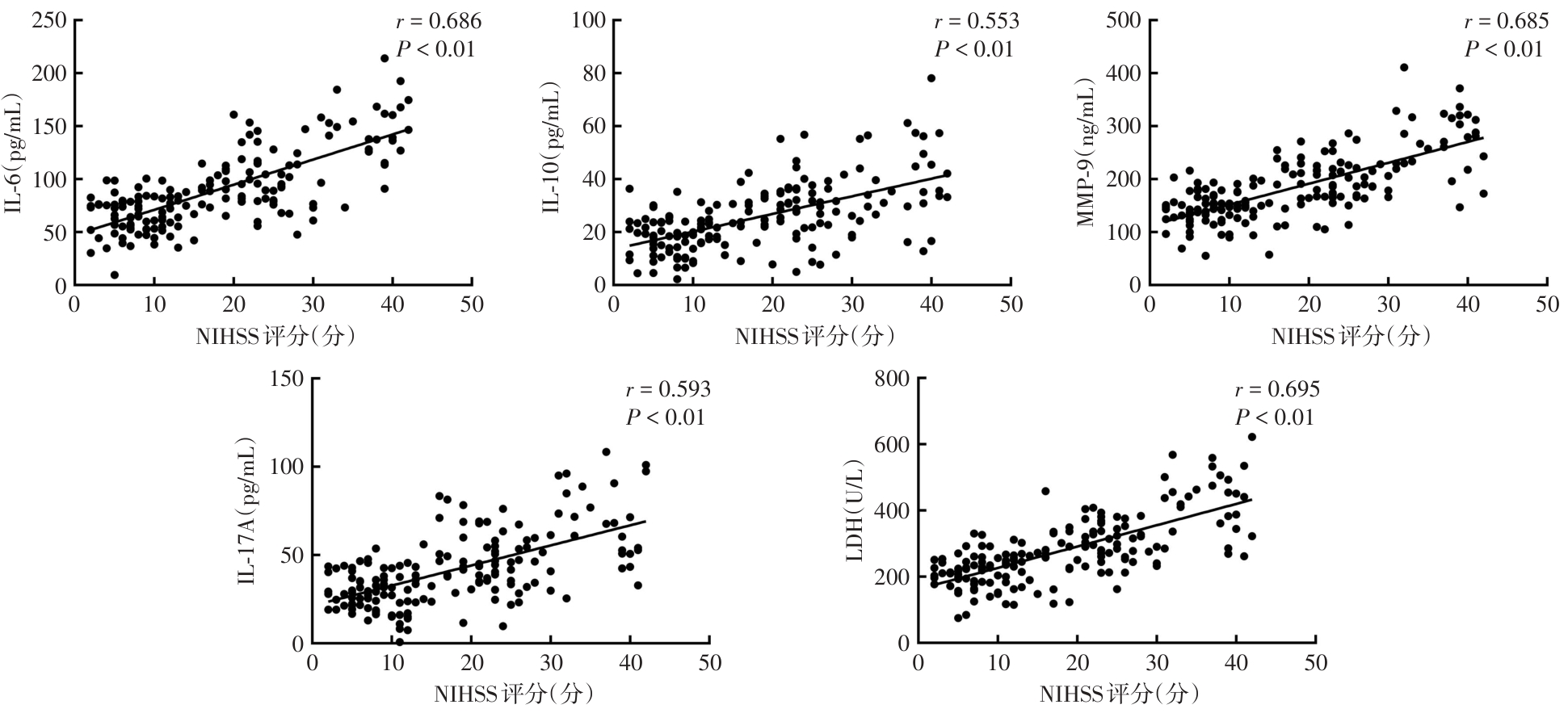
Fig.2
Scatter plots showing the correlations between CSF inflammatory factors and NIHSS scores of patients with sICH"
Tab.4
Comparison of clinical data between the survival group and the death group"
| 项目 | 死亡组(n = 38) | 生存组(n = 130) | χ2/t值 | P值 |
|---|---|---|---|---|
| 性别/[例(%)] | 0.366 | 0.545 | ||
| 男 | 26(68.42) | 82(63.08) | ||
| 女 | 12(31.58) | 48(36.92) | ||
| 年龄/岁 | 63.24 ± 10.55 | 65.45 ± 10.46 | 1.147 | 0.253 |
| BMI/(kg/m2) | 23.54 ± 3.71 | 24.31 ± 3.36 | 1.198 | 0.233 |
| 高血压/[例(%)] | 3.017 | 0.082 | ||
| 是 | 35(92.11) | 104(80.00) | ||
| 否 | 3(7.89) | 26(20.00) | ||
| 糖尿病/[例(%)] | 1.134 | 0.287 | ||
| 是 | 12(31.58) | 30(23.08) | ||
| 否 | 26(68.42) | 100(76.92) | ||
| 吸烟史/[例(%)] | 0.449 | 0.503 | ||
| 是 | 19(50.00) | 57(43.85) | ||
| 否 | 19(50.00) | 73(56.15) | ||
| 饮酒史/[例(%)] | 0.532 | 0.466 | ||
| 是 | 15(39.47) | 43(33.08) | ||
| 否 | 23(60.53) | 87(66.92) | ||
| 收缩压/(mmHg) | 163.08 ± 25.00 | 162.02 ± 24.64 | 0.232 | 0.817 |
| 舒张压/(mmHg) | 93.05 ± 15.15 | 92.35 ± 14.87 | 0.254 | 0.166 |
| 出血部位/% | ||||
| 基底核 | 18(47.37) | 78(60.00) | 1.916 | 0.166 |
| 脑叶 | 12(31.58) | 32(24.61) | 0.738 | 0.390 |
| 小脑 | 5(13.16) | 15(11.54) | 0.074 | 0.786 |
| 脑干 | 3(7.89) | 5(3.85) | 1.063 | 0.303 |
| 血肿大小/mL | 42.79 ± 18.6 | 28.52 ± 12.45 | 5.508 | < 0.001 |
| FPG/(mmol/L) | 7.18 ± 2.15 | 6.86 ± 1.86 | 0.885 | 0.377 |
| HbA1c/% | 6.77 ± 1.44 | 6.48 ± 1.14 | 1.307 | 0.193 |
| INS/(mU/L) | 12.6 ± 4.85 | 11.75 ± 4.23 | 1.056 | 0.293 |
| TC/(mmol/L) | 4.64 ± 1.17 | 4.49 ± 1.01 | 0.760 | 0.448 |
| TG/(mmol/L) | 1.79 ± 0.61 | 1.65 ± 0.54 | 1.378 | 0.170 |
| HDL-C/(mmol/L) | 1.29 ± 0.33 | 1.25 ± 0.38 | 0.627 | 0.532 |
| LDL-C/(mmol/L) | 2.73 ± 0.76 | 2.59 ± 0.68 | 1.084 | 0.280 |
| ApoA1/(g/L) | 1.25 ± 0.31 | 1.39 ± 0.31 | 2.519 | 0.013 |
| ApoB/(g/L) | 0.91 ± 0.18 | 0.84 ± 0.19 | 1.913 | 0.057 |
| NIHSS评分 | 27.84 ± 11.61 | 15.45 ± 9.52 | 6.701 | < 0.001 |
| IL-6/(pg/mL) | 122.38 ± 39.86 | 81.28 ± 29.66 | 6.919 | < 0.001 |
| IL-10/(pg/mL) | 35.34 ± 14.04 | 22.85 ± 11.02 | 5.755 | < 0.001 |
| MMP-9/(ng/mL) | 223.97 ± 87.76 | 172.83 ± 47.88 | 4.689 | < 0.001 |
| IL-17A/(pg/mL) | 55.54 ± 23.72 | 38.15 ± 18.27 | 4.808 | < 0.001 |
| LDH/(U/L) | 345.37 ± 142.33 | 260.55 ± 77.00 | 4.815 | < 0.001 |
Tab.5
Binary logistic regression analysis of factors affecting the prognosis of sICH"
| 指标 | B | SE | Wald | P值 | OR | 95%CI |
|---|---|---|---|---|---|---|
| 血肿大小 | 0.769 | 0.247 | 9.685 | 0.002 | 2.158 | 1.330 ~ 3.504 |
| IL-6 | 0.216 | 0.043 | 25.636 | < 0.001 | 1.241 | 1.141 ~ 1.349 |
| IL-10 | 0.158 | 0.077 | 4.272 | 0.039 | 1.172 | 1.008 ~ 1.361 |
| MMP-9 | 0.092 | 0.033 | 7.727 | 0.005 | 1.096 | 1.027 ~ 1.169 |
| IL-17A | 0.088 | 0.023 | 14.45 | < 0.001 | 1.092 | 1.044 ~ 1.143 |
| LDH | 0.098 | 0.03 | 10.313 | 0.001 | 1.103 | 1.039 ~ 1.171 |
| NIHSS评分 | 0.988 | 0.289 | 11.671 | 0.001 | 2.686 | 1.524 ~ 4.733 |
Tab.6
The efficacy of CSF inflammatory factors alone and in combination in predicting the prognosis of sICH"
| 指标 | AUC | SE | P值 | 95%置信区间 | 最佳截断值 | 灵敏度 | 特异度 | 约登指数 | |
|---|---|---|---|---|---|---|---|---|---|
| 下限 | 上限 | ||||||||
| IL-6 | 0.794 | 0.039 | < 0.001 | 0.717 | 0.871 | 70.435 pg/mL | 0.974 | 0.623 | 0.597 |
| IL-10 | 0.754 | 0.044 | < 0.001 | 0.667 | 0.840 | 18.395 pg/mL | 0.895 | 0.654 | 0.549 |
| MMP-9 | 0.670 | 0.061 | 0.001 | 0.550 | 0.791 | 166.545 ng/mL | 0.684 | 0.500 | 0.184 |
| IL-17A | 0.717 | 0.046 | < 0.001 | 0.627 | 0.807 | 35.43 pg/mL | 0.789 | 0.569 | 0.358 |
| LDH | 0.683 | 0.060 | 0.001 | 0.566 | 0.801 | 270.73 U/L | 0.632 | 0.600 | 0.232 |
| 联合 | 0.993 | 0.006 | < 0.001 | 0.982 | 1.000 | 0.199 | 0.947 | 0.977 | 0.924 |
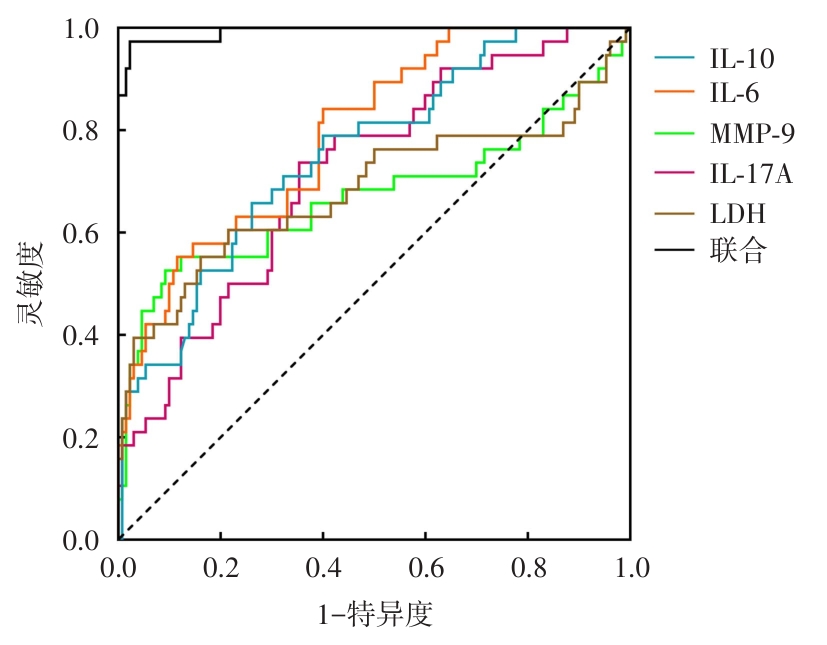
Fig.3
ROC curve of CSF inflammatory factors and combined prediction for the prognosis of sICH"
| [1] |
KASE C S, HANLEY D F. Intracerebral Hemorrhage: Advances in Emergency Care[J]. Neurol Clin, 2021, 39(2): 405-418. doi:10.1016/j.ncl.2021.02.002
doi: 10.1016/j.ncl.2021.02.002 |
| [2] |
MAGID-BERNSTEIN J, GIRARD R, POLSTER S, et al. Cerebral Hemorrhage: Pathophysiology, Treatment, and Future Directions[J]. Circ Res, 2022, 130(8): 1204-1229. doi:10.1161/circresaha.121.319949
doi: 10.1161/circresaha.121.319949 |
| [3] | 吴嘉诚, 刘振宁. 基于Mimics软件分析自发性小脑出血患者短期死亡的危险因素[J]. 中华危重病急救医学, 2024, 36(12): 1279-1284. |
| [4] |
SCOPELLITI G, CASOLLA B, BOULOUIS G, et al. Long-term anxiety in spontaneous intracerebral hemorrhage survivors[J]. Int J Stroke, 2022, 17(10): 1093-1099. doi:10.1177/17474930221085443
doi: 10.1177/17474930221085443 |
| [5] |
FANG Y, LIU Y, CHEN L, et al. Cerebrospinal fluid markers of neuroinflammation and coagulation in severe cerebral edema and chronic hydrocephalus after subarachnoid hemorrhage: A prospective study[J]. J Neuroinflammation, 2024, 21(1): 237. doi:10.1186/s12974-024-03236-y
doi: 10.1186/s12974-024-03236-y |
| [6] | 徐鹤, 徐鹏, 刘长林, 等. 自发性脑出血早期血肿扩大不同预测模型的对比分析以及多模态预测模型的构建[J]. 临床放射学杂志, 2025, 44(7): 1181-1187. |
| [7] | 陈飞龙, 于淼, 徐涛. 基于最小二乘回归的定量指标一致性评价的样本量公式研制[J]. 中国医学科学院学报, 2024, 46(2): 218-225. |
| [8] |
GREENBERG S M, ZIAI W C, CORDONNIER C, et al. 2022 Guideline for the Management of Patients With Spontaneous Intracerebral Hemorrhage: A Guideline From the American Heart Association/American Stroke Association[J]. Stroke, 2022, 53(7): e282-e361. doi:10.1161/str.0000000000000407
doi: 10.1161/str.0000000000000407 |
| [9] |
KIM Y S, CHAE H Y, JEONG H G, et al. Size-Related Differences in Computed Tomography Markers of Hematoma Expansion in Acute Intracerebral Hemorrhage[J]. Neurocrit Care, 2022, 36(2): 602-611. doi:10.1007/s12028-021-01347-5
doi: 10.1007/s12028-021-01347-5 |
| [10] | 徐瀚,陆岳,袁璞. 脑出血急性期血清神经递质及应激激素变化与继发性脑损伤的关系[J]. 实用医学杂志, 2024, 40(23): 3343-3348. |
| [11] |
JAIN A, MALHOTRA A, PAYABVASH S. Imaging of Spontaneous Intracerebral Hemorrhage[J]. Neuroimaging Clin N Am, 2021, 31(2): 193-203. doi:10.1016/j.nic.2021.02.003
doi: 10.1016/j.nic.2021.02.003 |
| [12] |
LI Y, YANG H, CAO L, et al. Short-term surgical outcomes of spontaneous intracerebral hemorrhage in China from 2019 to 2021: A retrospective cohort study[J]. Lancet Reg Health West Pac, 2023, 39: 100870. doi:10.1016/j.lanwpc.2023.100870
doi: 10.1016/j.lanwpc.2023.100870 |
| [13] |
MASSICOTTE S, LUN R, YOGENDRAKUMAR V, et al. How outcomes are measured after spontaneous intracerebral hemorrhage: A systematic scoping review[J]. PLoS One, 2021, 16(6): e0253964. doi:10.1371/journal.pone.0253964
doi: 10.1371/journal.pone.0253964 |
| [14] |
AMER H A, EL-JAAFARY S I M, SADEK H M A E, et al. Clinical and paraclinical predictors of early neurological deterioration and poor outcome in spontaneous intracerebral hemorrhage[J]. Egypt J Neurol Psychiatr Neurosurg, 2023, 59(1): 74. doi:10.1186/s41983-023-00675-x
doi: 10.1186/s41983-023-00675-x |
| [15] |
ALSBROOK D L, DI NAPOLI M, BHATIA K, et al. Neuroinflammation in Acute Ischemic and Hemorrhagic Stroke[J]. Curr Neurol Neurosci Rep, 2023, 23(8): 407-431. doi:10.1007/s11910-023-01282-2
doi: 10.1007/s11910-023-01282-2 |
| [16] |
HOLSTE K G, XIA F, YE F, et al. Mechanisms of neuroinflammation in hydrocephalus after intraventricular hemorrhage: A review[J]. Fluids Barriers CNS, 2022, 19(1): 28. doi:10.1186/s12987-022-00324-0
doi: 10.1186/s12987-022-00324-0 |
| [17] |
GUSDON A M, THOMPSON C B, QUIRK K, et al. CSF and serum inflammatory response and association with outcomes in spontaneous intracerebral hemorrhage with intraventricular extension: An analysis of the CLEAR-III Trial[J]. J Neuroinflammation, 2021, 18(1): 179. doi:10.1186/s12974-021-02224-w
doi: 10.1186/s12974-021-02224-w |
| [18] |
SASONGKO A B, PERDANA WAHJOEPRAMONO P O, HALIM D, et al. Potential blood biomarkers that can be used as prognosticators of spontaneous intracerebral hemorrhage: A systematic review and meta-analysis[J]. PLoS One, 2025, 20(2): e0315333. doi:10.1371/journal.pone.0315333
doi: 10.1371/journal.pone.0315333 |
| [19] |
GUSEV E, SOLOMATINA L, BOCHKAREV P, et al. The Role of Systemic Inflammation in the Pathogenesis of Spontaneous Intracranial Hemorrhage in the Presence or Absence of Effective Cerebral Blood Flow[J]. J Clin Med, 2024, 13(15): 4454. doi:10.3390/jcm13154454
doi: 10.3390/jcm13154454 |
| [20] |
KUMARI S, DHAPOLA R, SHARMA P, et al. The impact of cytokines in neuroinflammation-mediated stroke[J]. Cytokine Growth Factor Rev, 2024, 78: 105-119. doi:10.1016/j.cytogfr.2024.06.002
doi: 10.1016/j.cytogfr.2024.06.002 |
| [21] | 黄云秀,王亚楠,刘东,等. 新型血液炎症标志物与缺血性卒中出血性转化关系研究进展[J]. 中国现代神经疾病杂志, 2025, 25(5): 367-374. |
| [22] |
JI Y, GAO Q, MA Y, et al. An MMP-9 exclusive neutralizing antibody attenuates blood-brain barrier breakdown in mice with stroke and reduces stroke patient-derived MMP-9 activity[J]. Pharmacol Res, 2023, 190: 106720. doi:10.1016/j.phrs.2023.106720
doi: 10.1016/j.phrs.2023.106720 |
| [23] | 张嵘, 何地芹, 李丹青, 等. 自发性脑出血患者血清炎症因子和胶质纤维酸性蛋白水平变化及其临床意义[J]. 中国实用内科杂志, 2023, 43(7): 567-572. |
| [24] |
SU X, YANG S, LI Y, et al. γδ T cells recruitment and local proliferation in brain parenchyma benefit anti-neuroinflammation after cerebral microbleeds[J]. Front Immunol, 2023, 14: 1139601. doi:10.3389/fimmu.2023.1139601
doi: 10.3389/fimmu.2023.1139601 |
| [25] |
FENG J, LIU R, CHEN X. Association between lactate dehydrogenase and 28-day all-cause mortality in patients with non-traumatic intracerebral hemorrhage: A retrospective analysis of the MIMIC-IV database[J]. Biomol Biomed, 2025, 25(3): 663-671. doi:10.17305/bb.2024.11189
doi: 10.17305/bb.2024.11189 |
| [26] | FANG H, WANG S, LANG L, et al. Association of Cerebrospinal Fluid Biomarkers with Submental and Cerebral Hemorrhage: A Case-Control Study[J]. Altern Ther Health Med, 2023, 29(4): 200-204. |
| [27] |
JIN H, BI R, HU J, et al. Elevated Serum Lactate Dehydrogenase Predicts Unfavorable Outcomes After rt-PA Thrombolysis in Ischemic Stroke Patients[J]. Front Neurol, 2022, 13: 816216. doi:10.3389/fneur.2022.816216
doi: 10.3389/fneur.2022.816216 |
| Viewed | ||||||
|
Full text |
|
|||||
|
Abstract |
|
|||||
