

The Journal of Practical Medicine ›› 2025, Vol. 41 ›› Issue (21): 3378-3384.doi: 10.3969/j.issn.1006-5725.2025.21.012
• Clinical Research • Previous Articles
Xiudong YANG1,Xing LIU1,Xin LIU2,Yan JIANG1,Wei WANG1,Zongbin HE1,Sha HUANG1,Meihong WEN3,Yazhen. LIU1( )
)
Received:2025-06-03
Online:2025-11-10
Published:2025-11-13
Contact:
Yazhen. LIU
E-mail:263649576@qq.com
CLC Number:
Xiudong YANG,Xing LIU,Xin LIU,Yan JIANG,Wei WANG,Zongbin HE,Sha HUANG,Meihong WEN,Yazhen. LIU. Construction and clinical validation of a machine learning⁃based nomogram model for predicting lymphatic leakage following radical prostatectomy[J]. The Journal of Practical Medicine, 2025, 41(21): 3378-3384.
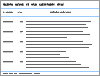
Tab.1
Comparison of general characteristics between the two groups"
| 因素 | 术后无淋巴漏(n = 159) | 术后是淋巴漏(n = 89) | χ2/t/Z值 | P值 |
|---|---|---|---|---|
| 手术总时长[M(P25,P75)]/min | 270.0(233.0,330.0) | 275.0(240.0,327.5) | -0.846 | 0.397 |
| 年龄[M(P25,P75)]/岁 | 71.0(66.0,75.0) | 71.0(66.0,74.0) | -0.429 | 0.668 |
| NRS2002评分[M(P25,P75)] | 2.0(1.0,2.0) | 2.0(1.0,2.0) | -0.991 | 0.322 |
| BMI( | 23.57 ± 3.07 | 23.69 ± 3.11 | -0.281 | 0.779 |
| PSA[M(P25,P75)] | 9.3(3.0,20.6) | 15.6(7.6,32.2) | -3.032 | 0.002 |
| Gleason评分[M(P25,P75)] | 7.0(7.0,9.0) | 8.0(7.0,9.0) | -1.646 | 0.100 |
| 抽烟情况 | 0.895 | 0.794 | ||
| 不吸烟 | 155(97.5) | 88(98.9) | ||
| 戒烟 | 2(1.3) | 0(0.0) | ||
| 吸烟 | 2(1.3) | 1(1.1) | ||
| 深静脉血栓史 | 0.560 | 0.454 | ||
| 无 | 155(97.5) | 88(98.9) | ||
| 是 | 4(2.5) | 1(1.1) | ||
| 术前血红蛋白( | 129.35 ± 17.96 | 129.09 ± 15.87 | 0.112 | 0.911 |
| 术前白蛋白( | 38.30 ± 4.42 | 38.76 ± 3.58 | -0.840 | 0.402 |
| 淋巴结清扫 | 13.705 | < 0.001 | ||
| 无 | 44(27.7) | 7(7.9) | ||
| 是 | 115(72.3) | 82(92.1) | ||
| 术中出血量[M(P25,P75)]/mL | 100.0(50.0,200.0) | 150.0(100.0,200.0) | -1.709 | 0.087 |
| 术后血红蛋白( | 112.52 ± 15.75 | 111.13 ± 15.87 | 0.660 | 0.510 |
| 术后白蛋白( | 32.27 ± 4.06 | 32.63 ± 3.76 | 0.687 | 0.493 |
| 术后禁食时间[M(P25,P75)]/d | 1.5(1.0,2.5) | 2.0(1.5,2.8) | -2.744 | 0.006 |
| 术后深静脉血栓 | 0.560 | 0.454 | ||
| 无 | 155(97.5) | 88(98.9) | ||
| 是 | 4(2.5) | 1(1.1) | ||
| 术后使用生长抑素 | 1.414 | 0.234 | ||
| 无 | 156(98.1) | 85(95.5) | ||
| 是 | 3(1.9) | 4(4.5) | ||
| 全肠外营养 | 0.362 | 0.547 | ||
| 无 | 133(83.6) | 77(86.5) | ||
| 是 | 26(16.4) | 12(13.5) | ||
| 使用血浆 | 10.387 | 0.001 | ||
| 无 | 135(84.9) | 60(67.4) | ||
| 是 | 24(15.1) | 29(32.6) |
Tab.2
Multivariate logistic regression analysis of risk factors for lymphatic leakage following PR surgery"
| 因素 | B | SD | Wald | OR | 95%CI | P值 |
|---|---|---|---|---|---|---|
| PSA | 0.003 | 0.002 | 1.854 | 1.003 | 0.999 ~ 1.008 | 0.173 |
| 术后禁食时间/d | 0.345 | 0.132 | 6.796 | 1.412 | 1.089 ~ 1.829 | 0.009 |
| 是否淋巴结清扫 | 1.689 | 0.467 | 13.069 | 5.415 | 2.167 ~ 13.532 | < 0.001 |
| 有无使用血浆 | 1.082 | 0.337 | 10.295 | 2.952 | 1.524 ~ 5.718 | 0.001 |
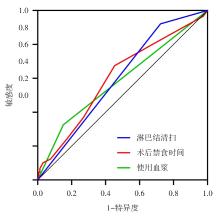
Fig.1
Receiver operating characteristic (ROC) curve of the single factor predictive model"
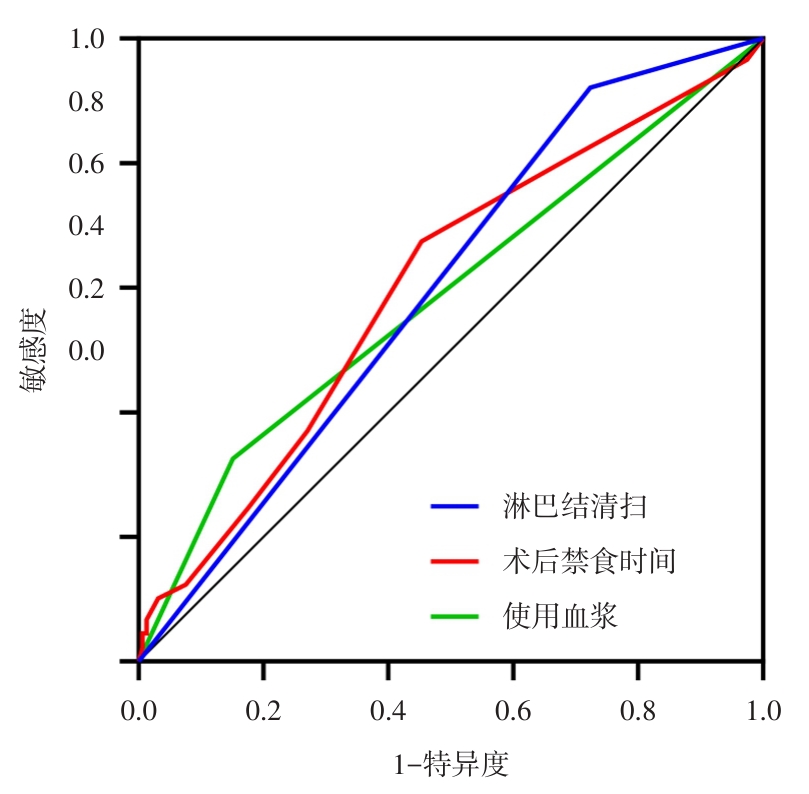
Tab.3
Results of the ROC analysis"
| 因素 | 截断值 | AUC | 95%CI | P值 | 敏感度 | 特异度 | YI |
|---|---|---|---|---|---|---|---|
| 是否淋巴结清扫 | - | 0.599 | 0.528 ~ 0.670 | 0.010 | 0.921 | 0.277 | 0.198 |
| 术后禁食时 | 1.750 | 0.603 | 0.530 ~ 0.677 | 0.007 | 0.674 | 0.547 | 0.221 |
| 有无使用血浆 | - | 0.587 | 0.512 ~ 0.663 | 0.022 | 0.326 | 0.849 | 0.175 |
| 联合预测概率 | 0.337 | 0.711 | 0.647 ~ 0.776 | < 0.001 | 0.764 | 0.597 | 0.362 |

Fig.2
Multi-factor Combined ROC Curve"
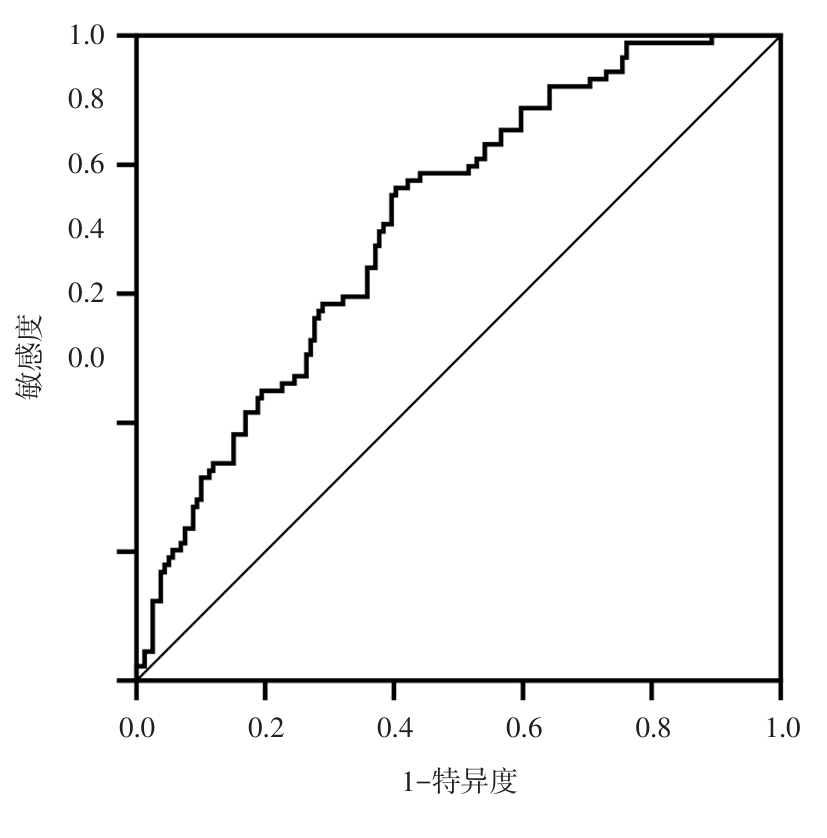

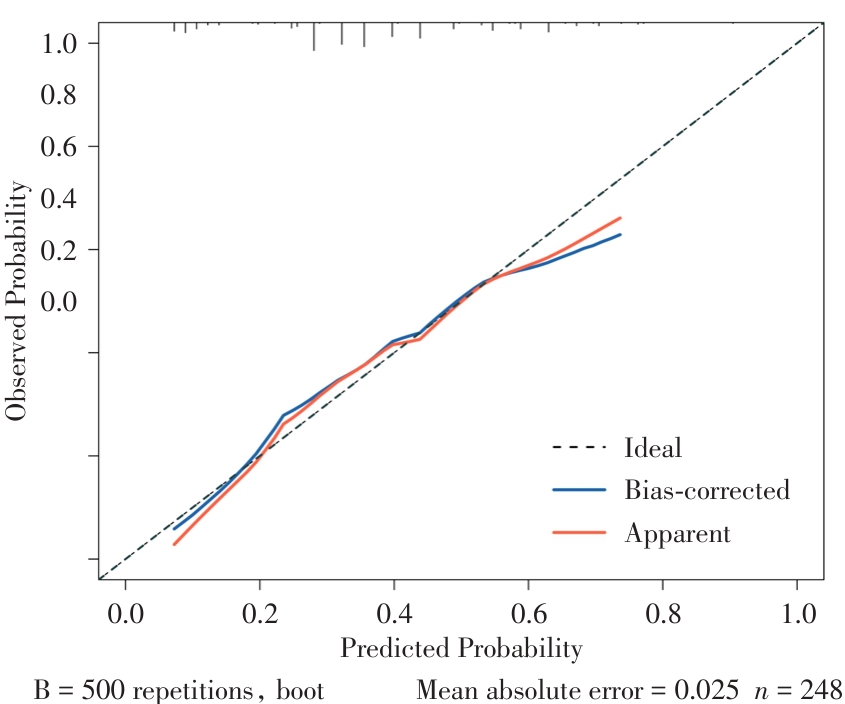
Fig.3
The calibration curve"
Tab.4
The results of 5-fold cross-validation"
| 项目 | 统计值 |
|---|---|
| 训练集AUC低值 | 0.720 |
| 训练集AUC | 0.822 |
| 训练集AUC高值 | 0.874 |
| 测试集AUC低值 | 0.727 |
| 测试集AUC | 0.829 |
| 测试集AUC高值 | 0.889 |

Fig.4
Nomogram for application of the predictive model"

| [1] |
SEKHOACHA M, RIET K, MOTLOUNG P, et al. Prostate Cancer Review: Genetics, Diagnosis, Treatment Options, and Alternative Approaches [J]. Molecules, 2022, 27(17): 5730. doi:10.3390/molecules27175730
doi: 10.3390/molecules27175730 |
| [2] | 杨梦霞, 王武亮, 赵虎. 妇科恶性肿瘤术后淋巴漏的危险因素分析[J]. 实用医学杂志, 2017, 33(6): 953-956. |
| [3] |
BHATIA H, AGARWAL P, KAUR R, et al. Congenital Peri-Lymphatic Fistula: Is CT Imaging Enough? [J]. Indian J Otolaryngol Head Neck Surg, 2023, 75(4): 4148-4150. doi:10.1007/s12070-023-03893-0
doi: 10.1007/s12070-023-03893-0 |
| [4] |
KIM W T, HAM W S, KOO K C,et al. Efficacy of octreotide for management of lymphorrhea after pelvic lymph node dissection in radical prostatectomy [J]. Urology, 2010, 76(2): 398-401. doi:10.1016/j.urology.2009.04.104
doi: 10.1016/j.urology.2009.04.104 |
| [5] |
KAMIYA N, NORO T, OKAZAKI T, et al. Multidisciplinary Treatment for Lymphorrhea and Chylorrhea Following Lymph Node Dissection for Genitourinary Cancer [J/OL]. Cancers, 2025, 17(4): 592. doi:10.3390/cancers17040592
doi: 10.3390/cancers17040592 |
| [6] | 熊洪涛,庄永青,傅小宽,等. 腹股沟区淋巴漏治疗的研究进展 [J]. 中国临床解剖学杂志, 2021, 39(5): 627-629. |
| [7] |
INOUE M, NAKATSUKA S, YASHIRO H, et al. Lymphatic intervention for various types of lymphorrhea: Access and treatment [J]. Radiographics, 2016, 36(7): 2199⁃2211. doi:10.1148/rg.2016160053
doi: 10.1148/rg.2016160053 |
| [8] |
ZHANG W, JI L, WANG X, et al. Nomogram Predicts Risk and Prognostic Factors for Bone Metastasis of Pancreatic Cancer: A Population-Based Analysis [J]. Front Endocrinol (Lausanne), 2021, 12: 752176. doi:10.3389/fendo.2021.752176
doi: 10.3389/fendo.2021.752176 |
| [9] |
FOSSATI N, WILLEMSE P M, VAN DEN BROECK T, et al. The Benefits and Harms of Different Extents of Lymph Node Dissection During Radical Prostatectomy for Prostate Cancer: A Systematic Review [J]. Eur Urol, 2017, 72(1): 84-109. doi:10.1016/j.eururo.2016.12.003
doi: 10.1016/j.eururo.2016.12.003 |
| [10] |
GOLER C, MAY M, WEIKERT S, et al. Long-Term FoLLow-Up of Peritoneal Interposition Flap in Symptomatic Lymphocele Reduction foLLowing Robot-Assisted Radical Prostatectomy: Insights from the PIANOFORTE Trial [J]. Cancers (Basel), 2024, 16(10): 1932. doi:10.3390/cancers16101932
doi: 10.3390/cancers16101932 |
| [11] |
NEUBERGER M, KOWALEWSKI K F, SIMON V, et al. Peritoneal Flap for Lymphocele Prophylaxis Following Robotic-assisted Radical Prostatectomy with Lymph Node Dissection: The Randomised Controlled Phase 3 PELYCAN Trial [J/OL]. Eur Urol Oncol, 2024, 7(1): 53-62. doi:10.1016/j.euo.2023.07.009
doi: 10.1016/j.euo.2023.07.009 |
| [12] |
STUDENT V J, TUDOS Z, STUDENTOVA Z, et al. Effect of Peritoneal Fixation (PerFix) on Lymphocele Formation in Robot-assisted Radical Prostatectomy with Pelvic Lymphadenectomy: Results of a Randomized Prospective Trial [J/OL]. European urology, 2023, 83(2): 154-162. doi:10.1016/j.eururo.2022.07.027
doi: 10.1016/j.eururo.2022.07.027 |
| [13] |
SU S, WANG J, LEI Y, et al. The efficacy of peritoneal flap fixation on symptomatic lymphocele formation following robotic-assisted laparoscopic radical prostatectomy with pelvic lymph node dissection: A systematic review and meta-analysis [J/OL]. Int J Surg, 2024, 110(2): 1172-1182. doi:10.1097/js9.0000000000000893
doi: 10.1097/js9.0000000000000893 |
| [14] |
CHUNG D Y, KANG D H. Cytoreductive prostatectomy may improve oncological outcomes in patients with oligometastatic prostate cancer: An updated systematic review and meta-analysis [J]. Investig Clin Urol, 2023, 64(3): 242-254. doi:10.4111/icu.20230058
doi: 10.4111/icu.20230058 |
| [15] |
DITONNO F, MANFREDI C, FRANCO A, et al. Impact of peritoneal reconfiguration on lymphocele formation after robot-assisted radical prostatectomy with pelvic lymph node dissection: A systematic review and meta-analysis of randomized controlled trials [J/OL]. Prostate Cancer Prostatic Dis, 2024, 27(4): 635-644. doi:10.1038/s41391-023-00744-5
doi: 10.1038/s41391-023-00744-5 |
| [16] |
DE HERTOGH O, LE BIHAN G, ZILLI T, et al. Consensus Delineation Guidelines for Pelvic Lymph Node Radiation Therapy of Prostate Cancer: On Behalf of the Francophone Group of Urological Radiation Therapy (GFRU) [J]. Int J Radiat Oncol Biol Phys, 2024, 118(1): 29-40. doi:10.1016/j.ijrobp.2023.07.020
doi: 10.1016/j.ijrobp.2023.07.020 |
| [17] |
SOUZA-SMITH F M, MOLINA P E, MAIYA R. Chronic alcohol feeding alters lymph and plasma proteome in a rodent model [J]. Life Sci, 2023, 327: 121818. doi:10.1016/j.lfs.2023.121818
doi: 10.1016/j.lfs.2023.121818 |
| [18] |
DEBRAH L B, GYASI C, AHIADORME M, et al. Association of haemato-biochemical indices and blood composite ratios with microfilaridermia in Onchocerciasis patients [J]. BMC Infect Dis, 2024, 24(1): 384-384. doi:10.1186/s12879-024-09278-0
doi: 10.1186/s12879-024-09278-0 |
| [19] |
WU E J, KABIR T, ZHAO J J, et al. MinimaLLy Invasive Versus Open Radical Antegrade Modular Pancreatosplenectomy: A Meta-Analysis [J]. World J Surg, 2022, 46(1): 235-245. doi:10.1007/s00268-021-06328-5
doi: 10.1007/s00268-021-06328-5 |
| [20] |
LUZZAGO S, PALUMBO C, ROSIELLO G, et al. Metabolic syndrome predicts worse perioperative outcomes in patients treated with radical prostatectomy for non-metastatic prostate cancer [J]. Surg Oncol, 2021, 37: 101519. doi:10.1016/j.suronc.2020.12.013
doi: 10.1016/j.suronc.2020.12.013 |
| [21] | 张苏杰, 赵卫红, 于路平, 等. 伴多发淋巴结肿大的乏脂型血管平滑肌脂肪瘤并发术后顽固性淋巴瘘1例报道及文献回顾 [J]. 北京大学学报(医学版), 2018, 50(4): 717-721. |
| [22] |
ERDEMIR A, D KD K M, RAŞA K. Thoracic Duct Embolization for Postoperative Lymphatic Fistula [J]. Case Rep Surg, 2022, 2022: 7510793. doi:10.1155/2022/7510793
doi: 10.1155/2022/7510793 |
| [23] |
SMITH R, HIGGINSON J, BREIK O, et al. Nutritional management of chyle leak after head and neck surgery: A systematic review and proposed protocol for management [J]. Oral MaxiLLofac Surg, 2024, 28(1): 51-62. doi:10.1007/s10006-023-01152-8
doi: 10.1007/s10006-023-01152-8 |
| [24] |
ZHU Q, YANG Q, SHEN L, et al. Impact of Sequential Lipid Meals on Lymphatic Lipid Absorption and Transport in Rats [J]. Genes, 2022, 13(2): 277. doi:10.3390/genes13020277
doi: 10.3390/genes13020277 |
| [25] |
SHYR B U, SHYR B S, CHEN S C, et al. Operative results and patient satisfaction after robotic pancreaticoduodenectomy [J]. Asian J Surg, 2020, 43(4): 519-525. doi:10.1016/j.asjsur.2019.08.012
doi: 10.1016/j.asjsur.2019.08.012 |
| [1] | Runfang WANG,Ya DUAN,Liyan DU,Xiaodan LIU,Wenning LIAN,Yan HUO,Dandan. YANG. Epidemiological status and risk factors associated with placental abruption among pregnant women in Hebei Province [J]. The Journal of Practical Medicine, 2025, 41(6): 904-910. |
| [2] | Dongli LIU,Zilin QUAN,Lingxiu ZHONG,Qiqi CHEN,Wenqiao CAI,Senpei ZHUANG,Ying WEI,Huiyi PAN,Yawen. LIN. Construction and validation of a predictive model for antibiotic-associated diarrhea after surgery in children with congenital heart disease [J]. The Journal of Practical Medicine, 2025, 41(5): 683-690. |
| [3] | Qiaoying MO,Fangyi ZHU,Cunkui ZHU,Shenglong. MA. Nomogram model of malnutrition risk in patients suffering from chronic heart failure grounded on GNRI score [J]. The Journal of Practical Medicine, 2025, 41(5): 691-698. |
| [4] | Xiaoying DING,Zhichao DONG,Jianna MAO,Changqing GUO,Aimin. YUE. Expression and clinical significance of serum CXCL1 and PRDM5 in lymph node metastasis of progressive gastric cancer [J]. The Journal of Practical Medicine, 2025, 41(20): 3206-3213. |
| [5] | Zhao WANG,Jiepeng ZUO,Hang CHE,Lingyun REN,Zhe XU,Lei. WANG. Evaluation of plasma PPARγ as a potential diagnostic marker for female interstitial cystitis/painful bladder syndrome and its predictive model [J]. The Journal of Practical Medicine, 2025, 41(2): 258-263. |
| [6] | Xiaozhen JIANG,Xiuxian CHEN,Wenming LI. Analysis of risk factors for pegaspargase⁃associated acute pancreatitis in childhood with B⁃cell acute lymphoblastic leukemia [J]. The Journal of Practical Medicine, 2025, 41(18): 2853-2858. |
| [7] | Dehong LI,Maomei NI,Ting CAI,Juanjuan REN. Risk factors for postoperative recurrence in patients with chronic sinusitis and nasal polyps treated by endoscopic sinus surgery [J]. The Journal of Practical Medicine, 2025, 41(18): 2928-2936. |
| [8] | Cuicui WANG,Wantong QIAO,Junying YAO,Qian LI,Weige GAO,Min FAN. Clinical application value of nutritional control status score combined with prognostic nutritional index in evaluating the risk of anemia in elderly colorectal cancer patients [J]. The Journal of Practical Medicine, 2025, 41(17): 2696-2704. |
| [9] | Mingbo LIU,Xinye HE,Xiaohong YANG,Zengwu. WANG. Interpretation of annual report on cardiovascular health and diseases in China 2024 [J]. The Journal of Practical Medicine, 2025, 41(14): 2111-2131. |
| [10] | Huangjunqing LIAO,Jiadong CAO,Zhichao WANG,Qiuhong ZHANG,Jianfu ZHOU,Songtao XIANG. Establishment and validation of a predictive model for the stone⁃free rateafter flexible ureteroscopy for lower pole calculi [J]. The Journal of Practical Medicine, 2025, 41(13): 1979-1986. |
| [11] | Zhiqing XIAO,Xue WU,Rui QIU,Jinghan CHI,Shaodong HUA,Bin ZHU,De CHANG. Construction and verification of multi⁃factor prediction model for refractory mycoplasma pneumoniae pneumonia in children [J]. The Journal of Practical Medicine, 2025, 41(13): 2004-2010. |
| [12] | Shulian GAO,Lingxiu ZHONG,Yamin SONG,Lixia LIN,Senpei ZHUANG,Jian TAO. Risk factors of tracheal reintubation after total aortic arch replacement [J]. The Journal of Practical Medicine, 2025, 41(11): 1681-1686. |
| [13] | Shaolin LI,Xiaohong MA,Dehe ZHANG,Peng. SONG. Development and validation of a predictive model for delayed neurological sequelae in acute carbon monoxide poisoning [J]. The Journal of Practical Medicine, 2025, 41(10): 1533-1539. |
| [14] | Qiannan JIANG,Tingting LIU,Yingying LIU,Kaijie CUI,Xiuxiang. LIU. Patent ductus arteriosus severity predicts the occurrence and mortality of pulmonary hemorrhage in premature infants with gestational age ≤ 32 weeks [J]. The Journal of Practical Medicine, 2025, 41(10): 1575-1583. |
| [15] | Qingqing WANG,Jie DING,Haiwen LI,Zhijian DONG,Yiying WANG,Siqi LIU,Guoji CHANG,Lijuan HUA,Huayi CHEN,Shenghao LI,Yongrui. YANG. Analysis of factors influencing short⁃term adverse clinical outcome in cirrhotic patients with grade 2/3 ascites [J]. The Journal of Practical Medicine, 2024, 40(8): 1114-1120. |
| Viewed | ||||||
|
Full text |
|
|||||
|
Abstract |
|
|||||
