

The Journal of Practical Medicine ›› 2026, Vol. 42 ›› Issue (5): 831-837.doi: 10.3969/j.issn.1006-5725.2026.05.014
• Chronic Disease Control • Previous Articles
Zhenggang WANG( ),Hui XIONG,Ting HE,Xiaojing LIU,Yanhua YE
Received:2025-11-21
Online:2026-03-10
Published:2026-03-09
Contact:
Zhenggang WANG
E-mail:13882964694@163.com
CLC Number:
Zhenggang WANG,Hui XIONG,Ting HE,Xiaojing LIU,Yanhua YE. Serum melatonin and IGFBP3 levels in the diagnosis and prognostic evaluation of age⁃related cataract[J]. The Journal of Practical Medicine, 2026, 42(5): 831-837.
Tab.1
Comparison of serum MT and IGFBP3 levels between the ARC group and the control group"
| 组别 | 例数 | MT(x ± s) | IGFBP3[M(P25,P75)] |
|---|---|---|---|
| ARC组 | 240 | 34.36 ± 5.38 | 5 044.34(3 898.12,6 132.26) |
| 对照组 | 187 | 40.98 ± 5.25 | 3 509.50(2 255.11,4 438.88) |
| t/U值 | -12.759 | 9 316.000 | |
| P值 | < 0.001 | < 0.001 |
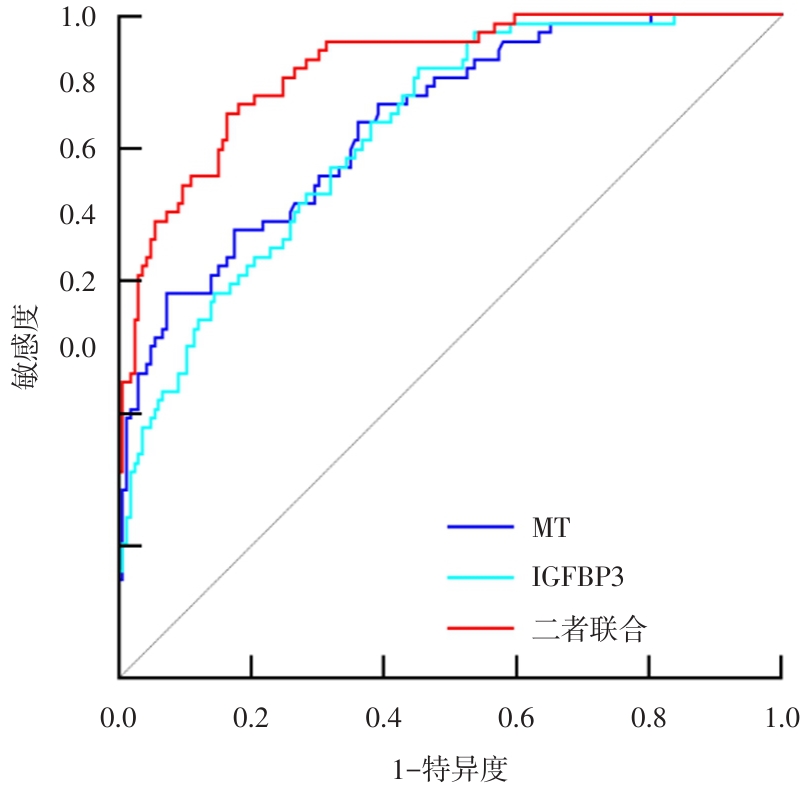
Tab.2
Diagnostic value of serum MT and IGFBP3 levels for ARC"
| 指标 | 曲线下面积 | 95%CI | P值 | 截断值 | 敏感度/% | 特异度/% | 最大约登指数 |
|---|---|---|---|---|---|---|---|
| MT | 0.817 | 0.777 ~ 0.853 | < 0.001 | 38.04 pg/mL | 76.67 | 73.80 | 0.5046 |
| IGFBP3 | 0.792 | 0.751 ~ 0.830 | < 0.001 | 4 640.72 pg/mL | 60.00 | 85.03 | 0.4503 |
| 二者联合 | 0.907 | 0.875 ~ 0.933 | < 0.001 | -* | 83.75 | 83.96 | 0.6771 |
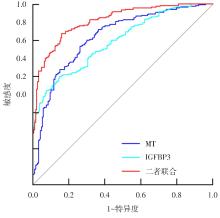
Fig.1
ROC curve of serum MT and IGFBP3 levels for diagnosing ARC"
Tab.3
Comparison of clinical data among ARC patients with different prognoses"
| 项目 | 不良组(n = 74) | 良好组(n = 166) | χ2/t/U值 | P值 |
|---|---|---|---|---|
| 性别/例 | 0.669 | 0.413 | ||
| 男 | 43 | 87 | ||
| 女 | 31 | 79 | ||
| 年龄(x ± s)/岁 | 61.20 ± 5.89 | 60.05 ± 5.74 | 1.428 | 0.155 |
| 病程[M(P25,P75 )]/个月 | 9.00(8.00,11.00) | 9.00(7.00,10.00) | 5 281.500 | 0.081 |
| 烟酒嗜好 | ||||
| 吸烟史 | 35(47.30) | 68(40.96) | 0.838 | 0.360 |
| 饮酒史 | 22(29.73) | 45(27.11) | 0.175 | 0.676 |
| 类型 | 0.636 | 0.888 | ||
| 混合型 | 17(22.97) | 33(19.88) | ||
| 后囊下型 | 13(17.57) | 26(15.66) | ||
| 核性白内障 | 19(25.68) | 49(29.52) | ||
| 皮质性白内障 | 25(33.78) | 58(34.94) | ||
| 合并疾病 | ||||
| 糖尿病 | 51(68.92) | 101(60.84) | 1.437 | 0.231 |
| 高血压 | 23(31.08) | 48(28.92) | 0.115 | 0.734 |
| 高脂血症 | 20(27.03) | 33(19.88) | 1.520 | 0.218 |
| 冠心病 | 26(35.14) | 39(23.49) | 3.512 | 0.061 |
| 晶状体核硬度 | 10.616 | 0.001 | ||
| Ⅰ—Ⅲ级 | 32(43.24) | 109(65.66) | ||
| Ⅳ—Ⅴ级 | 42(56.76) | 57(34.34) | ||
| 手术方式 | 6.660 | 0.010 | ||
| 白内障囊外摘除术 | 24(32.43) | 29(17.47) | ||
| 超声乳化白内障吸除术 | 50(67.57) | 137(82.53) | ||
| BCVA(x ± s)/logMAR | 0.62 ± 0.18 | 0.58 ± 0.15 | 1.791 | 0.075 |
| 眼压[M(P25,P75 )]/mmHg | 18.00(15.00,20.00) | 17.00(14.00,19.00) | 4 997.500 | 0.021 |
| 中央黄斑厚度(x ± s)/μm | 251.05 ± 32.27 | 243.45 ± 26.84 | 1.902 | 0.058 |
| CRT(x ± s)/μm | 250.41 ± 27.84 | 242.05 ± 24.21 | 2.354 | 0.019 |
| SFCT(x ± s)/μm | 208.82 ± 40.15 | 233.26 ± 33.49 | -4.902 | < 0.001 |
| MT(x ± s)/(pg/mL) | 29.98 ± 4.61 | 36.31 ± 4.48 | -10.002 | < 0.001 |
| IGFBP3[M(P25,P75 )]/(pg/mL) | 6 201.59(5 239.96,7 103.66) | 4 428.44(3 519.66,5 568.27) | 2 203.000 | < 0.001 |
Tab.4
Multivariate analysis of prognosis in ARC patients"
| 变量 | P值 | OR | 95%CI |
|---|---|---|---|
| 晶状体核硬度Ⅳ—Ⅴ级 | 0.003 | 4.632 | 1.702 ~ 12.609 |
| 白内障囊外摘除术 | 0.053 | 3.161 | 0.987 ~ 10.121 |
| 眼压升高 | 0.001 | 1.341 | 1.123 ~ 1.601 |
| CRT增加 | 0.148 | 1.013 | 0.995 ~ 1.031 |
| SFCT增加 | 0.001 | 0.978 | 0.964 ~ 0.991 |
| MT升高 | < 0.001 | 0.667 | 0.577 ~ 0.771 |
| IGFBP3升高 | < 0.001 | 1.001 | 1.001 ~ 1.002 |
| 常量 | 0.798 | 2.519 | - |
Tab.5
The assessment value of serum MT and IGFBP3 levels for poor prognosis in ARC patients"
| 指标 | 曲线下面积 | 95%CI | P值 | 截断值 | 敏感度/% | 特异度/% | 最大约登指数 |
|---|---|---|---|---|---|---|---|
| MT | 0.836 | 0.783 ~ 0.880 | < 0.001 | 30.25 pg/mL | 58.11 | 92.77 | 0.508 8 |
| IGFBP3 | 0.821 | 0.766 ~ 0.867 | < 0.001 | 4 644.48 pg/mL | 91.89 | 54.82 | 0.467 1 |
| 二者联合 | 0.919 | 0.877 ~ 0.951 | < 0.001 | -* | 85.14 | 83.73 | 0.688 7 |
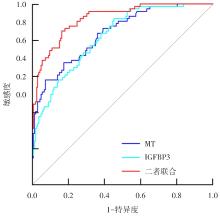
Fig.2
ROC curve of serum MT and IGFBP3 levels for assessing poor prognosis in ARC patients"
| [1] |
Vision Loss Expert Group of the Global Burden of Disease Study, GBD 2019 Blindness and Vision Impairment Collaborators. Global estimates on the number of people blind or visually impaired by cataract: A meta-analysis from 2000 to 2020[J]. Eye (Lond),2024,38(11):2156-2172. doi: 10.1038/s41433-024-02961-1 .
doi: 10.1038/s41433-024-02961-1 |
| [2] |
谢九冰,陈喜月,岳向东,等. 激光辅助巩膜切除及白内障摘除联合房角分离治疗闭角型青光眼[J]. 实用医学杂志,2024,40(2):213-218. doi:10.3969/j.issn.1006-5725.2024.02.015 .
doi: 10.3969/j.issn.1006-5725.2024.02.015 |
| [3] |
SUTKOWY P, LESIEWSKA H, WOŹNIAK A, et al. Inflammation-involved proteins in blood serum of cataract patients-a preliminary study[J]. Biomedicines,2023,11(10):2607. doi: 10.3390/biomedicines11102607 .
doi: 10.3390/biomedicines11102607 |
| [4] |
KULBAY M, WU K Y, NIRWAL G K, et al. Oxidative stress and cataract formation: Evaluating the efficacy of antioxidant therapies[J]. Biomolecules,2024,14(9):1055. doi: 10.3390/biom14091055 .
doi: 10.3390/biom14091055 |
| [5] |
JIA M, LUO A, WEI M, et al. Melatonin: Beyond circadian regulation - exploring its diverse physiological roles and therapeutic potential[J]. Sleep Med Rev,2025,82:102123. doi: 10.1016/j.smrv.2025.102123 .
doi: 10.1016/j.smrv.2025.102123 |
| [6] |
MI Y, WEI C, SUN L, et al. Melatonin inhibits ferroptosis and delays age-related cataract by regulating SIRT6/p-Nrf2/GPX4 and SIRT6/NCOA4/FTH1 pathways[J]. Biomed Pharmacother,2023,157:114048. doi: 10.1016/j.biopha.2022.114048 .
doi: 10.1016/j.biopha.2022.114048 |
| [7] |
SHEN C. ID1 and IGFBP3: Roles in cellular senescence, cardiac development, angiogenesis and cancer diagnosis[J]. J Transl Med,2023,21(1):797. doi: 10.1186/s12967-023-04701-7 .
doi: 10.1186/s12967-023-04701-7 |
| [8] |
LI W, ZOU Y, ZHENG W, et al. Transcription factor EGR2 drives cataract formation through IGFBP3-mediated oxidative injury in lens epithelial cells[J]. Free Radic Biol Med,2025,241:773-788. doi: 10.1016/j.freeradbiomed.2025.10.009 .
doi: 10.1016/j.freeradbiomed.2025.10.009 |
| [9] |
MILLER K M, OETTING T A, TWEETEN J P, et al. Cataract in the adult eye preferred practice pattern[J]. Ophthalmology,2022,129(1):P1-P126. doi: 10.1016/j.ophtha.2021.10.006 .
doi: 10.1016/j.ophtha.2021.10.006 |
| [10] |
中华医学会眼科学分会白内障及屈光手术学组. 中国成人白内障摘除手术指南(2023年)[J]. 中华眼科杂志,2023,59(12):977-987. doi:10.3760/cma.j.cn112142-20230829-00066 .
doi: 10.3760/cma.j.cn112142-20230829-00066 |
| [11] |
SENTHAMIZH T, ARAVIND H, SINGH T P.Factors associated with postoperative visual outcome in acute endophthalmitis after cataract surgery-a cross-sectional, analytical study[J].Digit J Ophthalmol,2022,28(1):1-6. doi: 10.5693/djo.01.2021.08.001 .
doi: 10.5693/djo.01.2021.08.001 |
| [12] |
唐娟,兰芬,孟林霞,等. 全程化血糖管理在改善无明显视网膜病变的2型糖尿病性白内障患者术后视力的效果分析:基于视觉电生理和OCTA研究[J]. 实用医学杂志,2024,40(20):2888-2899. doi:10.3969/j.issn.1006-5725.2024.20.012 .
doi: 10.3969/j.issn.1006-5725.2024.20.012 |
| [13] |
LI S, MA Y. Retrospective analysis of risk factors for unplanned anterior vitrectomy during planned cataract ultrasonic phacoemulsification in Chinese adult patients[J]. BMC Ophthalmol,2025,25(1):186. doi: 10.1186/s12886-025-04012-z .
doi: 10.1186/s12886-025-04012-z |
| [14] |
ZHANG Y, SU D, SUN Z, et al. EGCG mitigates apoptosis of lens epithelial cells in age-related cataract via the PAK1/cleaved Caspase-3 pathway[J]. Curr Mol Med,2025,25(10):1269-1281. doi: 10.2174/0115665240334265250213064823 .
doi: 10.2174/0115665240334265250213064823 |
| [15] |
RUSCIANO D. Light, sound, and melatonin: investigating multisensory pathways for visual restoration[J]. Medicina (Kaunas),2025,61(6):1009. doi: 10.3390/medicina61061009 .
doi: 10.3390/medicina61061009 |
| [16] |
杨鑫,刘旭辉,孟佳,等. 褪黑素抗人晶状体上皮细胞焦亡作用及其机制[J]. 中华实验眼科杂志,2022,40(5):414-421. doi: 10.3760/cma.j.cn115989-20210516-00307 .
doi: 10.3760/cma.j.cn115989-20210516-00307 |
| [17] |
王思文,李鹏飞,王从玉,等. 褪黑素对过氧化氢诱导的人晶状体上皮细胞凋亡及自噬的影响[J]. 眼科新进展,2023,43(11):848-852,857. doi: 10.13389/j.cnki.rao.2023.0170 .
doi: 10.13389/j.cnki.rao.2023.0170 |
| [18] |
LLEDÓ VE, ALKOZI HA, SÁNCHEZ-NAVES J, et al. Melatonin counteracts oxidative damage in lens by regulation of Nrf2 and NLRP3 inflammasome activity[J]. Exp Eye Res,2022,215:108912. doi: 10.1016/j.exer.2021.108912 .
doi: 10.1016/j.exer.2021.108912 |
| [19] |
SUN J, LIU Y, CHEN Z. Melatonin and retinal cell damage: molecular and biological functions[J]. Naunyn Schmiedebergs Arch Pharmacol,2025,398(4):3199-3212. doi: 10.1007/s00210-024-03575-w .
doi: 10.1007/s00210-024-03575-w |
| [20] |
LIU X, WANG M, JI Z, et al. PINK1-mediated mitochondrial autophagy protects lens epithelial cells by reducing ROS and apoptosis[J]. Exp Eye Res,2025,258:110437. doi: 10.1016/j.exer.2025.110437 .
doi: 10.1016/j.exer.2025.110437 |
| [21] |
PENG R, LIN H, ZHU H, et al. Involvement of IGF1 in endoplasmic reticulum stress contributes to cataract formation through regulating Nrf2/NF-κB signaling[J]. Funct Integr Genomics,2023,23(3):220. doi: 10.1007/s10142-023-01152-7 .
doi: 10.1007/s10142-023-01152-7 |
| [22] |
ZOU X, ZHANG J, WANG Y, et al. IGF-1 rs6218 polymorphisms modulate the susceptibility to age-related cataract[J]. PeerJ,2024,12:e17220. doi: 10.7717/peerj.17220 .
doi: 10.7717/peerj.17220 |
| [23] |
KHAN M, VERMA L. Crosstalk between signaling pathways (Rho/ROCK, TGF-β and Wnt/β-catenin pathways/ PI3K-AKT-mTOR) in cataract: A mechanistic exploration and therapeutic strategy[J]. Gene,2025,947:149338. doi: 10.1016/j.gene. 2025.149338 .
doi: 10.1016/j.gene. 2025.149338 |
| [24] |
WANG Y, YANG W, ZUO H, et al. Icariin interacts with IGFBP3 to alleviate diabetic cataract through PI3K/AKT signaling pathway[J]. iScience,2025,28(7):112796. doi: 10.1016/j.isci.2025.112796 .
doi: 10.1016/j.isci.2025.112796 |
| [25] |
YANG C, AN Q, ZHOU H, et al. Research progress on the impact of cataract surgery on corneal endothelial cells[J]. Adv Ophthalmol Pract Res,2024,4(4):194-201. doi: 10.1016/j.aopr. 2024.08.002 .
doi: 10.1016/j.aopr. 2024.08.002 |
| [26] |
SHAH Y S, GARG A K, RAMULU P Y. The effect of cataract surgery on lowering intraocular pressure[J]. Curr Opin Ophthalmol,2025,36(1):46-53. doi: 10.1097/ICU.0000000000001112 .
doi: 10.1097/ICU.0000000000001112 |
| [27] |
ZHANG L, LUO Y. Correlation analysis between OCT evaluation and postoperative visual prognosis of patients with age-related macular degeneration complicated with cataract[J]. BMC Ophthalmol,2025,25(1):266. doi: 10.1186/s12886-025-04094-9 .
doi: 10.1186/s12886-025-04094-9 |
| Viewed | ||||||
|
Full text |
|
|||||
|
Abstract |
|
|||||
