

The Journal of Practical Medicine ›› 2026, Vol. 42 ›› Issue (3): 447-454.doi: 10.3969/j.issn.1006-5725.2026.03.012
• Chronic Disease Control • Previous Articles
Jianhua JIAO1,Ruixue MA1,Honghong GU2,Xing WU3,Xiuli CAO4( )
)
Received:2025-11-13
Online:2026-02-10
Published:2026-02-09
Contact:
Xiuli CAO
E-mail:mnqw122@163.com
CLC Number:
Jianhua JIAO,Ruixue MA,Honghong GU,Xing WU,Xiuli CAO. Evaluation value of sCD163, SHR, pro-ADM, PTX3 combined with score of chest CT on the condition and prognosis of elderly patients with stroke-related pneumonia[J]. The Journal of Practical Medicine, 2026, 42(3): 447-454.
Tab.1
Comparison of clinical data, serum levels of sCD163, SHR, pro-ADM, PTX3 and chest CT score in elderly patients with stroke-related pneumonia of different conditions"
| 指标 | 轻度组(n = 36) | 中度组(n = 45) | 重度组(n = 31) | F/χ2值 | P值 |
|---|---|---|---|---|---|
| BMI/(kg/m2) | 23.47 ± 1.14 | 23.25 ± 1.09 | 23.11 ± 1.05 | 0.931 | 0.397 |
| 年龄/岁 | 72.55 ± 2.15 | 72.94 ± 2.33 | 73.15 ± 2.27 | 0.622 | 0.539 |
| 性别/[例(%)] | 0.062 | 0.970 | |||
| 男 | 21(58.33) | 27(60.00) | 19(61.29) | ||
| 女 | 15(41.67) | 18(40.00) | 12(38.71) | ||
| 卒中类型/[例(%)] | 1.340 | 0.512 | |||
| 脑梗死 | 29(80.56) | 37(82.22) | 28(90.32) | ||
| 脑出血 | 7(19.44) | 8(17.78) | 3(9.68) | ||
| 饮酒史/[例(%)] | 0.050 | 0.975 | |||
| 有 | 13(36.11) | 17(37.78) | 12(38.71) | ||
| 无 | 23(63.89) | 28(62.22) | 19(61.29) | ||
| 吸烟史/[例(%)] | 1.896 | 0.388 | |||
| 有 | 10(27.78) | 13(28.89) | 13(41.94) | ||
| 无 | 26(72.22) | 32(71.11) | 18(58.06) | ||
| 接受教育年限/年 | 8.56 ± 1.45 | 8.13 ± 1.25 | 7.96 ± 1.32 | 1.854 | 0.162 |
| sCD163/(ng/mL) | 474.69 ± 54.23 | 583.11 ± 60.78a | 682.25 ± 65.49ab | 99.795 | < 0.001 |
| SHR | 0.95 ± 0.24 | 1.22 ± 0.33a | 1.61 ± 0.38ab | 35.663 | < 0.001 |
| pro-ADM/(nmol/L) | 1.51 ± 0.22 | 1.85 ± 0.24a | 2.16 ± 0.27ab | 60.137 | < 0.001 |
| PTX3/(ng/mL) | 14.65 ± 3.12 | 20.29 ± 4.18a | 28.33 ± 5.46ab | 85.129 | < 0.001 |
| 胸部CT评分/分 | 3.72 ± 0.67 | 5.93 ± 1.05a | 8.45 ± 1.22ab | 186.552 | < 0.001 |
Tab.2
Comparison of clinical data, serum levels of sCD163, SHR, pro-ADM, PTX3 and chest CT score in elderly patients with stroke-related pneumonia with different prognosis"
| 指标 | 预后良好组(n = 77) | 预后不良组(n = 35) | t/χ2 值 | P值 |
|---|---|---|---|---|
| BMI/(kg/m2) | 23.34 ± 1.11 | 23.15 ± 1.07 | 0.849 | 0.398 |
| 年龄/岁 | 73.02 ± 2.35 | 72.55 ± 2.27 | 0.991 | 0.324 |
| 性别/[例(%)] | 0.736 | 0.391 | ||
| 男 | 44(57.14) | 23(65.71) | ||
| 女 | 33(42.86) | 12(34.29) | ||
| 卒中类型/[例(%)] | 0.814 | 0.367 | ||
| 脑梗死 | 63(81.82) | 31(88.57) | ||
| 脑出血 | 14(18.18) | 4(11.43) | ||
| 饮酒史/[例(%)] | 0.623 | 0.430 | ||
| 有 | 27(35.06) | 15(42.86) | ||
| 无 | 50(64.94) | 20(57.14) | ||
| 吸烟史/[例(%)] | 0.584 | 0.445 | ||
| 有 | 23(29.87) | 13(37.14) | ||
| 无 | 54(70.13) | 22(62.86) | ||
| 接受教育年限/年 | 8.31 ± 1.33 | 8.03 ± 1.25 | 1.052 | 0.295 |
| sCD163/(ng/mL) | 492.58 ± 155.38 | 758.57 ± 168.93 | 8.171 | < 0.001 |
| SHR | 1.15 ± 0.22 | 1.44 ± 0.35 | 5.327 | < 0.001 |
| pro-ADM/(nmol/L) | 1.63 ± 0.15 | 2.26 ± 0.21 | 18.092 | < 0.001 |
| PTX3/(ng/mL) | 16.28 ± 3.07 | 30.43 ± 4.56 | 19.297 | < 0.001 |
| 胸部CT评分/分 | 4.02 ± 1.26 | 10.09 ± 2.54 | 3.501 | < 0.001 |
Tab.3
Correlation between serum levels of sCD163, SHR, pro-ADM and PTX3 and chest CT score"
| 指标 | 胸部CT评分 | |
|---|---|---|
| r值 | P值 | |
| sCD163 | 0.775 | < 0.001 |
| SHR | 0.615 | 0.015 |
| pro-ADM | 0.825 | < 0.001 |
| PTX3 | 0.866 | < 0.001 |
Tab.4
Correlation between serum levels of sCD163, SHR, pro-ADM, PTX3, chest CT score and the condition of elderly patients with stroke-related pneumonia"
| 指标 | NIHSS评分 | |
|---|---|---|
| r值 | P值 | |
| sCD163 | 0.682 | 0.009 |
| SHR | 0.793 | < 0.001 |
| pro-ADM | 0.847 | < 0.001 |
| PTX3 | 0.805 | < 0.001 |
| 胸部CT评分 | 0.762 | < 0.001 |
Tab.5
Prognostic value of serum levels of sCD163, SHR, pro-ADM and PTX3 combined with chest CT score in elderly patients with stroke-related pneumonia"
| 指标 | AUC | 95%CI | P值 | 敏感度/% | 特异度/% | 约登指数 |
|---|---|---|---|---|---|---|
| sCD163 | 0.803 | 0.718 ~ 0.872 | < 0.001 | 71.43 | 77.92 | 0.494 |
| SHR | 0.758 | 0.668 ~ 0.834 | < 0.001 | 71.43 | 71.43 | 0.429 |
| pro-ADM | 0.786 | 0.698 ~ 0.858 | < 0.001 | 71.43 | 85.32 | 0.468 |
| PTX3 | 0.787 | 0.700 ~ 0.859 | < 0.001 | 68.57 | 83.12 | 0.517 |
| 胸部CT评分 | 0.752 | 0.661 ~ 0.828 | < 0.001 | 68.57 | 71.43 | 0.400 |
| 联合检测 | 0.903cdefg | 0.832 ~ 0.951 | < 0.001 | 82.86 | 89.61 | 0.725 |
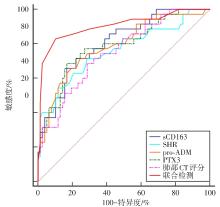
Fig.1
ROC curve of serum levels of sCD163, SHR,pro-ADM and PTX3 combined with chest CT score topredict the prognosis of elderly patients withstroke-related pneumonia"

Fig.2
CT examination of case 1"


Fig.3
CT examination of case 2"

| [1] |
ZHONG A. On the Pathophysiology of Stroke‐Associated Pneumonia: A Brief Review[J]. Neuro Clin Neuro, 2025, 13(5): 327-334. doi: 10.1111/NCN3.70030 .
doi: 10.1111/NCN3.70030 |
| [2] |
杨晓华, 陈惠娟, 何娟, 等. 急性缺血性脑卒中患者口腔清洁度异常与卒中相关性肺炎的影响因素及关系[J]. 实用医学杂志, 2022, 38(17): 2170-2174, 2180. doi: 10.3969/j.issn.1006-5725.2022.17.010 .
doi: 10.3969/j.issn.1006-5725.2022.17.010 |
| [3] |
WANG Y, WANG T, HU S, et al. Procalcitonin and biomarkers for stroke-associated pneumonia: A systematic review and meta-analysis[J]. BMC Pulm Med, 2025, 25(1): 286-286. doi: 10.1186/S12890-025-03750-6 .
doi: 10.1186/S12890-025-03750-6 |
| [4] |
LIN K, DENG X, XIAO Y, et al. Risk factors of stroke-associated pneumonia in patients with acute ischemic stroke treated by endovascular thrombectomy[J]. BMC Neuro, 2025, 25(1): 165-165. doi: 10.1186/S12883-025-04182-9 .
doi: 10.1186/S12883-025-04182-9 |
| [5] |
TAKEDA S, NAMISAKI T, KOIZUMI A, et al. The Macrophage Activation Marker Soluble CD163 Predicts the Response to Atezolizumab and Bevacizumab in Advanced Hepatocellular Carcinoma[J]. Anticancer Res, 2025, 45(10): 4493-4507. doi: 10.21873/ANTICANRES.17797 .
doi: 10.21873/ANTICANRES.17797 |
| [6] |
JIN X, DENG W, WENG Q, et al. Correlation between stress hyperglycemia ratio and risk of acute respiratory distress syndrome in patients with sepsis: A MIMIC-IV cohort study[J]. Sci Rep, 2025, 15(1): 34737-34737. doi: 10.1038/S41598-025-18349-4 .
doi: 10.1038/S41598-025-18349-4 |
| [7] |
LI Y, HUANG F, CHEN D, et al. Deep Learning Models for CT Segmentation of Invasive Pulmonary Aspergillosis, Mucormycosis, Bacterial Pneumonia and Tuberculosis: A Multicentre Study[J]. Mycoses, 2025, 68(7): e70084-e70084. doi: 10.1111/MYC.70084 .
doi: 10.1111/MYC.70084 |
| [8] |
代锟, 张莉莉, 夏语, 等. 基于“头气街”理论针刺联合血管内介入治疗缺血性脑卒中:随机对照试验[J]. 中国针灸, 2025, 45(6): 723-727. doi: 10.13703/j.0255-2930.20241107-k0003 .
doi: 10.13703/j.0255-2930.20241107-k0003 |
| [9] |
FLORENCIA G, MARIA A G, GUILLERMO J K. Usefulness of NIHSS score as a predictor of non-neurological in-hospital complications in stroke[J]. Med Clin (Barc), 2021, 157(9): 434-437. doi: 10.1016/J.MEDCLE.2020.07.045 .
doi: 10.1016/J.MEDCLE.2020.07.045 |
| [10] |
中国卒中学会急救医学分会, 中华医学会急诊医学分会卒中学组, 中国老年医学学会急诊医学分会, 等. 卒中相关性肺类诊治中国专家共识(2019更新版)[J]. 中国急救医学, 2019, 39(12): 1135-1143. doi: 10.7666/d.Y2180877 .
doi: 10.7666/d.Y2180877 |
| [11] |
杨晓华, 陈惠娟, 何娟, 等. 急性缺血性脑卒中患者口腔清洁度异常与卒中相关性肺炎的影响因素及关系[J]. 实用医学杂志, 2022, 38(17): 2170-2174+2180. doi: 10.3969/j.issn.1006-5725.2022.17.010 .
doi: 10.3969/j.issn.1006-5725.2022.17.010 |
| [12] |
ZHANG Q, LIU H, SUN J, et al. Reducing stroke-associated pneumonia through pulmonary rehabilitation in moderate-to-severe acute ischemic stroke[J]. Eur J Med Res, 2025, 30(1): 208-208. doi: 10.1186/S40001-025-02451-4 .
doi: 10.1186/S40001-025-02451-4 |
| [13] |
YANG X, LU Y, CHEN H, et al. Oral hygiene is independently associated with early stroke-associated pneumonia in hospitalized patients with ischemic stroke: An observational study[J]. Medicine, 2025, 104(10): e41758-e41758. doi: 10.1097/MD. 0000000000041758 .
doi: 10.1097/MD. 0000000000041758 |
| [14] |
CAILING X, JIANYU W, JUAN J, et al. Evaluation of a Specialized Nurse Decision Support System in the Prevention of Stroke-Associated Pneumonia[J]. J Clin Nurs, 2025, 8(12): 363-368. doi: 10.26689/JCNR.V8I12.9052 .
doi: 10.26689/JCNR.V8I12.9052 |
| [15] |
MOHAPATRA S, PATHI K B, MOHAPATRA I, et al. Bacteriological Profile of Patients With Stroke-Associated Pneumonia and Antimicrobial Susceptibility of Pathogens: A Cross-Sectional Study[J]. Cureus, 2024, 16(11): e74150-e74150. doi: 10.7759/CUREUS.74150 .
doi: 10.7759/CUREUS.74150 |
| [16] |
ZHENG F, GAO W, XIAO Y, et al. Systemic inflammatory response index as a predictor of stroke-associated pneumonia in patients with acute ischemic stroke treated by thrombectomy: A retrospective study[J]. BMC Neuro, 2024, 24(1): 287-287. doi: 10.1186/S12883-024-03783-0 .
doi: 10.1186/S12883-024-03783-0 |
| [17] |
陆伟, 柯荣湖, 蔡俊. 大螺距低剂量肺部CT技术在COPD患者中的应用价值[J]. 影像科学与光化学, 2020, 38(3): 503-507. doi: 10.7517/issn.1674-0475.191118 .
doi: 10.7517/issn.1674-0475.191118 |
| [18] |
梁拥辉, 杨中杰, 师新宇, 等. 肺炎支原体抗体滴度与肺炎支原体肺部感染成年患者CT影像特点的相关性分析[J]. 中华医院感染学杂志, 2020, 30(9): 1340-1344. doi: 10.11816/cn.ni.2020-190428 .
doi: 10.11816/cn.ni.2020-190428 |
| [19] |
杨浩然, 张学勤. 细菌感染性肺炎患者胸部CT征象及其与患者肺部炎症情况、预后的关系[J]. 影像科学与光化学, 2021, 39(5): 705-710. doi: 10.7517/issn.1674-0475.210212 .
doi: 10.7517/issn.1674-0475.210212 |
| [20] |
SHAO L, LIANG Y. Predictive value of bedside lung ultrasound, quantitative chest CT, and frailty assessment for short-term outcomes in elderly patients with severe pneumonia: A pilot study[J]. BMC Pulm Med, 2025, 25(1): 474-474. doi: 10.1186/S12890-025-03950-0 .
doi: 10.1186/S12890-025-03950-0 |
| [21] |
PARK S, CHOE J, KIM C H, et al. Evaluation of Autoimmune Features in Patients with Idiopathic Pulmonary Fibrosis and Pathologic Usual Interstitial Pneumonia: Implications for CT Patterns and Prognosis[J]. Radiology, 2025, 314(3): e242292-e242292. doi: 10.1148/RADIOL.242292 .
doi: 10.1148/RADIOL.242292 |
| [22] |
SHA L, LI W, NA C, et al. Differential clinical and CT imaging features of pneumonic-type primary pulmonary lymphoma and pneumonia: A retrospective multicentre observational study[J]. BMJ open, 2023, 13(10): e077198-e077198. doi: 10.1136/BMJOPEN-2023-077198 .
doi: 10.1136/BMJOPEN-2023-077198 |
| [23] |
MIWA K, KEN N, MAYUKO K, et al. Soluble CD163 is a predictor of fibrosis and hepatocellular carcinoma development in nonalcoholic steatohepatitis[J]. BMC gastroenterol, 2023, 23(1): 143-143. doi: 10.1186/S12876-023-02786-4 .
doi: 10.1186/S12876-023-02786-4 |
| [24] |
GKIOKAS A, GIGANTE P M, GKIOKA I A, et al. Tumor-Associated Macrophage (TAM)-Related Cytokines, sCD163, CCL2, and CCL4, as Novel Biomarkers for Overall Survival and Time to Treatment in Waldenstrom′s Macroglobulinemia: Emphasis on Asymptomatic WM[J]. Cells, 2025, 14(4): 275-275. doi: 10.3390/CELLS14040275 .
doi: 10.3390/CELLS14040275 |
| [25] |
PLEVRITI A, LAMPROU M, MOURKOGIANNI E, et al. The Role of Soluble CD163 (sCD163) in Human Physiology and Pathophysiology[J]. Cells, 2024, 13(20): 1679-1679. doi: 10.3390/CELLS13201679 .
doi: 10.3390/CELLS13201679 |
| [26] |
AKASAKA H, TABARA Y, FUKUMA K, et al. Association between plasma mid-regional pro-adrenomedullin levels and muscle properties[J]. Geriatr Gerontol Int, 2025, 25(10): 1418-1424. doi: 10.1111/GGI.70155 .
doi: 10.1111/GGI.70155 |
| [27] |
ARIAS Z T, MEDA A M, RIVERO A I, et al. N-Acetylcysteine and pro-adrenomedullin dual-crosslinked gelatin-chitosan hydrogels with enhanced mechanical and mineralization performance[J]. RSC Adv, 2025, 15(28): 22524-22533. doi: 10.1039/D5RA03349G .
doi: 10.1039/D5RA03349G |
| [28] |
GQ S, L Y, LY S, et al. Investigation of the clinical significance of detecting PTX3 for community-acquired pneumonia[J]. Eur Rev Med Pharmacol Sci, 2020, 24(16): 8477-8482. doi: 10.26355/EURREV_202008_22645 .
doi: 10.26355/EURREV_202008_22645 |
| [29] |
LI J, LV J, WONG G M, et al. Correlation of Urinary Soluble CD163 Levels With Disease Activity and Treatment Response in IgA Nephropathy[J]. Kidney Int Rep, 2024, 9(10): 3016-3026. doi: 10.1016/J.EKIR.2024.07.031 .
doi: 10.1016/J.EKIR.2024.07.031 |
| [30] |
XU J, ZHOU H, WANG Z. Accelerated biological aging mediates the associations of stress hyperglycemia ratio (SHR) with mortality in type 2 diabetes and obesity (diabesity)[J]. Cardiovasc Diabetol, 2025, 24(1): 368-368. doi: 10.1186/S12933-025-02931-1 .
doi: 10.1186/S12933-025-02931-1 |
| [31] |
OUSSALAH A, HAGHNEJAD V, RODRIGUEZ S M, et al. Mid-regional pro-adrenomedullin: A rapid sepsis biomarker for diagnosing spontaneous bacterial peritonitis in cirrhosis[J]. Eur J Clin Invest, 2025, 55(6): e70021-e70021. doi: 10.1111/ECI. 70021 .
doi: 10.1111/ECI. 70021 |
| [32] |
MATTIA L, MARCO M D, ROBERTA A, et al. Long Pentraxin 3 as a New Biomarker for Diagnosis of Hip and Knee Periprosthetic Joint Infections[J]. J Clin Med, 2023, 12(3): 1055-1055. doi: 10.3390/JCM12031055 .
doi: 10.3390/JCM12031055 |
| Viewed | ||||||
|
Full text |
|
|||||
|
Abstract |
|
|||||
