

The Journal of Practical Medicine ›› 2026, Vol. 42 ›› Issue (3): 438-446.doi: 10.3969/j.issn.1006-5725.2026.03.011
• Chronic Disease Control • Previous Articles
Ying FENG,Saiqun LV,Xiaohui ZENG,Tao PENG( )
)
Received:2025-10-27
Online:2026-02-10
Published:2026-02-09
Contact:
Tao PENG
E-mail:pengtao919@163.com
CLC Number:
Ying FENG,Saiqun LV,Xiaohui ZENG,Tao PENG. Association between CT-quantified body composition and severity of metabolic associated fatty liver disease[J]. The Journal of Practical Medicine, 2026, 42(3): 438-446.
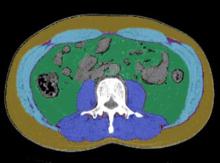
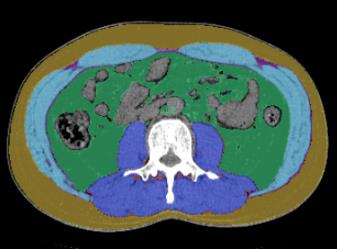
Fig.1
Schematic diagram of fully automated body composition assessment and organ segmentation"

Tab.1
Comparison of general clinical data between the two groups"
| 项目 | 轻度(n = 210) | 中重度 (n = 182) | t/χ2/Z值 | P值 |
|---|---|---|---|---|
| 年龄(x ± s)/岁 | 54.11 ± 9.88 | 54.35 ± 10.14 | -0.234 | 0.815 |
| 性别/例 | 0.804 | 0.370 | ||
| 男 | 146 | 134 | ||
| 女 | 64 | 48 | ||
| BMI/(kg/m2) | 23.94(22.03, 26.04) | 26.61(24.23, 28.79) | -7.771 | < 0.001 |
| 高血压/[例(%)] | 37(17.6) | 62(34.1) | 13.971 | < 0.001 |
| 糖尿病/[例(%)] | 23(11.0) | 42(23.1) | 10.362 | < 0.001 |
| 高血脂/[例(%)] | 92(43.8) | 124(68.1) | 23.314 | < 0.001 |
| TG/(mmol/L) | 1.58(1.09, 2.10) | 1.95(1.35, 2.83) | -4.842 | < 0.001 |
| TC/(mmol/L) | 5.07(4.53, 5.73) | 4.91(4.31, 5.55) | -2.100 | 0.036 |
| HDL-C(x ± s)/(mmol/L) | 1.59 ± 0.44 | 1.41 ± 0.44 | 4.416 | < 0.001 |
| LDL-C(x ± s)/(mmol/L) | 2.89 ± 0.76 | 2.84 ± 0.74 | 0.629 | 0.530 |
| AST/(U/L) | 24.0(21.0, 29.0) | 27.7(22.0, 33.1) | -3.740 | < 0.001 |
| ALT/(U/L) | 24.0(17.0, 34.4) | 35.8(25.0, 49.0) | -6.407 | < 0.001 |
| ALB(x ± s)/(g/L) | 44.26 ± 2.35 | 44.65 ± 2.56 | -1.577 | 0.116 |
| BUN/(mmol/L) | 5.30(4.70, 6.19) | 5.59(4.63, 6.51) | -1.079 | 0.280 |
| Cr/(μmol/L) | 69.0(58.0, 80.0) | 68.0(58.0, 79.0) | -0.256 | 0.798 |
| UA/(μmol/L) | 358.0(289.8, 420.8) | 377.0(323.5, 437.0) | -2.581 | 0.010 |
| SBP(x ± s)/mmHg | 122.10 ± 14.34 | 131.22 ± 16.98 | -5.766 | < 0.001 |
| DBP(x ± s)/mmHg | 76.54 ± 10.40 | 81.31 ± 10.86 | -4.438 | < 0.001 |
| FBG/(mmol/L) | 5.21(4.84, 5.67) | 5.54(5.11, 6.19) | -4.730 | < 0.001 |
| PLT(x ± s)/(× 10?/L) | 201.63 ± 53.41 | 199.02 ± 59.34 | 0.459 | 0.647 |
Tab.2
Comparison of body composition data between the two groups"
| 项目 | 轻度 | 中重度 | t/Z值 | P值 |
|---|---|---|---|---|
| BMD(x ± s)/(mg/cm3) | 120.85 ± 33.56 | 106.64 ± 30.63 | 4.354 | < 0.001 |
| SMI(x ± s)/(cm2/m2) | 48.07 ± 9.10 | 45.22 ± 9.00 | 3.101 | 0.002 |
| IMF% | 10.60(8.28,14.35) | 12.08(8.80,17.77) | -2.880 | 0.004 |
| MA/HU | 42.60(38.00,45.26) | 40.82(35.80,44.20) | -2.983 | 0.003 |
| SATI/(cm2/m2) | 35.47(27.15,48.85) | 44.30(34.33,61.11) | -5.077 | < 0.001 |
| VATI/(cm2/m2) | 45.95(27.42,59.27) | 61.97(49.02,76.83) | -7.580 | < 0.001 |
| VSR | 1.16(0.73,1.67) | 1.35 (0.94,1.84) | -2.934 | 0.003 |
Tab.3
Comparison of the prevalence of osteoporosis, sarcopenia, myosteatosis, and visceral obesity between the two groups"
| 项目 | 轻度 | 中重度 | χ2值 | P值 |
|---|---|---|---|---|
| 骨质疏松 | 12.90 | 22.00 | 5.724 | 0.017 |
| 肌少症 | 43.30 | 61.00 | 12.17 | < 0.001 |
| 肌脂肪变性 | 23.30 | 27.50 | 0.89 | 0.347 |
| 内脏肥胖 | 81.30 | 71.40 | 5.230 | 0.022 |
Tab.4
Correlation analysis among body composition parameters and hepatic fat content"
| 项目 | BMD | SMI | IMF | |||
|---|---|---|---|---|---|---|
| r值 | P值 | r值 | P值 | r值 | P值 | |
| 总体 | -0.135 | 0.007 | -0.131 | 0.009 | 0.121 | 0.016 |
| 性别 | ||||||
| 男 | -0.098 | 0.101 | -0.169 | 0.005 | 0.054 | 0.365 |
| 女 | -0.240 | 0.011 | -0.081 | 0.394 | 0.280 | 0.003 |
| 年龄 | ||||||
| < 60岁 | -0.095 | 0.092 | -0.094 | 0.096 | 0.068 | 0.234 |
| ≥ 60岁 | -0.201 | 0.074 | -0.230 | 0.040 | 0.321 | 0.004 |
| BMI | ||||||
| < 25 kg/m2 | -0.228 | 0.001 | 0.049 | 0.487 | 0.063 | 0.372 |
| ≥ 25 kg/m2 | -0.008 | 0.911 | -0.241 | < 0.001 | 0.113 | 0.122 |
| 项目 | MA | SATI | VATI | |||
| r值 | P值 | r值 | P值 | r值 | P值 | |
| 总体 | -0.105 | 0.038 | 0.289 | < 0.001 | 0.434 | < 0.001 |
| 性别 | ||||||
| 男 | -0.068 | 0.255 | 0.330 | < 0.001 | 0.398 | < 0.001 |
| 女 | -0.194 | 0.040 | 0.442 | < 0.001 | 0.528 | < 0.001 |
| 年龄 | ||||||
| < 60岁 | -0.039 | 0.491 | 0.315 | < 0.001 | 0.470 | < 0.001 |
| ≥ 60岁 | -0.339 | 0.002 | 0.123 | 0.278 | 0.293 | 0.008 |
| BMI | ||||||
| < 25 kg/m2 | -0.034 | 0.632 | 0.152 | 0.030 | 0.401 | < 0.001 |
| ≥ 25 kg/m2 | -0.076 | 0.301 | 0.138 | 0.057 | 0.179 | 0.013 |
Tab.5
Multivariate logistic regression analysis of osteoporosis, sarcopenia, myosteatosis, visceral obesity, and moderate-to-severe fatty liver and significant liver fibrosis"
| 项目 | 中重度脂肪肝 | 显著肝纤维化 | ||||
|---|---|---|---|---|---|---|
| OR | 95%CI | P值 | OR | 95%CI | P值 | |
| 骨质疏松 | 2.04 | 1.03 ~ 4.03 | 0.041 | 1.17 | 0.58 ~ 2.35 | 0.662 |
| 肌少症 | 2.19 | 1.37 ~ 3.52 | 0.001 | 1.73 | 1.11 ~ 2.69 | 0.016 |
| 肌脂肪变性 | 1.15 | 0.67 ~ 1.98 | 0.612 | 1.12 | 0.66 ~ 1.90 | 0.681 |
| 内脏肥胖 | 1.84 | 1.08 ~ 3.15 | 0.026 | 2.01 | 1.16 ~ 3.46 | 0.013 |
Tab.6
Comparison of Multivariate logistic regression analysis of osteoporosis, sarcopenia, myosteatosis, visceral obesity, and significant liver fibrosis"
| 项目 | 骨质疏松 | 肌少症 | ||||
|---|---|---|---|---|---|---|
| OR | 95%CI | P值 | OR | 95%CI | P值 | |
| 模型A | 1.17 | 0.58 ~ 2.35 | 0.662 | 1.73 | 1.11 ~ 2.69 | 0.016 |
| 模型B | 2.63 | 1.37 ~ 5.05 | 0.004 | 1.94 | 1.28 ~ 2.94 | 0.002 |
| 项目 | 肌脂肪变性 | 内脏肥胖 | ||||
| OR | 95%CI | P值 | OR | 95%CI | P值 | |
| 模型A | 1.12 | 0.66 ~ 1.90 | 0.681 | 2.01 | 1.16 ~ 3.46 | 0.013 |
| 模型B | 1.35 | 0.83 ~ 2.22 | 0.229 | 2.54 | 1.58 ~ 4.08 | < 0.001 |
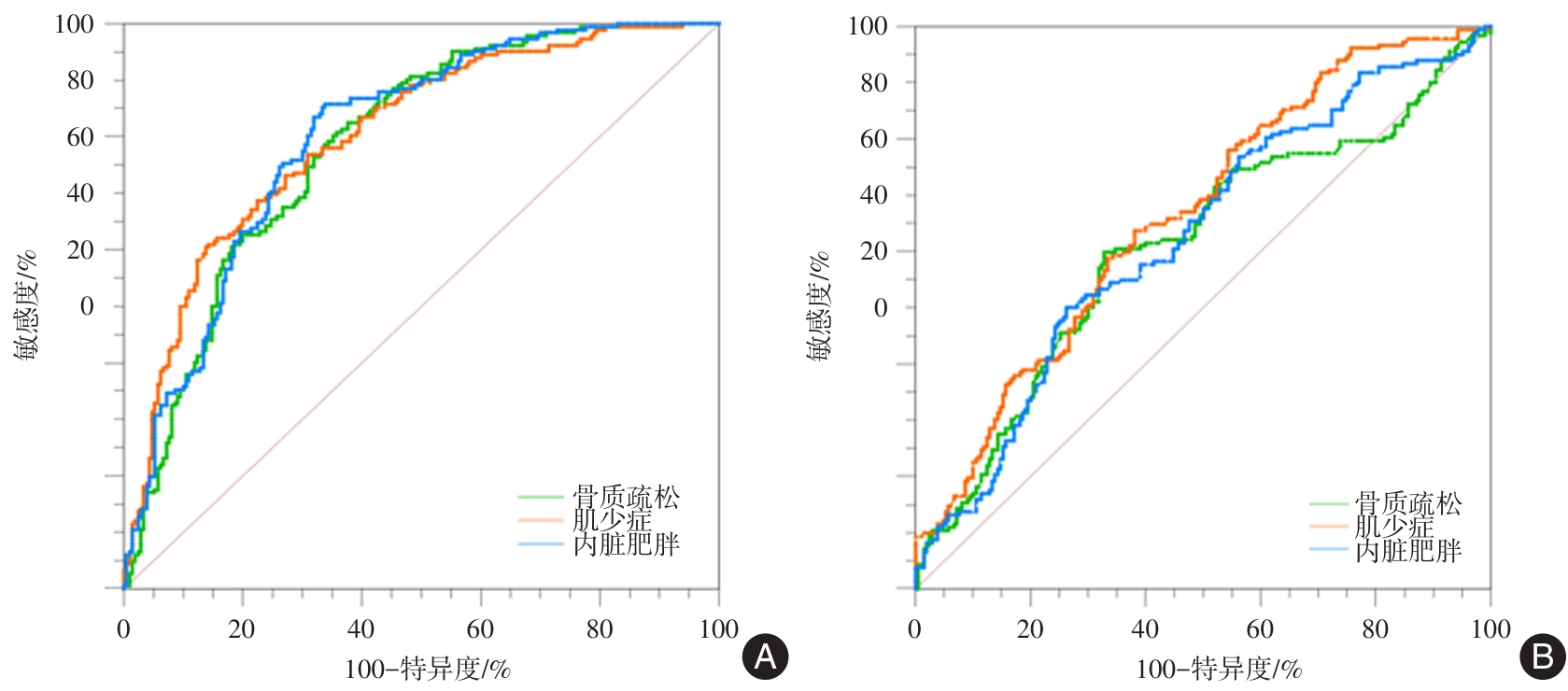
Fig.2
ROC curves of abnormal body compositions for predicting moderate-to-severe fatty liver and significant liver fibrosis"
Tab.7
Multivariate logistic regression subgroup analysis of sarcopenia, moderate-to-severe fatty liver, and significant liver fibrosis"
| 项目 | 中重度脂肪肝 | 显著肝纤维化 | ||||
|---|---|---|---|---|---|---|
| OR | 95%CI | P值 | OR | 95%CI | P值 | |
| 性别 | ||||||
| 男 | 3.32 | 1.86 ~ 5.94 | < 0.001 | 1.61 | 0.96 ~ 2.70 | 0.073 |
| 女 | 0.93 | 0.37 ~ 2.31 | 0.874 | 2.15 | 0.86 ~ 5.38 | 0.102 |
| 年龄 | ||||||
| < 60岁 | 2.36 | 1.35 ~ 4.13 | 0.003 | 1.66 | 1.05 ~ 2.64 | 0.030 |
| ≥ 60岁 | 2.46 | 0.80 ~ 7.62 | 0.118 | 2.84 | 0.89 ~ 9.03 | 0.077 |
| BMI | ||||||
| < 25 kg/m2 | 1.05 | 0.50 ~ 2.20 | 0.907 | 1.63 | 0.83 ~ 3.19 | 0.157 |
| ≥ 25 kg/m2 | 4.54 | 2.22 ~ 9.31 | < 0.001 | 2.20 | 1.14 ~ 4.23 | 0.018 |
| [1] |
ESLAM M, SANYAL A J, GEORGE J, et al. MAFLD: A consensus-driven proposed nomenclature for metabolic associated fatty liver disease[J]. Gastroenterology, 2020, 158(7): 1999-2014.e1. doi: 10.1053/j.gastro.2019.11.312 .
doi: 10.1053/j.gastro.2019.11.312 |
| [2] |
佘莎,戴锴. 《APASL临床实践指南:代谢相关脂肪性肝病的诊断和治疗(2025年版)》更新要点解读[J]. 中国临床医生杂志,2025,53(5): 51-54. doi: 10.3969/j.issn.2095-8552. 2025. 05.011 .
doi: 10.3969/j.issn.2095-8552. 2025. 05.011 |
| [3] |
ONISHI S, FUKUDA A, MATSUI M, et al. Body composition analysis in patients with metabolic dysfunction-associated fatty liver disease[J]. Nutrients, 2023, 15(18): 3878. doi: 10.3390/nu15183878 .
doi: 10.3390/nu15183878 |
| [4] |
ZHANG X, HE Z, SI Q, et al. The association of sarcopenia and visceral obesity with lean nonalcoholic fatty liver disease in Chinese patients with type 2 diabetes mellitus[J]. J Diabetes Res, 2022, 2022: 2229139. doi: 10.1155/2022/2229139 .
doi: 10.1155/2022/2229139 |
| [5] |
CHEN C, XIE L, ZHANG M, et al. The interplay between the muscle and liver in the regulation of glucolipid metabolism[J]. J Mol Cell Biol, 2024, 15(12): mjad073. doi: 10.1093/jmcb/mjad073 .
doi: 10.1093/jmcb/mjad073 |
| [6] |
JUNG C H, RHEE E J, KWON H, et al. Visceral-to-subcutaneous abdominal fat ratio is associated with nonalcoholic fatty liver disease and liver fibrosis[J]. Endocrinol Metab, 2020, 35(1): 165-176. doi:10.3803/EnM.2020.35.1.165 .
doi: 10.3803/EnM.2020.35.1.165 |
| [7] |
HAO X Y, ZHANG K, HUANG X Y, et al. Muscle strength and non-alcoholic fatty liver disease/metabolic-associated fatty liver disease[J].World J Gastroenterol, 2024, 30(7): 636-643. doi: 10.3748/wjg.v30.i7.636 .
doi: 10.3748/wjg.v30.i7.636 |
| [8] |
TAO J, LI H, WANG H, et al. Metabolic dysfunction-associated fatty liver disease and osteoporosis: The mechanisms and roles of adiposity[J]. Osteoporos Int, 2024, 35(12): 2087-2098. doi: 10.1007/s00198-024-07217-y .
doi: 10.1007/s00198-024-07217-y |
| [9] |
MOURTZAKIS M, PRADO C M M, LIEFFERS J R, et al. A practical and precise approach to quantification of body composition in cancer patients using computed tomography images acquired during routine care[J]. Appl Physiol Nutr Metab, 2008, 33(5): 997-1006. doi: 10.1139/H08-075 .
doi: 10.1139/H08-075 |
| [10] |
CAREY E J, LAI J C, WANG C W, et al. A multicenter study to define sarcopenia in patients with end-stage liver disease[J]. Liver Transpl, 2017, 23(5): 625-633. doi: 10.1002/lt.24750 .
doi: 10.1002/lt.24750 |
| [11] |
HSIEH Y C, JOO S K, KOO B K, et al. Muscle alterations are independently associated with significant fibrosis in patients with nonalcoholic fatty liver disease[J]. Liver Int, 2021, 41(3): 494-504. doi: 10.1111/liv.14719 .
doi: 10.1111/liv.14719 |
| [12] |
NACHIT M, HORSMANS Y, SUMMERS R M, et al. AI-based CT body composition identifies myosteatosis as key mortality predictor in asymptomatic adults[J]. Radiology, 2023, 307(5): e222008. doi: 10.1148/radiol.222008 .
doi: 10.1148/radiol.222008 |
| [13] |
KIM E H, KIM H K, LEE M J, et al. Sex differences of visceral fat area and visceral-to-subcutaneous fat ratio for the risk of incident type 2 diabetes mellitus[J]. Diabetes Metab J, 2022, 46(3): 486-498. doi: 10.4093/dmj.2021.0195 .
doi: 10.4093/dmj.2021.0195 |
| [14] |
中华医学会健康管理学分会, 国家骨科医学中心(首都医科大学附属北京积水潭医院), 国家级放射影像专业质控中心, 等. 定量 CT 在健康管理中的应用指南(2024)[J]. 中华健康管理学杂志, 2024,18(9): 645-654. doi:10.3760/cma.j.cn115624- 20240607-00474 .
doi: 10.3760/cma.j.cn115624- 20240607-00474 |
| [15] |
STERLING R K, LISSEN E, CLUMECK N, et al. Development of a simple noninvasive index to predict significant fibrosis in patients with HIV/HCV coinfection[J]. Hepatology, 2006, 43(6): 1317-1325. doi: 10.1002/hep.21178 .
doi: 10.1002/hep.21178 |
| [16] |
MUSIO A, PERAZZA F, LEONI L, et al. Osteosarcopenia in NAFLD/MAFLD: An underappreciated clinical problem in chronic liver disease[J]. Int J Mol Sci, 2023, 24(8): 7517. doi: 10.3390/ijms24087517 .
doi: 10.3390/ijms24087517 |
| [17] |
ZHOU T, YE J, LUO L, et al. Restoring skeletal muscle mass as an independent determinant of liver fat deposition improvement in MAFLD[J]. Skeletal Muscle, 2023, 13(1): 23. doi: 10.1186/s13395-023-00333-z .
doi: 10.1186/s13395-023-00333-z |
| [18] |
KIM G, LEE S, LEE Y, et al. Relationship between relative skeletal muscle mass and nonalcoholic fatty liver disease: A 7-year longitudinal study[J]. Hepatology, 2018, 68(5): 1755-1768. doi: 10.1002/hep.30049 .
doi: 10.1002/hep.30049 |
| [19] |
VISWANATH A, FOUDA S, FERNANDEZ C J, et al. Metabolic-associated fatty liver disease and sarcopenia: A double whammy[J]. World J Hepatol, 2024, 16(2): 152-163. doi: 10.4254/wjh.v16.i2.152 .
doi: 10.4254/wjh.v16.i2.152 |
| [20] |
FENG Z, ZHAO F, WANG Z, et al. The relationship between sarcopenia and metabolic dysfunction-associated fatty liver disease among the young and middle-aged populations[J]. BMC Gastroenterol, 2024, 24(1): 111. doi: 10.1186/s12876-024-03192-0 .
doi: 10.1186/s12876-024-03192-0 |
| [21] |
MALIK A, JAVAID S, MALIK M I, et al. Relationship between sarcopenia and metabolic dysfunction-associated steatotic liver disease (MASLD): A systematic review and meta-analysis[J]. Ann Hepatol, 2024, 29: 101544. doi: 10.1016/j.aohep. 2024. 101544 .
doi: 10.1016/j.aohep. 2024. 101544 |
| [22] |
FERENC K, JARMKIEWICZ-CZAJA S, FILIP R. What does sarcopenia have to do with nonalcoholic fatty liver disease?[J]. Life, 2023, 14: 37. doi: 10.3390/life14010037 .
doi: 10.3390/life14010037 |
| [23] |
LOSASSO M R, PARUSSOLO M L C, SILVA A O, et al. Unraveling the metabolic pathways between metabolic-associated fatty liver disease (MAFLD) and sarcopenia[J].Int J Mol Sci, 2025, 26(10): 4673. doi: 10.3390/ijms26104673 .
doi: 10.3390/ijms26104673 |
| [24] |
KIM T H, JEONG C W, LEE C, et al. Association between body composition contents and hepatic fibrosis in sarcopenic obesity[J]. J Clin Med, 2023, 12(13): 4279. doi: 10.3390/jcm12134279 .
doi: 10.3390/jcm12134279 |
| [25] |
LEE S, KIM K W, LEE J, et al. Reduction of visceral adiposity as a predictor for resolution of nonalcoholic fatty liver in potential living liver donors[J]. Liver Transpl, 2021, 27(10): 1424-1431. doi: 10.1002/lt.26071 .
doi: 10.1002/lt.26071 |
| [26] |
KENĐEL JOVANOVIĆ G, MRAKOVCIC-SUTIC I, PAVIČIĆ ŽEŽELJ S, et al. Metabolic and hepatic effects of energy-reduced anti-inflammatory diet in younger adults with obesity[J]. Can J Gastroenterol Hepatol, 2021, 2021:6649142. doi: 10.1155/2021/6649142 .
doi: 10.1155/2021/6649142 |
| [27] |
HONG Y, CHEN X, WANG L, et al. Machine learning prediction of metabolic dysfunction-associated fatty liver disease risk in American adults using body composition: Explainable analysis based on SHapley Additive exPlanations[J]. Front Nutr, 2025, 12: 1616229. doi: 10.3389/fnut.2025.1616229 .
doi: 10.3389/fnut.2025.1616229 |
| [28] |
MÁTIS D, HEGYI P, TEUTSCH B, et al. Improved body composition decreases the fat content in non-alcoholic fatty liver disease, a meta-analysis and systematic review of longitudinal studies[J]. Front Med, 2023, 10: 1114836. doi: 10.3389/fmed. 2023.1114836 .
doi: 10.3389/fmed. 2023.1114836 |
| [29] |
YOKOKAWA H, FUKUDA H, SAITA M, et al. An association between visceral or subcutaneous fat accumulation and diabetes mellitus among Japanese subjects[J]. Diabetol Metab Syndr, 2021, 13(1): 44. doi: 10.1186/s13098-021-00646-3 .
doi: 10.1186/s13098-021-00646-3 |
| [30] |
ELGUEZABAL RODELO R G, PORCHIA L M, TORRAS-RASGADO E, et al. Visceral and subcutaneous abdominal fat is associated with non-alcoholic fatty liver disease while augmenting metabolic syndrome's effect on non-alcoholic fatty liver disease: A cross-sectional study of NHANES 2017–2018[J]. PLoS One, 2024, 19(2): e0298662. doi: 10.1371/journal.pone.0298662 .
doi: 10.1371/journal.pone.0298662 |
| [31] |
ZHANG W, LI Y, LI S, et al. Associations of metabolic dysfunction-associated fatty liver disease and hepatic fibrosis with bone mineral density and risk of osteopenia/osteoporosis in T2DM patients[J]. Front Endocrinol, 2023, 14: 1278505. doi: 10.3389/fendo.2023.1278505 .
doi: 10.3389/fendo.2023.1278505 |
| [1] | Mingmei MA,Xiaochun MA,Shenghua MA,Yijin LI,Guifang JI. Effect of semaglutide injection on glycolipid metabolism and adipokine in the treatment of type 2 diabetes mellitus with different body mass index [J]. The Journal of Practical Medicine, 2025, 41(9): 1394-1400. |
| [2] | Shifang YANG,Xinglin GAO,Jing LI,Lupeng. JI. Sarcopenia associated with chronic obstructive pulmonary disease [J]. The Journal of Practical Medicine, 2024, 40(9): 1181-1185. |
| [3] | Kaiyang WANG,Jing TAO,Tingting WU,Jiahui YONG,Guoqing LI,Xiang XIE,Yining. YANG. Correlation of novel anthropometric indicators with long⁃term prognosis in patients with acute myocardial infarction [J]. The Journal of Practical Medicine, 2024, 40(21): 3040-3046. |
| [4] |
DENG Jiajie, YANG Yan, CAI Yulan, WU Min, WAN Ling, YANG Jia..
Study on the relationship between bone mineral density and serum 25(OH)D and Irisin in elderly men with different degrees of sarcopenia [J]. The Journal of Practical Medicine, 2023, 39(3): 321-325. |
| [5] | Yunchun XU,Xinya YU,Yazhi WANG,Yuanying SHEN,Le. GUO. Effect of lncRNA NEAT1 on palmitic acid⁃induced LO2 cell injury and inflammatory response through regulation of NF⁃κB signaling pathway [J]. The Journal of Practical Medicine, 2023, 39(17): 2164-2170. |
| [6] |
LIU Ying, TAN Yinfeng, WANG Lei, WANG Yujiao, CHEN Xiying, ZHAO Yanjin, QI Wei, ZHANG Ying, HE Shuyang..
Correlation between nutritional risk screening combined with scored patient ⁃generated subjective global assessment and malignant cancer⁃related sarcopenia [J]. The Journal of Practical Medicine, 2022, 38(2): 173-178. |
| [7] | ZHAO Ran, SHA Weihong.. Terminology change in metabolicassociated fatty liver disease and its impact on clinical practice [J]. The Journal of Practical Medicine, 2022, 38(19): 2390-2394. |
| [8] |
WANG Haibin, LI Hui, CHEN Xiaolei, LIU Na, YAN Xiaohui, ZOU Yu, LI Chunmei, WU Chan⁃ ghui, CHEN Huaxian, LIU Xiang, GONG Ming, LI Quanmei. .
Effects of adverse lifestyle on the progression of liver fibrosis in patients with metabolic associated fatty liver disease [J]. The Journal of Practical Medicine, 2022, 38(17): 2181-2185. |
| [9] |
XU Ziyuan, ZHANG Jiu′na, MENG Cancan, CHENG Yan, GUO Yongze, LI Xiaotian. .
Effects of Lactobacillus rhamnosus and curcumin on MAFLD by regulating TLR4 signaling pathway
[J]. The Journal of Practical Medicine, 2022, 38(13): 1624-1629.
|
| [10] | . Research progress of visceral fat in lung cancer [J]. The Journal of Practical Medicine, 2022, 38(10): 1292-1297. |
| [11] |
WANG Hua, WANG Chao, YIN Jian.
Effect of sarcopenia on postoperative mortality of elderly patients suffering osteoporotic thoracolumbar compression fracture
[J]. The Journal of Practical Medicine, 2021, 37(2): 134-137.
|
| [12] |
ZUO Yuqiang, LIU Qing, GAO Zhihong, WANG Zheng, GUAN Xing, YIN Yul⁃ ing, YANG Xu, FENG Pingyong. .
R445.3 Quantitative CT study on the relationship between skeletal muscle and fatty degree in L3 vertebral plane and sarcopenia in the elderly [J]. The Journal of Practical Medicine, 2021, 37(11): 1470-1475. |
| Viewed | ||||||
|
Full text |
|
|||||
|
Abstract |
|
|||||
