

The Journal of Practical Medicine ›› 2026, Vol. 42 ›› Issue (11): 2049-2055.doi: 10.3969/j.issn.1006-5725.2026.11.020
• Treatise:Mechanism and Practice • Previous Articles
Bo YANG1,Xinggui LIU1( ),Jingjing XIAO2,Lixian MO1,Jianhong SUN1,Yingmao QIN1,Junyang LI1,Deyuan LIU1
Received:2026-01-27
Online:2026-06-10
Published:2026-06-15
Contact:
Xinggui LIU
E-mail:Lxg13984164506@163.com
CLC Number:
Bo YANG,Xinggui LIU,Jingjing XIAO,Lixian MO,Jianhong SUN,Yingmao QIN,Junyang LI,Deyuan LIU. Influence of different common bile duct diameters on the therapeutic effect of laparoscopic common bile duct primary suture and biliary tract-related complications in patients with common bile duct stones[J]. The Journal of Practical Medicine, 2026, 42(11): 2049-2055.

Tab.1
Comparison of baseline data between the two groups"
| 项目 | A组(n = 42) | B组(n = 61) | t/χ2值 | P值 |
|---|---|---|---|---|
| 性别 | 0.220 | 0.639 | ||
| 男 | 18(42.86) | 29(47.54) | ||
| 女 | 24(57.14) | 32(52.06) | ||
| 年龄(x ± s)/岁 | 53.82 ± 11.27 | 55.41 ± 12.53 | 0.659 | 0.511 |
| BMI(x ± s)/(kg/m2) | 23.17 ± 2.94 | 23.86 ± 3.41 | 1.066 | 0.289 |
| 合并高血压 | 11(26.19) | 17(27.87) | 0.035 | 0.851 |
| 合并糖尿病 | 5(11.90) | 10(16.39) | 0.403 | 0.526 |
| CBDD(x ± s)/cm | 0.82 ± 0.13 | 1.37 ± 0.29 | 11.507 | < 0.001 |
Tab.2
Comparison of stone characteristics and incision conditions between the two groups"
| 项目 | A组(n = 42) | B组(n = 61) | t/χ2值 | P值 |
|---|---|---|---|---|
| 结石数量 | 2.554 | 0.110 | ||
| 单发 | 26(61.90) | 28(45.90) | ||
| 多发 | 16(38.10) | 33(54.10) | ||
| 最大结石直径(x ± s)/cm | 0.68 ± 0.19 | 1.15 ± 0.38 | 7.396 | < 0.001 |
| 胆总管切口长度(x ± s)/cm | 0.71 ± 0.20 | 1.74 ± 0.22 | 24.219 | < 0.001 |
Tab.3
Comparison of perioperative indicators between the two groups"
| 项目 | A组(n = 42) | B组(n = 61) | t值 | P值 |
|---|---|---|---|---|
| 手术时间/min | 112.91 ± 21.82 | 94.07 ± 17.53 | 4.847 | < 0.001 |
| 术中出血量/mL | 26.83 ± 10.51 | 29.15 ± 14.30 | 0.897 | 0.372 |
| 术后通气时间/h | 25.92 ± 6.17 | 24.83 ± 5.94 | 0.901 | 0.370 |
| 术后住院时间/d | 6.27 ± 1.82 | 5.39 ± 1.17 | 2.988 | 0.004 |
| 住院总费用/万元 | 1.51 ± 0.38 | 1.43 ± 0.45 | 0.943 | 0.348 |
Tab.4
Comparison of liver function indicators between the two groups before and after surgery"
| 项目 | A组(n = 42) | B组(n = 61) | t值 | P值 |
|---|---|---|---|---|
| ALT/(U/L) | ||||
| 术前 | 148.92 ± 41.08 | 156.34 ± 53.19 | 0.761 | 0.449 |
| POD1 | 82.17 ± 25.93* | 86.09 ± 30.14* | 0.686 | 0.494 |
| POD3 | 41.05 ± 14.82*# | 44.17 ± 17.39*# | 0.949 | 0.345 |
| TBIL/(μmol/L) | ||||
| 术前 | 35.61 ± 13.27 | 39.08 ± 16.54 | 1.131 | 0.261 |
| POD1 | 23.09 ± 8.14* | 22.87 ± 9.02* | 0.127 | 0.900 |
| POD3 | 17.09 ± 5.82*# | 16.53 ± 6.14*# | 0.465 | 0.643 |
Tab.5
Comparison of postoperative complications and outcomes between the two groups"
| 项目 | A组(n = 42) | B组(n = 61) | χ2值 | P值 |
|---|---|---|---|---|
| 合计 | 4(9.52) | 3(4.92) | 0.833 | 0.361 |
| 胆漏 | 3(7.14) | 2(3.28) | 0.219* | 0.639 |
| 残余结石 | 0(0.00) | 1(1.64) | 0.004* | 1.000 |
| 切口感染 | 1(2.38) | 0(0.00) | 0.493* | 0.408 |
| 胆道狭窄(远期) | 0(0.00) | 0(0.00) | - | - |
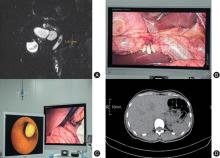
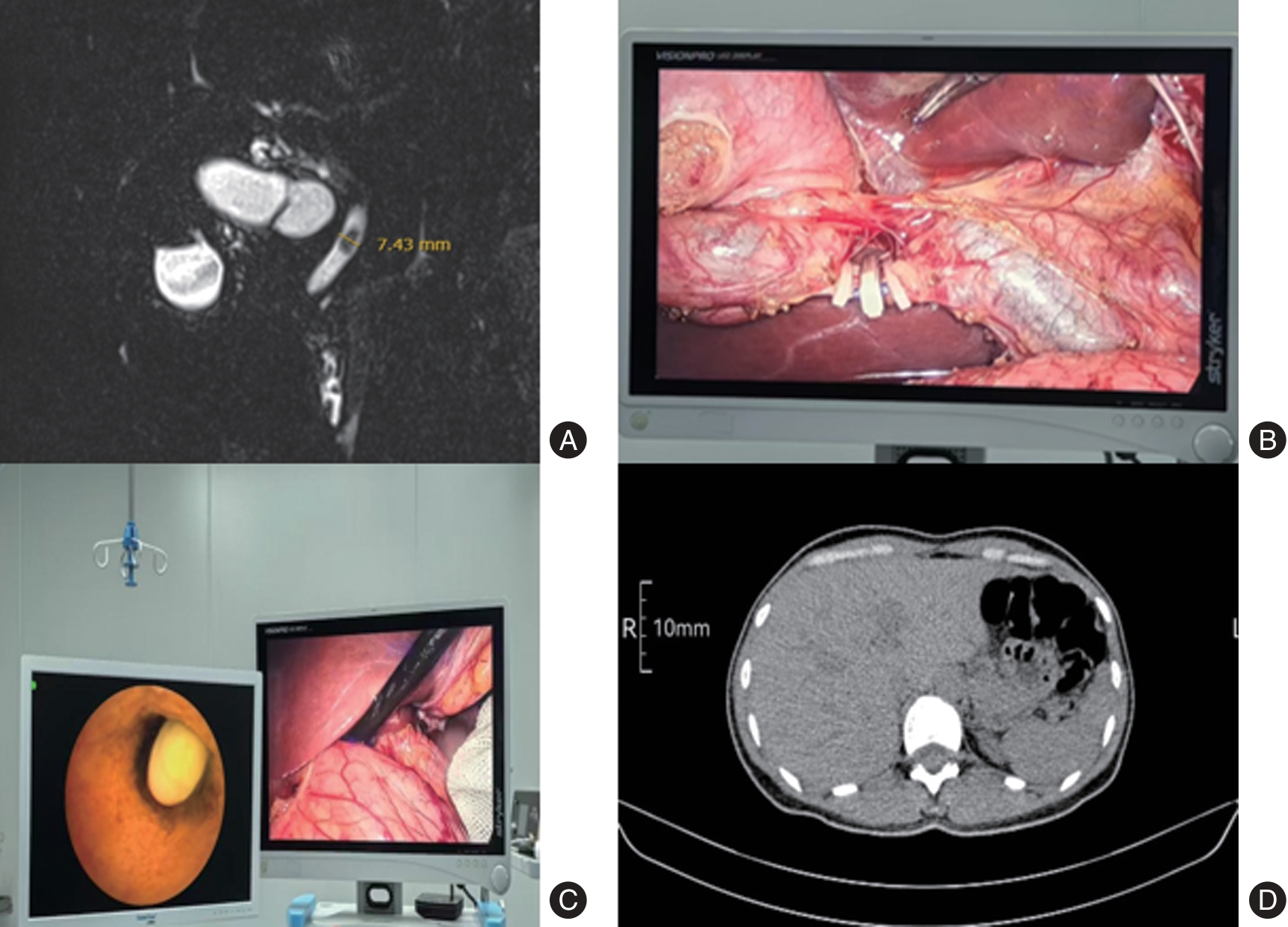
Fig.1
Preoperative and postoperative images of patients undergoing laparoscopic cholecystectomy plus LCBDE combined with primary suture"
| [1] |
YE H W, LIU F, GU D J, et al. Clinical safety study of laparoscopic common bile duct exploration and primary suture in elderly patients: A new strategy for the treatment of stones[J]. BMC Surg, 2025, 25(1): 401-404. doi: 10.1186/s12893-025-03146-7 .
doi: 10.1186/s12893-025-03146-7 |
| [2] |
WU D, JIN W, ZHANG Y, et al. Primary Suture of the Common Bile Duct: Continuous or Interrupted?[J]. J Laparoendosc Adv Surg Tech Am, 2022, 32(4): 390-394. doi: 10.1089/lap. 2021.0215 .
doi: 10.1089/lap. 2021.0215 |
| [3] |
于恒海, 魏晓平. 腹腔镜胆总管探查术中T管,双J管引流与单纯一期缝合的应用比较[J]. 中国普通外科杂志, 2022, 31(8): 1017-1023. doi: 10.1007/s13304-023-01451-5 .
doi: 10.1007/s13304-023-01451-5 |
| [4] |
ZHANG D, MA Y, SUN W, et al. Primary suture for patients of bile duct stones after laparoscopic biliary tract exploration: A retrospective cohort study[J]. Updates Surg, 2023, 75(4): 897-903. doi: 10.1007/s13304-023-01451-5 .
doi: 10.1007/s13304-023-01451-5 |
| [5] |
YE H W, LIU F, GU D J, et al. Correction: Clinical safety study of laparoscopic common bile duct exploration and primary suture in elderly patients: A new strategy for the treatment of stones[J]. BMC Surg, 2025, 25(1): 529-531. doi: 10.1186/s12893-025-03248-2 .
doi: 10.1186/s12893-025-03248-2 |
| [6] |
ZHUANG L, LI Y, ZHANG L, et al. A comparison of the therapeutic outcomes between primary duct closure and T-tube drainage after laparoscopic common bile duct exploration: A single-centre retrospective study[J]. Wideochir Inne Tech Maloinwazyjne, 2023, 18(1): 108-116. doi: 10.5114/wiitm.2022.120672 .
doi: 10.5114/wiitm.2022.120672 |
| [7] |
LAI W, XU N. Feasibility and safety of choledochotomy primary closure in laparoscopic common bile duct exploration without biliary drainage: A retrospective study[J]. Sci Rep, 2023, 13(1): 22473-22475. doi: 10.1038/s41598-023-49173-3 .
doi: 10.1038/s41598-023-49173-3 |
| [8] |
LU J, ZHANG X, ZENG C, et al. Clinical Analysis of Laparoscopic Common Bile Duct Primary Suture and T-Tube Drainage in the Treatment of Common Bile Duct Stones[J]. J Laparoendosc Adv Surg Tech A, 2023, 33(7): 622-625. doi: 10.1089/lap. 2022.0485 .
doi: 10.1089/lap. 2022.0485 |
| [9] |
冯其柱, 陈先志, 孙杰, 等. 老年胆总管结石合并急性胆管炎患者ERCP术后胆总管结石复发的危险因素分析[J]. 实用医学杂志, 2023, 39(15): 1945-1949. doi: 10.3969/j.issn.1006-5725.2023.15.015 .
doi: 10.3969/j.issn.1006-5725.2023.15.015 |
| [10] |
WANG Y, TAN Y, LI J, et al. Double-Needle Bidirectional Barbed Wire Continuous Layered Suture Technique for Laparoscopic Stage I Common Bile Duct Surgery[J]. J Laparoendosc Adv Surg Tech A, 2024, 34(9): 851-854. doi: 10.1089/lap. 2024.0149 .
doi: 10.1089/lap. 2024.0149 |
| [11] |
张吉祥, 何希平, 张娟, 等. 腹腔镜胆囊切除术+LCBDE胆管一期缝合术与ERCP+腹腔镜胆囊切除术两种手术方式的疗效和安全性对比[J]. 实用医学杂志, 2021, 37(12): 6. doi: 10.3969/j.issn.1006 .
doi: 10.3969/j.issn.1006 |
| [12] |
MEHENDALE V G, KAMDAR M S, SHENOY S N. Pragmatic algorithm for management of common bile duct calculi in resource-limited settings in India[J]. J Minim Access Surg, 2024, 20(4): 420-425. doi: 10.4103/jmas.jmas_293_23 .
doi: 10.4103/jmas.jmas_293_23 |
| [13] |
ZHOU H, HE Y, CHANG L. Comparative study of Indocyanine Green fluorescence imaging versus conventional fiber-optic imaging in laparoscopic choledochotomy for stone extraction and immediate biliary incision suturing[J]. Updates Surg, 2024, 76(6): 2247-2254. doi: 10.1007/s13304-024-01993-2 .
doi: 10.1007/s13304-024-01993-2 |
| [14] |
NAGATA T, ARIMURA Y, KOJO M, et al. Laparoscopic Common Bile Duct Exploration for Choledocholithiasis in a Patient with Situs Inversus Totalis and Prior Total Gastrectomy with Roux-en-Y Reconstruction: A Case Report[J]. Surg Case Rep, 2025, 11(1): 25-28. doi: 10.70352/scrj.cr.25-0608 .
doi: 10.70352/scrj.cr.25-0608 |
| [15] |
HUA X, WANG G, LI B, et al. Comparison of the efficacy of laparoscopic primary closure of the common bile duct and T-tube drainage in the treatment of choledocholithiasis in elderly patients[J]. BMC Geriatr, 2025, 25(1): 549-552. doi: 10.1186/s12877-025-06210-2 .
doi: 10.1186/s12877-025-06210-2 |
| [16] |
SUN Y, ZHOU S, TANG S, et al. Laparoscopic primary suture of the common bile duct in patients with common bile duct stones: A comparative analysis of two suturing methods in terms of safety, efficacy, and convenience with 16-month follow-up[J]. BMC Surg, 2025, 25(1): 155-157. doi: 10.1186/s12893-025-02904-x .
doi: 10.1186/s12893-025-02904-x |
| [17] |
XU S, XU M. Clinical Effect of Primary Suture After Laparoscopic Common Bile Duct Exploration for Elderly Patients With Gallbladder Stones and Common Bile Duct Stones[J]. Am Surg, 2026, 92(1): 201-208. doi: 10.1177/00031348251358435 .
doi: 10.1177/00031348251358435 |
| [18] |
LIU L, ZHOU T, CAO Y, et al. Clinical Evaluation of Primary Suturing of Normal-Diameter Common Bile Ducts After Microincision of Cystic Duct Confluence for Stone Removal[J]. Surg Laparosc Endosc Percutan Tech, 2024, 34(4): 419-423. doi: 10.1097/SLE.0000000000001299 .
doi: 10.1097/SLE.0000000000001299 |
| [19] |
BRONSWIJK M, GÖKCE E, HINDRYCKX P, et al. Single-session endoscopic ultrasound-directed transgastric endoscopic retrograde cholangiopancreatography with a dedicated over-the-scope fixation device: Feasibility study (with video)[J]. Dig Endosc, 2025, 37(2): 176-182. doi: 10.1111/den.14879 .
doi: 10.1111/den.14879 |
| [20] |
JI H, HOU Y, CHENG X, et al. Association of Laparoscopic Methods and Clinical Outcomes of Cholecystolithiasis Plus Choledocholithiasis: A Cohort Study[J]. Turk J Gastroenterol, 2023, 34(1): 35-42. doi: 10.5152/tjg.2022.22110 .
doi: 10.5152/tjg.2022.22110 |
| [21] |
NAGATA T, ARIMURA Y, KOJO M, et al. Laparoscopic Common Bile Duct Exploration for Choledocholithiasis in a Patient with Situs Inversus Totalis and Prior Total Gastrectomy with Roux-en-Y Reconstruction: A Case Report[J]. Surg Case Rep, 2025, 11(1): 25-29. doi: 10.70352/scrj.cr.25-0608 .
doi: 10.70352/scrj.cr.25-0608 |
| [22] |
PADILLA ZEGARRA E D, MEMBA IKUGA R, CORONADO LLANOS D, et al. Primary choledochorraphy after laparoscopic common bile duct exploration: Comparative study of 3 different methods, safety, and efficacy[J]. J Gastrointest Surg, 2025, 29(9): 102122-102125. doi: 10.1016/j.gassur.2025.102122 .
doi: 10.1016/j.gassur.2025.102122 |
| [23] |
RENDELL V R, PAULI E M. Laparoscopic Common Bile Duct Exploration[J]. JAMA Surg, 2023, 158(7): 766-767. doi: 10.1001/jamasurg.2022.8141 .
doi: 10.1001/jamasurg.2022.8141 |
| [24] |
HUANG J, HU W, LIU J, et al. Laparoscopic Transcystic Common Bile Duct Exploration: 8-Year Experience at a Single Institution[J]. J Gastrointest Surg, 2023, 27(3): 555-564. doi: 10.1007/s11605-023-05594-z .
doi: 10.1007/s11605-023-05594-z |
| [25] |
DAS S, JHA A K, KUMAR M. Laparoscopic common bile duct exploration in cases of common bile duct stones: Can LCBDE replace ERCP as first line treatment[J]. Am J Surg, 2023, 226(2): 290-292. doi: 10.1016/j.amjsurg.2023.03.006 .
doi: 10.1016/j.amjsurg.2023.03.006 |
| [26] |
RAMSER B, COLEOGLOU CENTENO A, FERRE A, et al. Laparoscopic common bile duct exploration is an effective, safe, and less-costly method of treating choledocholithiasis[J]. Surg Endosc, 2024, 38(10): 6076-6082. doi: 10.1007/s00464-024-11139-5 .
doi: 10.1007/s00464-024-11139-5 |
| Viewed | ||||||
|
Full text |
|
|||||
|
Abstract |
|
|||||
