

The Journal of Practical Medicine ›› 2026, Vol. 42 ›› Issue (15): 2752-2760.doi: 10.3969/j.issn.1006-5725.2026.15.011
• Treatise:Mechanism and Practice • Previous Articles
Xuelian KANG1,Bo ZHANG2( ),Pengfei YANG1
Received:2026-04-14
Revised:2026-06-21
Accepted:2026-06-22
Online:2026-08-10
Published:2026-08-13
Contact:
Bo ZHANG
E-mail:1141093237@126.com
CLC Number:
Xuelian KANG,Bo ZHANG,Pengfei YANG. Research progress on mechanism of traditional Chinese medicine in preventing and treating ulcerative colitis based on the gut microbiota-short-chain fatty acid axis[J]. The Journal of Practical Medicine, 2026, 42(15): 2752-2760.
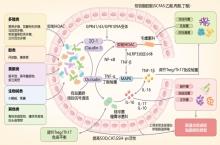
Fig.1
Schematic diagram of the mechanism by which chinese herbal monomers intervene in ulcerative colitis via regulating the gut microbiota-scfas axis at the cellular level"
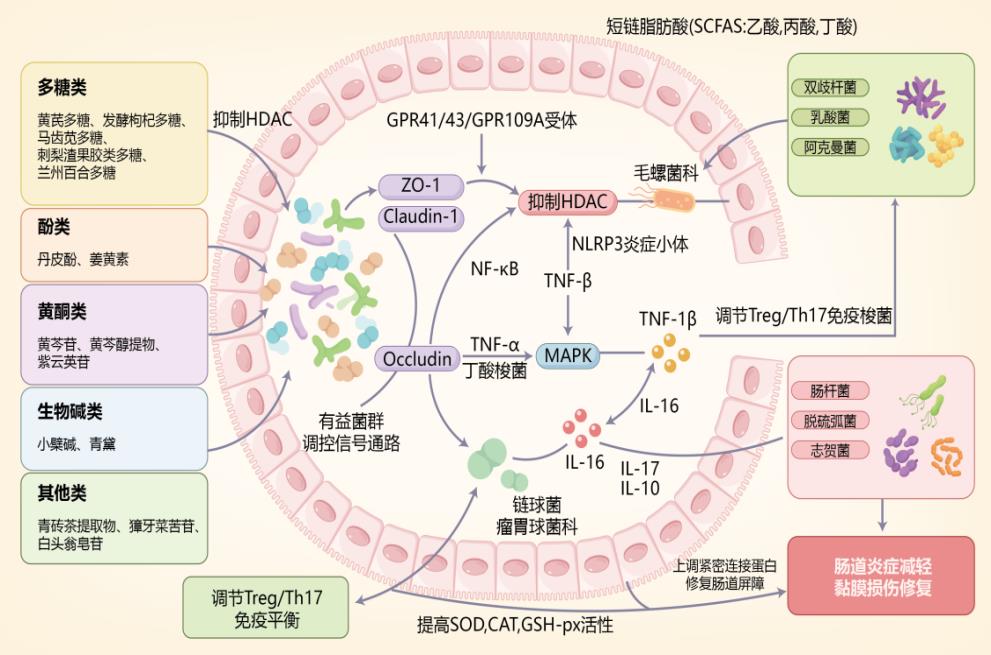
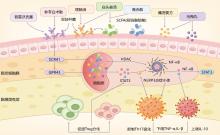
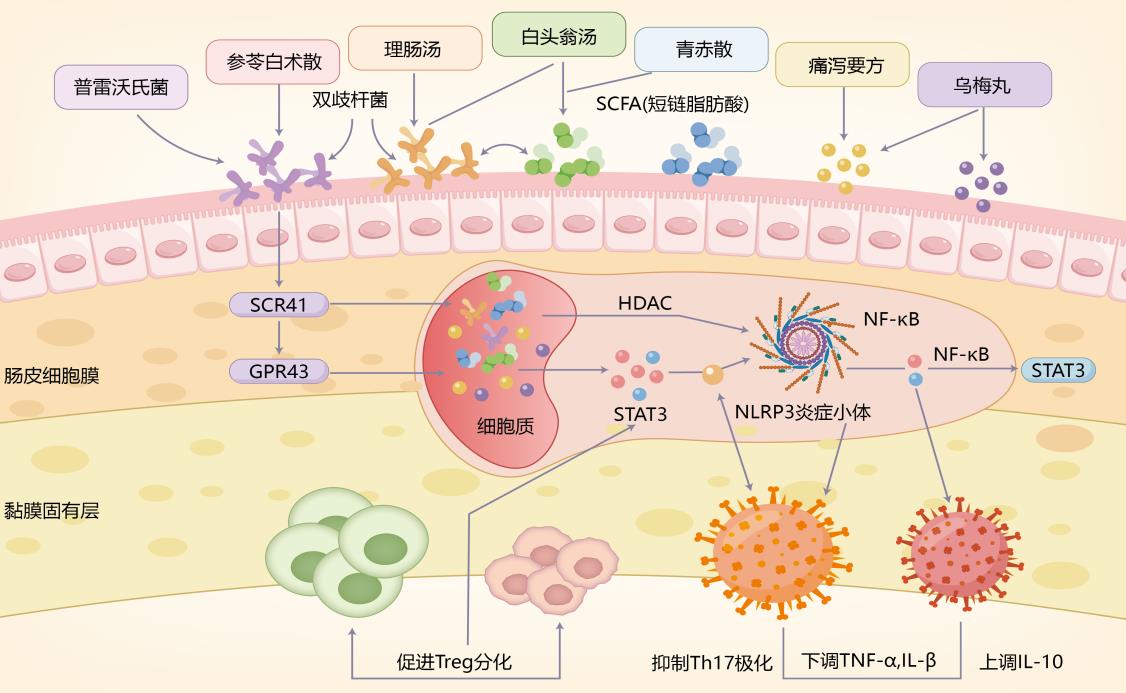
Fig.2
Schematic illustration of the cellular mechanism by which Chinese herbal formulas alleviate ulcerative colitis via modulating the gut microbiota-SCFAs axis"

Tab.1
Summary on the treatment mechanism of ulcerative colitis by Chinese herbal formulas via regulating the gut microbiota-SCFAs axis"
| 代表复方 | 中医证型 | 核心治法 | 主要调控菌群(丰度变化) | SCFAs变化 | 核心作用特点 | 参考文献 |
|---|---|---|---|---|---|---|
| 参苓白术散 | 脾虚湿盛证 | 健脾益气、渗湿止泻 | ↑普雷沃菌、颤杆菌属;↓脱硫弧菌属、嗜胆菌属 | 整体升高 SCFAs水平 | 改善氧化应激,修复肠黏膜,适用于UC缓解期 | [ |
| 理肠汤 | 健脾和肠、利湿止泻 | ↑双歧杆菌、乳杆菌、酵母菌、消化球菌 | SCFAs总量升高 | 抑制NLRP3炎症小体,修复肠紧密连接 | [ | |
| 白头翁汤 | 大肠湿热证 | 清热利湿、解毒止痢 | ↑拟杆菌门、毛螺菌属 | ↑乙酸、丙酸 | 激活GPR43,抑制HDACs,调控肠屏障与免疫 | [ |
| 加味葛根芩连汤 | 清热解表、燥湿止利 | ↑阿克曼菌属、罗斯菌属、毛螺菌科、梭菌属 | ↑乙酸、丁酸 | 依赖肠道菌群发挥作用,抗炎、抗氧化、修复肠屏障 | [ | |
| 芍药汤 | 清热燥湿、调气和血 | ↑厚壁菌门、拟杆菌门、乳杆菌、双歧杆菌 | ↑乙酸、丙酸、丁酸 | 调控Th17/Treg平衡,稳定肠道微生态 | [ | |
| 榆苋方 | 清肠化湿、解毒敛疡 | ↑双歧杆菌、乳酸杆菌;↓肠杆菌、肠球菌 | ↑乙酸、丙酸 | 调节胃肠激素,平衡炎症因子,促进黏膜修复 | [ | |
| 清肠化湿方 | 清热化湿、理肠解毒 | ↑厚壁菌门 | ↑丁酸 | 抑制NLRP3通路,保护杯状细胞与肠道干细胞 | [ | |
| 复方芩柏颗粒 | 清热燥湿、凉血解毒 | 富集多种产SCFAs有益菌 | SCFAs总量显著升高 | 上调SCFAs相关受体GPR41/GPR43/GPR109A,强效抗炎 | [ | |
| 青赤散 | 湿热瘀毒证 | 清热解毒、凉血止血、收敛生肌 | ↑乳杆菌、双歧杆菌、丁酸梭菌 | ↑丁酸、丙酸 | 调控Treg/Th17平衡,抑制HDAC,重建肠道免疫稳态 | [ |
| 痛泻要方 | 肝郁脾虚证 | 疏肝健脾、抑肝扶脾 | ↑厚壁菌门/拟杆菌门比值 | ↑丁酸、戊酸 | 降低促炎因子,修复肠屏障,改善肠道炎症 | [ |
| 四神丸合痛泻要方 | 脾肾阳虚兼肝郁证 | 温肾健脾、疏肝止泻 | 纠正整体菌群紊乱 | ↑乙酸、丙酸、丁酸 | 调节免疫平衡,抑制STAT3通路,针对慢性反复发作UC | [ |
| 半夏泻心汤 | 寒热错杂证 | 辛开苦降、寒热平调 | ↑乳酸杆菌、双歧杆菌、普雷沃菌;↓脱硫弧菌、拟杆菌 | 促进SCFAs合成 | 改善菌群失调,减轻黏膜损伤 | [ |
| 乌梅丸 | 寒热并用、涩肠固脱 | ↑厚壁菌门、拟杆菌门;↓变形菌门 | ↑丁酸、丙酸 | 抑制TLR4/MyD88/NF-κB通路,多靶点抗炎、修复肠屏障 | [ |
| [1] |
YANG L, GAO H, LIU D. Advance on establishment of pathological model of ulcerative colitis[J]. Front Vet Sci, 2025, 12: 1618260. doi:10.3389/fvets.2025.1618260 .
doi: 10.3389/fvets.2025.1618260 |
| [2] |
CHE S, QIN B, WU K, et al. EGCG drives gut microbial remodeling-induced epithelial GPR43 activation to lessen Th1 polarization in colitis[J]. Redox Biol, 2024, 75: 103291. doi:10.1016/j.redox.2024.103291 .
doi: 10.1016/j.redox.2024.103291 |
| [3] |
WANGCHUK P, YESHI K, LOUKAS A. Ulcerative colitis: Clinical biomarkers, therapeutic targets, and emerging treatments[J]. Trends Pharmacol Sci, 2024, 45(10): 892-903. doi:10. 1016/j.tips.2024.08.003 .
doi: 10. 1016/j.tips.2024.08.003 |
| [4] |
LIU Z, JIANG Z, ZHANG Z, et al. Bacillus coagulans in combination with chitooligosaccharides regulates gut microbiota and ameliorates the DSS-induced colitis in mice[J]. Microbiol Spectr, 2022, 10(4): e00641-e00622. doi:10.1128/spectrum.00641-22 .
doi: 10.1128/spectrum.00641-22 |
| [5] |
LI H, PAN M, LI Y, et al. New targets for the treatment of ulcerative colitis: Gut microbiota and its metabolites[J]. Comput Struct Biotechnol J, 2025, 27: 1850-1863. doi:10.1016/j.csbj. 2025.05.006 .
doi: 10.1016/j.csbj. 2025.05.006 |
| [6] |
纪海静, 刘海燕, 潘颖, 等. 不同疾病活动度溃疡性结肠炎患者肠道菌群变化及其与体液免疫和炎症反应的相关性[J]. 中国微生态学杂志, 2024, 36(7): 821-827. doi:10.13381/j.cnki.cjm.202407013 .
doi: 10.13381/j.cnki.cjm.202407013 |
| [7] |
SALVI P S, COWLES R A. Butyrate and the intestinal epithelium: Modulation of proliferation and inflammation in homeostasis and disease[J]. Cells, 2021, 10(7): 1775. doi:10.3390/cells10071775 .
doi: 10.3390/cells10071775 |
| [8] |
毛慧芳, 梁永林. 黏质阿克曼菌及其代谢物短链脂肪酸与溃疡性结肠炎肠黏膜屏障的相关性研究[J]. 微生物学报, 2023, 63(4): 1411-1431. doi:10.13343/j.cnki.wsxb.20220657 .
doi: 10.13343/j.cnki.wsxb.20220657 |
| [9] |
PARK B O, KANG J S, PAUDEL S, et al. Novel GPR43 agonists exert an anti-inflammatory effect in a colitis model[J]. Biomol Ther (Seoul), 2022, 30(1): 48-54. doi:10.4062/biomolther.2021.078 .
doi: 10.4062/biomolther.2021.078 |
| [10] |
SINGH N, GURAV A, SIVAPRAKASAM S, et al. Activation of Gpr109a, receptor for niacin and the commensal metabolite butyrate, suppresses colonic inflammation and carcinogenesis[J]. Immunity, 2014, 40(1): 128-139. doi:10.1016/j.immuni.2013. 12.007 .
doi: 10.1016/j.immuni.2013. 12.007 |
| [11] |
LIN M Y, DE ZOETE M R, VAN PUTTEN J P M, et al. Redirection of epithelial immune responses by short-chain fatty acids through inhibition of histone deacetylases[J]. Front Immunol, 2015, 6: 554. doi:10.3389/fimmu.2015.00554 .
doi: 10.3389/fimmu.2015.00554 |
| [12] |
JIN L, GUO F, LIANG J, et al. Dimethyl fumarate alleviated DSS-induced colitis by regulating Th17/Treg balance via suppressing JAK2/STAT3 and NF-κB signaling[J]. Cell Signal, 2026, 143: 112488. doi:10.1016/j.cellsig.2026.112488 .
doi: 10.1016/j.cellsig.2026.112488 |
| [13] |
ZENG J, LEI L, ZENG Q, et al. Ozone therapy attenuates NF-κB-mediated local inflammatory response and activation of Th17 cells in treatment for psoriasis[J]. Int J Biol Sci, 2020, 16(11): 1833-1845. doi:10.7150/ijbs.41940 .
doi: 10.7150/ijbs.41940 |
| [14] |
王春敏, 韩桂华, 马淑霞. 短链脂肪酸对肠黏膜屏障的影响[J]. 中国微生态学杂志, 2022, 34(12): 1471-1475. doi:10. 13381/j.cnki.cjm.202212020 .
doi: 10. 13381/j.cnki.cjm.202212020 |
| [15] |
ZHANG Y, XI Y, YANG C, et al. Short-chain fatty acids attenuate 5-fluorouracil-induced THP-1 cell inflammation through inhibiting NF-κB/NLRP3 signaling via glycerolphospholipid and sphingolipid metabolism[J]. Molecules, 2023, 28(2): 494. doi:10. 3390/molecules28020494 .
doi: 10. 3390/molecules28020494 |
| [16] |
刘槃, 席德双, 黄瑞, 等. 短链脂肪酸通过抑制白细胞介素17A和NF-κB信号通路减轻γδT细胞介导的炎症反应[J]. 实用医学杂志, 2024, 40(8): 1088-1094. doi:10.3969/j.issn. 1006-5725.2024.08.012 .
doi: 10.3969/j.issn. 1006-5725.2024.08.012 |
| [17] |
WU Z, HE J, ZHANG Z, et al. Propionic acid driven by the Lactobacillus johnsonii culture supernatant alleviates colitis by inhibiting M1 macrophage polarization by modulating the MAPK pathway in mice[J]. J Agric Food Chem, 2023, 71(41): 14951-14966. doi:10.1021/acs.jafc.3c00278 .
doi: 10.1021/acs.jafc.3c00278 |
| [18] |
贾雪冰, 周芝兰, 张博枰, 等. 适宜浓度短链脂肪酸混合物对小胶质细胞炎症抑制及机制研究[J]. 生物化学与生物物理进展, 2019, 46(5): 504-512. doi:10.16476/j.pibb.2018.0310 .
doi: 10.16476/j.pibb.2018.0310 |
| [19] |
BARAKAT H, SAKR S S, ALFHEEAID H A, et al. Oxidative stress–gut microbiome crosstalk: Intestinal redox imbalance and probiotics therapeutic potential[J]. Antioxidants, 2026, 15(5): 533. doi:10.3390/antiox15050533 .
doi: 10.3390/antiox15050533 |
| [20] |
CHEN M, LI Y, ZHAI Z, et al. Bifidobacterium animalis subsp. lactis A6 ameliorates bone and muscle loss via modulating gut microbiota composition and enhancing butyrate production[J]. Bone Res, 2025, 13: 28. doi:10.1038/s41413-024-00381-1 .
doi: 10.1038/s41413-024-00381-1 |
| [21] |
LV J, KONG X, LIU W, et al. Rhodiola crenulata polysaccharide alleviates dextran sulfate sodium-induced ulcerative colitis in mice by repairing the intestinal barrier and regulating the intestinal microecology[J]. Front Pharmacol, 2025, 16: 1519038. doi:10.3389/fphar.2025.1519038 .
doi: 10.3389/fphar.2025.1519038 |
| [22] |
宁可. 马齿苋对DSS诱导的溃疡性结肠炎的缓解作用及其机制研究[D]. 长春: 吉林大学, 2024. doi:10.27162/d.cnki.gjlin. 2024.000468 .
doi: 10.27162/d.cnki.gjlin. 2024.000468 |
| [23] | 杨倩妮. 刺梨渣果胶类多糖的提取分离、化学修饰及其改善溃疡性结肠炎的构效关系研究[D]. 成都: 成都大学, 2025. |
| [24] | 韩金凤. 兰州百合多糖的体外消化酵解特性及改善溃疡性结肠炎的作用研究[D]. 兰州: 西北师范大学, 2025. |
| [25] |
ZHAO M, XIE X, XU B, et al. Paeonol alleviates ulcerative colitis in mice by increasing short-chain fatty acids derived from Clostridium butyricum [J]. Phytomedicine, 2023, 120: 155056. doi:10.1016/j.phymed.2023.155056 .
doi: 10.1016/j.phymed.2023.155056 |
| [26] | 邹俊, 李俊杰, 程芳芳, 等. 姜黄素重建肠道微生态环境改善溃疡性结肠炎小鼠机制研究[J]. 浙江临床医学, 2023, 25(8): 1147-1150. |
| [27] |
ZHU L, XU L Z, ZHAO S, et al. Protective effect of baicalin on the regulation of Treg/Th17 balance, gut microbiota and short-chain fatty acids in rats with ulcerative colitis[J]. Appl Microbiol Biotechnol, 2020, 104(12): 5449-5460. doi:10.1007/s00253-020-10527-w .
doi: 10.1007/s00253-020-10527-w |
| [28] |
郭春雨, 董红敬, 郭兰萍, 等. 基于Th17/Treg免疫平衡研究黄芩醇提物治疗溃疡性结肠炎的作用机制[J]. 中国新药杂志, 2024, 33(4): 390-399. doi:10.3969/j.issn.1003-3734.2024. 04.010 .
doi: 10.3969/j.issn.1003-3734.2024. 04.010 |
| [29] |
黄静, 廖艳花, 莫昕莹, 等. 紫云英苷调节肠道菌群缓解小鼠溃疡性结肠炎的作用机制[J]. 中国药房, 2025, 36(14): 1709-1716. doi: 10.6039/j.issn.1001-0408.2025.14.04 .
doi: 10.6039/j.issn.1001-0408.2025.14.04 |
| [30] |
XIAO Y, LI X, FANG Y, et al. Berberine suppresses colon inflammation via integrated modulation of host metabolism, microbial ecology, and innate immune signaling[J]. Theranostics, 2026, 16(4): 2019-2036. doi:10.7150/thno.116546 .
doi: 10.7150/thno.116546 |
| [31] |
ZHAN X Y, XU R, HU L Z, et al. Indigo Naturalis regulates the gut microbiota to increase SCFAs content and improve ulcerative colitis lesions[J]. Front Cell Infect Microbiol, 2026, 16: 1772977. doi:10.3389/fcimb.2026.1772977 .
doi: 10.3389/fcimb.2026.1772977 |
| [32] |
唐加峰, 王丽娟, 游毅青, 等. 獐牙菜苦苷对溃疡性结肠炎小鼠肠道菌群和短链脂肪酸的影响[J]. 天然产物研究与开发, 2025, 37(6): 1012-1019. doi:10.16333/j.1001-6880.2025. 6.003 .
doi: 10.16333/j.1001-6880.2025. 6.003 |
| [33] |
LIU Y, ZHOU M, YANG M, et al. Pulsatilla chinensis saponins ameliorate inflammation and DSS-induced ulcerative colitis in rats by regulating the composition and diversity of intestinal flora[J]. Front Cell Infect Microbiol, 2021, 11: 728929. doi:10.3389/ fcimb.2021.728929 .
doi: 10.3389/ fcimb.2021.728929 |
| [34] |
叶丹, 赵依叶, 苗潇磊, 等. 青砖茶提取物缓解小鼠溃疡性结肠炎机制研究[J]. 湖北科技学院学报(医学版), 2024, 38(5): 374-379. doi:10.16751/j.cnki.2095-4646.2024.05.0374 .
doi: 10.16751/j.cnki.2095-4646.2024.05.0374 |
| [35] |
GU D, ZHOU S, YAO L, et al. Effects of ShenLing BaiZhu San supplementation on gut microbiota and oxidative stress in rats with ulcerative colitis[J]. Evid Based Complementary Altern Med, 2021, 2021(1): 3960989. doi:10.1155/2021/3960989 .
doi: 10.1155/2021/3960989 |
| [36] |
姜小艳, 谢伟昌, 周大桥, 等. 理肠汤对脾虚湿困型溃疡性结肠炎患者肠道微生态、代谢产物及炎症因子的影响[J]. 新中医, 2019, 51(2): 142-146. doi:10.13457/j.cnki.jncm.2019. 02.043 .
doi: 10.13457/j.cnki.jncm.2019. 02.043 |
| [37] |
NIU C, HU X L, YUAN Z W, et al. Pulsatilla decoction improves DSS-induced colitis via modulation of fecal-bacteria-related short-chain fatty acids and intestinal barrier integrity[J]. J Ethnopharmacol, 2023, 300: 115741. doi:10.1016/j.jep.2022. 115741 .
doi: 10.1016/j.jep.2022. 115741 |
| [38] |
LI Q, CUI Y, XU B, et al. Main active components of Jiawei Gegen Qinlian decoction protects against ulcerative colitis under different dietary environments in a gut microbiota-dependent manner[J]. Pharmacol Res, 2021, 170: 105694. doi:10.1016/j.phrs.2021.105694 .
doi: 10.1016/j.phrs.2021.105694 |
| [39] | 韩罗霞. 芍药汤调控Th17/Treg平衡及短链脂肪酸治疗小鼠湿热型结肠炎作用研究[D]. 兰州: 甘肃农业大学, 2024. |
| [40] |
王庆娜, 杨振斌, 刘乐, 等. 榆苋方对大肠湿热型溃疡性结肠炎大鼠肠道微生态及血清VIP、CCK、IL-17、IL-23、IL-10表达的影响[J]. 四川中医, 2024, 42(12): 57-60. doi:10.3969/j.issn.1000-3649.2024.12.sczy202412021 .
doi: 10.3969/j.issn.1000-3649.2024.12.sczy202412021 |
| [41] |
HU J, HUANG H, CHE Y, et al. Qingchang Huashi Formula attenuates DSS-induced colitis in mice by restoring gut microbiota-metabolism homeostasis and goblet cell function[J]. J Ethnopharmacol, 2021, 266: 113394. doi:10.1016/j.jep.2020.113394 .
doi: 10.1016/j.jep.2020.113394 |
| [42] |
贺守炎, 罗雯鹏, 潘燎, 等. 复方芩柏颗粒对溃疡性结肠炎大鼠的改善作用及机制研究[J]. 中国药房, 2025, 36(6): 686-691. doi:10.6039/j.issn.1001-0408.2025.06.08 .
doi: 10.6039/j.issn.1001-0408.2025.06.08 |
| [43] | 周正华, 冀建斌, 康洪昌, 等. 青赤散对溃疡性结肠炎小鼠肠道菌群及Treg/Th17免疫平衡的影响[J]. 中华中医药杂志, 2022, 37(8): 4438-4442. |
| [44] |
郑灿磊, 于斌, 厉启芳, 等. 痛泻要方对葡聚糖硫酸钠诱导溃疡性结肠炎小鼠肠道菌群及短链脂肪酸的影响[J]. 时珍国医国药, 2025, 36(19): 3646-3654. doi:10.70976/j.1008-0805.SZGYGY-2025-1907 .
doi: 10.70976/j.1008-0805.SZGYGY-2025-1907 |
| [45] |
刘雅清, 刘海帆, 刘滨, 等. 四神丸合痛泻要方治疗脾肾阳虚兼肝郁型溃疡性结肠炎的药效及作用机制[J]. 中国实验方剂学杂志, 2024, 30(7): 40-48. doi:10.13422/j.cnki.syfjx. 20231719 .
doi: 10.13422/j.cnki.syfjx. 20231719 |
| [46] |
LUO Y, FU S, LIU Y, et al. Banxia Xiexin decoction modulates gut microbiota and gut microbiota metabolism to alleviate DSS-induced ulcerative colitis[J]. J Ethnopharmacol, 2024, 326: 117990. doi:10.1016/j.jep.2024.117990 .
doi: 10.1016/j.jep.2024.117990 |
| [47] |
LU D X, LIU F, WU H, et al. Wumei pills attenuates 5-fluorouracil-induced intestinal mucositis through Toll-like receptor 4/myeloid differentiation factor 88/nuclear factor-κB pathway and microbiota regulation[J]. World J Gastroenterol, 2022, 28(32): 4574-4599. doi:10.3748/wjg.v28.i32.4574 .
doi: 10.3748/wjg.v28.i32.4574 |
| Viewed | ||||||
|
Full text |
|
|||||
|
Abstract |
|
|||||
